

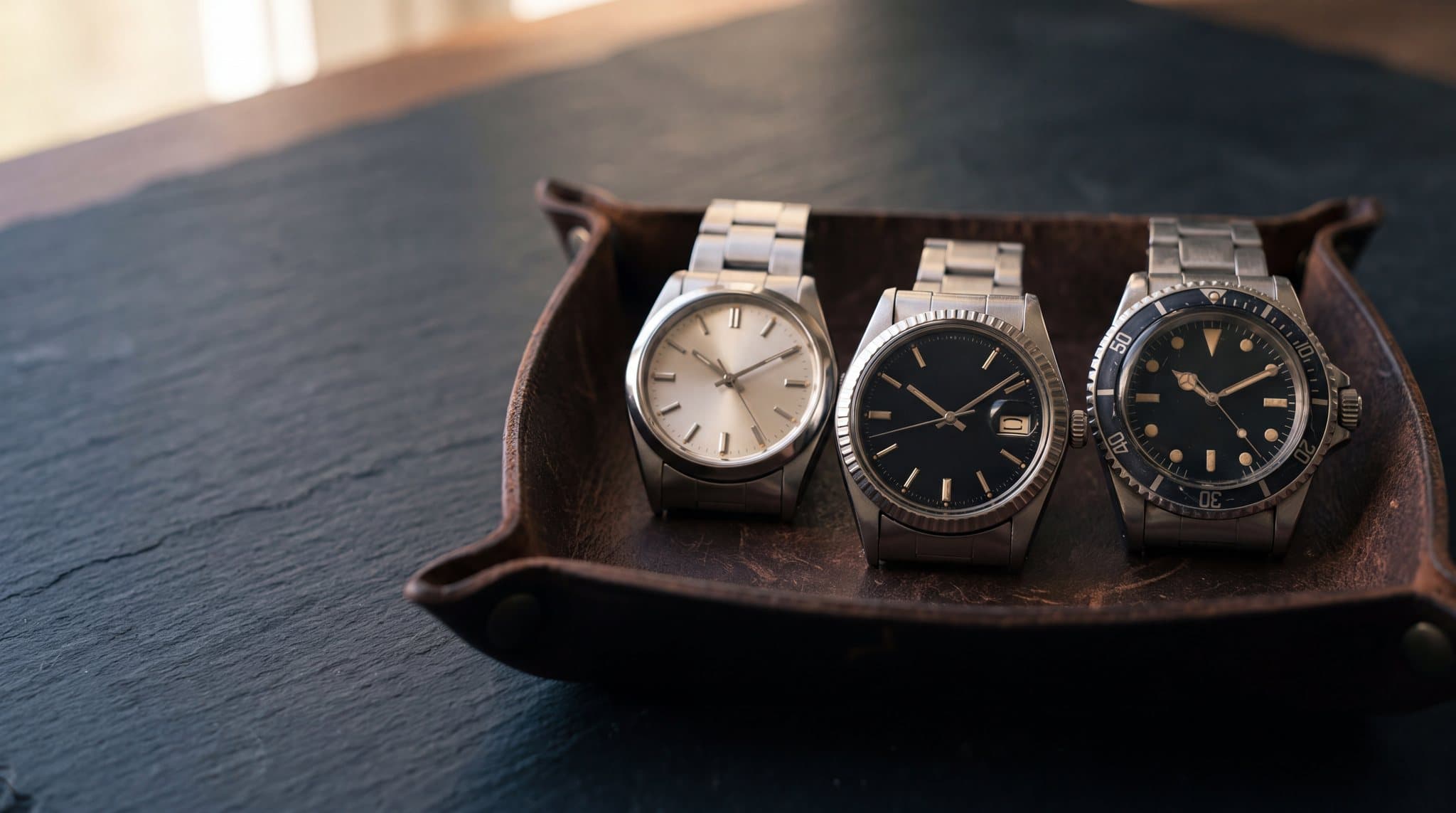
Short answer: buy the reference you understand, pay for originality, and check the case and dial before anything else. A vintage Rolex is valued on how much of it is still the way it left the factory. Two watches with the same reference can be thousands of dollars apart because of a polished case, a replaced dial or the wrong bracelet. This guide covers what "vintage" means for Rolex, which references to start with, how to judge a watch part by part, and how to pay a fair price.
What Counts as Vintage
Collectors don't agree on an exact cutoff, but for Rolex the working line sits around the end of the 1980s. Watches from before then usually share a few traits: an acrylic crystal (sapphire arrived across the range from the late 1970s and through the 1980s), tritium lume that has aged to cream or yellow, and the earlier calibre families, such as the 1520, 1570 and 1575. Watches from the 1990s and 2000s, with sapphire crystals and modern lume, are usually called neo-vintage.
The distinction matters because the two are bought differently. A neo-vintage Rolex is judged mostly on condition and completeness. A vintage one is judged on originality, and that takes more care.
Where to Start: References That Reward a First Purchase
The best first vintage Rolex is a reference made in large numbers, well documented and easy to service. Each of these has its own page on our site with production years, movements and what changed over its run.
Simple and honest
- Oyster Perpetual 1002, about 1959 to the early 1980s. 34 mm, no date, calibre 1560 then 1570.
- Air-King 5500, 1957 to 1989. A long-running, time-only 34 mm.
- Oyster Perpetual Date 1500, about 1962 to 1983. Adds the date in the same proportions.
The classic Datejust
- Datejust 1601 and 1603, about 1960 to the late 1970s, fluted and smooth bezels, with a huge range of dials.
- Datejust 16030, 1977 to 1988, the quickset-date successor with calibre 3035, and a good bridge between vintage and neo-vintage.
Tool watches
- Explorer 1016, about 1963 to 1989.
- Submariner 5513, 1962 to 1989, the no-date Submariner and the textbook vintage diver.
- Submariner 1680, about 1967 to 1979, the first Submariner Date.
- GMT-Master 1675, about 1959 to 1980, and its successor the 16750, about 1980 to 1988.
The tool watches are where the money and the mistakes are. Their prices attract altered and assembled examples, so they reward a buyer who has already handled a few simpler references. You can browse every family from our Rolex reference guide.
Judging a Watch, Part by Part
The case
The case can't be replaced without the watch losing its identity, and it's the part most often damaged by polishing. Look at the lugs from the side: an unpolished case has thick lugs with crisp edges, and on many references a sharp bevel along the top. Repeated polishing rounds the edges and thins the lugs. Look at the holes for the spring bars too; on some references, heavy polishing leaves them oddly close to the edge.
Wear is fine. A fifty-year-old watch should look like one. What you don't want is a case that has been polished back to "new," because that metal doesn't come back.
The dial
Most of a vintage Rolex's value lives in the dial, and three kinds exist:
- Original dials, aged as they are. Patina, cream lume and small imperfections are part of the appeal.
- Service dials, fitted by Rolex at a service, often with fresh lume. Genuine, but worth noticeably less than an original.
- Redials, original dials refinished by a third party. Printing that is too thick, too bold, slightly off in font or misaligned is the usual giveaway.
Then there are the variations collectors chase: different printing styles, colors and text layouts within a single reference, some of which carry large premiums. If a listing claims a rare dial, ask how the seller knows, and compare it with documented examples before you pay for it.
Hands and lume
Hands are replaced routinely, often with new lume. The quickest check on any vintage Rolex: does the lume on the hands match the lume on the dial? Untouched watches usually aged together. Bright hands on a cream dial mean the hands are later, and so may be other parts.
Bezel and insert
On sports models the bezel insert fades, cracks and gets replaced. Faded originals are often prized, and replacement inserts are common. Neither is a problem if it's disclosed; both affect price.
Crystal, crown and movement
A vintage acrylic crystal is a wear part and is often replaced with a correct new one, which is fine. The crown and tube get swapped at services. The movement should be the right calibre for the reference and era, and a watchmaker can confirm that, and its condition, in a few minutes with the caseback off.
The bracelet
The right bracelet and end links for a given reference can be worth a significant share of the watch on some models. A watch on a later bracelet, an aftermarket bracelet or a strap should be priced lower than one on its period-correct bracelet.
Dating and Paperwork
The serial between the lugs dates the case. Our serial number lookup turns it into a year, and our guide to dating a Rolex beyond the serial covers caseback codes, dial markings and calibres. Everything about the watch should agree with that year within a reasonable margin.
Papers and the original box add value only when the serial on the papers matches the watch. Many vintage watches have none, which is normal; just price them as watch-only examples. Service papers are worth having too, because they explain which parts were replaced and when.
Paying a Fair Price
Price a vintage Rolex from completed sales of the same reference, in similar condition, with similar originality. Asking prices tell you what sellers hope for. Then adjust:
- Originality first. An original dial, unpolished case and correct hands are the biggest drivers of value.
- Completeness next. Box, papers and the correct bracelet add to the price, papers most of all.
- Condition and service. A recent, sympathetic service is a plus; one that replaced the dial and hands without telling you is not.
Treat anything priced well below the market as a question to answer, not a bargain to grab.
Where to Buy
At auction, where bidders set the price. On Grey Market auctions, every watch is verified in hand by an independent verifier before it ships, the buyer's payment is held by Grey Market, and the seller is only paid after the buyer has the watch.
On the Exchange, where collectors set their own prices. Every member is ID-verified, questions happen in the open on each post, and you can add independent verification to any purchase before the watch reaches you.
From specialist dealers, who often charge more but stand behind what they sell. Ask about their return policy and authenticity guarantee in writing.
In forums and collector communities, where prices can be good and reputation is visible, but payment protection depends entirely on how you pay. Our guide to buying a watch safely online covers the rules that apply anywhere.
The Short Version
Learn on a common reference. Check the case for polishing and the dial for refinishing. Match the lume on the hands and dial, and the serial to the rest of the watch. Ask what has been replaced, get the answers in writing, and pay for originality, because originality is what you'll be able to sell.
Questions People Ask
What is the best vintage Rolex to buy first? A simple, high-production reference like the Oyster Perpetual 1002, the Air-King 5500 or a Datejust 1601 or 1603. They're well documented, easy to service and have deep markets to compare prices against.
Is a vintage Rolex a good investment? Some references have risen a great deal; others have barely moved. Buy one you want to wear, at a fair price, with as much originality as you can afford. That's what holds value best.
Does a service dial ruin a vintage Rolex? No, but it lowers the value compared with an original dial, sometimes considerably on sports references. It should always be disclosed.
How can I tell if a vintage Rolex has been polished? Look at the lugs from the side. Thick lugs with crisp edges and sharp bevels suggest little polishing. Rounded edges and thin lugs suggest a lot.
Do I need box and papers? Not for a vintage watch. They add value when they match the watch, but many good examples have none. Just don't pay a full-set price for a watch-only example.
Reference guides
Deep dives on the references discussed in this story:
- Rolex Submariner 6200 (c. 1954–1956)
- Rolex Submariner 6204 (c. 1953–1955)
- Rolex Submariner 6536/1 (c. 1956–1959)
- Rolex Oyster Perpetual 1002 (c. 1959–early 1980s)
- Rolex Air-King 5500 (1957–1989)
- Rolex Oyster Perpetual 1500 (c. 1962–1983)
- Rolex Datejust 1601 (c. 1960–1977)
- Rolex Datejust 1603 (c. 1960–1978)