

Rolex Submariner 6536/1
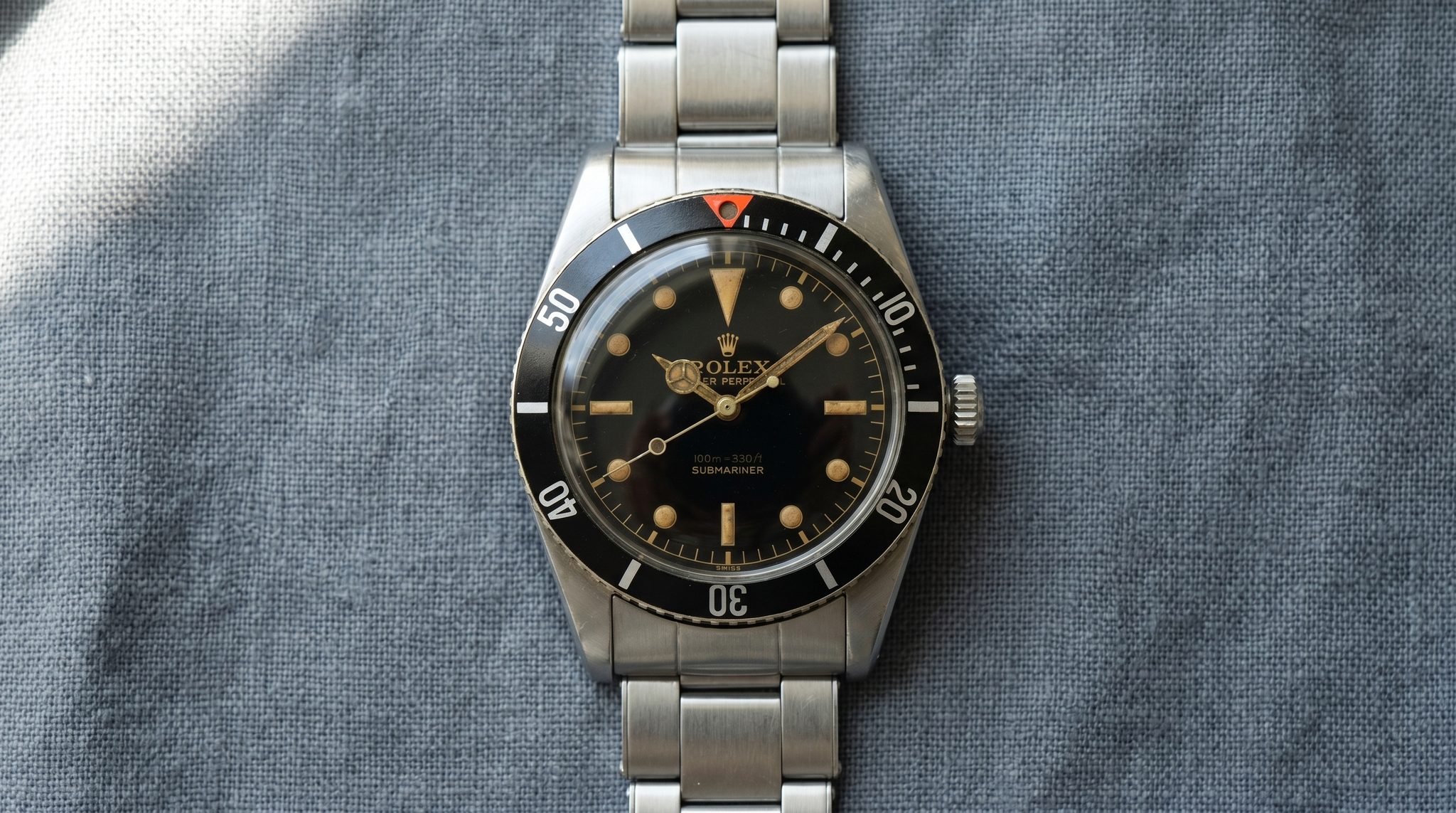
The Rolex Submariner 6536/1 is the thin-case, 100 m small-crown Submariner whose identity is written on the surface: a stable 37 mm steel case and Cal. 1030, and a fast-changing dial and bezel that let surviving watches be read like dated artifacts.
- Production
- c. 1956–1959
- Case
- Stainless steel
- Diameter
- 37 mm
- Thickness
- ~12 mm
- Lug width
- 20 mm
- Crown
- 6 mm (small crown)
- Water res.
- 100 m / 330 ft
- Crystal
- Acrylic (#16)
- Bezel
- Timing bezel
- Dial
- Gloss gilt, chapter ring
- Movement
- Rolex Cal. 1030 (auto)
- Lume
- Radium
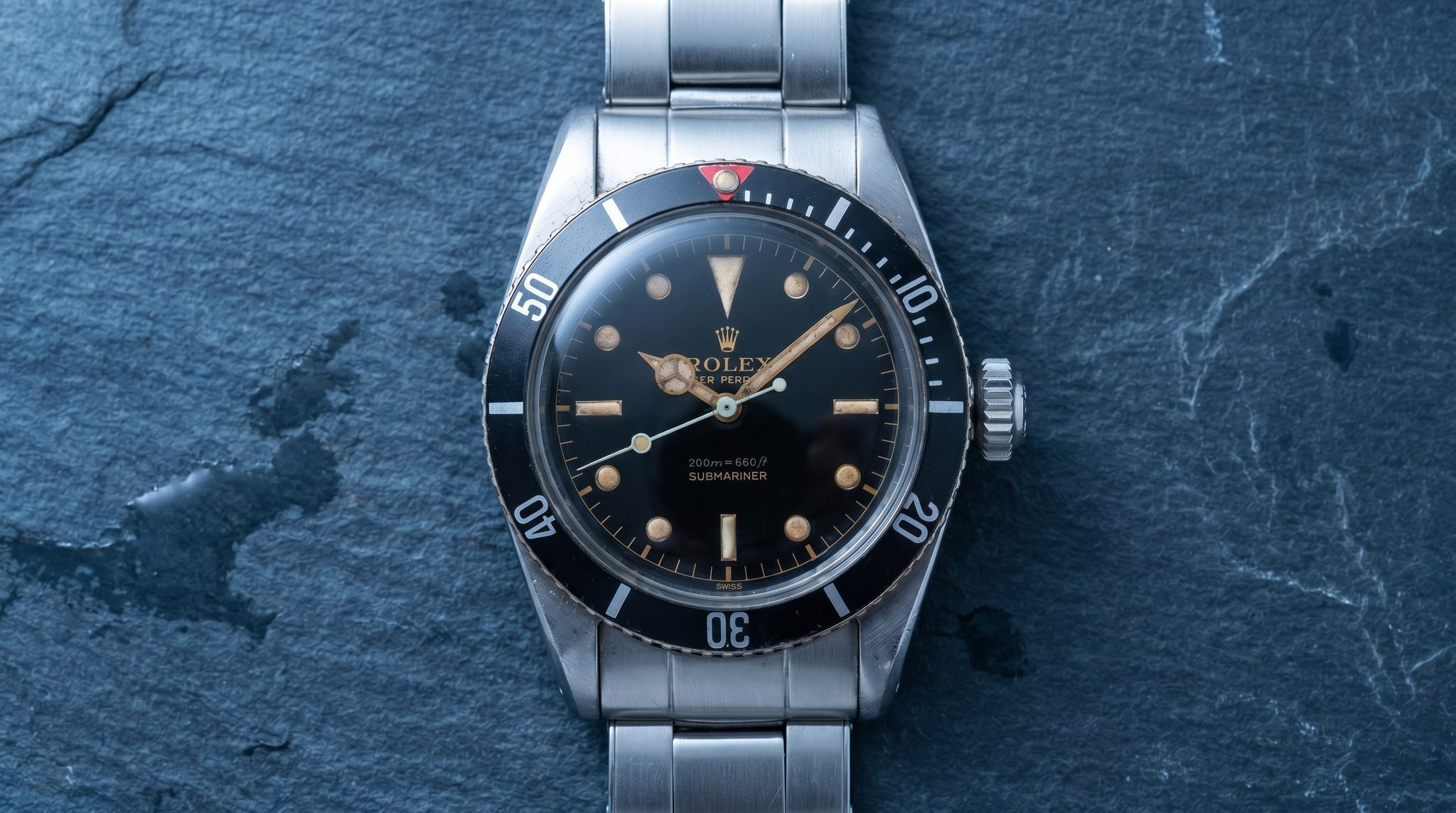
The Rolex Submariner 6536/1 is the small-crown Submariner that proves how quickly the early formula was still being edited, even while the underlying watch stayed essentially fixed. One of the clearest snapshots is the “Gold Depth” second batch documented in 1956, where a serial around 155,6xx is paired to a newly styled gilt depth line and a changed handset, evidence of Rolex refining the look in tight, serial-adjacent steps rather than in modern, neatly announced model years.
Most surviving 6536/1 examples can be reduced to a simple constant and a set of surface tells. The constant is the architecture: a slim, no-crown-guard steel case around 37 mm, a 6 mm crown, and the automatic Cal. 1030. The tells are what collectors study: the color and wording of the 100/330 depth text, the style of the hour hand, and which early red-triangle insert execution sits on the bezel. Production is commonly reconstructed as circa 1956–1959, with credible but less firmly evidenced indications of late-1955 examples and an imprecise cutoff, which is why these visual details matter so much when evaluating any individual watch.
“A 6536/1 stays the same where it counts, but it changes where you look: later examples show a markedly glossier gilt dial and later red-triangle insert styles, while the thin 37 mm small-crown case and Cal. 1030 remain the reference’s spine.”
6536/1 across c. 1956–1959
Ref. 6536/1 sits in the early Submariner line as the deliberately slimmer, lower-rated counterpart to the period’s thick-case, big-crown watches. Monochrome ties its case architecture directly to the earlier ref. 6205: the 6536/1 keeps the 6 mm crown and the thinner profile, and the resulting watch is rated to 100 m rather than the 200 m figures carried by contemporaneous big-crown references. The reason Rolex held it at 100 m is documented as a consequence of that thin-case, small-crown construction; beyond that, Rolex did not publish a tidy change log, so much of the reference’s internal story is reconstructed from surviving watches.
Within that stable shell, the 6536/1’s visible components move quickly. Early examples are documented with red depth printing (a red “100/300” line above the Submariner script), while Rolexhaven documents a distinct 1956 “Gold Depth” second batch where the depth printing switches to gilt and the hands change as well. Those two facts matter together, but they are not the same fact: dial printing is fixed to the dial, while hands are serviceable parts and can migrate across watches over decades.
Bezel inserts compress the same idea into even fewer millimeters. Le Monde Edmond’s study of three watches traces a path from very early triangle styles through a red triangle execution without 15-minute hashes that they place in 1957, and on to later red-triangle inserts that add the hashed first quarter, seen on a 1959 example. A late 1950s 6536/1 can also present with a notably glossier gilt dial, described as far more mirror-like than the earlier, thinner gloss observed on mid-1950s pieces.
The zoomed-out view is what gives the 6536/1 its particular appeal. It is not a reference with a long list of case or movement generations. It is a short, mid-1950s run where the platform stays steady and the exterior changes in small, datable steps, so every surviving watch is a test of whether its dial, bezel, hands, and case tell one coherent period story.
- c. 1956Introduced37 mm case, 6 mm crown
- c. 1955/56Red-depth subsetRed “100/300” line
- 1956“Gold Depth” batchGilt depth text (no red)
- 1957Rare insert yearRed triangle, no hashes
- c. 1959Late glossy seriesMirror-like gilt lacquer
- c. 1959Successor appearsRef. 5508, Cal. 1530
6536/1 against its neighbours
Ref. 6536/1 makes the most sense when framed by the thin-case small-crown watch it descends from, the small-crown watch that replaces it, and the big-crown sibling that shows what Rolex sacrificed to keep the case slim. Together, these three references explain why the 6536/1 is defined less by mechanical change than by the rapid evolution of its dial and bezel details.
This reference 6536/1 Rolex · focal c. 1956–1959 | ||||
|---|---|---|---|---|
| Production | c. 1954–1955 | c. 1955–1959 | c. 1956–1959 | c. 1957/58–1962 |
| Case | Stainless steel | Stainless steel | Stainless steel | Stainless steel |
| Diameter | ~37–37.5 mm | 37.5 mm | 37 mm | ~37.5–38 mm |
| Crown | 6 mm (small crown) | 8 mm (big crown) | 6 mm (small crown) | 6 mm (small crown) |
| Water res. | 100 m / 330 ft | 200 m / 660 ft | 100 m / 330 ft | 100 m / 330 ft |
| Crystal | Acrylic (#16) | Acrylic | Acrylic (#16) | Acrylic (#16) |
| Movement | Rolex Cal. A260 | Rolex Cal. 1030 | Rolex Cal. 1030 (auto) | Rolex Cal. 1530 |
| Dial | Gloss gilt (var.) | Gloss gilt (var.) | Gloss gilt, chapter ring | Gloss gilt (var.) |
| Lume | Radium | Radium | Radium | Radium |
Seven dial generations across the run
On the earliest subset of 6536/1s, the depth rating is the first thing the eye catches because it is not gilt at all. The “100/300” line is printed in red above the Submariner script, a small accent that makes the dial feel closer to a prototype than a settled product. This red printing is a dial trait with its own short window, but it should not be used as a proxy for other parts, since hands and inserts are easily replaced over decades of servicing.
What to check before buying a 6536/1
Buying a Submariner 6536/1 is less about chasing one headline specification than about verifying that the watch’s visible parts tell one consistent mid-1950s story. Because the case and Cal. 1030 platform are broadly stable, the market’s biggest disagreements, and the biggest price swings, live in the dial and bezel: early red-depth dials, mid-1956 “Gold Depth” dials, and correct red-triangle insert variants are all treated very differently.
That same dynamic creates the main risk. Dials, hands, crowns, and especially bezel inserts were serviceable components, and the brief explicitly documents later service-dial examples. A 6536/1 can therefore look convincing at a glance while being chronologically mixed in the details. The strongest approach is to treat each element as its own piece of evidence, then ask whether the combination makes sense alongside the caseback dating that is documented on known examples.
In practice, this reference often suits a buyer who values mid-century wearability as much as collecting scholarship. The 37 mm case, the notably thin profile, and the small 6 mm crown make it feel compact and low on the wrist compared with thicker early Submariners, yet it still carries the full early-Sub visual language in gilt and radium. When the dial and insert are right, the watch reads like an object that has kept its own time, rather than one assembled later from the era’s spare parts.
Rolex Submariner 6536/1 for sale
Auctions on Grey Market run on seven-day cycles, every watch verified before it sells. Browse what's live now, or consign your 6536/1.
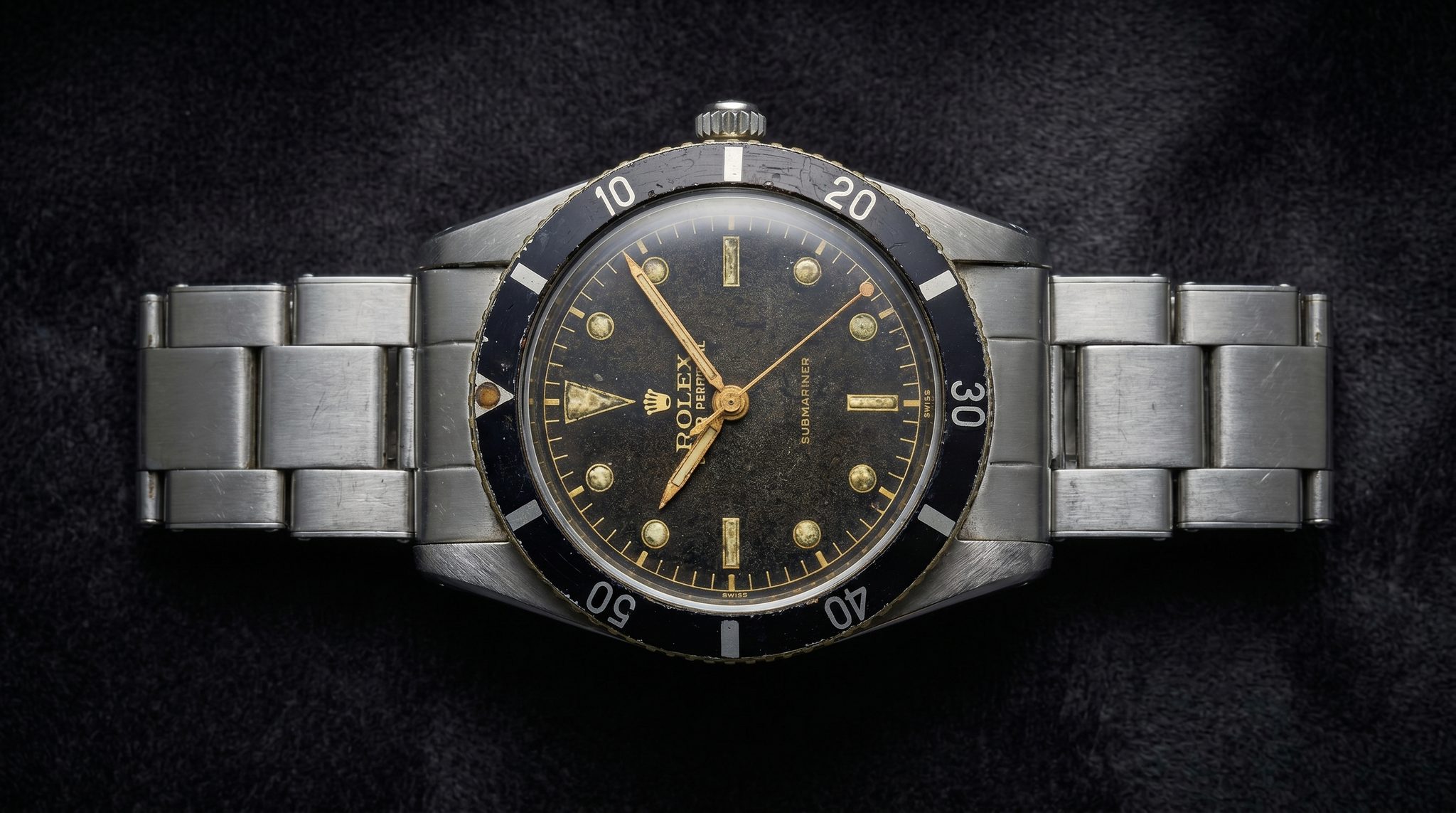
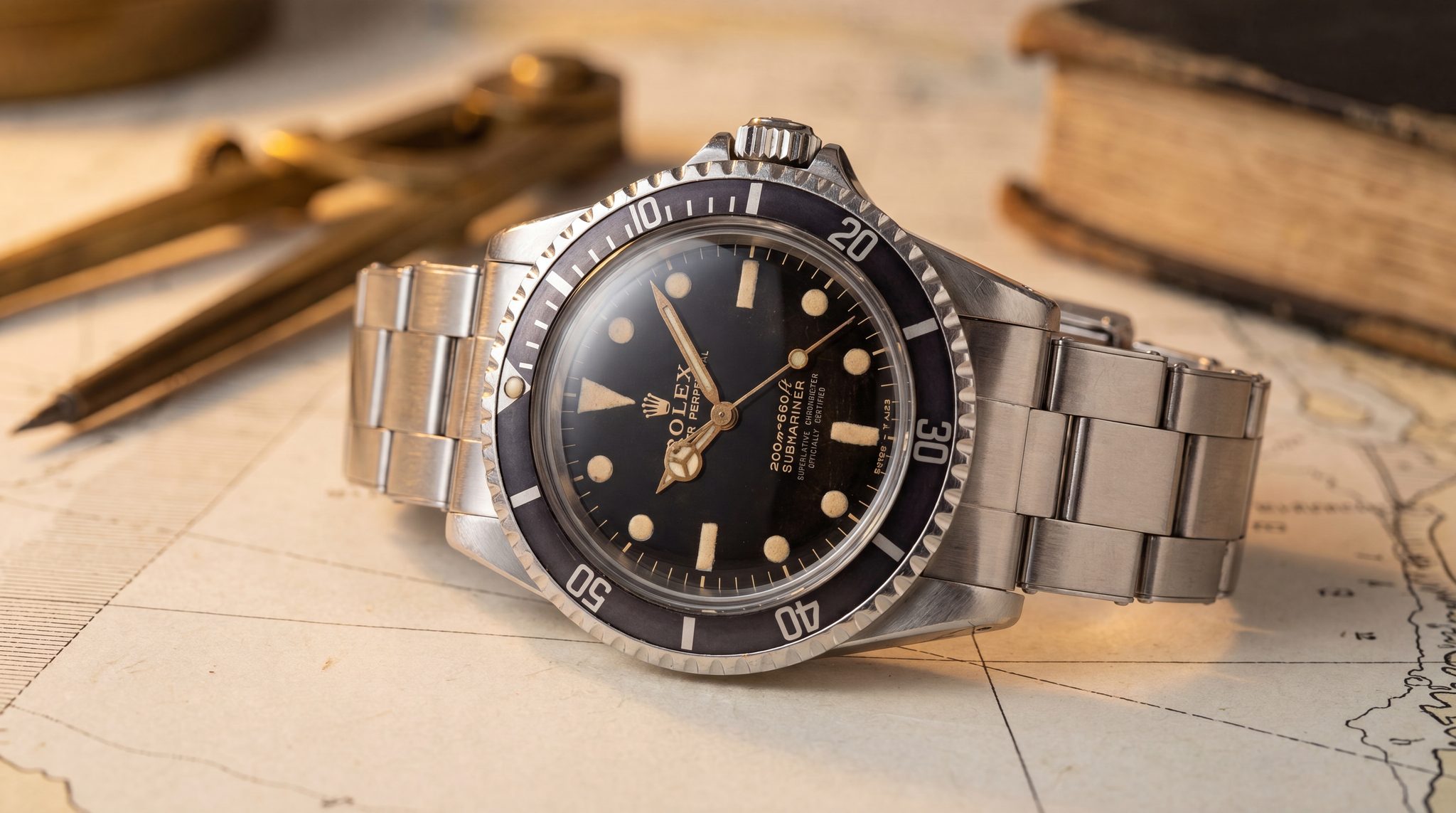
Adjacent in the Submariner family
Common questions about the 6536/1
Rolex did not publish a factory production window for ref. 6536/1. Surviving evidence and specialist commentary commonly reconstruct production as circa 1956–1959, with credible but less firmly evidenced indications of late-1955 examples and uncertainty about the precise cutoff year.
- History of the Rolex Submariner Part 1 (early references, incl. 6536/1 thin-case and 100 m rating context)monochrome-watches.com
- Rolexhaven: Submariner 6536-1 circa 1956 “Gold Depth” (case, crown, crystal, batch note)rolexhaven.com
- Le Monde Edmond: study of three 1950s Rolex Submariner 6536-1 (dial gloss evolution, insert variants)le-monde-edmond.com
Show 9 more
- WatchProSite: 5508 vs 6536/1 (caseback example, Cal. 1030 mention, early dial traits)watchprosite.com
- Loupe This: Submariner 6536-1 small crown gilt dial red triangle (auction description)loupethis.com
- Loupe This: 6536-1 no crownguard “James Bond” service dial (service-dial example)loupethis.com
- Craft & Tailored: 1959 small-crown 6536-1 with papers (late sale-in-1959 evidence)craftandtailored.com
- Chrono24 listing: Rolex Submariner 6536-1 (example specs: 37 mm, 20 mm lugs, Cal. 1030, 12 mm thickness)chrono24.com
- Collector Square index: Rolex Submariner ref. 6536 (Cal. 1030 description, 6536-family context)collectorsquare.com
- Bob’s Watches: Submariner 6536 ultimate buying guide (collecting/value framing; early red-depth desirability)bobswatches.com
- Rolexhaven: Submariner 6536/8 Double Reference 1954 (context for transitional sibling)rolexhaven.com
- Phillips video: “Missing Text Makes This Incredible Submariner A Trophy Watch” (unit-less red depth variation highlighted)youtube.com