

Short answer: the serial number between the lugs tells you roughly when the case was made. Our Rolex serial number lookup turns that number into a year in seconds. But a Rolex is more than its case. Dials, hands, bezels, bracelets and movement parts are replaced over a watch's life, and a watch sold in 1990 may have left the factory years earlier. Collectors date a Rolex by checking that every part tells the same story. Here is how.
What the Serial Actually Dates
Rolex engraves the serial on the case. So the year the serial points to is the year the case was made, give or take one either side, because no official factory list exists and the published ranges were compiled by collectors and dealers over decades.
That is usually close to when the watch was finished and shipped. It is not necessarily when it was sold. A watch could sit in a retailer's case for a year or two, which is why the date on an original warranty card can be later than the serial suggests. Both can be right.
The serial format alone narrows the era before you look anything up:
- Before 1954: short numbers from overlapping early series. Date these with an expert, not a chart.
- 1954 to 1987: numbers that climb steadily year by year. This is where a serial is most useful.
- 1987 to 2010: a letter followed by six digits, each letter covering roughly a year.
- 2010 onward: scrambled serials that don't encode a date. The warranty card is the reference.
The lookup page has the full chart, the letter list and where to find the engraving on your watch. What follows is what to check next.
Check the Caseback
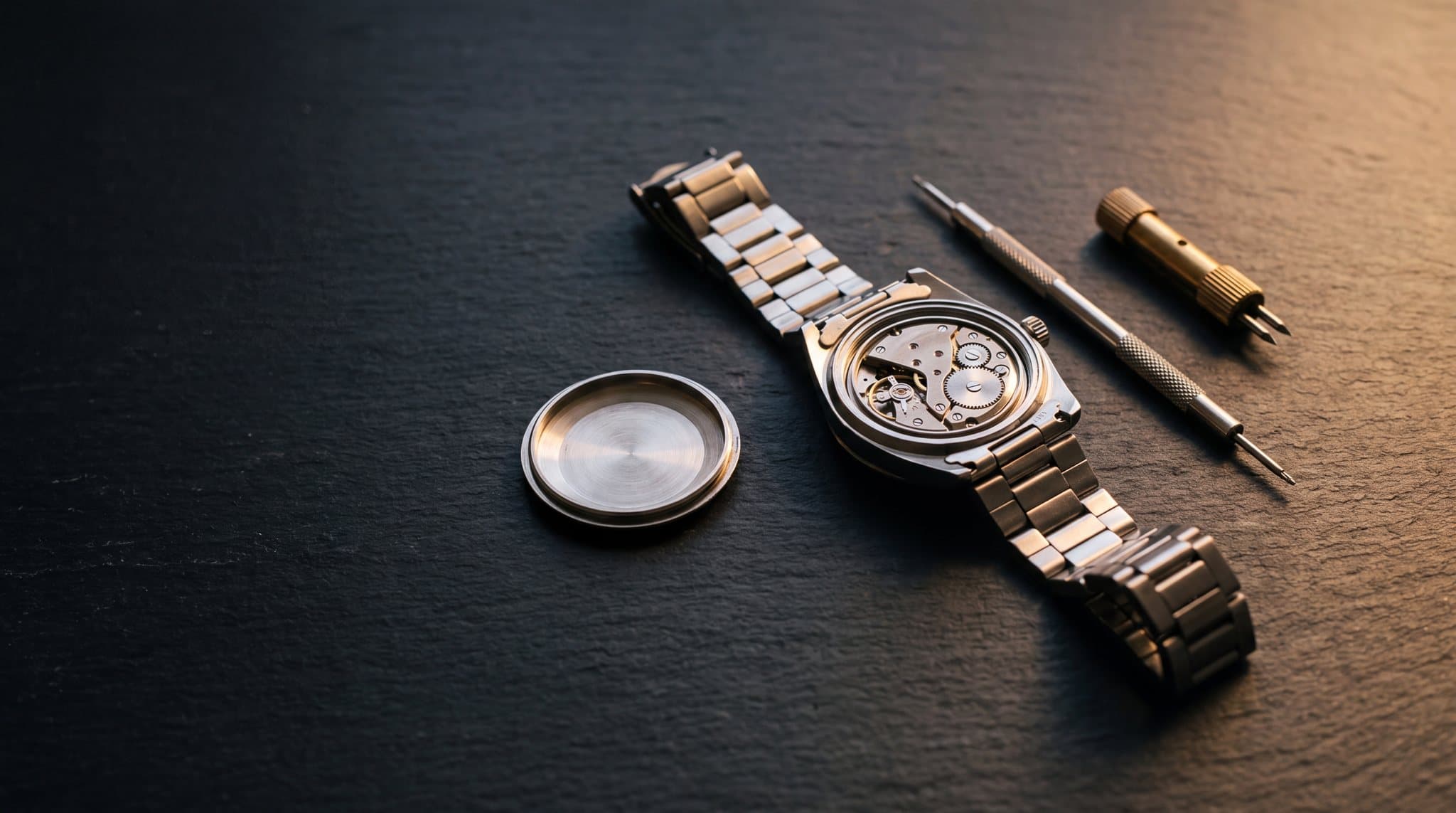
Open the caseback, or ask your watchmaker to, and look at the inside. On many Oyster casebacks from roughly the 1950s to the late 1970s, Rolex stamped a quarter and year, written as a Roman numeral and two digits: IV.67 means the fourth quarter of 1967. The caseback reference stamped alongside should match the reference between the lugs.
A caseback dated a year or so before the serial is normal: the parts were made before the watch was assembled. A caseback ten years away from the serial is a question. Casebacks get swapped in service, so a mismatch doesn't make a watch fake, but it changes what you're buying.
Read the Dial's Small Print
The text at six o'clock on a vintage Rolex dial is a dating tool in its own right, because it records the luminous material:
- Tritium dials, used from the 1960s to the late 1990s, are marked with a small T, typically as "SWISS - T < 25" or "T SWISS T". The lume ages to cream or a deeper yellow.
- Luminova dials, from around 1998, read just "SWISS".
- Super-LumiNova dials, from around 2000, read "SWISS MADE".
So a watch with a 1970s serial and a dial reading "SWISS MADE" has a later dial. That's common on watches that went back to Rolex for service, and it's legitimate, but a service dial is worth less to collectors than an original one. Compare the lume on the hands with the lume on the dial while you're there. On untouched watches they tend to have aged together.
Look at the Movement
The calibre is another check on the era. A few examples from references on our site:
- The 1570 family powers watches like the Explorer 1016 and the Oyster Perpetual 1002 through the 1960s, 1970s and 1980s.
- The 1575 family appears in date models of the same era, such as the GMT-Master 1675, the Datejust 1601 and the Submariner 1680.
- The 3035 arrives in the late 1970s: the Datejust 16030, made from 1977 to 1988, uses it.
- The 3135 runs from the late 1980s into the 2010s, in references like the Submariner 116610LN.
A movement that is too new or too old for the serial points to a replacement, or to a watch assembled from parts. A watchmaker can confirm the calibre in a few minutes.
Bracelets and Clasps Tell Their Own Story
Many Rolex clasps carry a date code of their own. It dates the bracelet, not the watch, and bracelets are the part most often swapped. A period-correct bracelet adds real value on some references, so it's worth knowing whether yours is original to the watch or a later replacement. Just don't use the clasp to date the watch itself.
Papers, If You Have Them
The original warranty card or certificate is the strongest single piece of evidence, as long as its serial matches the case. It gives you the sale date and the retailer, and on post-2010 watches it is the only practical way to date the watch at all. Service papers help too: they record what was replaced and when, which explains mismatches that would otherwise look suspicious.
Putting It Together
A correctly dated Rolex is one where the serial, the caseback stamp, the dial markings, the movement and the paperwork all agree within a reasonable margin. When they do, you know what you have. When one of them doesn't, that isn't proof of a problem, but it is the thread to pull before you buy, sell or insure the watch.
Start with the serial number lookup, then work through the list above. Our Rolex reference pages list production years and movements for each model, which makes this check quicker. If you'd like a second pair of eyes, every watch sold at auction on Grey Market is verified in hand before the seller is paid.
Questions People Ask
Can I find out exactly when my Rolex was made? To the year, usually, from the serial, for watches made between 1954 and 2010. To the day, no: Rolex doesn't publish production records.
Why doesn't my Rolex serial number work in the lookup? If it's a scrambled mix of letters and numbers, it's a post-2010 serial that doesn't encode a date. Use the warranty card. If it's a short number, it may be from before 1954, when Rolex used overlapping series.
My serial and my warranty card show different years. Is something wrong? Usually not. The serial dates the case; the card records the sale, which can be a year or two later.
Does a replaced dial or bracelet make my Rolex fake? No. Service replacement parts are genuine Rolex parts. They do change the value, especially on vintage references, and they should always be disclosed when you sell.
Reference guides
Deep dives on the references discussed in this story:
- Rolex Submariner 16610 (1989–2010)
- Rolex Submariner 14060 (c. 1990–1999)
- Rolex GMT-Master 16710 (c. 1989–2007)
- Rolex Datejust 16013 (c. 1977–1988)
- Rolex Explorer 1016 (c. 1963–1989)
- Rolex Oyster Perpetual 1002 (c. 1959–early 1980s)
- Rolex GMT-Master 1675 (c. 1959–1980)
- Rolex Datejust 1601 (c. 1960–1977)