

Rolex Explorer 1016
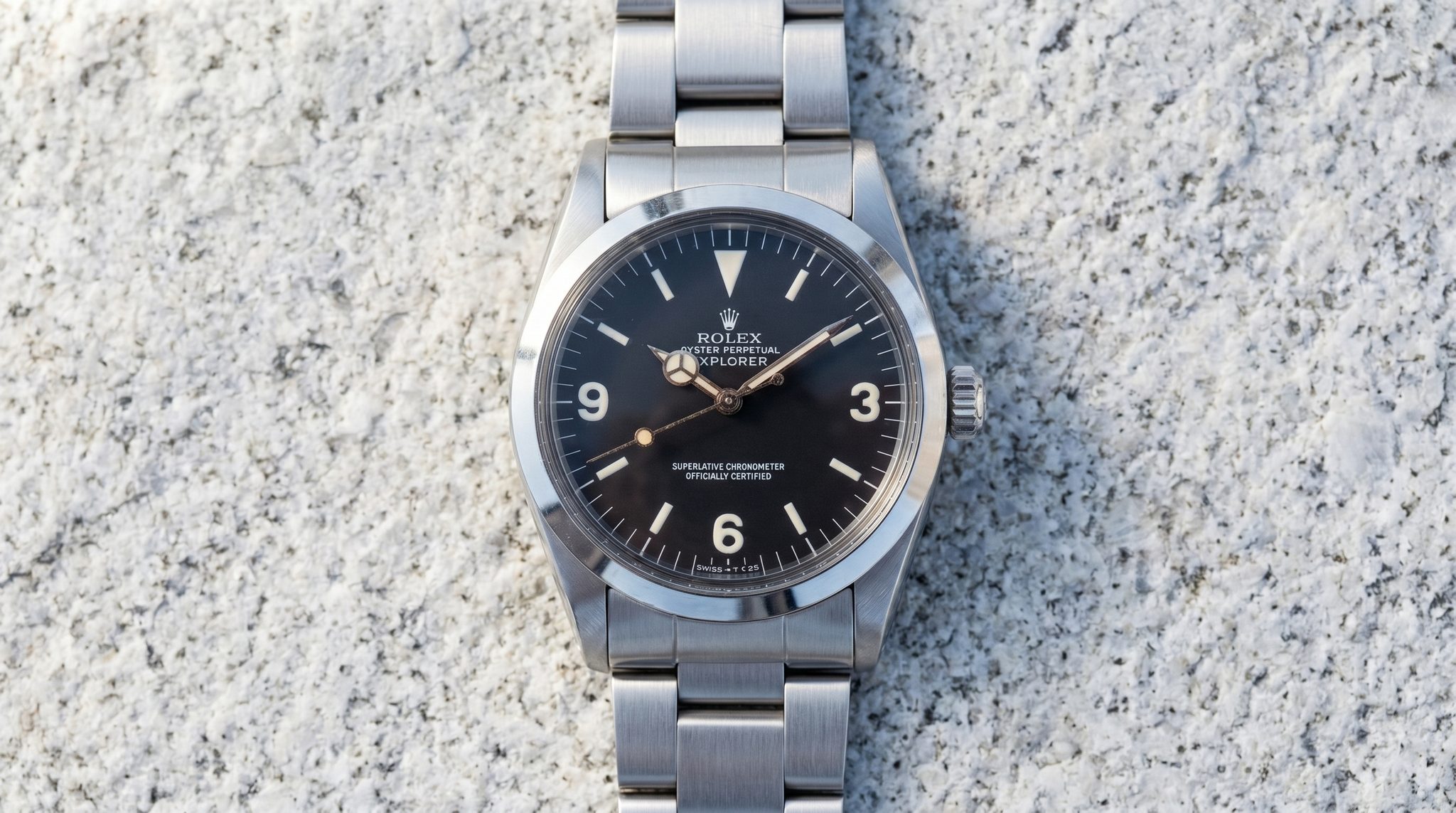
The Explorer 1016 is the long-lived, time-only Explorer that turned small, visible production details into the main way collectors understand an otherwise steady design.
- Production
- c. 1963–1989
- Case
- Stainless steel
- Diameter
- 36 mm
- Crystal
- Domed acrylic
- Bezel
- Smooth fixed steel
- Water res
- 100 m
- Dial
- Black 3-6-9
- Movement
- Cal. 1560 → 1570
- Chronometer
- Yes
- Lume
- Radium → Tritium
The Rolex Explorer 1016 was produced from about 1963 to 1989.
- Production years
- c. 1963–1989
- Replaced
- 6610
- Replaced by
- 14270
- Movement
- Cal. 1560 → 1570
The Explorer 1016 is the Rolex that proves how much history can hide inside a watch that looks almost unchanged. It stayed in production from the early 1960s to around 1989, long enough that a single reference can span glossy gilt dials with a chapter ring, later matte dials classified into “Mark” variants, and even two generations of Rolex’s 15xx automatic chronometer movements.
Often shortened to the Explorer 1016, or simply the Rolex 1016, it sits in the Explorer I line between the ref. 6610 and the sapphire-crystal ref. 14270. Rolex never published official start and end dates, so the “Explorer 1016 production years” are reconstructed from surviving watches and period documentation. That uncertainty is not a flaw of the reference so much as part of how it is collected: the 1016 rewards close looking, because dial surface, dial text at 6 o’clock, and movement generation do not all change on the same schedule.
In the hand, the watch’s story is easiest to read on the dial. Early examples can have a glossy black surface where gilt printing catches light, sometimes framed by a chapter ring that visually tightens the dial. Later examples flatten into matte black with bright white printing, and the charm moves from shimmer to legibility, with aged luminous plots and hands providing most of the warmth. Across the run, the bottom line of text shifts from early “SWISS” signatures associated with radium to tritium-era “T-SWISS-T” or “SWISS T 25”, a quick clue that must be weighed alongside the rest of the watch rather than treated as a single cutoff.
What ties these decades together is a consistent idea of the Explorer as a simple, robust, no-date tool watch in a 36 mm steel Oyster case, now strongly associated with 100 m water resistance and “Superlative Chronometer Officially Certified” dial text. The 1016’s staying power is precisely why its small, visible differences matter: it is one reference with enough time inside it to teach the eye.
“The Explorer 1016 looks steady from a distance, but its long production run turns dial finish, lume text, and movement generation into the details that define the reference.”
Rolex Explorer 1016 production years: c. 1963–1989
The Explorer 1016’s history is unusually hard to compress into a single set of dates because Rolex did not publish an official production range, and because the traits collectors care about do not switch in lockstep. The most widely repeated span runs from roughly 1960 to 1989, while other scholarship narrows the start into the early 1960s. In practice, the reference is best understood as an early-1960s introduction that remains in the catalog until around 1989, with overlap at both ends with neighboring references.
Early 1016s are defined visually by glossy black gilt dials, sometimes with a chapter ring that forms a fine printed circle just inside the hour markers. Those early executions are also where the simplest “at-a-glance” dating clue appears: the tiny signature at 6 o’clock. Some early examples show “SWISS,” a marking associated with radium lume in the sources used for this reference, while later dials are marked “T-SWISS-T” or “SWISS T 25” for tritium. The reason for the shift is not documented in the material summarized here, and surviving watches show enough overlap that it reads as a transition rather than a single handoff.
The mechanical story is similarly continuous rather than abrupt. The 1016 begins with Rolex’s automatic Cal. 1560 and later uses Cal. 1570, both chronometer-rated. Rolex did not document a clean switchover year, so the change is reconstructed from watches in the market, and it is best treated as an overlap period observed in the mid-1960s rather than a single dated event.
By the late 1960s, the Explorer’s dial language shifts from gloss and gilt to a matte surface with white printing, the canvas for the Mark 1 through Mark 5 classifications used by collectors. Those “Marks” are not Rolex factory terminology, and their boundaries are debated, but they capture a real experience of the watch: from a distance, it is still the same 3-6-9 Explorer, but at close range the typography and layout become the quiet record of years passing.
One lesson emerges from seeing these separate threads at once: the Explorer that later generations treat as a fixed archetype was still being worked out in real time. The 1016 is what remains when the big decisions had already been made, and the rest of the story lived in details small enough to miss until you learn how to look.
- c. 1960 – 1963Introduced36 mm 3-6-9 dial
- c. mid-1960sMovement overlap1560 vs 1570 engraving
- c. 1960sGilt eraGilt text on glossy dial
- c. mid/late 1960sLume text shiftsSWISS vs T-SWISS-T
- c. late 1960sMatte eraFlat matte dial surface
- c. 1989Discontinued14270 has sapphire
1016 against its neighbours
The Explorer 1016 is easiest to place by bracketing it with the last pre-15xx Explorer that came before it and the first sapphire-crystal Explorer that replaced it. Ref. 6610 frames the 1016 as the more robust, chronometer-era Explorer associated with 100 m water resistance, while ref. 14270 shows the modern shift to sapphire and applied white-gold numerals that ended the 1016’s printed-dial era.
6610 Predecessor c. 1955–1959 | This reference 1016 Rolex · focal c. 1963–1989 | |||
|---|---|---|---|---|
| Production | c. 1955–1959 | c. 1963–1989 | 1971–c. 1984/85 | 1989–2001 |
| Diameter | 36 mm | 36 mm | ~39 mm | 36 mm |
| Crystal | Acrylic | Domed acrylic | Acrylic (plexiglass) | Sapphire |
| Water res | 50 m (many examples) | 100 m | 10 ATM | 100 m |
| Movement | Cal. 1030 | Cal. 1560 → 1570 | Cal. 1575 (GMT) | Cal. 3000 |
| Chronometer | – | Yes | Yes (COSC) | Yes (COSC) |
| Dial | Black 3-6-9 | Black 3-6-9 | 24-hour layout | Applied 3-6-9 |
| Lume | Radium | Radium → Tritium | Tritium | Tritium → Super-LumiNova |
Eight dial generations across the run
The earliest Explorer 1016 look is glossy and reflective, with gilt printing that seems to float under the lacquer when light hits it. On some examples a chapter ring adds a thin printed circle that tightens the dial’s proportions and makes the 3-6-9 layout feel more “contained” than later, open dials. This chapter-ring trait is its own axis: it is best used as a visual identifier of an early execution, not as proof of a specific lume era.
At 6 o’clock, some early dials show the simple “SWISS” signature associated in the sources summarized here with radium luminous material. Other early glossy dials appear with later tritium-era signatures, underscoring that dial surface, chapter ring presence, and lume text should be read as separate clues rather than bundled into one definition.
What to check before buying a 1016
Buying a Rolex Explorer 1016 is less about hunting a single “correct configuration” than about confirming that the watch’s independent clues agree with one another. The reference spans glossy gilt dials and matte Mark dials, radium-associated “SWISS” signatures and tritium “T-SWISS-T / SWISS T 25” text, and two movement generations (Cal. 1560 and Cal. 1570), so a watch that looks plausible in isolation can still be wrong in combination.
The good news is that the same long run that makes the 1016 complicated also makes it understandable. Once the dial is right, the rest of the watch tends to read clearly: a 36 mm steel Oyster case with domed acrylic crystal, no date, and a chronometer-rated movement. In everyday wear, that simplicity is the point. The 1016 is often chosen by people who want a vintage Rolex that disappears on the wrist until you look closely enough to see its time still preserved in small details.
Rolex Explorer 1016 price and value
A Rolex Explorer 1016 sells for about $14,750 at the median, typically $11,000 to $18,000 across 160 comparable sales.
Rolex Explorer 1016 for sale
Indicative figures from recent dealer, auction, and Grey Market sales (updated this week). Every watch is verified before it sells here.
Each point is a recent dealer or auction sale, banded to an indicative figure. The range shown is not a valuation.
Adjacent in the Explorer family
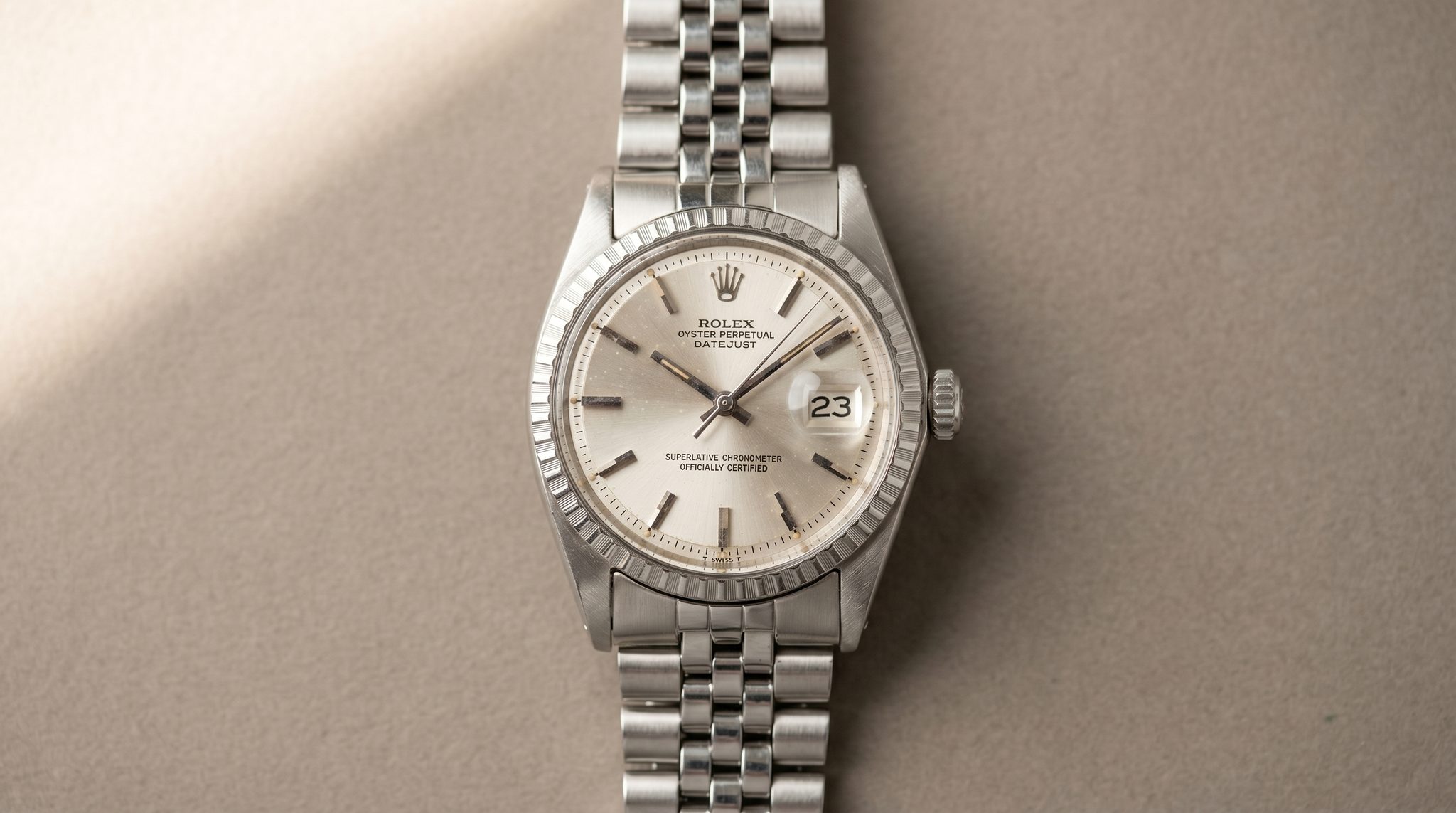
Stories that discuss the 1016
Common questions about the 1016
Rolex did not publish official production dates for the Explorer 1016. Most scholarship places it in production from the early 1960s (commonly cited as 1960–1963 for the start) until around 1989, when it was replaced by the Explorer ref. 14270.
- The Complete Guide To The Rolex Explorer - Hodinkeehodinkee.com
- Vintage Explorer 1016 Ultimate Reference Guide - Bob's Watchesbobswatches.com
- Rolex Explorer I Ref 1016 - Wind Vintagewindvintage.com
Show 7 more
- The History of the Rolex Explorer, The All-Rounder Watch Personified - Monochromemonochrome-watches.com
- Rolex Explorer 1016 Buying Guide - SwissWatchExposwisswatchexpo.com
- Rolex Explorer 1016 | Ref. 1016 Watches on Chrono24chrono24.com
- History - Rolex Explorer 1016explorer1016.com
- Rolex Explorer ref. 1016 mk V Dial (example listing) - Craft + Tailoredcraftandtailored.com
- Rolex Explorer Reference 1016 Gilt Dial - Wind Vintagewindvintage.com
- My First Vintage Watch: The Rolex Explorer Reference 1016 - Wind Vintagewindvintage.com