

Rolex Datejust 1601
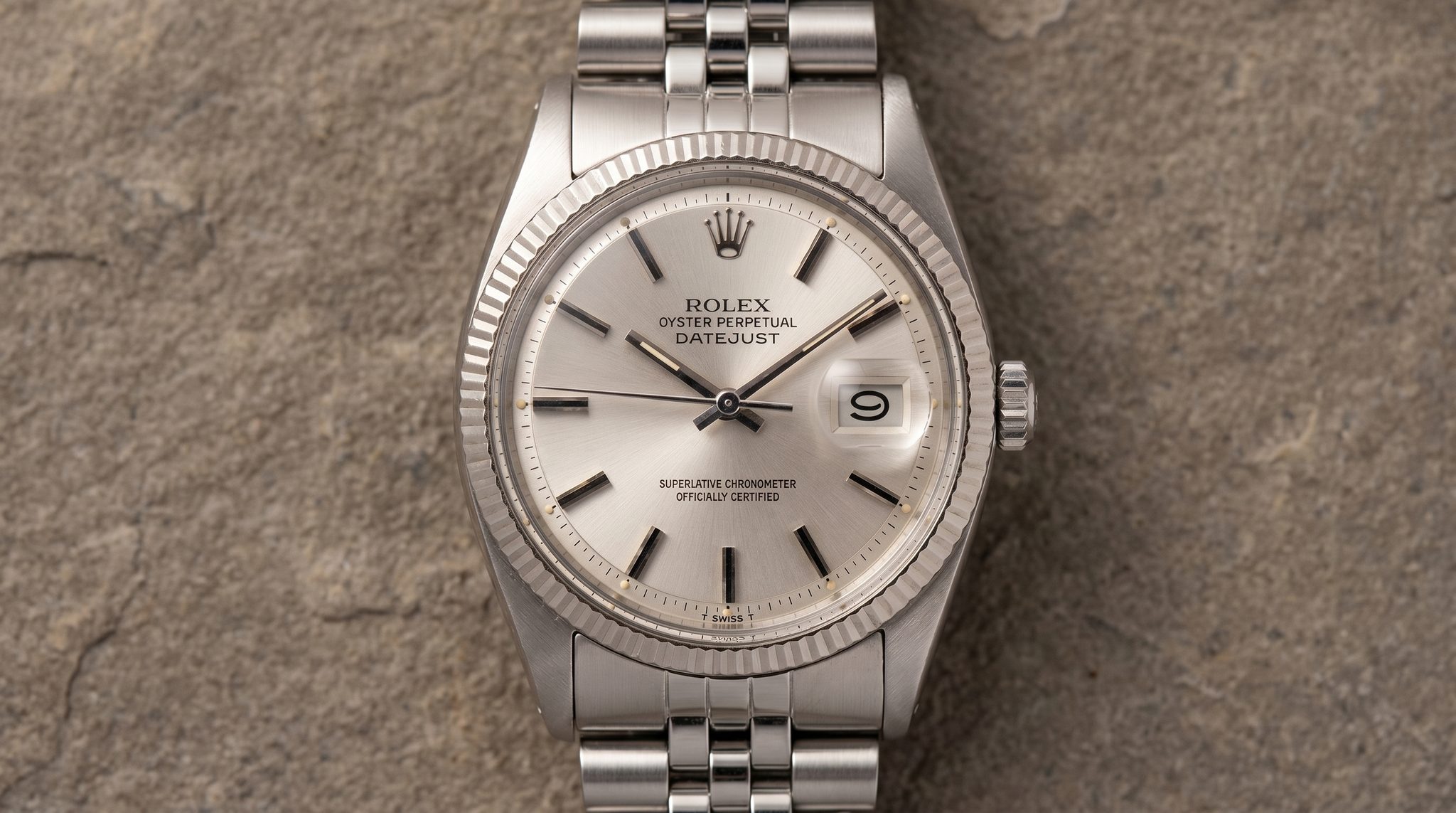
The Rolex Datejust 1601 is the long-running, non-quickset Datejust that fixed the classic 36 mm fluted-bezel template in place, then let dial details do the talking.
- Production
- c. 1960–1977
- Case
- Oyster (steel or gold)
- Diameter
- 36 mm
- Thickness
- ~12 mm
- Lug width
- 20 mm
- Bezel
- Fluted, gold
- Crystal
- Plexiglass, Cyclops
- Water resist
- 100 m (when new)
- Movement
- Cal. 1565 → 1575
- Power
- 48h
- Date
- Non-quickset
- Lugs
- Drilled
The Rolex Datejust 1601 is the vintage Datejust that became a standard, not by staying frozen, but by running long enough for small differences to become the whole game. A single reference can plausibly span from about 1959 into the late 1970s, and documented late examples exist, including a 1978 Datejust 1601 fitted with calibre 1575 and sold with a sigma dial.
That longevity is the point of the 1601. Rolex used it to settle the dressy, everyday Datejust formula into a repeatable shape: a 36 mm Oyster case, an acrylic crystal with Cyclops, and the fluted bezel that is always gold, often white gold on steel. Mechanically it also captures the last, unhurried era of the Datejust: the date is not quickset, so setting it after a few days off the wrist is a matter of winding the hands through midnight, again and again.
Because Rolex never published official start and stop years for the reference, the cleanest way to understand a Datejust 1601 is as a platform with overlapping sub-eras. Movements step from calibre 1565 to 1575 in the mid-1960s, and later 1575 examples gain hacking seconds around 1972. Meanwhile, the dial side stays recognizably “1601” through the pie-pan profile, but branches into executions that collectors actually notice in hand: early gilt-like printing on darker dials, textured linen surfaces, and the unmistakable sigma marks at 6 o’clock on many 1970s pieces.
“The 1601 is the Datejust that lasted long enough for tiny, visible details, not headline specs, to become the way collectors tell its story.”
1601 across c. 1960–1977
Ref. 1601 belongs to the four-digit 16xx Datejust generation that replaced the earlier 1950s references and established what many people now picture when they picture a classic Datejust: 36 mm, fluted bezel, Cyclops, and a dial whose outer edge drops away in a pie-pan step. Rolex did not publish firm boundary dates for this reference, so its timeline is reconstructed from editorial histories and surviving examples. The best-supported picture puts the start around 1959 or 1960, with most production running into the late 1970s and some overlap into the early 1980s as the next generation took over.
Under the dial, the 1601’s story has two clear mechanical chapters. Early watches use calibre 1565, beating at 18,000 vph, before a mid-1960s transition to calibre 1575 at 19,800 vph. Later in the run, around 1972, hacking seconds appears, so setting the watch becomes a modern-feeling, crown-out stop, rather than a best-effort alignment.
On the outside, changes are less like a model refresh and more like a shifting vocabulary of dials offered in parallel. The pie-pan form is the anchor, but surface and signature vary: some earlier watches show gilt-like printing on darker dials, later 1970s examples often carry sigma marks at 6 o’clock, and textured options like linen appear as part of the broad 1960s and 1970s palette. In one generation, the Datejust goes from a single recognizable face to a collection of small, legible tells.
The zoomed-out effect is that the 1601 turns the Datejust into an idea that can survive fashion. Rolex kept the essentials stable for so long that the era reads through details: the warmth of acrylic, the crispness or softness of fluting after decades of polishing, and whether the dial speaks in plain “SWISS” lines or in the little σ characters that pin a watch to a particular slice of the 1970s.
- c. 1959/1960Reference beginsFluted gold bezel, pie-pan dial
- c. mid-1960sCalibre changeMovement marked 1565 vs 1575
- 1972Hacking addedSeconds hand stops at time-set
- c. early/mid-1970sSigma eraSmall σ marks at 6 o’clock
- late 1970sSuccessor overlap16014 uses Cal. 3035 quickset
- 1978Late example1978 example with sigma dial
- late 1970sCore run endsMarket shifts to 16014 generation
1601 against its neighbours
The 1601 makes the most sense when it is bracketed by its siblings, which share the same 36 mm Oyster architecture and movement evolution, and by its practical successor, which keeps the fluted-bezel look but modernizes how the watch sets. If the 1601 is the dressier face of the four-digit Datejust, the 1600 and 1603 show how much of that identity is really the bezel, and the 16014 shows where Rolex chose convenience over continuity.
6605 Predecessor (closest concept) 1950s–c. 1959 | This reference 1601 Rolex · focal c. 1960–1977 | |||
|---|---|---|---|---|
| Production | 1950s–c. 1959 | c. 1960–1978 | c. 1960–1977 | late 1970s–1980s |
| Diameter | 36 mm | 36 mm | 36 mm | 36 mm |
| Bezel | Fluted or other | Engine-turned steel | Fluted, gold | Fluted, 18k WG |
| Crystal | Acrylic | Acrylic, Cyclops | Plexiglass, Cyclops | Acrylic, Cyclops |
| Movement | Cal. 1065/1066 | Cal. 1565 → 1575 | Cal. 1565 → 1575 | Cal. 3035 |
| Date | Non-quickset | Non-quickset | Non-quickset | Quickset |
| Lugs | 20 mm | Drilled | Drilled | 20 mm |
| Water resist | 50 m | 100 m (when new) | 100 m (when new) | 100 m |
Six dial generations across the run
The configuration most people mean when they say “Rolex 1601” is stainless steel with a white-gold fluted bezel. In person it reads like steel until light hits the flutes, where white gold takes on a softer, slightly creamier sheen than the case. This pairing appears throughout the reference’s life, which is why the watch is often approached by era cues elsewhere: whether the movement is 1565 or 1575, whether the seconds hack, and what the dial is doing at 6 o’clock.
What to check before buying a 1601
Buying a Rolex Datejust 1601 is less about chasing a single “correct” spec and more about judging coherence. The reference ran for so long, and with so many dial and metal combinations, that the risks concentrate in the places that are easiest to swap: dials, bezels, and bracelets, plus the slow softening of cases and fluting from repeated polishing.
The mechanics are durable, but they reward documentation. Older 1601s use non-quickset movements, and wear points like the automatic weight pivot and reversing wheels can be expensive surprises when there is no service history. A later 1575 with hacking seconds can feel more convenient day to day, but originality still sets the value ceiling: collectors pay for an honest dial, matching hands, and a bezel whose flutes still look like they were cut, not melted.
Rolex Datejust 1601 for sale
Indicative market value from recent dealer, auction, and Grey Market sales: median ≈ $4,000, with a typical $3,400–$4,700 range across 1120 comparable sales (updated this week).
Each point is a recent dealer or auction sale, banded to an indicative figure. The range shown is not a valuation.
Common questions about the 1601
The best-supported range places Rolex Datejust 1601 production from about 1959/1960 through the late 1970s, with evidence that some examples were sold, and possibly assembled, into the very early 1980s as five-digit models took over.
- 1978 Rolex Datejust Ref. 1601 With 'Sigma' Dial (Hodinkee Shop listing)shop.hodinkee.com
- Rolex Datejust 1600 vs 1601 vs 1603: Vintage Icons Comparedwristler.eu
- Exploring Evergreens: Rolex Datejust 36mm Ref. 1601fratellowatches.com
Show 7 more
- What If This Was the Only One? The Rolex DateJust Ref. 1601journal.craftandtailored.com
- Rolex 1601 (overview)bobswatches.com
- Rolex 1601 vs 16014 – Datejust 36mmrubberb.com
- Rolex Datejust 1601 collection and pricing contextchrono24.com
- Rolex Datejust 1601 market and buying contextwatchguys.com
- Rolex Datejust Ref. 1601 vs Ref. 16014 Comparedphigora.com
- Two Tone Rolex Datejust Compare (includes 1601 context)beckertime.com