

Rolex Oyster Perpetual 1002
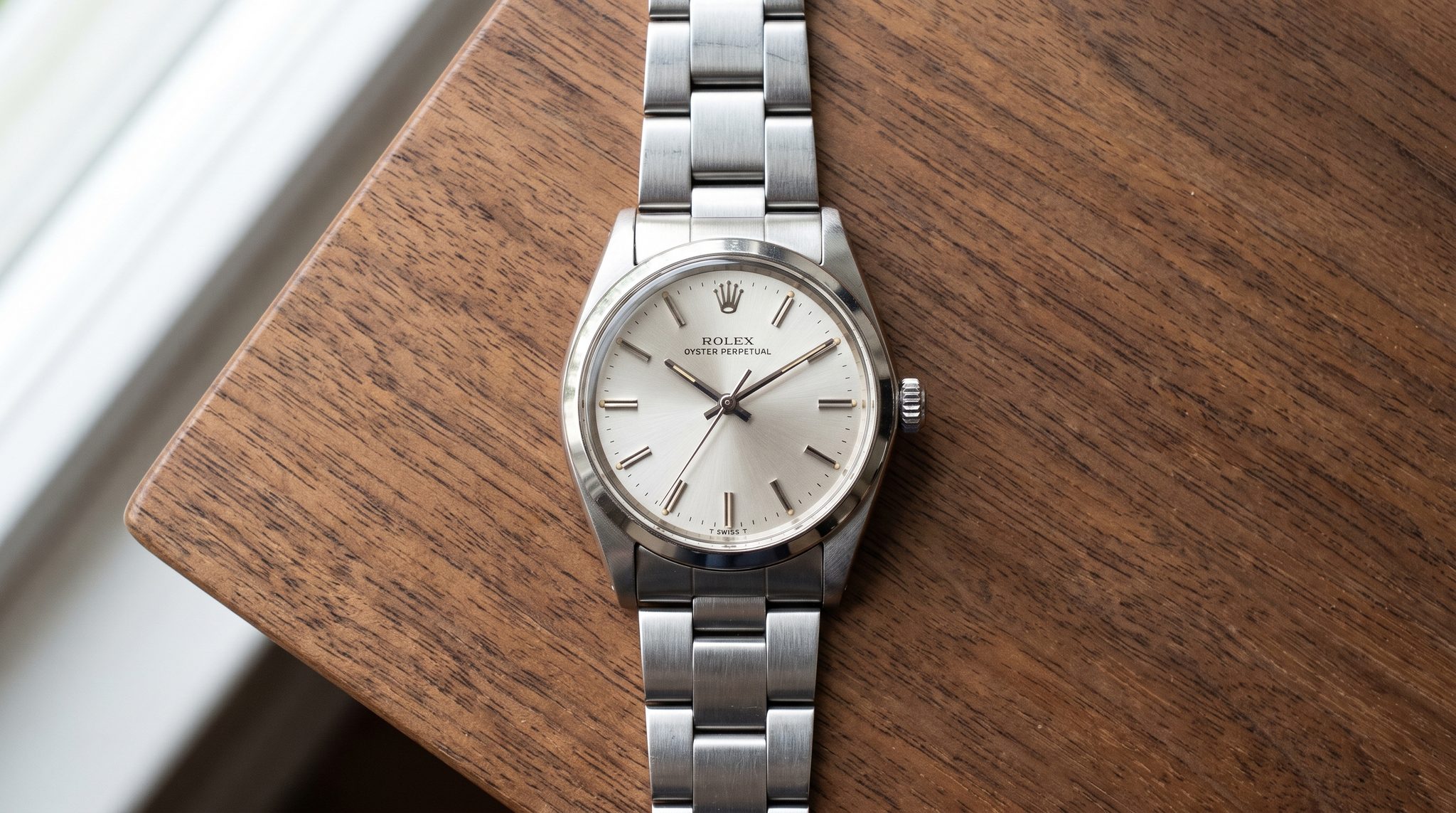
The Rolex Oyster Perpetual 1002 is the compact 34 mm, no-date Oyster that spans Rolex’s mid-1960s movement handoff, shifting from Cal. 1560 (18,000 vph) to Cal. 1570 (19,800 vph) without turning the watch into a different idea.
- Production
- c. 1959–early 1980s
- Case
- Steel (common)
- Diameter
- 34 mm
- Thickness
- ~10.7–11.2 mm
- Lug width
- 19 mm (typical)
- Bezel
- Smooth or engine-turned
- Crystal
- Acrylic
- Movement
- Cal. 1560 → 1570
- Power res.
- ~42h → ~48h
- Functions
- Time only
- Lume
- Tritium documented
The Rolex Oyster Perpetual 1002 is the rare kind of “simple” watch that matters because it sits directly on a technical seam in Rolex history, the quiet shift from Cal. 1560 to Cal. 1570. The change is measurable in the movement itself: 18,000 vph and about 42 hours of power reserve on the 1560, then 19,800 vph and about 48 hours on the 1570, while the watch on the wrist stays the same compact 34 mm, no-date Oyster.
That steadiness is the point. Ref. 1002 was produced approximately from the late 1950s (often cited around 1959) into the early 1980s, and it shows how Rolex’s everyday line could evolve by substitution rather than by a headline redesign. The case is consistently described as a 34 mm Oyster with an acrylic crystal, and surviving examples span a wide range of dials, hands, and even case metals as described in editorials and listings, from the common stainless steel watch to two-tone and solid-gold executions.
Collectors tend to approach the 1002 less like a reference with rigid “marks” and more like a platform. The most defensible dividing line is mechanical, Cal. 1560 in earlier watches and Cal. 1570 in later ones, and the rest is about learning to see what is actually in front of you: the bezel’s texture (smooth or engine-turned), the dial’s finish (from straightforward sunburst to textured linen), the honest patina of lume, and whether the bracelet is a period-correct riveted Oyster or a later replacement.
“Rolex Oyster Perpetual 1002: a 34 mm no-date Oyster that quietly bridges Cal. 1560 to Cal. 1570, with the change hiding in the beat rate.”
1002 across c. 1959–early 1980s
Ref. 1002’s story is less about a parade of visible redesigns and more about continuity that makes the few confirmed changes stand out. The clearest hinge is the movement. Early examples are described and photographed with Cal. 1560, a 26-jewel automatic beating at 18,000 vph with roughly 42 hours of reserve, and later examples are documented with Cal. 1570, still a time-only automatic in this reference but updated to 19,800 vph and roughly 48 hours. The reason for the change inside ref. 1002 is not documented in the public record, but the timing matches the broader introduction of Cal. 1570 in 1965.
What does not cleanly track that movement handoff is almost everything a buyer first notices. Ref. 1002 appears with both smooth and engine-turned bezels, and sources do not tie either bezel treatment to a dated introduction or discontinuation. Likewise, dials and hands are presented across a wide menu: silver and gilt are described early, stick hands dominate later listings, and textured options like linen are discussed as part of the reference’s broader cosmetic range. Lume is another case where the evidence is strongest for later watches: tritium is explicitly documented on a 1972 example, but the exact transition point for earlier 1002s is not pinned down by the available sources.
Seen all at once, the 1002 becomes a reminder that an “archetypal Rolex” was not always a single frozen configuration. Over a long, loosely bounded production span, the reference stayed anchored to the same compact Oyster format while Rolex and the market treated its exterior as a set of choices. That is why the most reliable way to understand a particular 1002 is to start with what can be proven on that exact watch, especially the caliber under the caseback, and then let the rest of the configuration speak for itself.
- c. 1959In production34 mm no-date, “1002” caseback
- c. 1960Cal. 1560 eraMovement stamped “1560”
- 19651570 introduced19,800 vph 1570 family
- c. 19681570 documentedMovement stamped “1570”
- 1972Later examplesTritium lume on dial
- c. early 1980sEnd of runLater dated listings, exact cutoff unknown
1002 against its neighbours
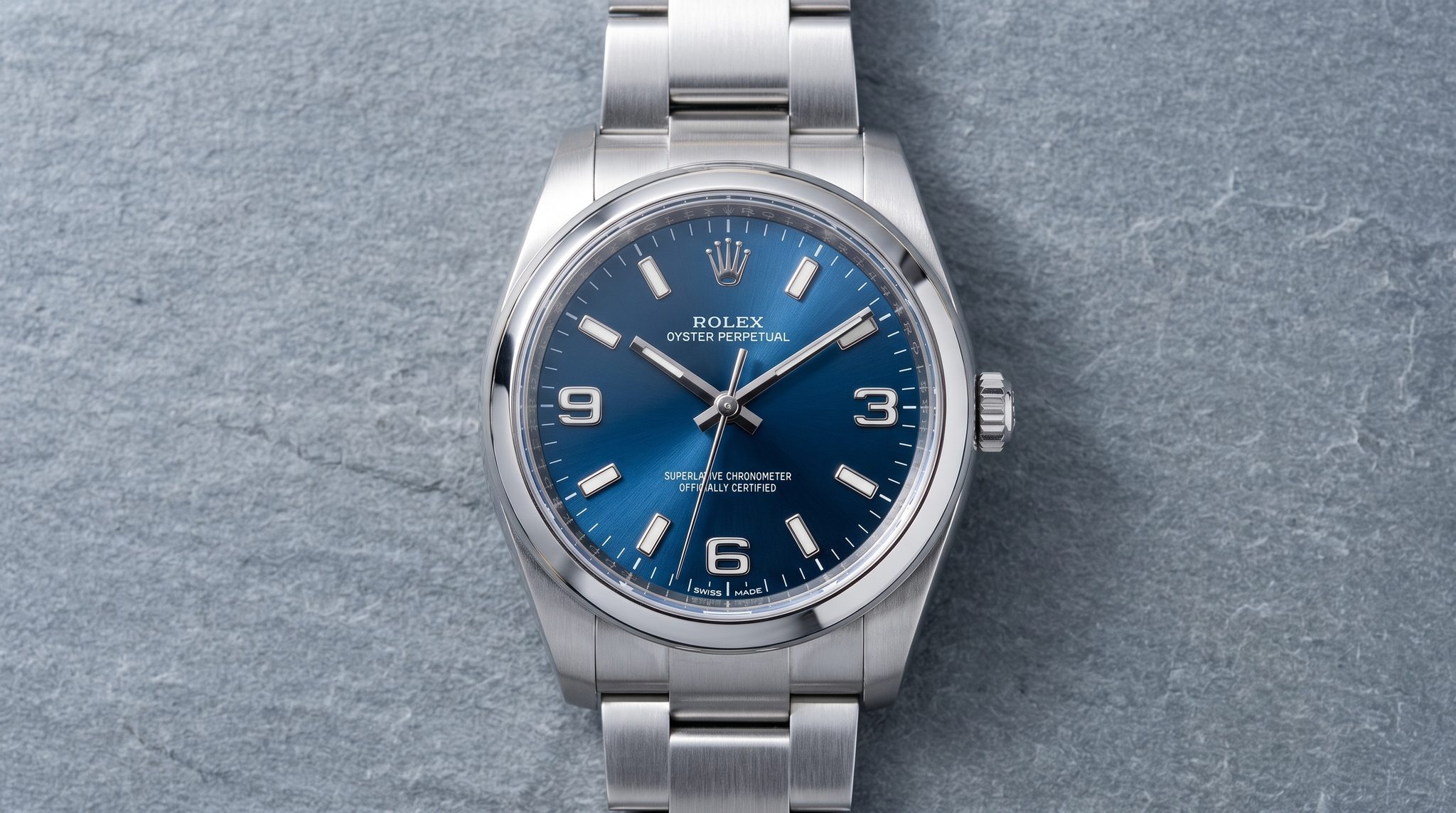
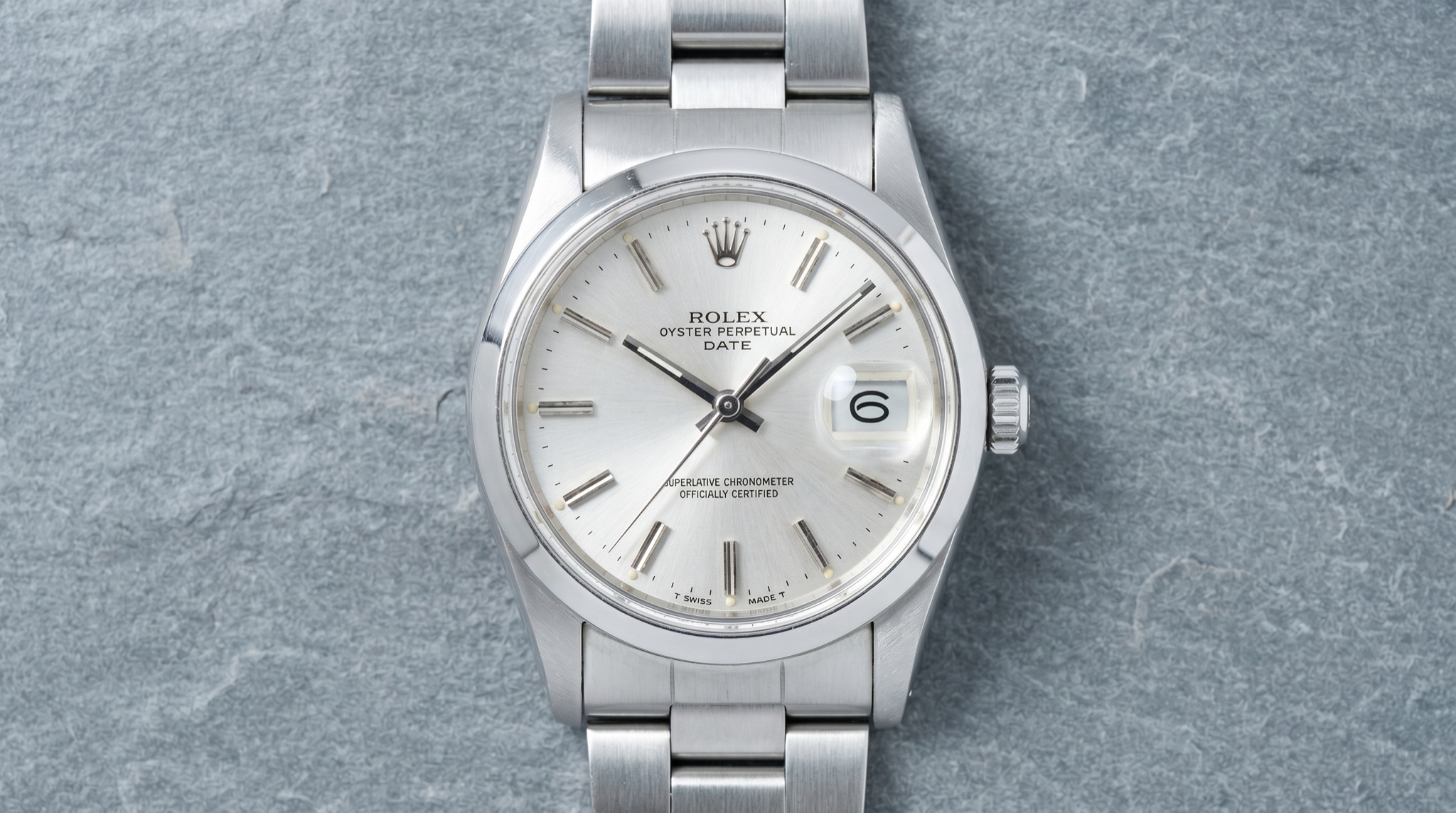
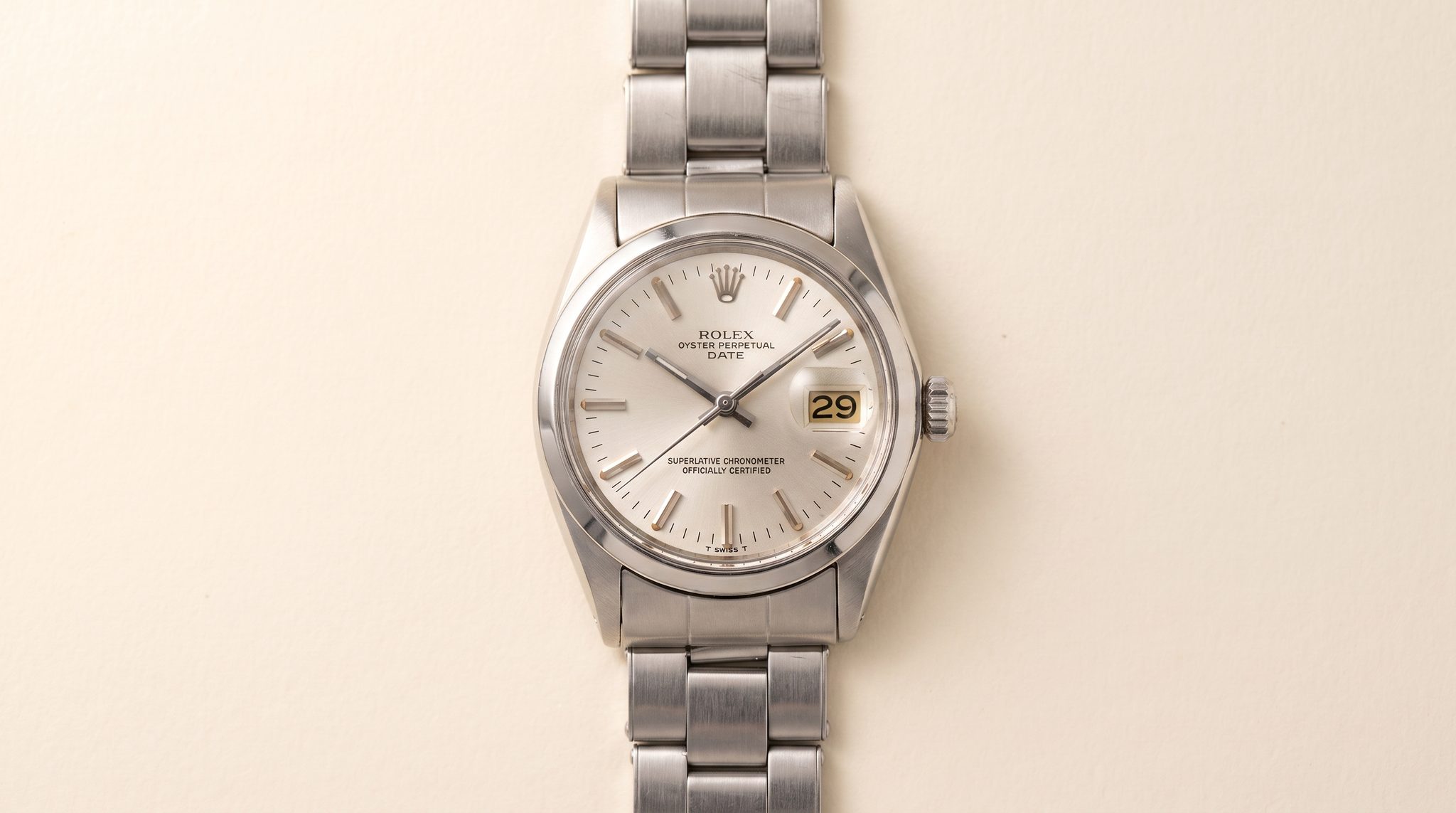
Ref. 1002 is easiest to understand when it is placed next to its closest adjacent 34 mm, no-date Oyster Perpetual references. Ref. 1000 is commonly treated as the nearest earlier counterpart in the same size and concept, while ref. 1003 is often presented as the Rolesor sibling in the same era. None of these relationships has a clean, factory-published handoff date in the public record, which is exactly why ref. 1002 is best read through what is verifiable on the individual watch, especially the caliber.
This reference 1002 Rolex · focal c. 1959–early 1980s | |||
|---|---|---|---|
| Production | c. 1959–early 1980s | c. 1962–1983 | c. 2007–c. 2018–2020 |
| Diameter | 34 mm | 34 mm | 34 mm |
| Bezel | Smooth or engine-turned | Smooth, fixed | Smooth domed, fixed |
| Crystal | Acrylic | Acrylic, Cyclops | Sapphire |
| Movement | Cal. 1560 → 1570 | Cal. 1565 → 1575 | Cal. 3130 |
| Functions | Time only | Time, date | Time only |
Six dial generations across the run
The most meaningful early “variant” is not a dial at all, it is the caliber. Ref. 1002 is documented with Cal. 1560, a 26-jewel automatic with an 18,000 vph beat rate and about 42 hours of power reserve, and it is described as a chronometer-grade movement with a Breguet hairspring. In hand, none of this announces itself from the outside. The case, the dial layout, and even the presence of chronometer text on the dial are not reliable substitutes for opening the watch, which is why movement confirmation is the cleanest way to place an early 1002 in its correct technical era.
What to check before buying a 1002
Buying a Rolex 1002 is less about hunting a single “correct” variant and more about confirming that the watch’s independent parts belong together. The reference spans two movement generations, Cal. 1560 and Cal. 1570, and the rest of the watch, from bezel style to dial finish, does not come with source-backed cutoffs that let you date it by appearance alone.
Condition is the biggest swing factor. Period descriptions and listings repeatedly emphasize case integrity, since decades of polishing can soften the 34 mm Oyster into rounded lugs and blurred edges, and dial originality, since refinished or swapped dials are common value traps on simple vintage Rolexes. Movement state matters just as much. Auction condition notes explicitly warn that examples may need service, and a correct caliber does not guarantee healthy performance without recent maintenance.
The physical appeal is also part of the practicality. Reported measurements cluster around a slim ~11 mm thickness (roughly 10.7–11.2 mm in dealer measurements) with a typical 19 mm lug width, which makes the 1002 easy to wear on its intended bracelets or on leather without feeling oversized. This is the sort of vintage Rolex that rewards a patient buyer: confirm the caliber, prioritize an honest dial and an unoverpolished case, and pay premiums only for things that can be checked, like a period-correct riveted bracelet or credible box and receipt.
Rolex Oyster Perpetual 1002 for sale
Indicative market value from recent dealer, auction, and Grey Market sales: median ≈ $2,700, with a typical $2,000–$3,500 range across 100 comparable sales (updated this week).
Each point is a recent dealer or auction sale, banded to an indicative figure. The range shown is not a valuation.
Adjacent in the Oyster Perpetual family
Common questions about the 1002
Rolex did not publish a definitive public archive entry for ref. 1002, so the production window is stated approximately. Specialist sources repeatedly place it starting in the late 1950s (often cited around 1959) and continuing into the early 1980s, with many documented examples in the 1960s and 1970s.
- Vintage of the Week: Rolex Oyster Perpetual Ref. 1002bobswatches.com
- My First Rolex: The Oyster Perpetual 1002fratellowatches.com
- 1972 Rolex Oyster Perpetual Reference 1002shop.hodinkee.com
Show 7 more
- Rolex Oyster Perpetual reference 1002timerediscovered.com
- Rolex Oyster Perpetual 1002gregoandco.com
- Rolex 1560 and 1570 Movements: A Chronometer Grade Movementbeckertime.com
- Rolex Oyster Perpetual ref 1002 Mens 34mm 1960swatchprosite.com
- Rolex Oyster Perpetual Ref. 1002 Vintage w/ Box for...chrono24.com
- Oyster Perpetual - Ref. Rolex - 1002 - Collector Squarecollectorsquare.com
- ROLEX OYSTER PERPETUAL Ref.1002timeanagram.com