

Rolex Datejust 1603
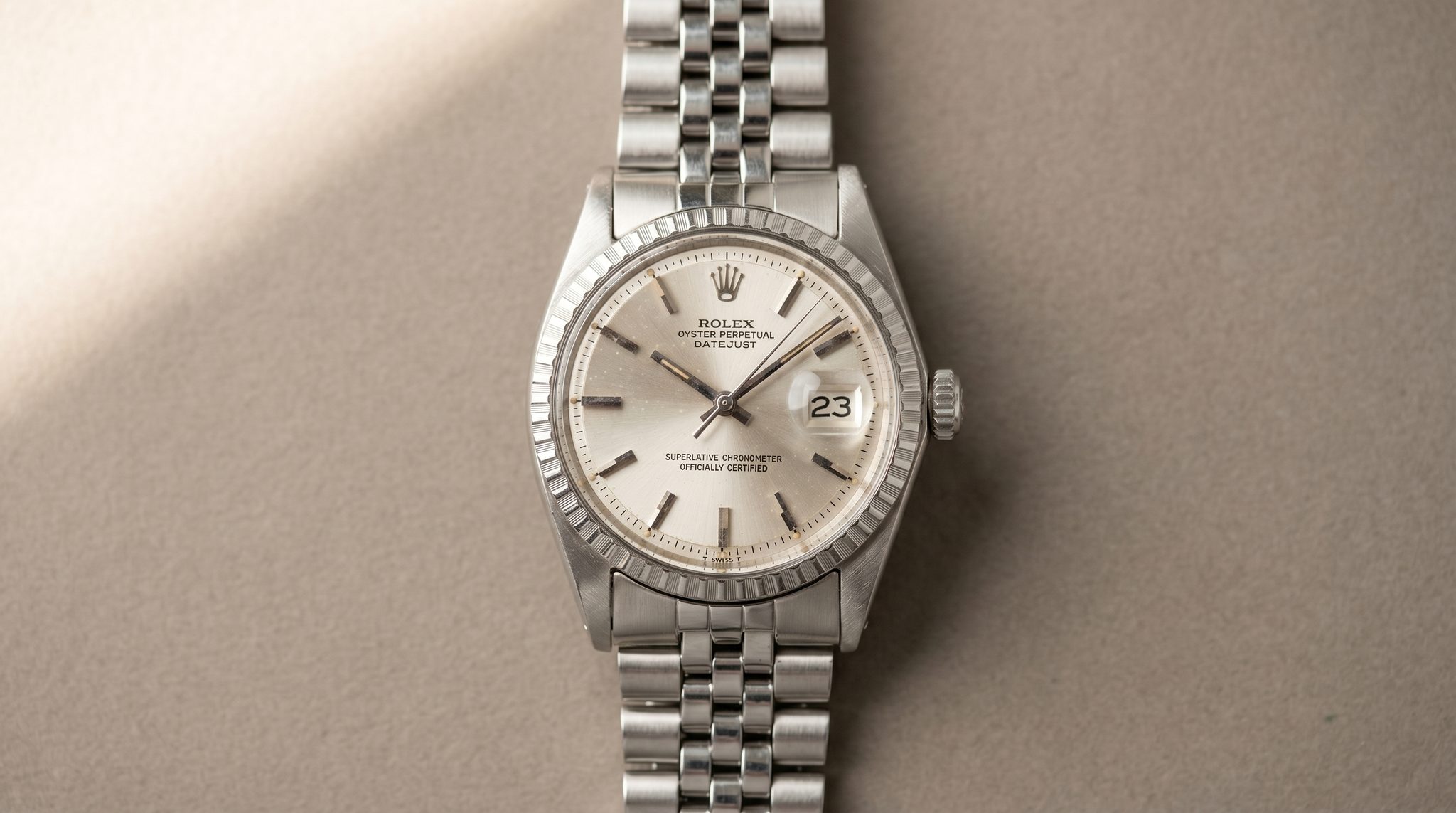
The Rolex Datejust 1603 is the long-running, all-steel Datejust defined by its engine-turned bezel, a reference whose real variety hides in movements and dials rather than in metals or case shapes.
- Production
- c. 1960–1978
- Case
- Steel Oyster
- Diameter
- 36 mm
- Bezel
- Engine-turned steel
- Crystal
- Acrylic (typ.), Cyclops
- Movement
- Cal. 1565 → 1575
- Date
- Instantaneous (15xx)
- Lume
- Tritium (some dials)
- Lug width
- 20 mm
- Lugs
- Drilled
The Rolex Datejust 1603 is the proof that a Datejust can be unmistakable without being flashy: for roughly c. 1960–1978 it kept the same 36 mm, all-steel formula, then signed it with an engine-turned bezel that reads like fine machining when light skims across it. The twist is that this reference is not collected for metal variations or dramatic case redesigns, it is collected because most of the meaningful differences live where you have to look twice: inside the case (15xx movement generations) and on the dial (lume or no lume, and a handful of distinct executions that change the entire personality of an otherwise steady watch).
In the 16xx Datejust lineup, the 1603 sits alongside the smooth-bezel 1600 and the fluted-bezel 1601 as the steel, textured alternative. That bezel choice locked the 1603 into a particularly practical, restrained corner of the Datejust family, and it is why the reference has become a favorite entry point for vintage Rolex buyers who want a period-correct Oyster case and Cyclops date, but do not want the precious-metal signal of a fluted bezel. At the same time, the 1603 is a reminder that Rolex’s reference numbers in this era encode configuration more than a strict technical progression: “predecessor” and “successor” relationships are often a cataloging convention built around bezel execution.
A Datejust 1603 review that stays on the surface will make it sound uniform. In practice, two 1603s can wear very differently: one might carry tritium plots and age into creamy dots, another might be deliberately clean with no luminous material at all; one might be a rarer Wide Boy handset and marker package, another a Buckley dial with painted Roman numerals; some 1970s dials even advertise gold furniture with small sigma symbols. The reference stays the same. The watch does not.
“The 1603 barely changes its silhouette, so the story is told by what is under the caseback and what is printed, plated, or luminous on the dial.”
1603 across c. 1960–1978
The Datejust 1603’s chronology is best read as a long period of visual continuity with a few important mechanical and dial-side forks. Most references place the core production span at about c. 1960–1978, while some sellers extend availability into the early 1980s due to sell-through of remaining stock rather than a clearly documented, clean end date.
Mechanically, specialist coverage describes an early Cal. 1565 period, then a transition to Cal. 1575 in the mid-1960s. The underlying “because” is not documented by Rolex in the provided material, but secondary descriptions frame the 1575 as an update within the same 15xx architecture, including a higher beat rate (18,000 vph for 1565, 19,800 vph for 1575) positioned as improving stability and accuracy. Complicating matters, some retail listings describe the reference simply as “1570,” and a circa-1969 example is explicitly shown with a 1570 labeled movement described as non-hacking with 26 jewels and about 48 hours of power reserve. In other words, the 1603 clearly lives within the 15xx Datejust movement family, but exact caliber labeling in the market is not always consistent.
On the dial side, the most important lesson is that features do not move together. Lume presence is a choice, not a strict era marker: many 1603s carry tritium plots and matching luminous hands, while many others are intentionally non-luminous. Separately, the 1970s bring Sigma dials for a few years, marked by small sigma symbols that signal 18k gold hands and hour markers, a detail that can be missed until you know to look near the bottom text.
The zoomed-out view is that the 1603 became a stable template early, then spent nearly two decades accumulating small, independent, and highly visible differences. That is why collectors treat originality as the main headline: if a watch has been rebuilt from service parts or swapped dials, the reference number still reads 1603, but the historical signal is gone.
- c. 1960Reference appearsMachined bezel, all-steel case
- c. 1965Movement update15xx caliber stamp under rotor
- c. 1970 – 1979Sigma dialsSmall σ symbols near “SWISS”
- c. 1972Hacking reportedSeconds stops when crown pulled
- c. 1978Phased outLater serial-era cases, sold through
1603 against its neighbours
The 1603 makes the most sense when framed against its two nearest 16xx siblings: the 1600 and 1601 share the same basic case platform and movement family, but their bezels push them into noticeably different personalities, from minimal (1600) to precious-metal dressy (1601). A later engine-turned successor such as the 16030 shows what changed when Rolex moved the Datejust into the quickset era.
1600 Closest sibling (smooth bezel) c. 1960–1977 | This reference 1603 Rolex · focal c. 1960–1978 | |||
|---|---|---|---|---|
| Production | c. 1960–1977 | c. 1960–1977 | c. 1960–1978 | 1977–1988 |
| Diameter | 36 mm | 36 mm | 36 mm | 36 mm |
| Bezel | Smooth steel | Fluted (gold) | Engine-turned steel | Engine-turned steel |
| Crystal | Acrylic, Cyclops | Acrylic, Cyclops | Acrylic (typ.), Cyclops | Acrylic |
| Movement | Cal. 1565 → 1575 | Cal. 1565 → 1575 | Cal. 1565 → 1575 | Cal. 3035 |
| Date | Instantaneous (15xx) | Instantaneous (15xx) | Instantaneous (15xx) | Quickset |
| Lugs | Drilled | Drilled | Drilled | – |
| Lug width | 20 mm | 20 mm | 20 mm | 20 mm |
Eight dial generations across the run
Early Datejust 1603s are associated with Rolex Cal. 1565. Nothing about the watch announces this from across a room, because the case and bezel identity stays consistent, but the movement matters to collectors because it is one of the few reference-level separations that is not easily faked with a dial swap. When assessing an early example, the key is coherence: the case, dial style, hands, and bracelet should feel like they belong to the same early-1960s watch, not like a later 1603 that has been “backdated” cosmetically.
What to check before buying a 1603
Buying a Rolex 1603 is less about hunting a single “correct” spec and more about confirming that independent traits agree with each other: 15xx movement generation, lume or no lume, dial execution, bezel style, and bracelet era. The reference is also affordable enough, relative to many vintage Rolex models, that it attracts parts-swapped watches, especially around premium dials like Buckley, Sigma, and Tiffany.
The first priority is dial honesty. Refinished dials are common, and the incentives are obvious: a standard dial can be repainted to resemble a Buckley layout, a Tiffany co-signature, or a Sigma dial. Print quality, correct fonts, and correct pairing of hands and markers do most of the authentication work before any story does.
Then look at the wear surfaces that cannot be repainted. Over-polishing softens the Datejust’s lug geometry, and on a 1603 it can also blunt the crisp relief of the engine-turned bezel. A strong example still looks like machined steel rather than rounded metal, and the drilled lugs should not be distorted by years of aggressive refinishing.
Finally, living with a 1603 is living with its era. It wears as a compact 36 mm Oyster with 20 mm lugs, and it delivers the vintage Datejust experience of a 15xx movement and acrylic crystal, with the bezel texture adding just enough grip and sparkle to keep the watch from feeling plain. For many owners, that balance is the entire point: a daily-wear vintage Rolex that stays understated until someone looks closely enough to read the details.
Rolex Datejust 1603 for sale
Indicative market value from recent dealer, auction, and Grey Market sales: median ≈ $3,900, with a typical $3,300–$4,800 range across 397 comparable sales (updated this week).
Each point is a recent dealer or auction sale, banded to an indicative figure. The range shown is not a valuation.
Adjacent in the Datejust family
Common questions about the 1603
Most references place the Rolex Datejust 1603 at approximately c. 1960–1978. Some sellers extend availability into the early 1980s, which is generally explained as sell-through of remaining stock rather than a clearly documented, separate production run.
- Rolex Datejust 1600 vs 1601 vs 1603: Vintage Icons Comparedwristler.eu
- Review: The Rolex Datejust ref. 1603beckertime.com
- Rolex 1603 Review: A Timeless Buyers and Collectors Guidebobswatches.com
Show 7 more
- Pre-Owned Rolex 1603 Datejust for Salebqwatches.com
- Rolex DATEJUST Reference 1603-Circa 1969youtube.com
- Rolex Datejust Reference 1603 - 1963analogshift.com
- Rolex Datejust 36 1603 | Ref. 1603 Watches on Chrono24chrono24.com
- Rolex 1603 (Datejust) » Check Prices & Morewristler.eu
- Rolex Datejust 1603 Stainless steel | Dealereverywatch.com
- Rolex DateJust 1603 - Vintage Watch Advisorsvintagewatchadvisors.com