

Rolex Air-King 5500
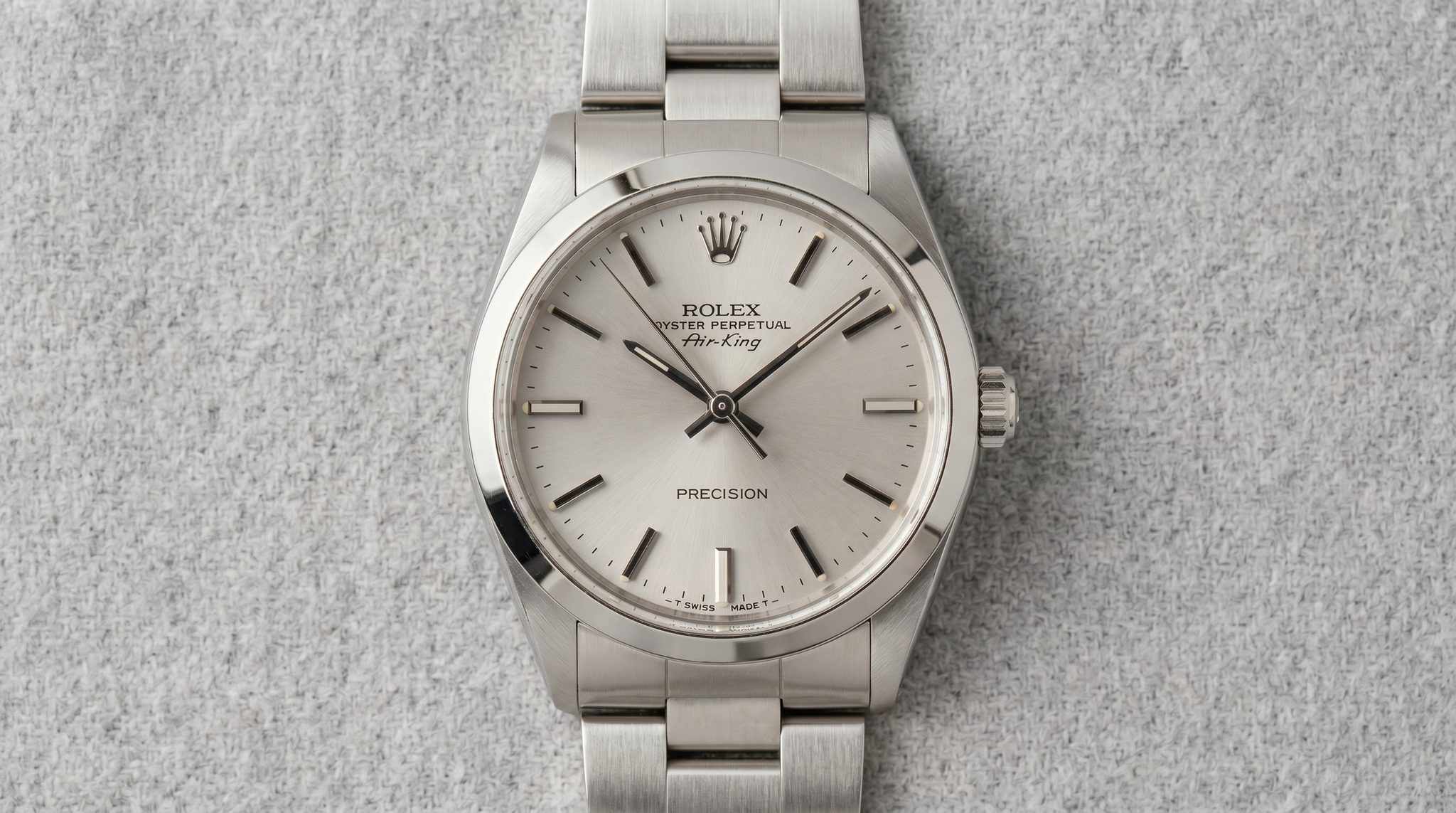
The Rolex Air-King 5500 is the long-running, non-chronometer Air-King whose single reference number hides decades of dial, movement, and material crossovers that collectors learn to read one trait at a time.
- Production
- 1957–1989
- Case
- Steel or 9k/14k gold
- Diameter
- 34 mm
- Lug width
- 19 mm
- Bezel
- Smooth, fixed
- Crystal
- Acrylic
- Water resist
- 50 m
- Movement
- Cal. 1530 → 1520
- Power
- ~42h
- Chronometer
- No
- Dial
- Time-only, no date
- Bracelet
- Oyster (var.)
The Rolex Air-King 5500 was produced from 1957 to 1989.
- Production years
- 1957–1989
- Replaced
- 6552
- Replaced by
- 14000
- Movement
- Cal. 1530 → 1520
The Rolex Air-King 5500 is the Air-King that stayed in the catalog long enough to become its own dating language: one reference number, three decades, and a set of traits that do not move in lockstep. The quickest way to feel that is to set a late example next to an early one. The case still reads 34 mm and the bezel is still smooth, yet you can encounter a 5500 with an Explorer-signed 3-6-9 dial that trades in five figures, while the “default” silver Precision dial remains one of Rolex’s most accessible vintage entries.
Production is best supported as 1957–1989, with a useful nuance at the very start. Rolex has associated the first Air-King with 1958, but documented serial-number evidence places ref. 5500 examples in 1957, a common split between production and retail timing. Over that long run Rolex kept the formula simple: an Oyster case with screw-down crown rated to 50 m, an acrylic crystal, and non-chronometer automatic 15xx-series movements, primarily cal. 1530 early and cal. 1520 later.
Collectors care about the 5500 less for a single headline spec than for its unusually wide spread of legitimate factory looks. Dagger 3-6-9 dials, Explorer dials, silver and colored stick dials, “Precision” and “Super Precision” text, alpha hands, tritium and no-lume executions, and even oddities like a caseback stamped “1002” inside a watch that is plainly a 5500 between the lugs all appear in the record. The result is a reference that rewards careful, visual reading. A correct 5500 is not “one configuration,” it is a family of period-correct combinations that can be judged only by separating dial, lume, hands, metal, bracelet, and movement into their own timelines.
“A single reference number that ran from 1957 to 1989, the Air-King 5500 is best understood as many period-correct watches hiding inside one caseback engraving.”
Rolex Air-King 5500 production years: 1957–1989
Ref. 5500 enters the Air-King line in 1957, and the long production span that follows is the core of its identity. The case stays resolutely conservative: a 34 mm Oyster with smooth bezel and acrylic crystal, rated to 50 m with a screw-down crown. What changes, and what makes the reference interesting to study, is everything that can be swapped without changing that case engraving.
The first major split is mechanical. Early watches are associated with cal. 1530, and later watches with cal. 1520, but published data places both calibers in the mid-1960s. Rolex never published a clean switchover date, so the only decisive identifier is the movement engraving itself. Dial text sometimes tracks this tiering, with “Super Precision” more often seen on 1530 examples and “Precision” commonly on 1520 examples, but exceptions are explicitly documented, which is why text alone is not proof.
In parallel, Rolex offered some of the most arresting 5500s early: the 3-6-9 dagger-style dials of the late 1950s and early 1960s, and the Explorer-dial 5500s, produced from about 1958 until around 1967. Those Explorer dials pull the watch into a different collecting universe because the case is still marked 5500, yet the dial may be signed EXPLORER, and market pricing can jump from typical four-figure Air-King territory into five figures for a genuine, all-original example.
Later decades bring a quieter kind of variation. The silver stick dial becomes the default template, then opens out into less-common colors such as black and dark blue. Within that same stick-dial era, index and handset details shift, with Rescapement noting a change from steel markers on early examples to white-gold markers beginning around the mid-1970s, and later dials that lean deliberately dressy with more prominently yellow-gold-colored indices and hands. Lume language also diverges, with tritium-marked dials and no-lume executions both appearing across the 1970s and 1980s. The reason for those parallel offerings is not documented in the cited material.
Late in the run, the reference reads like a summary of Rolex’s entry-level Oyster strategy: the same compact case and smooth bezel, paired with whatever period-correct dial, lume, bracelet, and movement combination Rolex could supply without elevating the watch into chronometer territory. It is easy to treat the 5500 as “the simple Air-King,” until the accumulated crossovers make the opposite point. Rolex’s most straightforward model line still changed constantly, just in smaller, more datable ways than its sports watches.
- 1957Introduced5500 engraved between lugs
- 1958Explorer dialDial reads “EXPLORER”
- c. 1963 – 1967Movement overlapMovement bridge marked 1520/1530
- 1967Explorer endsExplorer dial absent after era
- c. 1975Bracelet shiftEndlinks typically 557
- 1989DiscontinuedSapphire-era 14000 follows
5500 against its neighbours
The Air-King 5500 makes the most sense when framed by the watch it replaced, the watch that replaced it, and the nearest “same era, same size” alternative for buyers who want a date. Ref. 6552 shows the last, shorter-lived pre-5500 Air-King design language; ref. 14000 shows how abruptly the line modernized at the end of the 1980s with sapphire and a new movement family; and ref. 5700 demonstrates how closely Rolex built adjacent models on the same 34 mm platform.
6552 Predecessor c. 1953–mid-1950s | This reference 5500 Rolex · focal 1957–1989 | 5700 Nearest sibling 1960s–early 1980s | ||
|---|---|---|---|---|
| Production | c. 1953–mid-1950s | 1957–1989 | 1960s–early 1980s | c. 1989–c. 1999/2000 |
| Diameter | 34 mm | 34 mm | 34 mm | 34 mm |
| Crystal | Acrylic | Acrylic | Acrylic | Sapphire |
| Water resist | – | 50 m | – | 100 m |
| Movement | Early Perpetual auto | Cal. 1530 → 1520 | Automatic date | Cal. 3000 |
| Chronometer | – | No | – | No |
| Bezel | Smooth, fixed | Smooth, fixed | Smooth, fixed | Smooth, fixed |
| Dial | Time-only | Time-only, no date | Date at 3 | Time-only |
| Lug width | 19 mm | 19 mm | 19 mm | 19 mm |
Six dial generations across the run
The dagger-dial Air-King 5500 is the version that reads most like a mid-century Rolex experimental sketch. In place of plain batons, applied Arabic numerals at 3, 6, and 9 anchor the dial, and the remaining hours are picked out with sharply pointed triangular markers. On the wrist the effect is more instrument-like than the later “dress Oyster” template, even though the case and smooth bezel stay identical.
Many examples are seen with early luminous plots and handsets, sometimes including the faceted alpha-style hands that taper to fine points. That pairing feels coherent because both details emphasize sharp geometry over the later straight-baton minimalism. The exact transition away from this dial type is not documented in the cited material, but it clusters in the late 1950s and early 1960s period, before the stick-marker dial becomes the dominant look.
What to check before buying a 5500
A Rolex Air-King 5500 for sale can look like the simplest purchase in vintage Rolex, until the reference’s long run catches up with you. The watch is easy to wear and easy to service relative to more complicated models, but it is also easy to alter. Dials, hands, crowns, and bracelets are all parts that can be swapped, and the market has enough value spread between common and rare variants that misrepresentation is not an edge case.
The biggest trap is paying for a story the watch cannot support. Explorer-dial 5500s are real, documented, and expensive, and that combination invites dial and hand conversions into ordinary 5500 cases. At the other end, colorful and “fun” dials are exactly where aftermarket printing most often appears, sometimes sold with confident language that the fonts and coronet shape do not actually earn.
The safest way to buy is to anchor the watch to what cannot be faked cheaply: a case correctly engraved 5500 between the lugs and, inside, a movement that is plainly cal. 1520 or cal. 1530. Once those fundamentals are right, value follows the aesthetics and the integrity of the aging. The best 5500s are the ones that look like they have lived one continuous life, with a dial, hands, lume, and bracelet that belong to the same decade and the same kind of wear.
Owned on its own terms, the 5500 is the compact, everyday Rolex that later Air-Kings tried to modernize with sapphire and newer calibers, but never really replaced in feel. A good 34 mm Oyster with acrylic has a particular warmth on the wrist, and the reference’s affordability in standard form is exactly what lets a buyer be picky: hold out for the dial that speaks to you, then insist that the rest of the watch agrees with it.
Rolex Air-King 5500 price and value
A Rolex Air-King 5500 sells for about $3,000 at the median, typically $2,200 to $3,600 across 219 comparable sales.
Rolex Air-King 5500 for sale
Indicative figures from recent dealer, auction, and Grey Market sales (updated this week). Every watch is verified before it sells here.
Each point is a recent dealer or auction sale, banded to an indicative figure. The range shown is not a valuation.
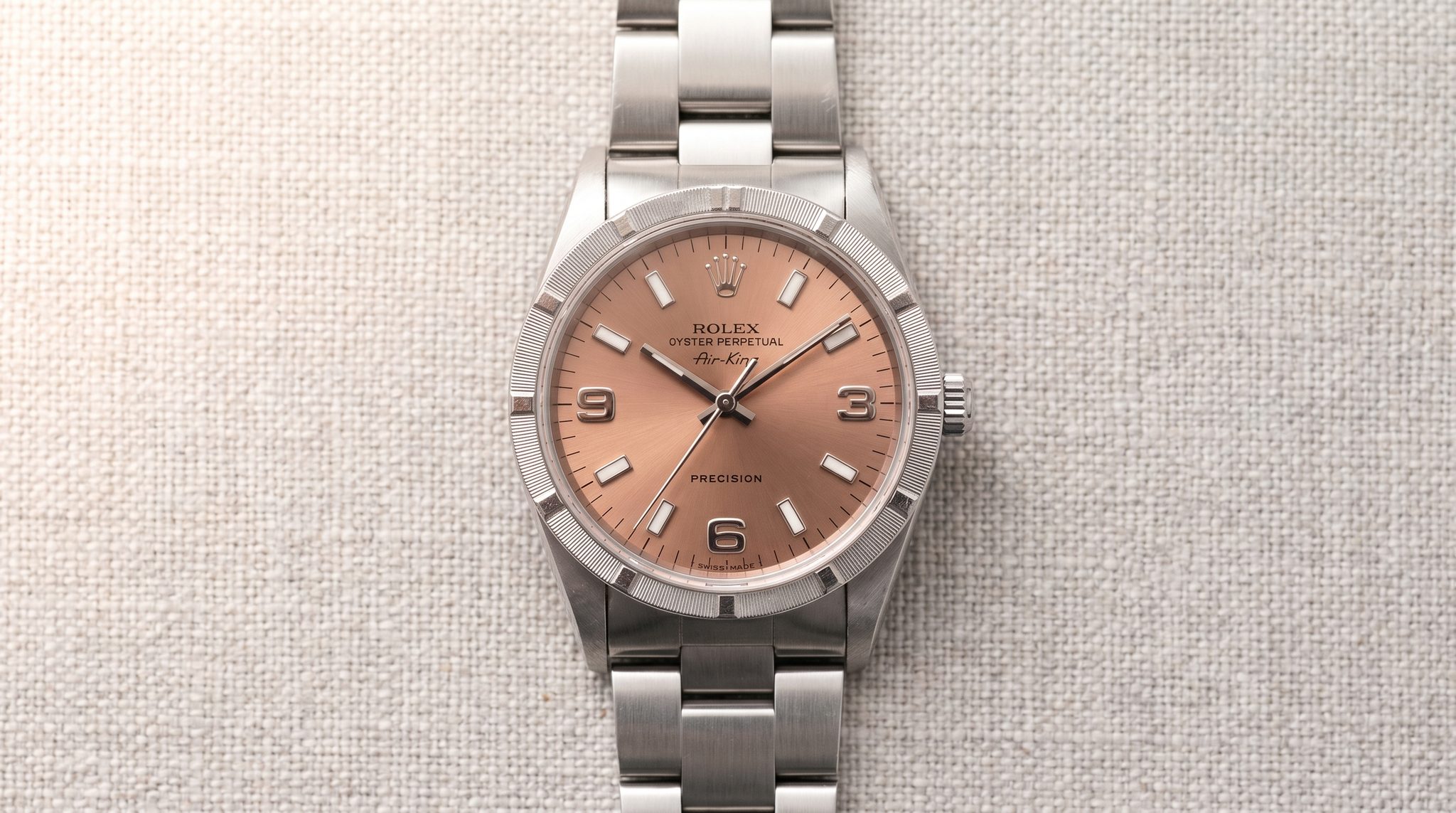
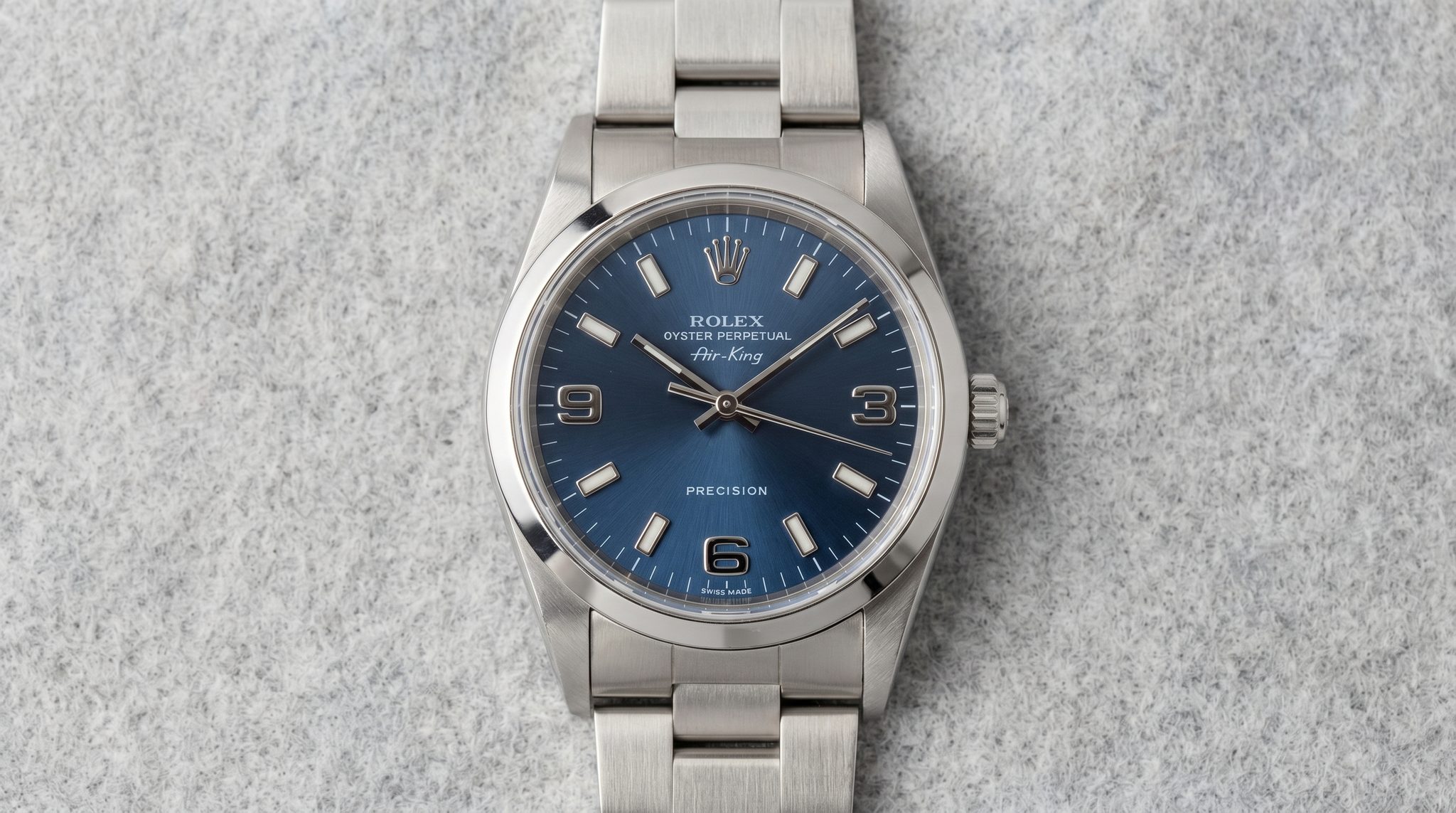
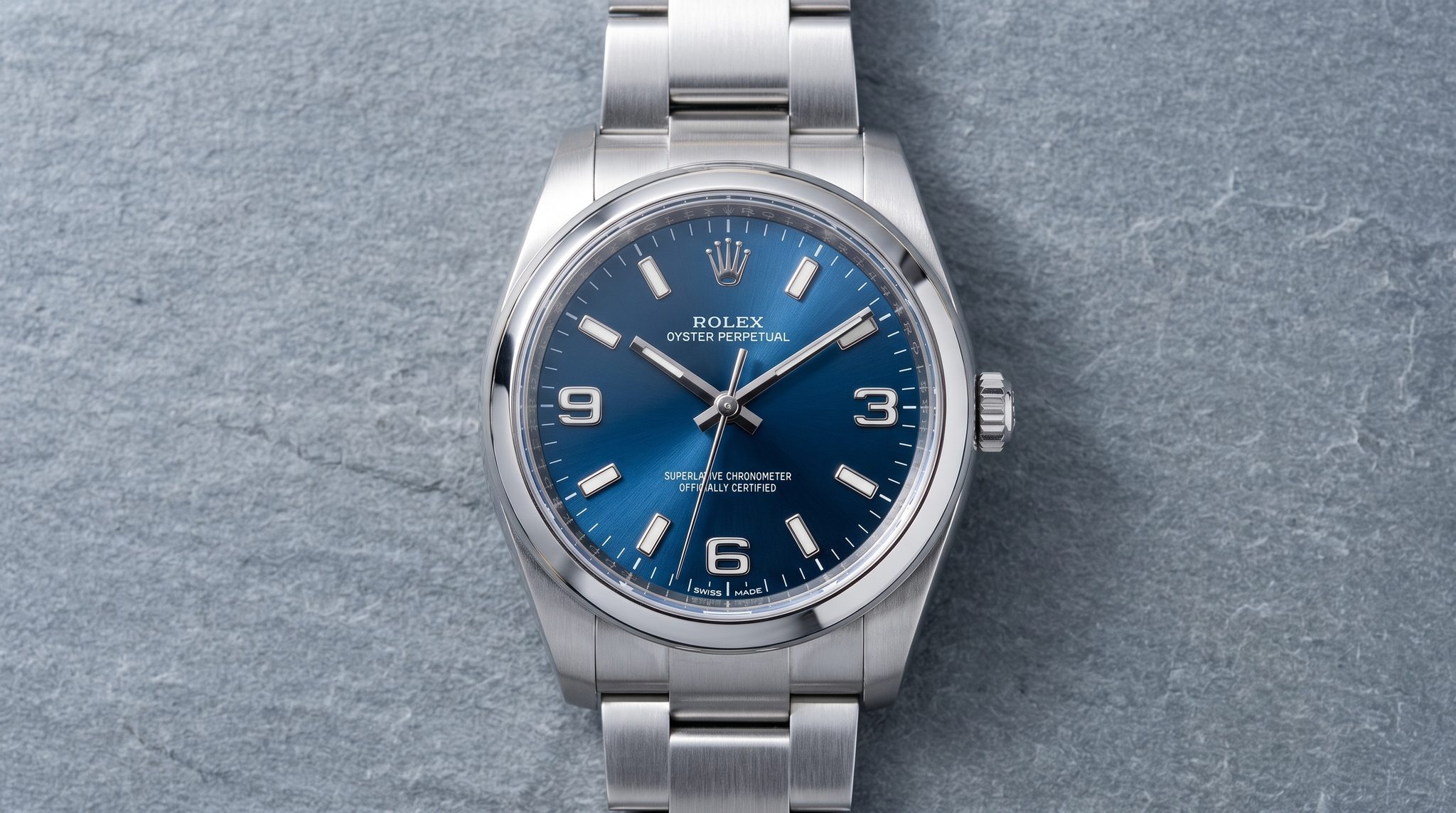
Adjacent in the Air-King family
Stories that discuss the 5500
Common questions about the 5500
The best-supported production span for the Rolex Air-King 5500 is 1957–1989. Rolex has associated the first Air-King with 1958, but documented serial-number evidence places ref. 5500 examples in 1957, which is typically explained as production versus retail timing.
- For Your Reference: Rolex Air-King Reference 5500rescapement.com
- 1972 Rolex Air-King Ref. 5500 (HODINKEE Shop listing)shop.hodinkee.com
- Rolex Air-King Ref. 5500 Collector's Guideluxurybazaar.com
Show 7 more
- Rolex 5500 Air King Ultimate Buying Guidebobswatches.com
- A Brief History of the Rolex Air-Kingjournal.craftandtailored.com
- 1965 Rolex Air-King Ref. 5500 (HODINKEE Shop listing)shop.hodinkee.com
- Why You Should Consider the Vintage Rolex Air-King 5500everestbands.com
- The History & Evolution of the Rolex Air-Kinggrayandsons.com
- The Rolex Air-King Ultimate Guideswisswatchexpo.com
- Rolex Air-King 5500 Watches on Chrono24 (reference overview)chrono24.com