

Rolex Submariner 5513
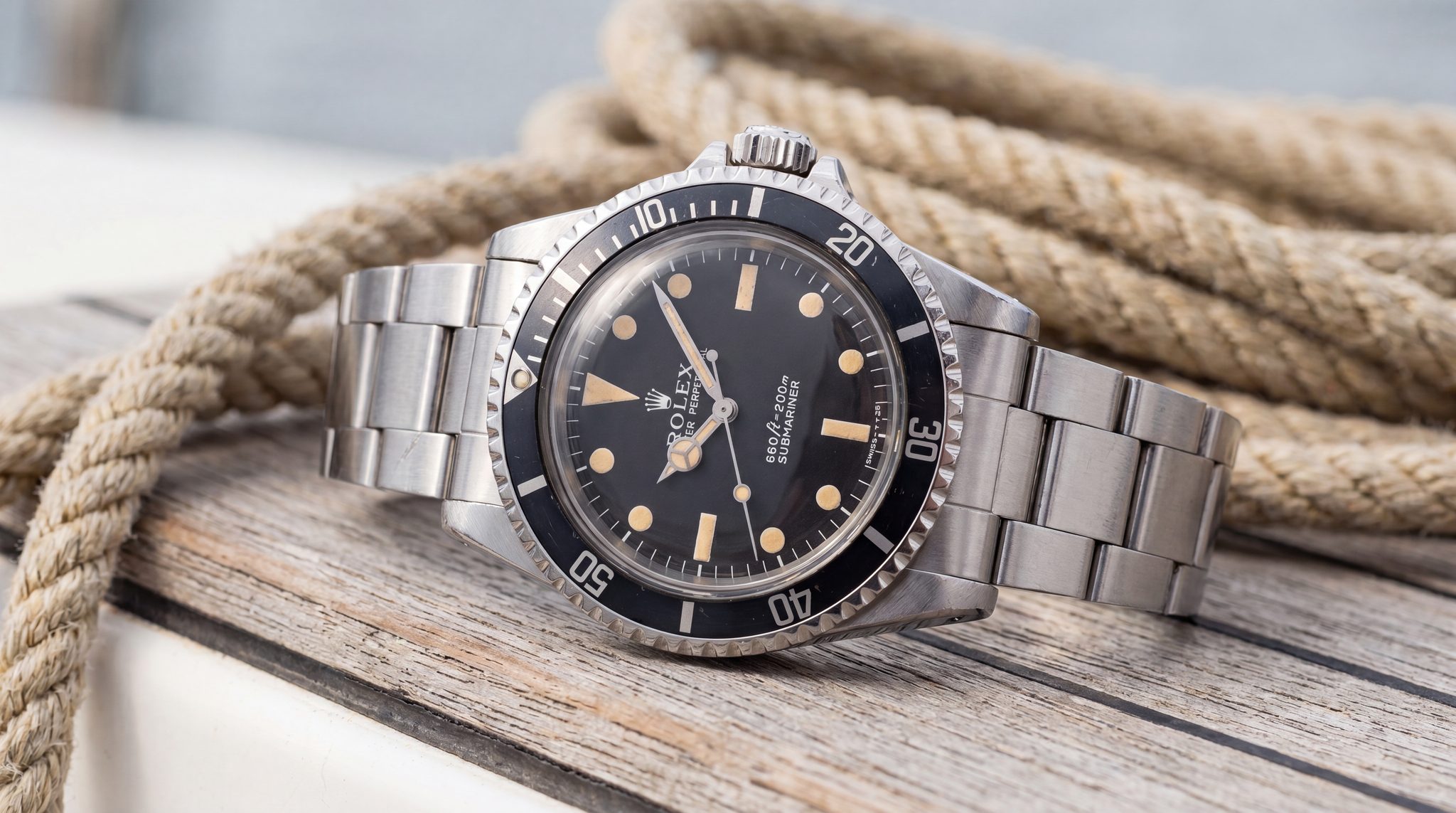
The no-date Submariner that became the collector’s “dial textbook”: made from 1962 to 1989, the 5513 is read by its small, datable shifts, from gilt gloss to meters-first matte to late glossy white-gold surrounds.
- Production
- 1962–1989
- Case
- Stainless steel
- Diameter
- 40 mm
- Bezel
- Rotating timing bezel
- Insert
- Aluminum (black)
- Crystal
- Acrylic (plexiglass)
- Dial
- Gilt; matte; glossy WGS
- Movement
- Cal. 1530, then 1520
- Chronometer
- No
- Lume
- Radium (early), tritium
- Crown guards
- Yes
The Rolex Submariner 5513 is the no-date Submariner whose smallest details became history lessons. Rolex kept it in production from 1962 to 1989, and auction scholarship notes a “vast variety of dials” across that span, enough that the dial alone can place a watch in time when the parts are right.
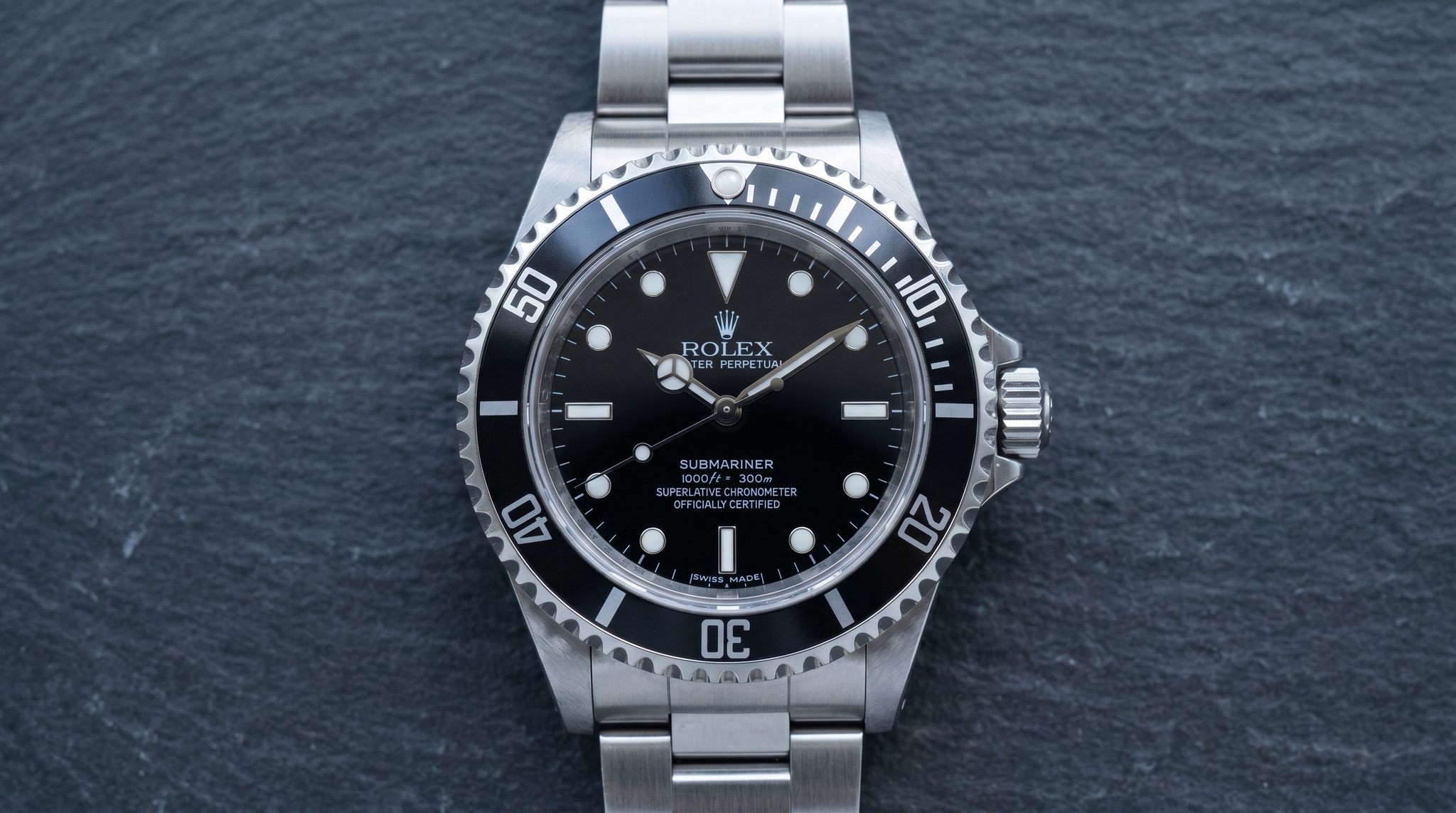
This is the version of the crown-guard Submariner that typically stays on the simpler, non-chronometer side of the lineup. Next to the closely related Submariner 5512, the contrast is often visible at a glance: many 5512 dials carry the chronometer wording, while many 5513 dials do not. Even that tidy distinction has a documented edge case. Christie’s catalogued a 1964 watch described as ref. 5513 with “Superlative Chronometer Officially Certified” on the dial and a calibre 1570, presenting it as an “interesting transitional version.”
What makes the Submariner 5513 (often shortened to Rolex 5513) unusually readable is that its defining traits move on separate tracks. Dial finish sets the big eras, glossy gilt in the early years, then a long matte tool-watch period, then late glossy dials with applied white-gold surrounds. Inside the matte era, the depth rating flips order from “meters first” (200m = 660ft) to “feet first” (660ft = 200m), and the two layouts overlap rather than switching overnight. Later still, “Maxi” dials enlarge the luminous plots within the matte family instead of replacing it. The watch rewards a simple discipline: treat each trait as its own clue, and insist the whole watch agrees.
“On a 5513, the dial does the dating: small changes, spread across 1962 to 1989, carry most of the reference’s story.”
5513 across 1962–1989
Dated broadly by Sotheby’s and Christie’s to 1962–1989, the Submariner 5513 is best understood as a long, steady platform with a dial that keeps getting edited. The cause behind the variety is simple and unromantic: when a reference runs for decades, Rolex can update printing, suppliers, and luminous conventions without changing the reference number, and the watch that survives in collections becomes a record of those quiet revisions.
The first anchor is finish. Early gilt dials are glossy black lacquer with gilt printing that reads warm under light, then matte dials arrive and flatten everything into crisp white text and a non-reflective surface. In the final phase, gloss returns again, but in a different register than the early years: glossy black dials with applied white-gold surrounds around the hour plots.
Within matte production, the depth rating gives a second, independent track. The “meters first” line (200m = 660ft) and the later “feet first” line (660ft = 200m) overlap during the change, with Sotheby’s placing that overlap from late 1968 to early 1970. That overlap is why a meters-first dial feels like an early matte cue rather than a single-year stamp.
Luminous signing adds a third track. Christie’s documents radium on early “exclamation” examples, and Phillips ties a broader luminous-signature shift to 1964, when “Swiss”-only dials give way to tritium signatures such as “SWISS T<25” (a change Phillips attributes to new regulations, without documenting the specific regulation). Late in the reference, the “Maxi” idea arrives inside the matte family. Revolution places Maxi dials roughly from 1976 to about 1984, defined by larger luminous hour plots, and Hodinkee’s classification breaks the Maxi subset into five variations.
One zoomed-out consequence becomes hard to miss: the 5513 looks like a single archetype in photographs, but in person it is a stack of small, separable design decisions, accumulated over 27 years. That is why it can be both familiar and surprisingly specific once the eye learns what to look for.
- 1962IntroducedBetween-lugs “5513” engraving.
- c. 1962 – 1963Cal. 1530 seenMovement signed “1530”.
- c. 1964SWISS T<25“SWISS T<25” at 6.
- c. 1966/67Matte dialsFlat, non-gloss dial.
- c. 1968 – 1970Meters to feetDepth line order flips.
- c. 1976Maxi eraOversized hour plots.
- c. 1984Glossy WGSApplied marker surrounds.
- 1989DiscontinuedLate glossy WGS examples.
5513 against its neighbours
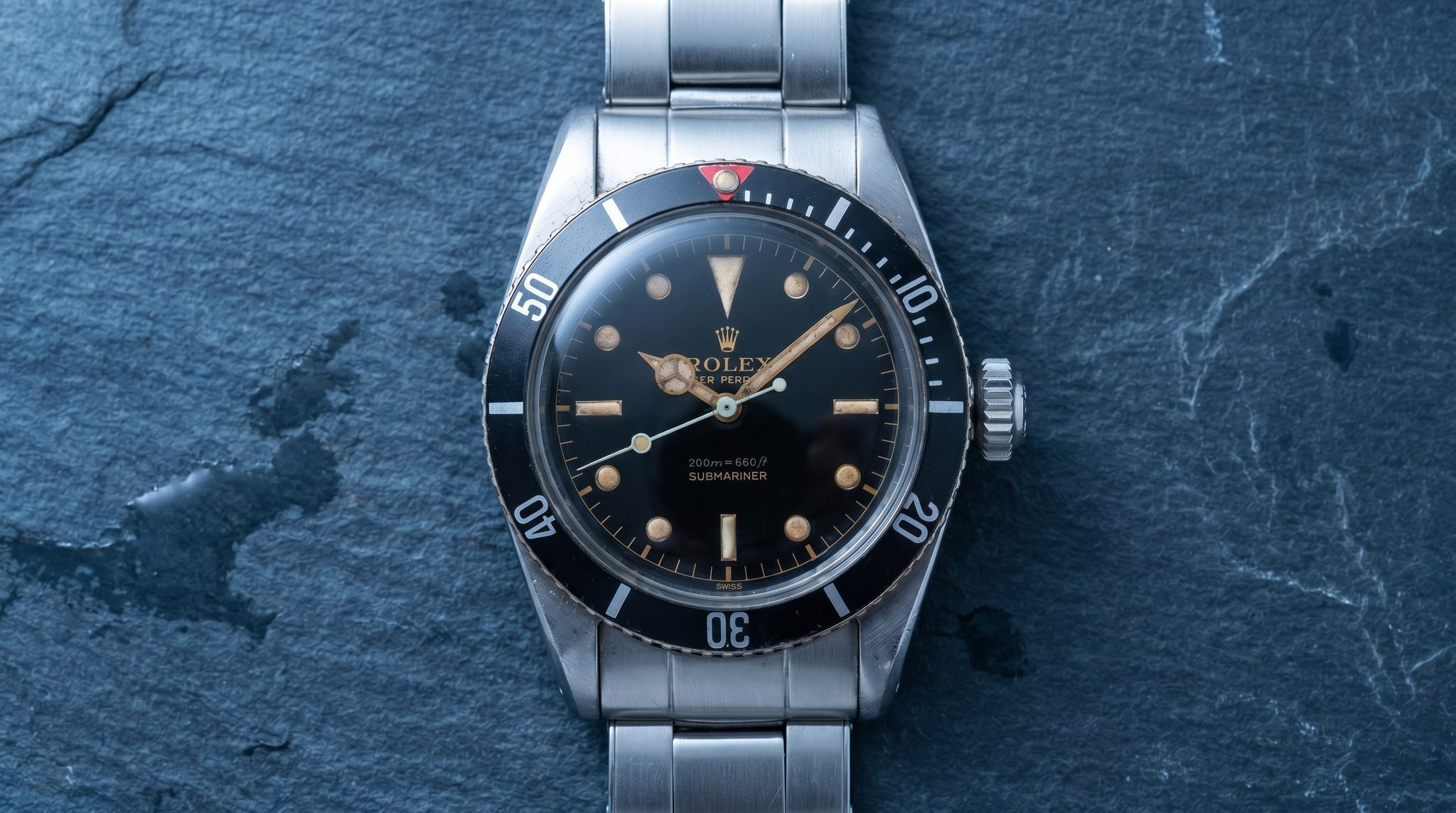
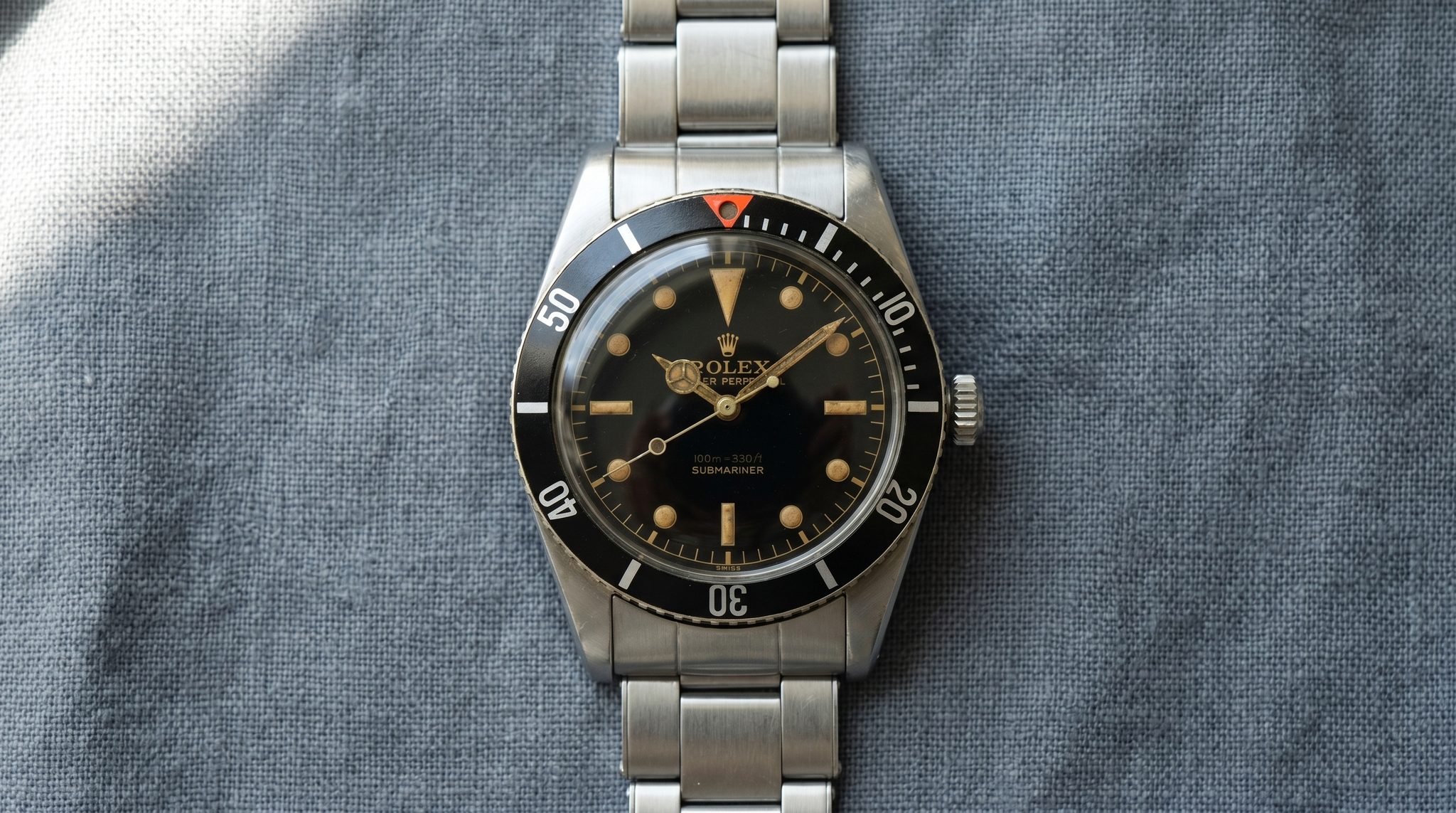
Ref. 5512 frames the 5513 better than any other vintage Submariner because the watches share the same basic no-date, crown-guard format, while diverging in certification and the dial text that often follows from it. At the other end of the story, ref. 14060 picks up the same no-date Submariner idea after 5513 production ends, carrying it into the sapphire-crystal era. A pre-guard reference like 6538 provides the useful reminder of what the Submariner looked like before the 5512 and 5513 architecture settled.
This reference 5513 Rolex · focal 1962–1989 | ||||
|---|---|---|---|---|
| Production | c. 1955–1959 | c. 1959–1978 | 1962–1989 | c. 1990–1999 |
| Movement | Cal. 1030 | Cal. 1530 → 1560/1570 | Cal. 1530, then 1520 | Cal. 3000 |
| Case | Stainless steel | Stainless steel | Stainless steel | Stainless steel |
| Chronometer | Offered (2- vs 4-line) | Yes (most); early no | No | No |
| Crown guards | No | Yes | Yes | Yes |
Six dial generations across the run
Early Submariner 5513s can appear with glossy black gilt dials, lacquer that reflects like wet ink, with gilt printing that looks golden rather than white. In this family, the strongest visual cue is the finish itself: gloss plus gilt print, before the later matte tool-watch look takes over.
The lume story inside early gilt production is not a single clean switch, and the most reliable tells are the markings and the specific dial types. Christie’s documents radium-lumed examples, including “exclamation” dials. Phillips places a broader luminous-signature change from 1964 onward, stating that new regulations mandated changes in luminous material and that the earlier “Swiss”-only indication was replaced by tritium signatures such as “SWISS T<25.”
Two gilt-era subtypes are especially easy to spot from the dial side. “Chapter-ring” gilt dials show a connected outer minute track, a complete circle near the edge. Phillips places the connected-track style among the earliest gilt-gloss executions, produced until roughly 1963–1964 in its broader discussion of gilt and gloss dials. “Underline” dials add a small horizontal line beneath a line of text; Hodinkee treats underline dials across Rolex sports watches as a transitional marker often discussed in connection with the radium-to-tritium era, while noting that Rolex never publicly confirmed a single official meaning.
What to check before buying a 5513
Buying a Submariner 5513 is rarely about finding the reference and more often about finding a coherent example. The watch’s 1962–1989 span means many pieces lived long service lives, and service can replace the very parts collectors use to date the watch, especially dials and hands.
The safest purchases are the ones that make sense without forcing them to. Acrylic crystals and aluminum bezel inserts are consistent with the 5513’s era, and Bob’s Watches notes that period-correct inserts often show natural fading or “ghosting,” which many collectors prefer to a crisp modern service insert. The dial, hands, and bezel should look like they have aged together.
There is also a reason not to lean on any single line of dial text. Ref. 5513 is generally non-chronometer, yet Christie’s catalogued a 1964 watch described as ref. 5513 with chronometer wording and a calibre 1570, presented as a transitional version. Living with a good 5513 is therefore less about winning an argument online and more about owning a watch whose visible details agree, day after day, on the wrist.
Rolex Submariner 5513 for sale
Indicative market value from recent dealer, auction, and Grey Market sales: median ≈ $11,500, with a typical $8,500–$15,000 range across 616 comparable sales (updated this week).
Each point is a recent dealer or auction sale, banded to an indicative figure. The range shown is not a valuation.
Adjacent in the Submariner family
Common questions about the 5513
The Submariner 5513 production years are commonly given as 1962–1989, and Sotheby’s and Christie’s both date ref. 5513 to that span.
- How To Buy A Vintage Rolex Submariner Ref. 5513hodinkee.com
- Sotheby’s overview dating Submariner ref. 5513 production to 1962–1989sothebys.com
- Christie’s lot note dating Submariner ref. 5513 production through 1989christies.com
Show 19 more
- History of the Rolex Submariner, Part 2 (55xx and 1680 references)monochrome-watches.com
- Sotheby’s catalog entry listing 40 mm diameter for ref. 5513sothebys.com
- Sotheby’s lot note referencing an early Submariner 5513 with calibre 1530 (circa 1962)sothebys.com
- Phillips auction catalog PDF describing a ref. 5513 circa 1963 with cal. 1530 and caseback stampdist.phillips.com
- Sotheby’s listing describing a ref. 5513 circa 1967 with cal. 1520 (meters-first)sothebys.com
- Sotheby’s note on meters-first and feet-first overlap (late 1968 to early 1970)sothebys.com
- Christie’s lot describing a 1964 watch catalogued as ref. 5513 with chronometer text and cal. 1570 (transitional example)christies.com
- Christie’s lot describing an exclamation dial 5513 and radium contextchristies.com
- A look in the mirror: admiring the gilt slash gloss dial (chapter-ring and SWISS T<25 context)phillips.com
- Rolex Submariner Reference Points (underline-dial context and transitional discussion)hodinkee.com
- Explaining the “Bart Simpson” Rolex Submariner (coronet style context)hodinkee.com
- Christie’s lot describing a circa 1966 5513 with “Bart Simpson” crown emblemchristies.com
- Everything You Need to Know About the Rolex Submariner Maxi Dial 5513revolutionwatch.com
- Hodinkee Shop listing describing five Maxi dial variations (Marks I–V)shop.hodinkee.com
- Hodinkee Shop listing placing the matte-to-glossy WGS change around 1984shop.hodinkee.com
- Collecting Rolex Submariner ref. 5513 (service parts and originality guidance)bobswatches.com
- Vintage Submariners reference 5512 and 5513 (acrylic crystal throughout 5513)bobswatches.com
- The Rolex Submariner Buying Guide for Pre-Owned Collectors (refinished-dial warning)wpbwatchco.com
- WatchCharts overview for Rolex Submariner 5513 market price benchmarkwatchcharts.com