

Rolex Oyster Perpetual 1500
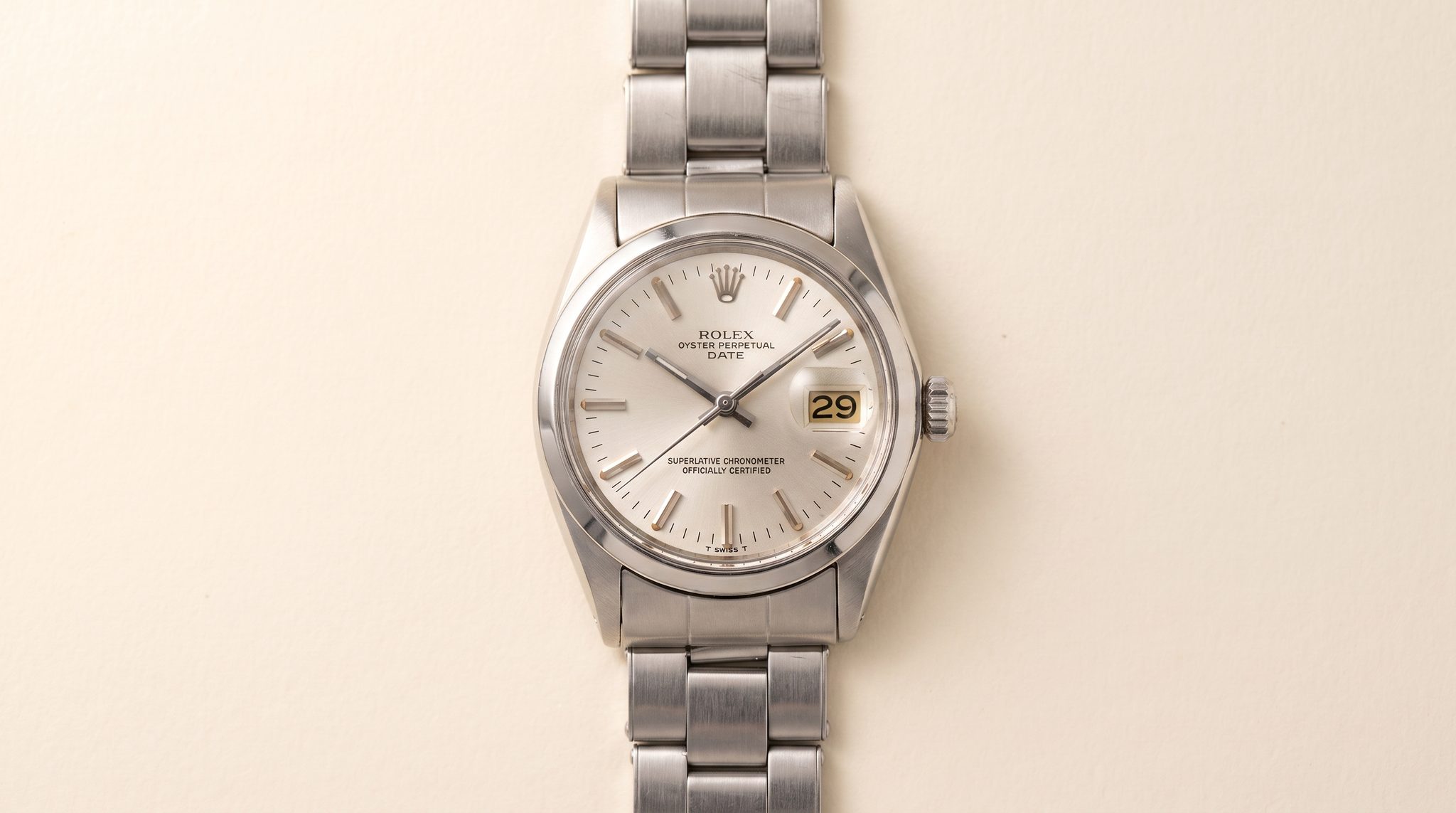
The Rolex Oyster Perpetual Date 1500 is the long-running 34 mm Rolex that stayed physically simple while quietly evolving underneath and on the dial, making originality a matter of matching independent, overlapping eras.
- Production
- c. 1962–1983
- Case
- Stainless steel
- Diameter
- 34 mm
- Thickness
- ~10.5 mm
- Lug width
- 19 mm
- Bezel
- Smooth, fixed
- Crystal
- Acrylic, Cyclops
- Water res.
- 100 m
- Movement
- Cal. 1565 → 1575
- Chronometer
- COSC
- Lume
- Radium → Tritium
- Functions
- Time, date
The Rolex Oyster Perpetual 1500 was produced from about 1962 to 1983.
- Production years
- c. 1962–1983
- Replaced by
- 15000
- Movement
- Cal. 1565 → 1575
The Rolex Oyster Perpetual Date 1500 is the kind of “plain” Rolex that becomes a document of Rolex’s own mid-century fine-tuning. Its headline is almost stubbornly consistent, a 34 mm stainless-steel Oyster case with a smooth bezel and an acrylic Cyclops, yet the mechanics and the dials move on their own schedules, overlapping instead of marching neatly from one generation to the next.
The most repeatable proof is the movement arc: ref. 1500 begins with the Cal. 1565 and, from 1965, shifts to the faster Cal. 1575, with hacking seconds arriving around 1972. That evolution matters because it is a built-in reminder that a 1500 cannot be “dated” by one feature alone. A mid-1960s-looking dial can sit over either calibre around the handoff years, and later dials can appear before or after the stop-seconds upgrade.
What stays constant is what you feel on the wrist. At 34 mm and roughly 10.5 mm thick, the 1500 wears slim and compact, closer in presence to vintage Oyster Perpetual and Air-King sized watches than to a 36 mm Datejust. From there, the fun is in the surface: sunburst silver and black dials make up much of the production, but the reference is also seen with textured blue “mosaic” dials around the early 1970s and with occasional crest or emblem dials, including documented UAE armed forces examples.
“One reference number, one steady 34 mm case, but multiple overlapping eras of movement and dial that reward careful, trait-by-trait originality.”
Rolex Oyster Perpetual 1500 production years: c. 1962–1983
Ref. 1500 sits in Rolex’s 34 mm Date line at a moment when the company was standardizing the “small Date” concept into a long-lived, serviceable format. The reference emerges with the 15xx Date generation that follows the earlier 65xx family, and it keeps its identity straightforward: a steel Oyster case with a smooth bezel and an acrylic crystal with a Cyclops magnifier.
The clearest, documented change is mechanical. The early movement is the Cal. 1565, beating at 18,000 vph, and in 1965 it gives way to the Cal. 1575 at 19,800 vph, a higher-frequency evolution intended to improve stability and timekeeping. Both calibres share the family’s modernized date mechanism, which uses a cam and jewel system designed for an instantaneous date change rather than a slow rollover across hours. In about 1972, the 1575 line adds hacking seconds, a practical upgrade that finally lets the wearer set the watch to the second.
Cosmetic evolution is less codified. Unlike many Rolex sport references, the 1500 does not have a tightly published “mark” progression for its dials, and Rolex did not document precise cutover years for small details such as luminous text signatures. What is consistently observable is that the 1500’s long run accommodates a broad dial palette, from common silver and black to more distinctive textures, and even special emblem deliveries.
The zoomed-out view is that the 1500’s reputation for simplicity is earned by the case, not by a frozen specification. Over roughly two decades, Rolex changed the engine, then changed how precisely you could set it, while offering dials that range from everyday sunburst finishes to the kind of special-order crests that usually get associated with more “important” models. The result is a reference where the best examples look assembled by time, with a dial, hands, lume, and movement that make sense together even when their timelines overlap.
- c. 1962Introduced1500 engraved between lugs
- 1965Movement updateMovement bridge stamped 1575
- c. 1972Hacking addedSeconds stops when crown pulled
- c. 1971Mosaic dialsBlue dial with mosaic texture
- 1975 – 1977Family outlier1530 between lugs (not 1500)
- c. 1983End of runLate serials, Cal. 1575
1500 against its neighbours
The ref. 1500 is easiest to understand when framed by its closest neighbors: the 1501 as the same 34 mm Date idea with a different bezel treatment, and the 15000 as the successor generation where the defining change is not the case size but the move to a high-beat, quickset movement. Together they show what the 1500 really represents: the last long stretch of the “small Date” before quickset and the later 1980s update cycle took over.
1501 Nearest sibling (bezel) 1960s–1970s | This reference 1500 Rolex · focal c. 1962–1983 | ||
|---|---|---|---|
| Production | 1960s–1970s | c. 1962–1983 | c. 1977–1989 |
| Diameter | 34 mm | 34 mm | 34 mm |
| Bezel | Engine-turned | Smooth, fixed | Smooth, fixed |
| Crystal | Acrylic, Cyclops | Acrylic, Cyclops | Acrylic or sapphire |
| Water res. | 100 m | 100 m | – |
| Movement | Cal. 1565/1575 | Cal. 1565 → 1575 | Cal. 3035 |
| Chronometer | COSC | COSC | COSC |
| Lug width | 19 mm | 19 mm | 19 mm |
| Functions | Time, date | Time, date | Time, date |
| Case | Stainless steel | Stainless steel | Stainless steel |
Eight dial generations across the run
The earliest ref. 1500s are defined internally by the Cal. 1565. It is a chronometer-rated automatic from Rolex’s “1500 family,” beating at 18,000 vph, and it carries the modernized date mechanism Rolex introduced in this generation, a cam and jewel system designed for an instantaneous date change rather than a slow drift across hours. Because the calibre sits behind a closed caseback, the practical takeaway is not that the dial must look a certain way, but that early-1960s cases can legitimately pair with more than one dial execution as Rolex’s dial supply and luminous markings evolved.
What to check before buying a 1500
Buying a Rolex 1500 is less about hunting a single “correct” configuration and more about refusing mismatched parts that did not live their decades together. The reference’s long run, plus the documented movement handoffs in 1965 and around 1972, means legitimate overlap is normal. What hurts value is incoherence.
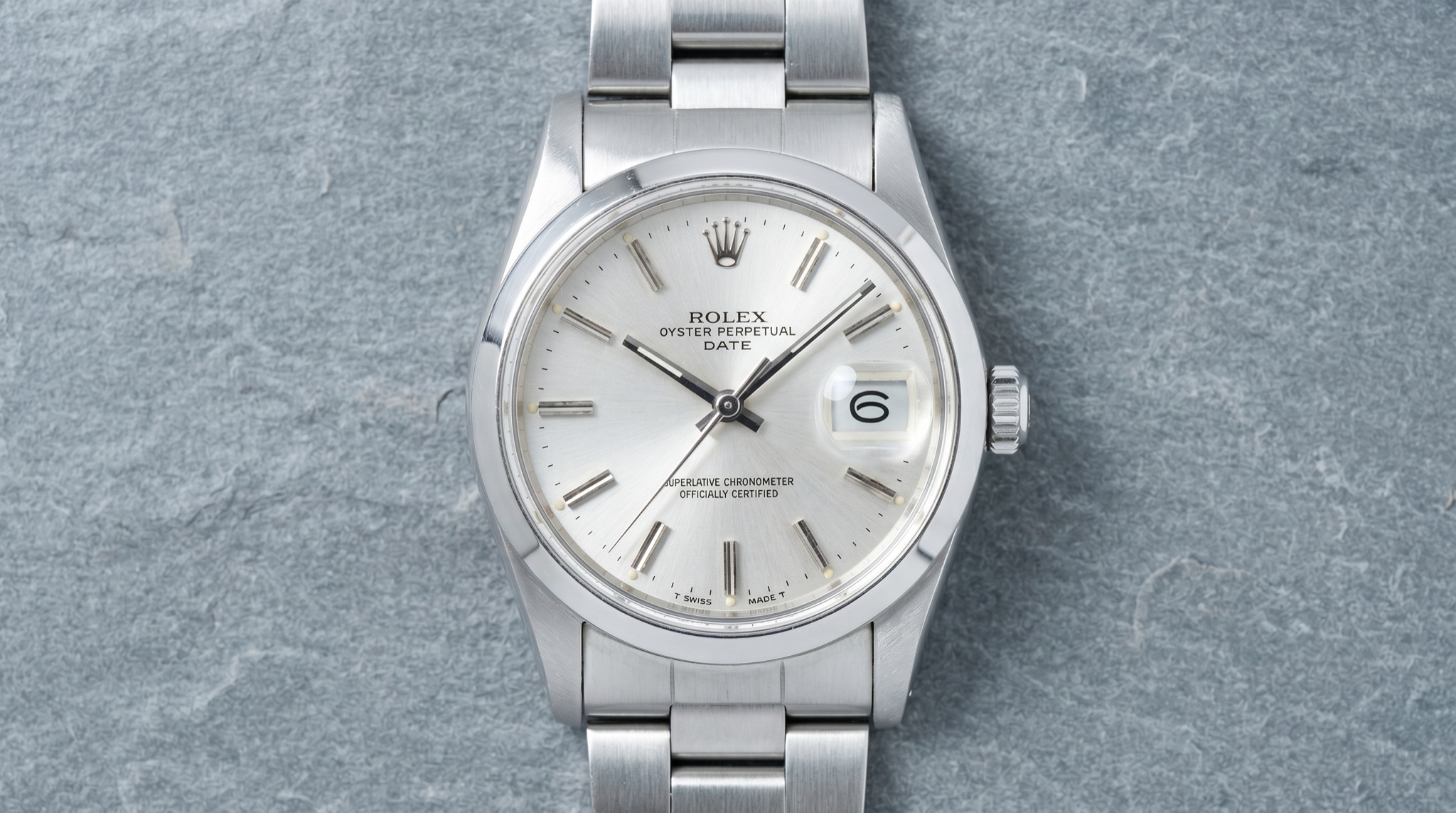
Start with the fixed points that define a true ref. 1500: a 34 mm steel Oyster case with a smooth bezel, and an acrylic Cyclops crystal. From there, let the dial tell its own story. The small signatures at 6 o’clock are the most informative details available in listings: “SWISS,” “SWISS T < 25,” “T SWISS T,” and sigma markings such as “σ T SWISS T σ.” None gives an exact year for this reference, but each is evidence about luminous era and dial type.
Finally, treat the movement as the tie-breaker. A Cal. 1565 is consistent with early examples, while a Cal. 1575 is expected from 1965 onward, with hacking seconds arriving around 1972. Because service history and parts replacement are common on vintage Rolex, the best purchases tend to be the ones that feel honest rather than pristine: a dial with intact printing and even patina, hands that age in the same color as the plots, and a case that still shows the Oyster lines instead of rounded polishing.
Rolex Oyster Perpetual 1500 price and value
A Rolex Oyster Perpetual 1500 sells for about $3,200 at the median, typically $2,600 to $3,900 across 370 comparable sales.
Rolex Oyster Perpetual 1500 for sale
Indicative figures from recent dealer, auction, and Grey Market sales (updated this week). Every watch is verified before it sells here.
Each point is a recent dealer or auction sale, banded to an indicative figure. The range shown is not a valuation.
Adjacent in the Oyster Perpetual family
Stories that discuss the 1500
Common questions about the 1500
For the Rolex Oyster Perpetual Date ref. 1500, the best supported range from the available published references is approximately 1962–1983, with many observed examples concentrated in the 1960s and 1970s and late production often cited to about 1983.
- Rolex Date 1500 Review: A Deep Dive into Its Design and Legacybobswatches.com
- Review: The Rolex Date ref. 1500beckertime.com
- 1965 Rolex Oyster Perpetual Date Ref. 1500shop.hodinkee.com
Show 7 more
- Rolex Oyster Perpetual Date Ref 1500 Sigma Dialcwwatchshop.com
- A Date with Rolex Oyster Perpetual Dategrayandsons.com
- Rolex Oyster Perpetual Date Ref. 1500 - Blue 'Mosaic' Dialoliverandclarke.com
- Rolex Oyster Perpetual Date 1500 Reviews, Prices & Listingswatchprosite.com
- Oyster Perpetual Date - Ref. Rolex - 1500collectorsquare.com
- Rolex Oyster Perpetual Date ref. 1500 - Black dial (V I) - Steel braceletdebonarwatches.com
- One-on-One Rolex Review: Vintage Date or Modern...youtube.com