

Rolex GMT-Master 1675
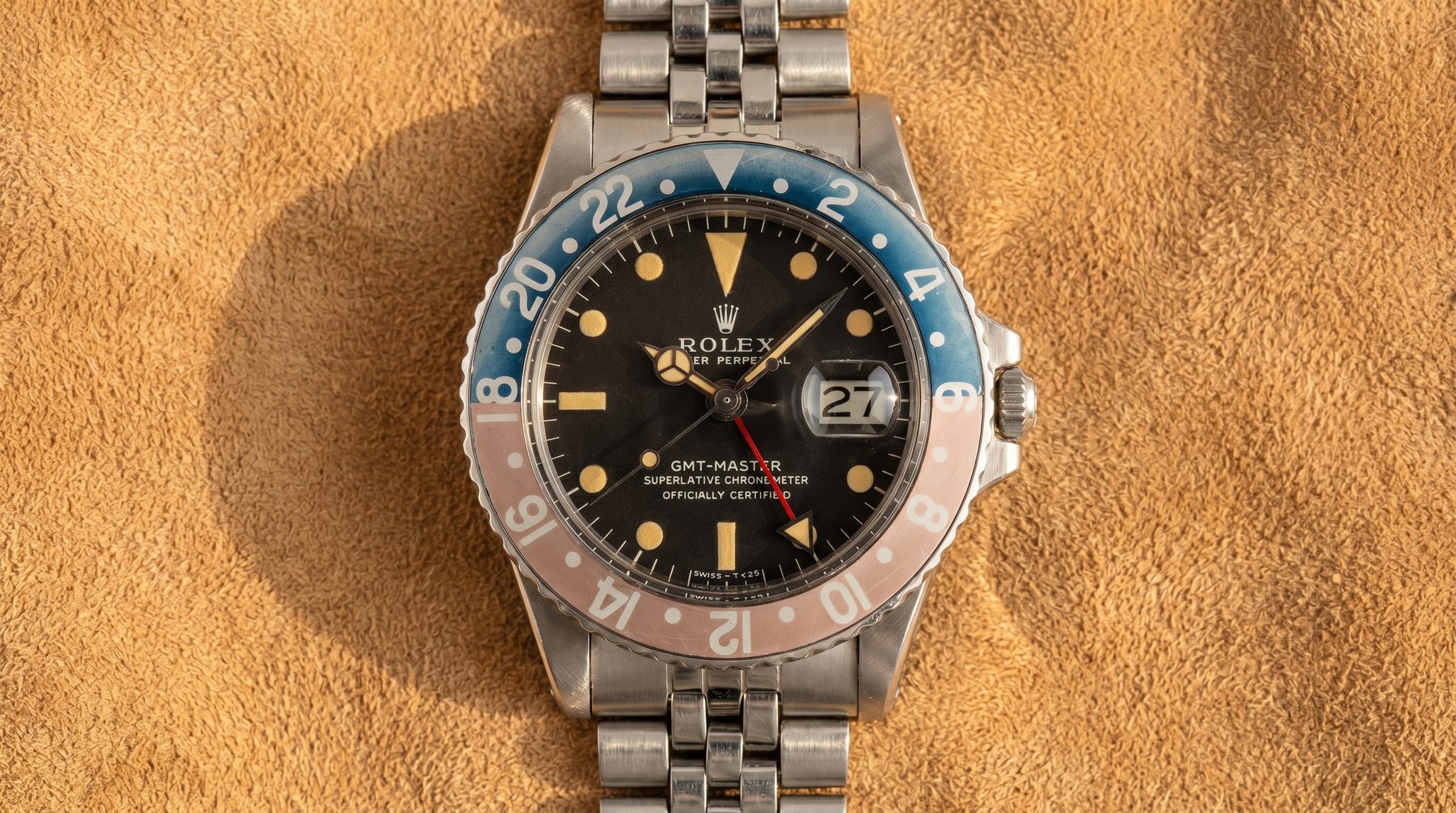
Rolex’s GMT-Master 1675 is the reference that locked the GMT into its modern shape, then stayed in the catalog long enough that originality is judged by whether dozens of small parts belong together.
- Production
- c. 1959–1980
- Case
- Stainless steel
- Diameter
- 40 mm
- Bezel
- Bidirectional 24h
- Insert
- Aluminum (Pepsi/black)
- Crystal
- Acrylic (Tropic 127)
- Water res.
- 50 m / 165 ft
- Dial
- Gloss gilt → matte
- Movement
- Cal. 1565 → 1575
- Date
- Non-quickset
- Chronometer
- Dial: “Superlative…”
The Rolex GMT-Master 1675 was produced from about 1959 to 1980.
The Rolex GMT-Master 1675 is the GMT that stopped being an experiment and became the template. No GMT-Master reference before or since has run as long, roughly 1959 to 1980, and the distance shows: the watch Rolex sold in 1959 and the one it sold in 1979 share a reference number but read like different generations. That is why the 1675 is collected as a series of eras rather than a single “correct” configuration.
Rolex replaced the earlier GMT-Master ref. 6542 in 1959, enlarging the case from 38 mm to 40 mm and adding crown guards, and it moved the model to an aluminum 24-hour bezel insert. Inside, the reference spans Rolex’s 15xx GMT movements, anchored in mainstream accounts by caliber 1565 early and caliber 1575 later, with the date remaining non-quickset throughout.
What makes the 1675 uniquely legible in hand is that the changes are visible. Early watches carry glossy black gilt dials whose gold-toned printing seems to sit under lacquer; later ones switch to matte dials with a flatter, more utilitarian surface. Bezel inserts can be the familiar red and blue “Pepsi” or all-black, and a few narrow, celebrated insert stories exist on their own separate timelines. Because the 1675 was serviced for decades and many parts interchange cleanly, the reference rewards an evidence-based idea of originality: the strongest watches look like they were assembled by time, not assembled later.
“The ref. 1675 is the stabilized GMT-Master template, and its long production run is why every dial, insert, and movement-era detail has to agree.”
Rolex GMT-Master 1675 production years: c. 1959–1980
Ref. 1675 arrives in 1959 as the next, more settled chapter after the short-lived ref. 6542: the case grows to 40 mm and gains crown guards, and the 24-hour bezel insert is aluminum rather than the earlier Bakelite format. The sources document what changed, but Rolex did not publish a rationale for the material and case updates.
The reference then becomes a study in overlapping component eras. The clearest dividing line is the dial surface itself: glossy gilt dials dominate the early years, then give way around c. 1966–1967 to matte dials that carry the model through the 1970s. Mechanically, mainstream accounts place caliber 1565 in earlier production and caliber 1575 later, with the date remaining non-quickset throughout and the second time zone read in the classic GMT-Master way, via the 24-hour hand against the rotating bezel.
The 1675 is often spoken of as a fixed archetype, yet it was still being refined in plain sight for decades. That is why “c. 1959–1980” is only the beginning of identification, and why the end of the reference feels like a transition rather than a hard stop, with late 1675s overlapping the early life of the quickset-date successor, the ref. 16750.
- 1959Introduced40 mm, guarded crown
- 1959Insert changeAluminum 24h insert
- c. 1965Movement shiftMovement confirmed inside
- c. 1966 – 1967Dial shiftGloss lacquer vs matte print
- c. 1980Transition16750 has quickset date
1675 against its neighbours
The 1675 makes the most sense when it is bracketed by the two references that define its “before” and “after.” The ref. 6542 shows the original GMT-Master idea in a smaller, crown-guardless case with a Bakelite-era bezel. The ref. 16750 shows how Rolex modernized the same basic look with a quickset-date, higher-beat movement. Between them, the 1675 is the long middle, the stable platform that turned tiny dial and insert differences into the real story.
This reference 1675 Rolex · focal c. 1959–1980 | ||||
|---|---|---|---|---|
| Production | c. 1954–1959 | c. 1959–1980 | Mainly 1970s | c. 1979/80–1988 |
| Diameter | 38 mm | 40 mm | 40 mm | 40 mm |
| Case | Stainless steel | Stainless steel | Steel + yellow gold | Stainless steel |
| Crystal | Acrylic | Acrylic (Tropic 127) | Acrylic | Acrylic |
| Water res. | 50 m | 50 m / 165 ft | 50 m / 165 ft | 100 m |
| Bezel | 24h (Bakelite) | Bidirectional 24h | Bidirectional 24h | Bidirectional 24h |
| Movement | Cal. 1036/1065/1066 | Cal. 1565 → 1575 | Cal. 1575 | Cal. 3075 |
| Date | Non-quickset | Non-quickset | Non-quickset | Quickset |
| Dial | Glossy gilt | Gloss gilt → matte | Brown/black, applied | Matte → gloss (WG) |
Six dial generations across the run
Early ref. 1675 dials are glossy and gilt, a look defined less by color than by optics. Under light the black surface behaves like lacquer, and the printing reads warm, gold-toned, as if it sits beneath the gloss rather than on top of it. This is the dial family most closely associated with the reference’s first years, and most sources place its end around 1966–1967, without a published hard cutoff.
Several traits people talk about as separate “types” actually live inside this one glossy-gilt umbrella. Some early glossy dials show a printed chapter ring near the minute track while others do not, and collectors also describe a set of “type 0–3” layouts based on small changes in gilt-era text arrangement. These are worth treating as independent tells rather than as a single early-period package, because two watches can share the same glossy finish but differ in layout details that point to different early batches.
What to check before buying a 1675
A Rolex GMT-Master 1675 for sale is rarely a question of whether the watch is recognizable. The harder question is whether it is internally consistent. The reference lived long enough that Rolex made real running changes, and it also lived long enough that routine servicing could replace dials, hands, and inserts with parts from later eras.
The value ladder follows that same structure. Early glossy gilt dials, very early OCC text, scarce matte executions like the Mark 3 radial dial, and rare inserts such as the fuchsia Pepsi are all documented premium drivers, and they are also the parts most worth swapping into an otherwise ordinary watch. The cleanest purchases are usually the ones that make a modest claim and prove it with a coherent set of components.
Owning a strong 1675 is, in practice, living with an old-tool watch that still does its job the old way: an acrylic crystal with cyclops over a non-quickset date, and a second time zone read from a rotating 24-hour bezel. What survives best is not perfection but honesty, a case that still shows its original lines and a dial that has aged in step with the hands.
Rolex GMT-Master 1675 price and value
A Rolex GMT-Master 1675 sells for about $14,500 at the median, typically $9,900 to $21,000 across 689 comparable sales.
Rolex GMT-Master 1675 for sale
Indicative figures from recent dealer, auction, and Grey Market sales (updated this week). Every watch is verified before it sells here.
Each point is a recent dealer or auction sale, banded to an indicative figure. The range shown is not a valuation.
What a 1675 has sold for here
One 1675 has sold on Grey Market, verified before it shipped.
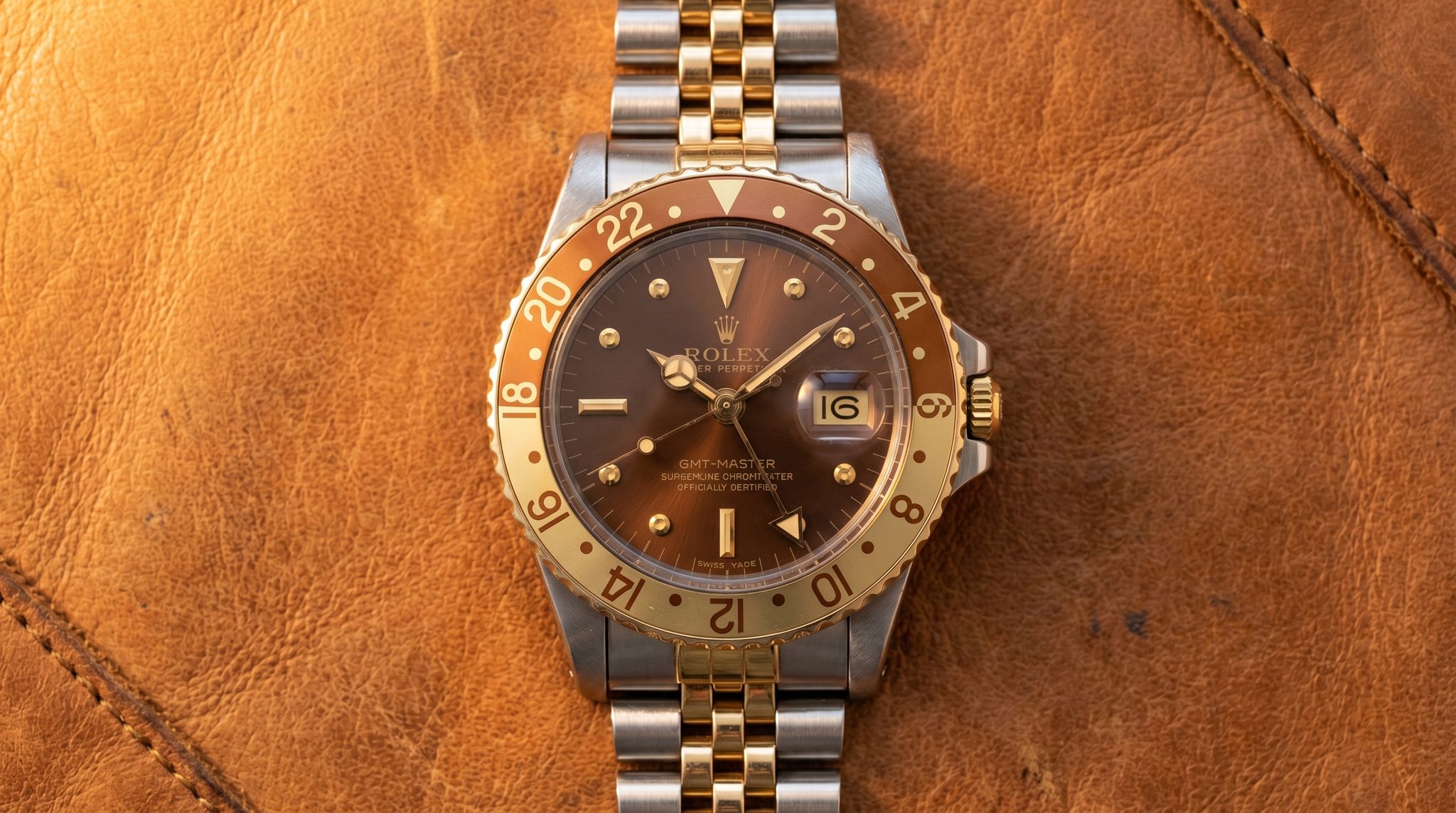
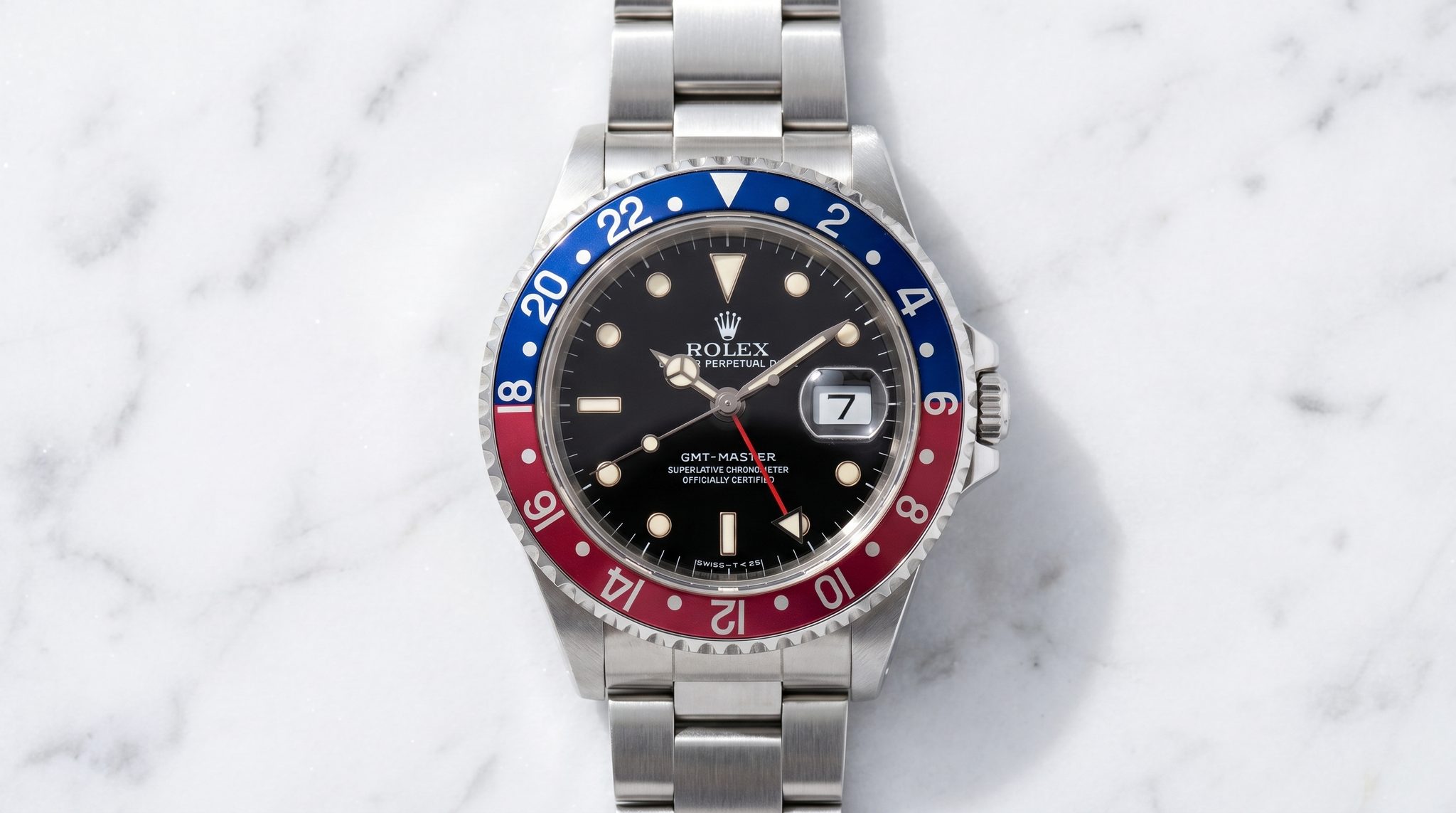
Adjacent in the GMT-Master family
Stories that discuss the 1675
Common questions about the 1675
Specialist writing consistently places the GMT-Master 1675 from 1959 to around 1980. Rolex did not publish a single precise cutoff, and late 1675 production overlaps the introduction of the successor ref. 16750, so the endpoint is best treated as circa 1980.
- Reference Points: Understanding The Rolex GMT-Masterhodinkee.com
- Collector's Guide: The Rolex GMT-Master Reference 1675 in Steelwindvintage.com
- The History and Evolution of the Rolex GMT-Mastergrayandsons.com
Show 7 more
- Rolex 1675 Review: A Collector's Guide on a Classic GMT-Masterbobswatches.com
- Bob's Watches - Vintage Rolex GMT Master 1675 (YouTube)youtube.com
- History & Ephemera - Rolex GMT Master 1675gmtmaster1675.com
- Rolex GMT-Master 1675 | Ref. 1675 Watches on Chrono24chrono24.com
- The Reference 1675 Rolex GMT-Mastercraftandtailored.com
- A Guide to the Rolex GMT-Master and GMT-Master IIanalogshift.com
- Vintage Rolex GMT Master 1675 Fuscia Dial 1968 - Precision Watchesprecisionwatches.com