

Vacheron Constantin
Vacheron Constantin is the rare major house whose identity is built less on one blockbuster model than on continuity, finishing, and historically anchored design choices.
Vacheron Constantin is the watchmaker that turned uninterrupted continuity into a collector value in its own right, not by leaning on one defining model but by repeatedly proving it can carry high-grade watchmaking across centuries. The claim starts with a concrete document: the maison treats Jean-Marc Vacheron’s 1755 apprenticeship contract in Geneva as its “birth certificate,” because it is the earliest surviving record of the workshop.
From a collector’s perspective, the brand’s appeal is an unusual three-part overlap. First, it is early: specialist histories and mainstream references alike emphasize how far back the paper trail runs, and how much of Swiss watchmaking’s development sits within that span. Second, it is technically consequential, with milestones commonly cited in collector histories ranging from mid-19th century industrialization under Georges-Auguste Leschot to the ultra-thin Caliber 1003 in 1955. Third, it has remained legible as a house style, even when the watches themselves move between categories, from pocket-watch era craft to modern sport-luxury.
That continuity shows up in how Vacheron structures its modern collections. The brand’s current families are deliberately separated by intent and design language: Overseas for integrated-bracelet sport wear, Patrimony for restrained mid-century-inspired dress minimalism, Traditionnelle for classical Geneva haute horlogerie codes and complications, Historiques for archival reinterpretations tied to specific historic designs, Fiftysix as a more accessible contemporary line with heritage cues, Égérie as the dedicated women’s collection with couture-linked textures and asymmetrical displays, and Métiers d’Art as the showcase for decorative crafts such as enamel and engraving. The families are not subtle variants of one theme, they are the brand’s way of keeping “Vacheron Constantin” coherent while serving very different collector use cases.
The vintage market logic follows the same pattern. For much of the 20th century, the brand’s reputation was strongest among specialists, supported by rarity, complications, and finishing rather than broad mass visibility. After Vacheron Constantin joined Richemont in the 1990s, its international profile and collection coherence strengthened, and later scholarship and auction cataloging made originality and documentation more central to what the market rewards. In practice, the most durable drivers of collector interest are provenance and paper trail, correctness of dial and signatures, technical content (especially complications and ultra-thin work), and the degree to which a watch sits on a clearly documented branch of the brand’s design history.
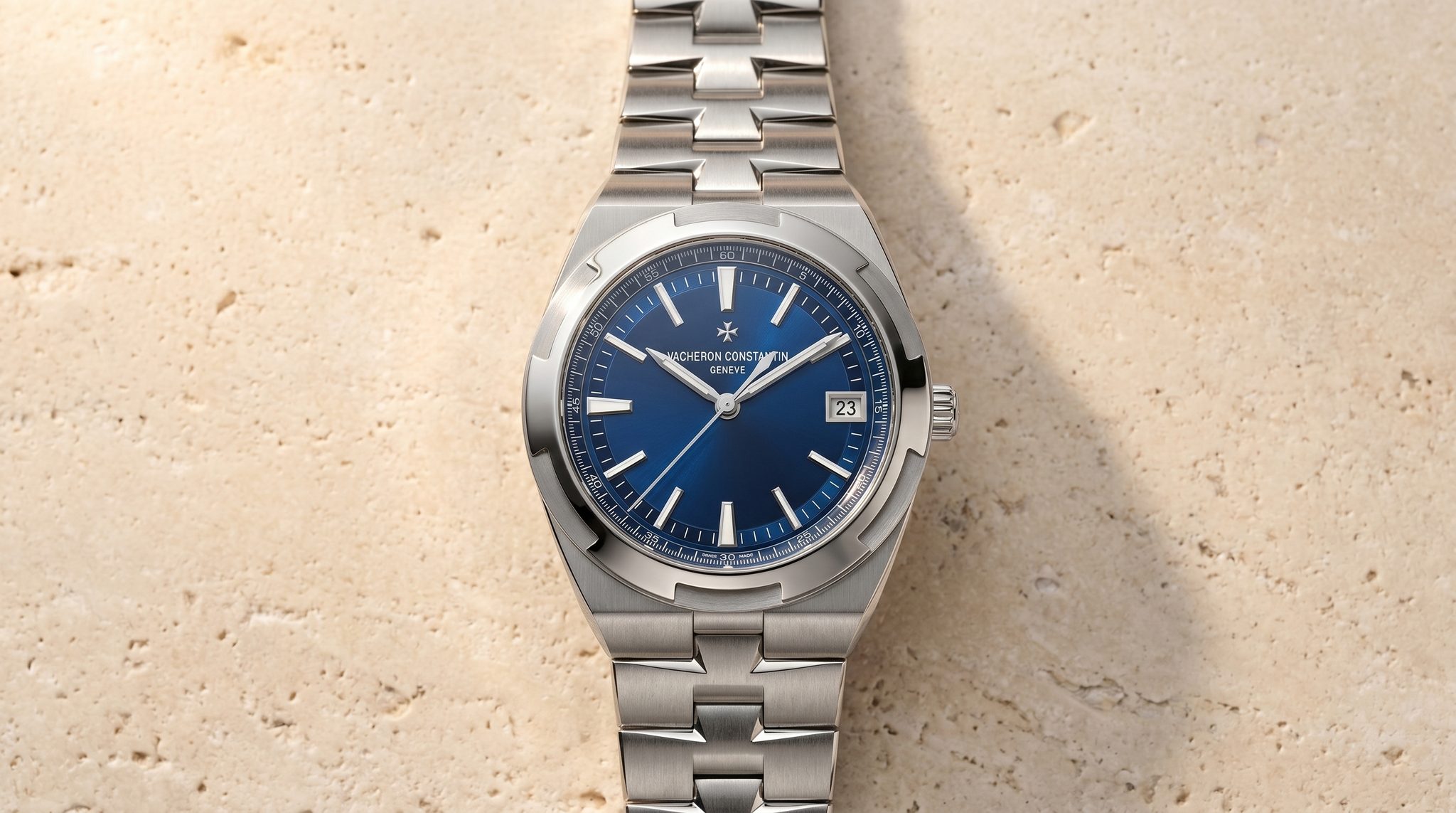
In the modern era, that same continuity has had a new consequence: where broader collector demand has favored steel sport watches, Vacheron has been able to translate its finishing and restraint into an Overseas line that competes directly with the category’s established benchmarks. The zoomed-out view is that the brand’s “throughline” is not a single silhouette, it is a habit of making watches that remain defensible, on the page and under a loupe, long after taste cycles move on.
1 references across 1 model families
How Vacheron Constantin reference numbers work
Vacheron Constantin reference numbers come in two broad styles that reflect the brand’s shift from simpler mid-century coding to modular modern SKUs. Older pieces often use short, all-numeric references that primarily identify a model or case design, without openly encoding material, dial, or strap details. Modern references, by contrast, use a segmented alphanumeric structure where the first block identifies the base model line, and later blocks specify execution.
In today’s format, a core block such as 4500V identifies the underlying Overseas design. After that, a slash block commonly indicates the bracelet or strap execution, with examples like /110 for bracelet and /000 for strap in collector and dealer references. A letter following that block is typically used as a material code, with A appearing for steel and R or G used for precious metals in worked examples. A final hyphenated suffix functions as a configuration code, often used to distinguish dial and finish variants. Because a complete factory decoding key is not published as a universal table across all collections, the most reliable approach is to treat the base block as the model anchor and confirm suffix meanings against model-specific documentation or an archival extract.
Where to start with Vacheron Constantin
Collecting Vacheron Constantin tends to reward a different kind of attentiveness than brands whose market is dominated by a few steel staples. The brand’s most important dividing line is intent: Overseas is the contemporary daily-wear sport choice, Patrimony and Traditionnelle are the dress families separated by minimalism versus classical high-horology formality, Historiques is for collectors who want a direct bridge to a specific archival design, Fiftysix is positioned as an accessible on-ramp, and Égérie and Métiers d’Art serve design-led and craft-led niches.
A new collector typically starts with the family that matches how the watch will be used. Buyer and dealer guides most often point first-time buyers to Overseas for a single do-everything watch, to Patrimony for a clean dress baseline, and to Fiftysix for a more casual, lower-entry way into the brand. The market over roughly the mid-2010s to mid-2020s has most strongly rewarded steel sport Vacheron Constantin models, particularly steel Overseas, reflecting the broader luxury-sport boom, and it has also elevated select Historiques reissues that translate specific historical designs into modern ownership. Across both vintage Vacheron Constantin and modern pieces, the consistent premium is paid for documented originality, clear signatures, and watches whose design language ties cleanly to a known chapter of the maison’s history.
Common questions about Vacheron Constantin
Vacheron Constantin traces its origins to 1755 in Geneva, founded by Jean-Marc Vacheron. The brand treats his apprenticeship contract as its “birth certificate,” because it is the earliest known record of the workshop.
- Vacheron Constantin timeline (Maison)vacheron-constantin.com
- Our historical timeline (Heritage)vacheron-constantin.com
- Vacheron Constantin: Understanding the Key Modelssothebys.com
Show 9 more
- Vacheron Constantin (brand overview)thenakedwatchmaker.com
- Vacheron Constantin story and historybachmann-scher.de
- Vacheron Constantin: 260 Years of uninterrupted history (overview)gentlemansgazette.com
- Patrimony collection (brand description)vacheron-constantin.com
- Traditionnelle collection (brand description)vacheron-constantin.com
- Historiques collection (brand description)vacheron-constantin.com
- Chrono24 buyer’s guide to the Vacheron Constantin Overseaschrono24.com
- A buyer’s guide to pre-owned Vacheron Constantin (market context)europeanwatch.com
- Vacheron Constantin (general history)en.wikipedia.org