

Rolex Submariner 14060
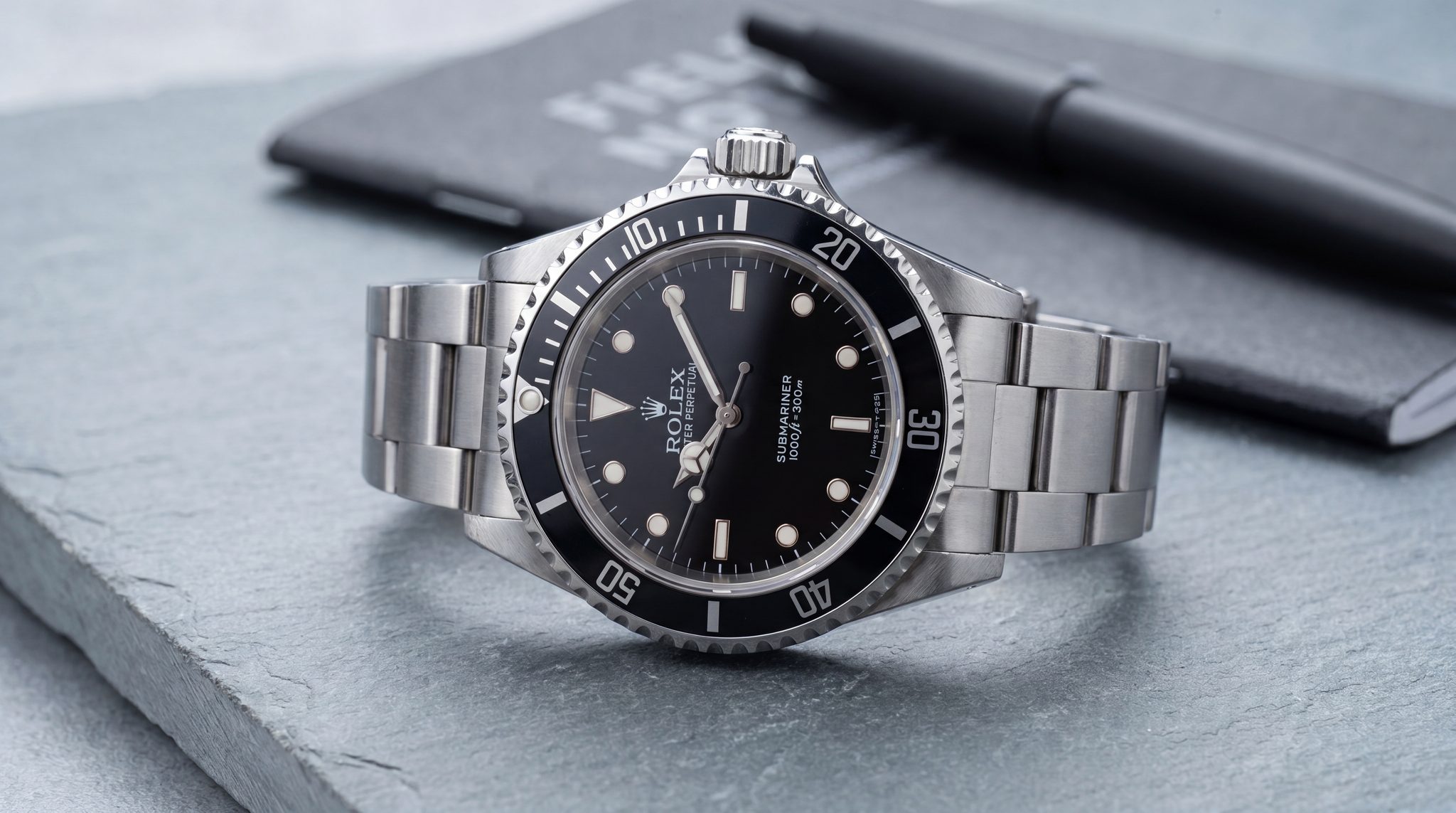
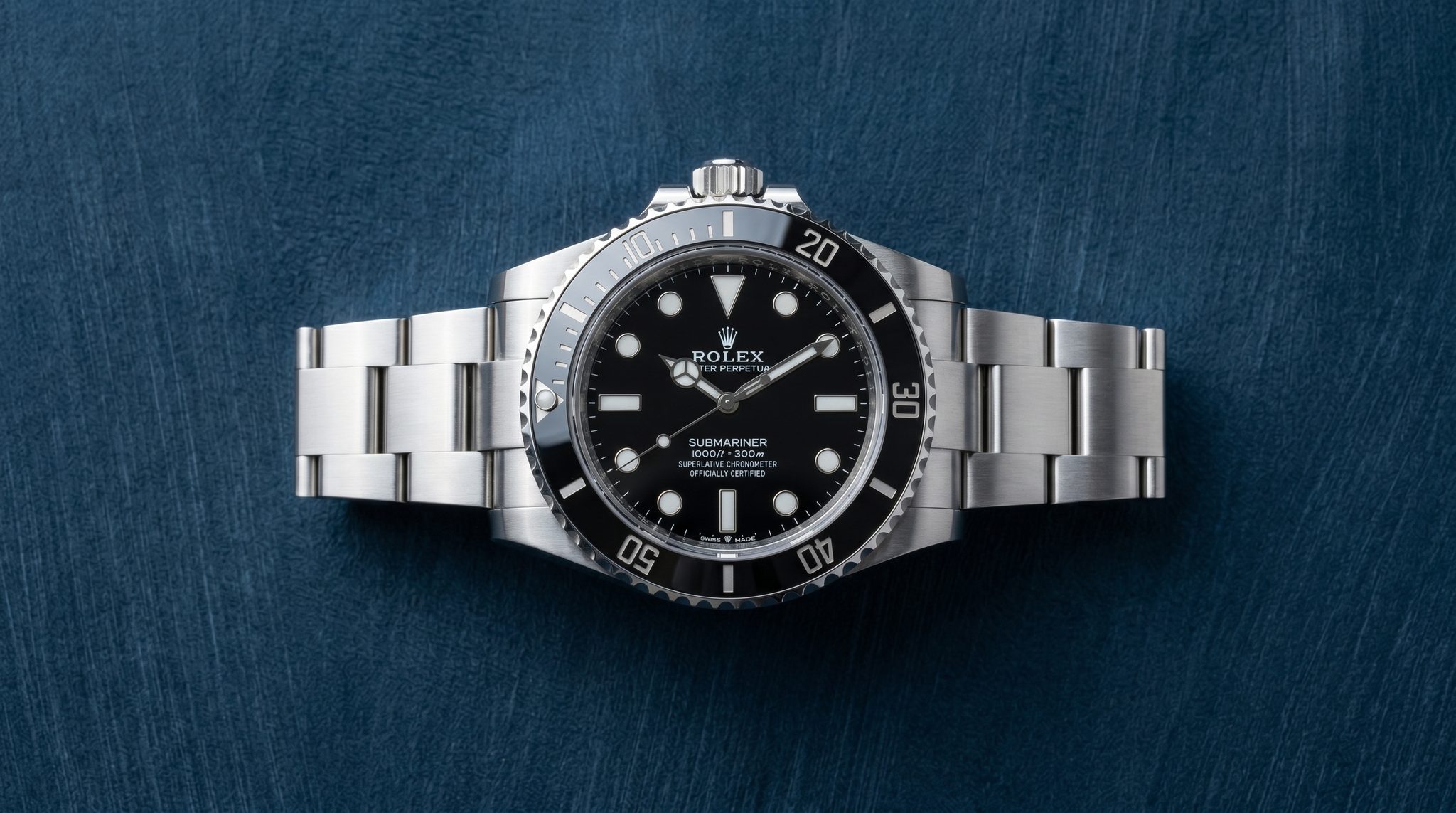
The Rolex Submariner 14060 modernized the no-date Sub with sapphire, 300 m sealing, and Cal. 3000, while keeping the deliberately spare two-line dial.
- Production
- c. 1990–1999
- Case
- 904L stainless steel
- Diameter
- 40 mm
- Thickness
- ~12 mm
- Lug width
- 20 mm
- Lug-to-lug
- ~47.3–48.0 mm
- Bezel
- Unidirectional, aluminum insert
- Crystal
- Flat sapphire
- Water res.
- 300 m / 1,000 ft
- Dial
- Gloss black, two-line
- Movement
- Cal. 3000
- Chronometer
- No
The Rolex Submariner 14060 is the no-date Submariner that made “modern Sub” feel inevitable. It keeps the dial as terse as the earlier non-chronometer models, but it arrives with a flat sapphire crystal and a 300 m (1,000 ft) depth rating, a combination that cleanly separates it from the acrylic-era 5513 it succeeded around 1990.
That mix of restraint and upgrade is the reference’s whole character. The case moves into 904L stainless steel, the movement is the in-house Cal. 3000, and the watch remains firmly time-only: no date window, no magnifier, no chronometer lines. In hand it reads like a familiar Submariner, but the materials and sealing belong to the five-digit era.
The one truly decisive change within the non-M run is small enough to miss at a glance. Early dials carry the tritium signature “SWISS – T<25” at 6 o’clock. Late in the 1990s, a short transitional run appears with “SWISS” only, a dial signature that signals the exit from tritium even though the rest of the watch stays visually consistent.
“Ref. 14060 is the moment the no-date Submariner gained sapphire and 300 m sealing without surrendering its spare two-line dial.”
14060 across c. 1990–1999
Rolex’s own archives for this period are not public, so the Submariner 14060 is dated through specialist consensus and the evidence left on the watches themselves. The best-supported outline is compact: ref. 14060 appears around 1990 as the no-date successor to the 5513, and it is replaced around 1999 by the 14060M. What changes immediately is not the look of the dial, but the construction behind it. The 14060 brings the no-date Submariner into the sapphire-crystal, 300 m era, in a 904L steel case powered by the in-house Cal. 3000.
Rolex then keeps the face steady. Throughout the non-M run the dial remains two-line and non-chronometer, a layout that preserves the watch’s tool-first legibility. The main visible evolution is confined to the tiny print at 6 o’clock. Early examples spell out tritium with “SWISS – T<25.” Late in the 1990s, a short transitional batch is signed “SWISS” only, and the change matters because it is one of the clearest ways to tell where a watch sits relative to the industry-wide move away from tritium lume.
The reference handoff to the 14060M around 1999 is a mechanical decision, not a redesign. The successor continues the same basic external language while updating the movement to Cal. 3130. Later developments commonly discussed under the broader “14060 family,” such as four-line chronometer dials and engraved rehauts, belong to the 14060M era rather than to ref. 14060 itself.
- c. 1990IntroducedFlat sapphire; 300 m text
- c. 1990 – c. 1998Tritium era“SWISS – T<25” at 6
- c. 1998 – 1999Swiss-only“SWISS” only at 6
- c. 199914060M replacesCal. 3130 inside
- 2012Line replacedCeramic bezel generation
14060 against its neighbours
The Submariner 14060 is easiest to understand by looking at the watches that surround it. The 5513 shows what Rolex moved on from: acrylic crystal and an earlier 200 m rating. The 14060M shows how little Rolex felt the need to change once the five-digit formula was established, updating the movement while largely preserving the look. The 114060 marks the next clean break, when the no-date Submariner adopts a ceramic bezel and a heavier case profile.
This reference 14060 Rolex · focal c. 1990–1999 | ||||
|---|---|---|---|---|
| Production | 1962–1989 | c. 1990–1999 | c. 1999–2012 | 2012–2020 |
| Case | Stainless steel | 904L stainless steel | Stainless steel | Stainless steel |
| Diameter | 40 mm | 40 mm | 40 mm | 40 mm |
| Crystal | Acrylic (plexiglass) | Flat sapphire | Flat sapphire | Sapphire |
| Bezel | Unidirectional, aluminum insert | Unidirectional, aluminum insert | Unidirectional, aluminum insert | Cerachrom insert |
| Water res. | 200 m / 660 ft | 300 m / 1,000 ft | 300 m / 1,000 ft | 300 m / 1,000 ft |
| Movement | Cal. 1530, then 1520 | Cal. 3000 | Cal. 3130 | Cal. 3130 |
| Chronometer | No | No | Yes | Yes |
| Dial | Gilt → matte → glossy | Gloss black, two-line | Two-line or four-line | Maxi markers |
| Lume | Radium → tritium | – | Super-LumiNova | Chromalight |
| Bracelet | 9315 or 93150 | – | 93150 Oyster | Solid links, Glidelock |
Two dial generations across the run
Early Submariner 14060 dials announce their era in the smallest possible print. At 6 o’clock, beneath the depth rating and “SUBMARINER” text, the dial is signed “SWISS – T<25.” That line is the tritium declaration, and on a watch that is now decades old it often shows up as a particular kind of surface life: lume that has shifted away from bright white and toward warmer tones, sometimes evenly across dial and hands, sometimes not.
On an original example, the appeal is coherence. The glossy black dial, white-gold marker surrounds, and aluminum bezel insert can look almost unchanged, while the luminous material slowly tells time’s story. The same trait also creates the most common originality trap. A tritium-signed dial paired with unusually fresh, pure-white luminous material, or hands that look like they came from a different watch, is more often evidence of replacement or relume work than a factory outlier.
What to check before buying a 14060
A Submariner 14060 can look deceptively straightforward, but surviving examples often reflect long service lives: dials and hands swapped to newer luminous materials, bezel inserts replaced, and cases polished until their original geometry softens. Because the reference itself stays visually consistent, the most expensive mistakes tend to be quiet ones, a dial that does not belong to the case, hands that do not match the dial, or a “too clean” tritium watch that has actually been rebuilt.
The best purchases are usually the most internally consistent. A tritium “SWISS – T<25” dial with matching hands, or a correct late “SWISS”-only dial that looks like it has lived alongside the rest of the watch, is more persuasive than any single superlative in a listing. Once that coherence is in place, the 14060’s appeal becomes simple: five-digit Submariner proportions, sapphire toughness, and the uncluttered no-date layout that makes the reference feel calm on the wrist even after decades of use.
Rolex Submariner 14060 for sale
Indicative market value from recent dealer, auction, and Grey Market sales: median ≈ $7,200, with a typical $6,200–$8,500 range across 314 comparable sales (updated this week).
Each point is a recent dealer or auction sale, banded to an indicative figure. The range shown is not a valuation.
Adjacent in the Submariner family
Common questions about the 14060
The Rolex Submariner 14060 (non-M, Cal. 3000) is most often dated to approximately 1990–1999, with some accounts allowing a late-1989 introduction. It is generally described as replaced around 1999 by the 14060M.
- The Rolex Submariner Ref. 14060craftandtailored.com
- Rolex Submariner 14060 (52Mondayz, week #17)fratellowatches.com
- Guide to the Rolex Submariner 14060 and 14060Mluxurybazaar.com
Show 9 more
- Rolex Submariner 14060 | Ref. 14060 Watcheschrono24.com
- Rolex 14060 Review: Why This Vintage Submariner Still Shinesbobswatches.com
- Rolex 14060 & 14060M (Submariner) Check Prices & Morewristler.eu
- Rolex Submariner 14060 No-Date Reviewwatchguys.com
- Reference: 14060 (BezelBase wiki)bezelbase.org
- Rolex, Ref. 14060, Submariner, a stainless steel wristwatch (bracelet ref. 93150, end links 501B)sothebys.com
- Rolex (bracelet details recorded in lot description)phillips.com
- Submariner lug width (20 mm) listinganalogshift.com
- Submariner 14060 lug width (20 mm) listingshop.hodinkee.com