

Rolex Explorer II 16570
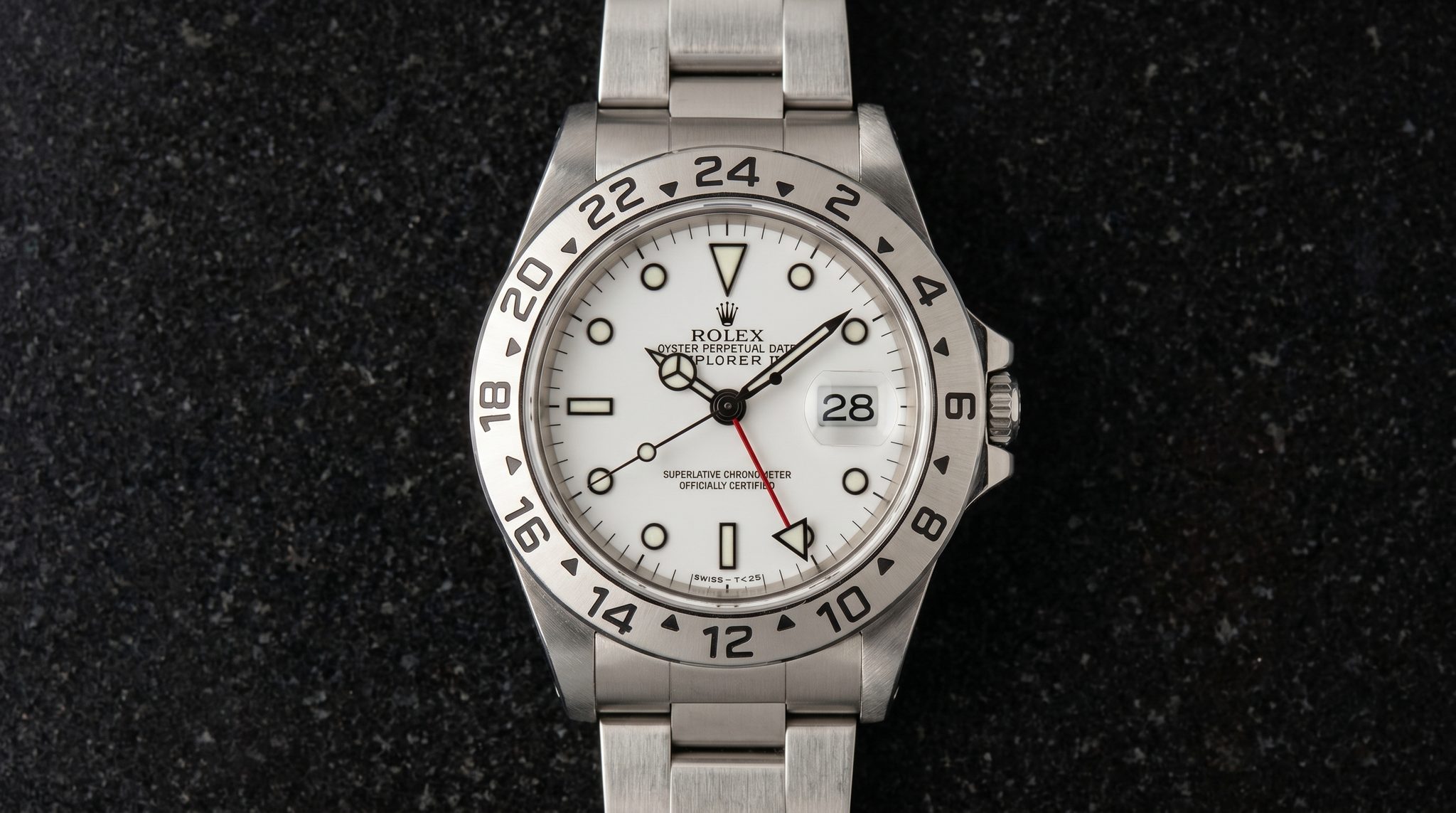
The Rolex Explorer II 16570 is the unusually “readable” Explorer II, a long-run 40 mm reference whose dial’s 6 o’clock legend changes in clear steps, then drifts out of sync with case and movement updates in the 2000s.
- Production
- c. 1989–2011
- Case
- Steel
- Diameter
- 40 mm
- Thickness
- 12.2 mm
- Lug-to-lug
- 47 mm
- Bezel
- Fixed steel 24h
- Crystal
- Sapphire + cyclops
- Water res.
- 100 m
- Dial
- Black or Polar
- Movement
- Cal. 3185 → 3186
- Lume
- Tritium → LumiNova → SLN
- Chronometer
- Yes (COSC)
The Rolex Explorer II 16570 was produced from about 1989 to 2011.
The Rolex Explorer II 16570 is the Explorer II you can date with your eyes before you ever open the caseback. The tell is printed at 6 o’clock: Rolex cycles through “SWISS – T<25,” then “SWISS,” then “SWISS MADE,” a sequence that maps directly to tritium, LumiNova, and Super-LumiNova across the reference’s c. 1989–2011 run.
That clarity matters because the rest of the watch does not move in lockstep. The 16570 keeps its 40 mm footprint and fixed steel 24-hour bezel throughout, yet its drilled lugs fade out around 2003–2004, its Oyster bracelet evolves from older hollow construction to solid end links around 2000–2003, and its late movement transition from Caliber 3185 to Caliber 3186 is usually placed in the mid-2000s with overlap. By the time Rolex adds the engraved inner rehaut and Parachrom hairspring that Fratello highlights around 2007, the dial has already been “SWISS MADE” for years.
The result is a reference that rewards careful, trait-by-trait reading. Early tritium pieces can look almost vintage, especially in Polar form where the white surface, black marker surrounds, and aging luminous plots create a look later examples cannot replicate. Late watches, especially the 3186 era, read as the most modern possible five-digit Explorer II: still compact at 40 mm, but with the later case and bracelet hardware that collectors associate with the end of the line before the 42 mm ref. 216570 arrived in 2011.
“On the Explorer II 16570, the dial tells the time and the era: “SWISS – T<25,” “SWISS,” and “SWISS MADE” are the backbone, while the case and movement changes arrive on their own clock.”
Rolex Explorer II 16570 production years: c. 1989–2011
The Explorer II 16570 arrives in 1989 as the successor to the short-lived ref. 16550, keeping the 40 mm format and fixed 24-hour steel bezel while refining the look with a thinner red 24-hour hand. Mechanically, the reference spends most of its life with Caliber 3185, a 4 Hz GMT movement with an independently adjustable local hour hand that makes the date quick-set by jumping the hour.
The easiest production-era anchor is the dial’s text at 6 o’clock. Tritium dials read “SWISS – T<25” through about 1997; a short transitional run around 1998–1999 switches to LumiNova and the distinctive “SWISS” only signature; then “SWISS MADE” marks the long Super-LumiNova era from about 1999 to the end. Those dial eras cut cleanly, but the watch’s hardware updates do not. Drilled lug holes persist well into the Super-LumiNova period and are phased out around 2003–2004, while the Oyster bracelet is moving from earlier hollow end-link construction toward solid end links around 2000–2003.
In the mid-2000s Rolex begins phasing in Caliber 3186, a refinement of the 3185 that is associated with improved GMT-hand stability. Fratello calls out 2007 as a visible late-era landmark for the reference, when the engraved rehaut appears and Parachrom is noted alongside the “no more wobbling GMT hand” update. That is the 16570’s defining pattern in miniature: the dial may say “SWISS MADE” across a huge span of production, but the watch still keeps changing underneath and around it.
Viewed from a distance, the 16570 is Rolex holding one idea steady for roughly two decades, then letting small, practical updates accumulate until the same reference can feel either distinctly neo-vintage (tritium, drilled lugs) or distinctly modern-for-five-digit Rolex (no-holes case, upgraded bracelet, late movement). The 42 mm ref. 216570’s arrival in 2011 makes that long 40 mm chapter feel closed and unusually self-contained.
- 1989IntroducedThin red 24h hand
- c. 1998 – 1999Swiss-only dial“SWISS” at 6 o’clock
- 1999Swiss Made“SWISS MADE” at 6
- c. 2003 – 2004No-holes caseNo lug holes in case
- c. 2005 – 2011Cal. 3186 eraMovement check required
- 2007Rehaut engravedROLEX rehaut text
- 2011Discontinued216570 is 42 mm
16570 against its neighbours
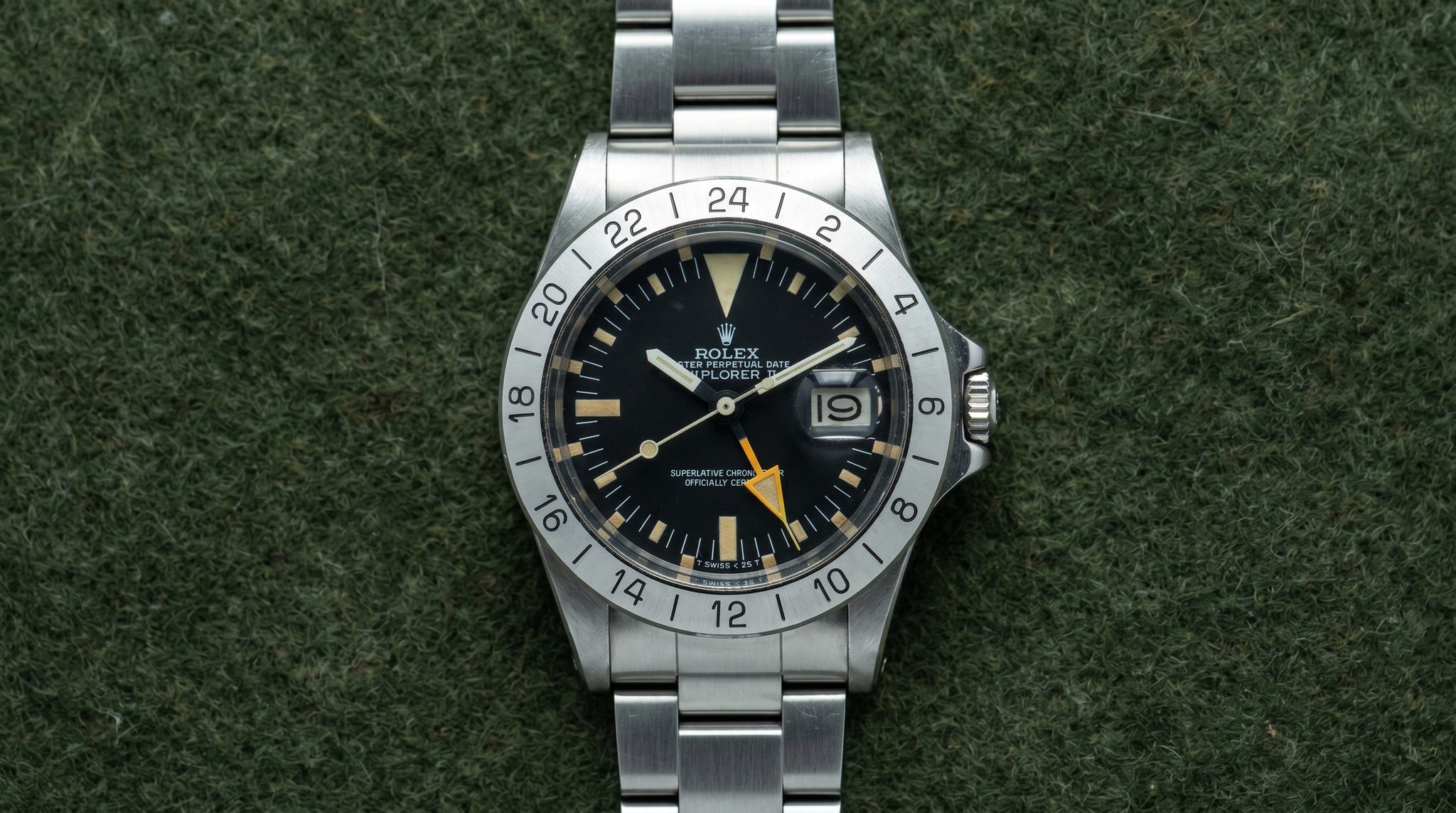
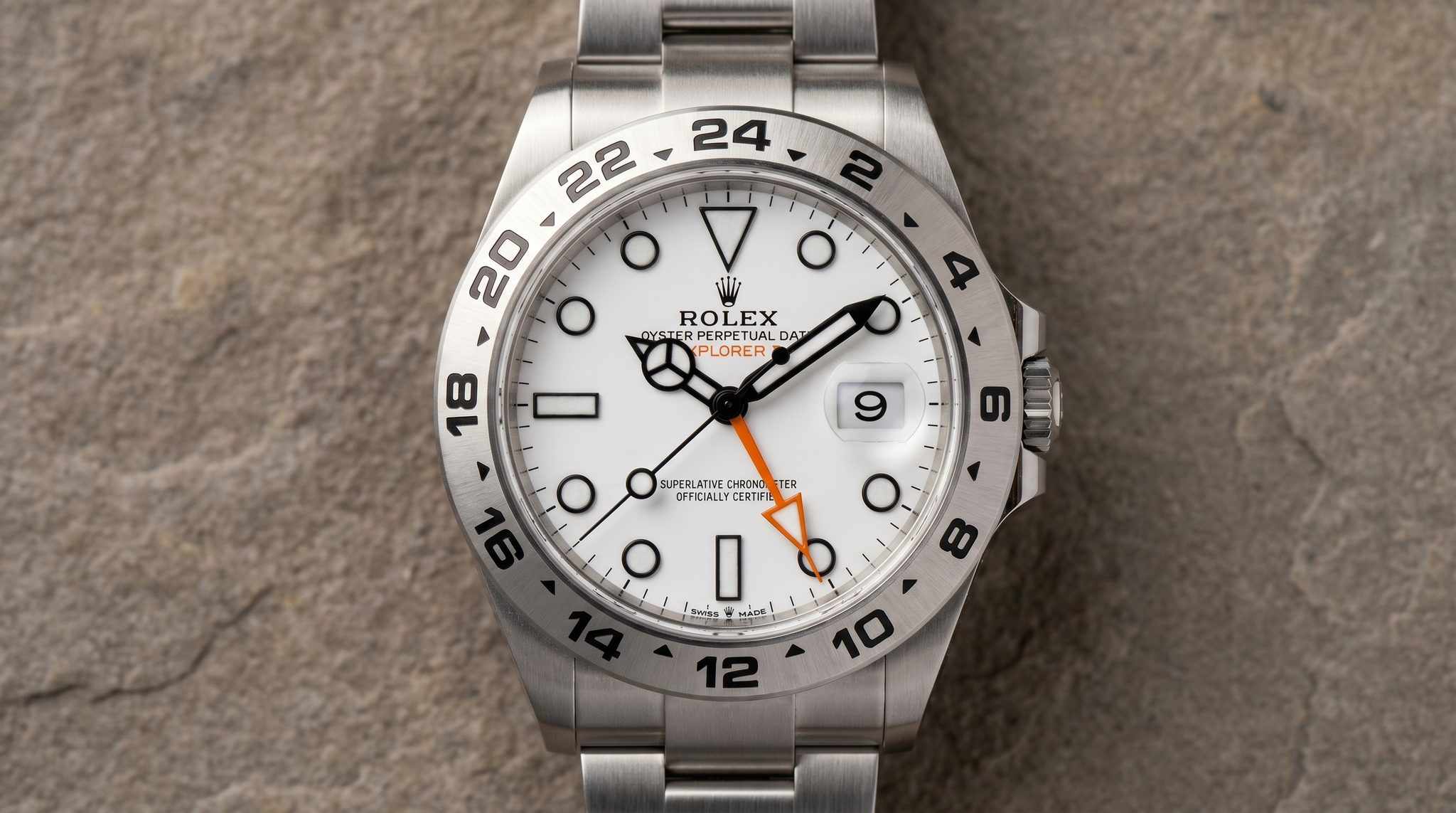
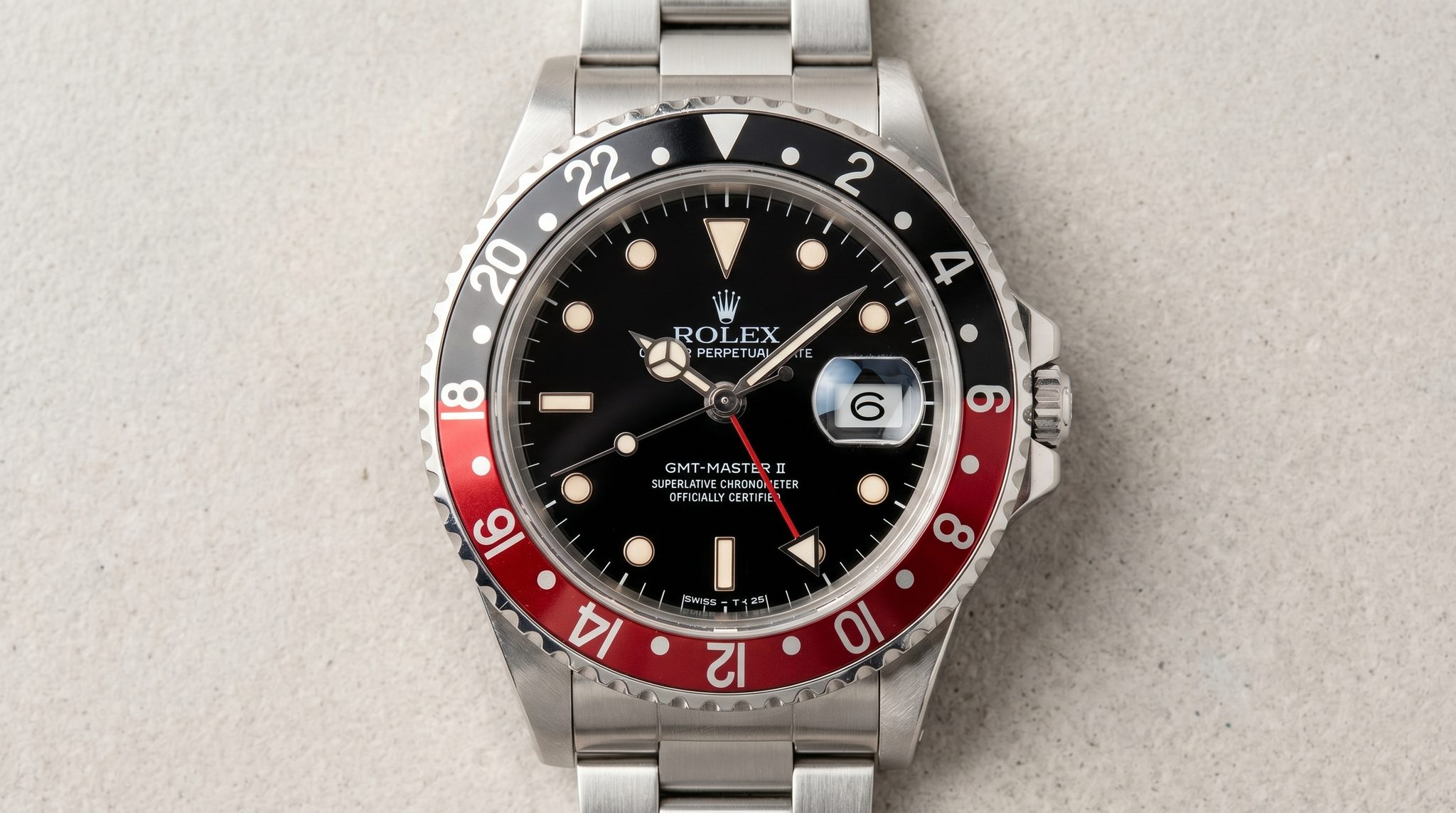
The 16570 makes the most sense framed by its immediate Explorer II neighbors. The ref. 16550 is the short, transitional predecessor that introduces the modern 40 mm, dual-time template, while the ref. 216570 is the larger 42 mm successor that ends the five-digit proportions entirely. For a mechanical cousin outside the line, the GMT-Master II ref. 16710 parallels the 16570 for much of its lifespan and shares the same 3185 and late 3186 movement family, but expresses it through a rotating bezel rather than a fixed steel scale.
This reference 16570 Rolex · focal c. 1989–2011 | ||||
|---|---|---|---|---|
| Production | c. 1985–1989 | c. 1989–2007 | c. 1989–2011 | 2011–2021 |
| Diameter | 40 mm | 40 mm | 40 mm | 42 mm |
| Bezel | Fixed steel 24h | Rotating 24h | Fixed steel 24h | Fixed steel 24h |
| Crystal | Sapphire + cyclops | Sapphire + cyclops | Sapphire + cyclops | Sapphire |
| Water res. | 100 m | 100 m | 100 m | 100 m |
| Movement | Cal. 3085 | Cal. 3185 → 3186 | Cal. 3185 → 3186 | Cal. 3187 |
| Dial | Black or white | Black | Black or Polar | Black or Polar |
| Lume | Tritium | Tritium → LumiNova → SL | Tritium → LumiNova → SLN | Chromalight |
Seven dial generations across the run
The first Explorer II 16570 dials announce themselves plainly: at 6 o’clock they read “SWISS – T<25,” and the luminous material is tritium. On the wrist the difference is not the glow, it is what time does to the watch. Tritium plots and hands can age, sometimes gently to an even parchment tone, sometimes more dramatically on Polar dials where the warm lume stands out against the white surface. This is also the period associated with early micro-layout quirks like “rail” text alignment and with Polar finishes described as glossier than later matte dials.
Most examples from this era pair the tritium dial with Caliber 3185 and early case and bracelet details such as drilled lug holes and older Oyster hardware, but those features should be treated as separate timelines. A late tritium dial and an early bracelet specification can coexist, yet the dial text remains the cleanest, least ambiguous marker of the era.
What to check before buying a 16570
Buying an Explorer II 16570 is less about hunting one perfect year than about deciding which timeline you want to live in, then checking that the watch is consistent within that choice. The dial’s 6 o’clock text is the first pass, because it anchors lume type and a broad period. After that, the main risks come from the independent nature of the later upgrades: a “SWISS MADE” dial can belong to either a relatively early 3185 watch with drilled lugs or to a late 3186 watch with rehaut engraving.
Condition and originality drive the real spread. Fratello notes premiums for superb, unpolished examples and full sets, while multiple guides warn that early tritium watches are commonly found with later service hands. That matters most on Polars, where patina and texture are part of the appeal and mismatched hands can read immediately once you know to look.
The 16570’s enduring attraction is that it offers a compact, 40 mm Explorer II profile with modern usability, and it lets buyers choose their balance of neo-vintage character versus late-spec hardware without leaving the reference. In practical terms, it is a watch that can be worn daily as a travel-friendly GMT, yet still rewards the slower pleasure of noticing details that only appear when a reference is allowed to run for two decades.
Rolex Explorer II 16570 price and value
A Rolex Explorer II 16570 sells for about $6,900 at the median, typically $6,100 to $7,800 across 800 comparable sales.
Rolex Explorer II 16570 for sale
Indicative figures from recent dealer, auction, and Grey Market sales (updated this week). Every watch is verified before it sells here.
Each point is a recent dealer or auction sale, banded to an indicative figure. The range shown is not a valuation.
Adjacent in the Explorer II family
Stories that discuss the 16570
Common questions about the 16570
The Rolex Explorer II 16570 was produced from about 1989 to 2011, with the 42 mm ref. 216570 introduced in 2011. One secondary summary gives an end date of 2010; Rolex does not publish month-by-month cutoffs, and overlapping deliveries around a changeover are not documented publicly.
- Buyer's Guide: The Rolex Explorer II Ref. 16570fratellowatches.com
- Rolex 16570bobswatches.com
- No Longer Made: Rolex Explorer II 16570 Watchablogtowatch.com
Show 7 more
- Rolex Explorer II 16570: The Best Value Rolex GMTteddybaldassarre.com
- Collector Guide The Rolex Explorer II (All References In Detail)beyondthedial.com
- Rolex Explorer II Ultimate Guideswisswatchexpo.com
- A Brief Guide to the Rolex Explorer II 'Polar'analogshift.com
- History and evolution of the Rolex Explorer IIgrayandsons.com
- Collector's Guide to the Rolex Explorer II Ref. 16570luxurybazaar.com
- Rolex Explorer II 16570 | Ref. 16570 Watcheschrono24.com