

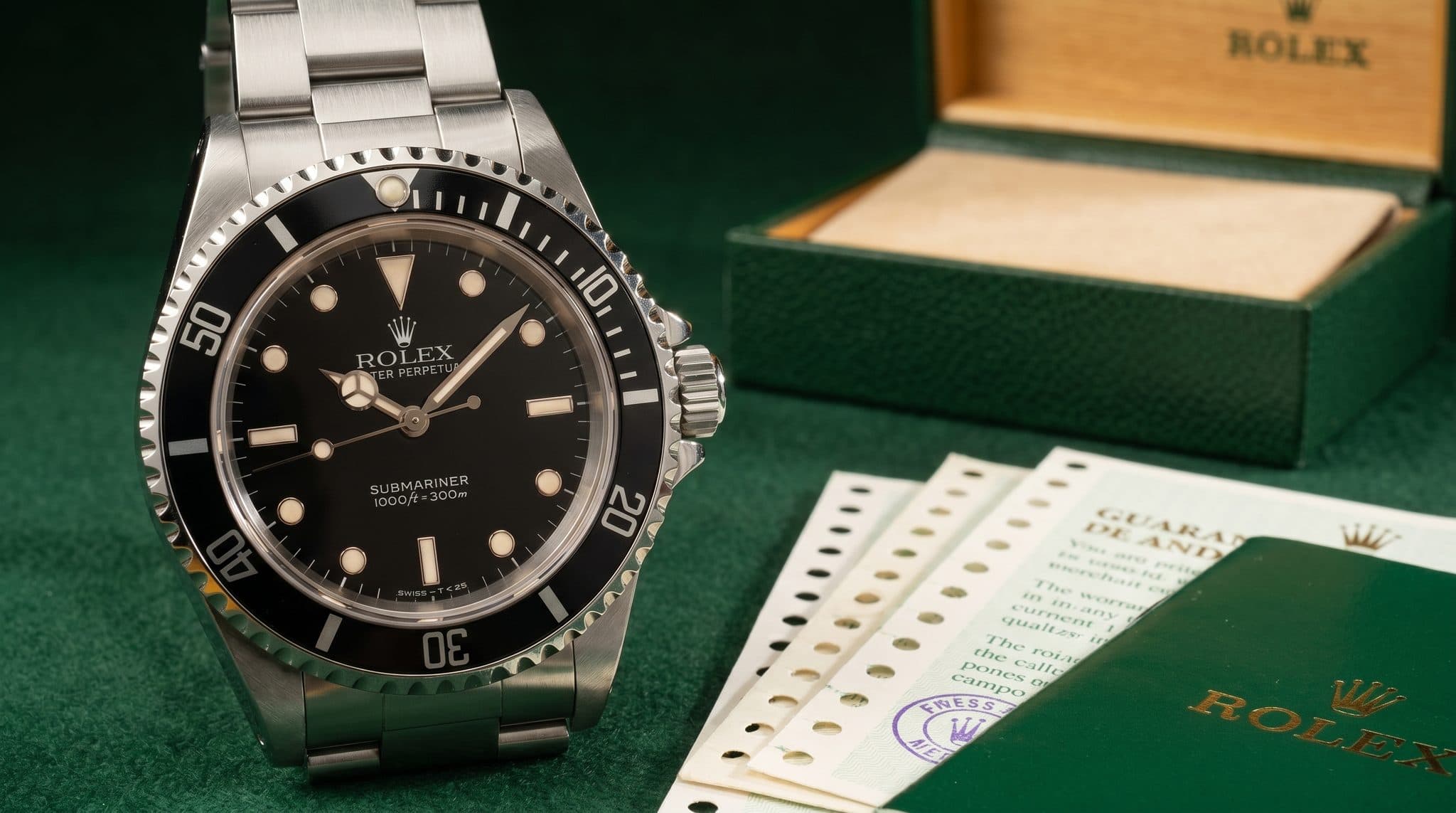
The most expensive cardboard box you will ever own.
What Are "Box and Papers"?
In the watch world, "box and papers" refers to the complete set of accessories that originally accompanied a luxury watch at the time of purchase. The specific components vary by brand, but a full set typically includes:
- The outer box — the branded presentation case
- The inner box or watch pillow — the cushion or holder the watch sits on
- Warranty card — the stamped card showing the authorized dealer, date of sale, and serial number. This is the single most valuable paper document
- Instruction manual / booklet — operating instructions for the movement and complications
- Hang tags — the tags attached to the bracelet at retail (Rolex green tag, Omega pictogram card, etc.)
- COSC chronometer certificate — for certified chronometers, the individual timing certificate
- Original receipt — the purchase receipt from the authorized dealer
- Extra links — removed bracelet links stored in the box
When a seller describes a watch as a "full set," they mean all of the above are included. "Watch only" means the timepiece alone — no box, no papers, no accessories.
How Much Value Do Box and Papers Add?
The short answer: it depends on the watch. But the data from completed sales across major platforms shows clear patterns.
Modern Production Watches (Current Models)
For current-production watches less than five to ten years old, a complete set with box and warranty card typically adds 10 to 15 percent to the resale value compared to a watch-only example. The warranty card matters most — it serves as proof of authenticity and establishes the watch's provenance. A watch with papers but no box loses less value than a watch with a box but no papers.
Discontinued References (10-30 Years Old)
The premium for completeness grows as watches transition from "used" to "collectible." For discontinued references, a full set can command 15 to 25 percent more than a watch-only example. Rolex sports references in this category (Submariner 16610, GMT-Master II 16710, Explorer II 16570) show some of the strongest premiums because the collector market for these references is deep and completeness is a primary sorting criterion for serious buyers.
Vintage Watches (30+ Years Old)
For vintage pieces, the premium becomes dramatic. Original papers for a 1960s or 1970s reference are exceptionally rare — most were discarded decades ago. A vintage Rolex Daytona or Submariner with matching original papers can sell for 25 to 40 percent more than a comparable watch-only example. In some cases, particularly for rare references with documented provenance, the premium is even higher.
As a general rule: the older and more collectible the watch, the more the papers matter.
Why Papers Matter More Than the Box
Not all components of a "full set" carry equal weight. Here is the hierarchy, from most to least valuable:
- Warranty card / guarantee certificate. This is the anchor document. It ties the serial number to a specific date of sale and authorized dealer, establishing provenance. On a Rolex, our serial lookup shows whether the date on the card fits the case. For authentication purposes, this is the most important piece of paper in the set.
- Original purchase receipt — Corroborates the warranty card and provides the original sale price. Increasingly important for insurance documentation.
- COSC certificate — Shows the individual movement's chronometric test results. Moderately collectible for vintage pieces.
- Hang tags — The Rolex green tag with its hologram sticker is the most collected hang tag in the watch world. Condition matters — tags with intact stickers are worth more than damaged ones.
- Instruction manual / booklet — Adds modest value. Period-correct booklets for vintage pieces have a small collector premium.
- Outer and inner box — The branded case. Adds value, but less than papers. Boxes are bulky and were frequently discarded, making period-correct boxes for older references somewhat uncommon.
- Extra links — Important for ensuring the bracelet fits the next owner, but the value impact is minimal compared to papers.
If you had to choose between buying a watch with papers and no box versus a box and no papers, always choose papers.
When Box and Papers Matter Less
Completeness is not equally important across all watches. The premium is smaller for:
- High-demand modern references. Watches like the Rolex Daytona or Audemars Piguet Royal Oak sell quickly regardless of completeness because demand vastly exceeds supply. The box-and-papers premium for these pieces is closer to 5 to 10 percent — still meaningful, but less decisive than for less liquid references.
- Non-sports watches. Dress watches, gold pieces, and complications outside the popular sports-watch segment see smaller premiums for completeness. The buyer pool is smaller and less focused on collecting "full sets."
- Watches needing service. If the watch requires significant mechanical work, the box and papers premium is diluted because the buyer is already factoring in service costs that compress the total value calculation.
What If You Have Lost Your Box and Papers?
If you are selling a watch and no longer have the original box and papers, you have several options:
Do Not Buy Replacement Papers
An aftermarket warranty card or reproduction papers provide zero value — and can actually raise red flags with buyers who suspect the watch itself may not be genuine. The used-watch market has a well-known problem with forged papers, and experienced buyers view non-original documentation with suspicion rather than confidence.
Replacement Boxes: Acceptable but Not Ideal
Buying a correct-era box for your watch is more acceptable than buying replacement papers, and some sellers do this to present the watch more attractively. However, transparent sellers disclose that the box is a replacement. Trying to pass a replacement box as original is dishonest and will damage your reputation if discovered.
Lean Into Transparency
The best strategy for selling a watch without box and papers is to be upfront about it, price accordingly, and compensate with other trust signals: high-quality photography, a detailed listing description, and third-party authentication. On platforms like Grey Market, the AI verification report provides the authenticity assurance that missing papers cannot, which narrows the price gap significantly.
How to Protect Your Box and Papers
If you are buying a watch as a complete set, treat the accessories as part of the investment:
- Store papers in a dry, climate-controlled environment. Humidity, direct sunlight, and temperature fluctuations damage paper and card stock over time.
- Keep the warranty card separate from the watch. If the watch is stolen, the warranty card becomes your proof of ownership for insurance claims. Storing both together means losing both together.
- Photograph everything. High-resolution photos of the warranty card (front and back), receipt, hang tags, and box provide backup documentation if the originals are damaged or lost.
- Do not write on or modify the warranty card. Any marks beyond the original dealer stamp reduce its value and authenticity.
The Bottom Line
Box and papers are not just accessories — they are financial instruments. For modern watches, they add 10 to 15 percent. For discontinued references, 15 to 25 percent. For vintage pieces, potentially 25 to 40 percent or more. The warranty card alone accounts for the majority of that premium.
When buying, factor completeness into your price research — a "great deal" on a watch-only example may not actually be cheaper than a full set once you account for the resale penalty. When selling, be transparent about what is and is not included, and let the watch's condition and documentation quality speak for itself.
For the complete buyer's framework — including auction strategy, condition assessment, and scam avoidance — read our Ultimate Guide to Buying a Pre-Owned Luxury Watch Online.
Reference guides
Deep dives on the references discussed in this story:
- Rolex GMT-Master 16760 (c. 1983–1988)
- Rolex Day-Date 1803 (c. 1959/60–1977/78)
- Rolex Submariner 16610 (1989–2010)
- Rolex GMT-Master 16710 (c. 1989–2007)
- Rolex Explorer II 16570 (c. 1989–2011)