

Rolex GMT-Master 116710LN
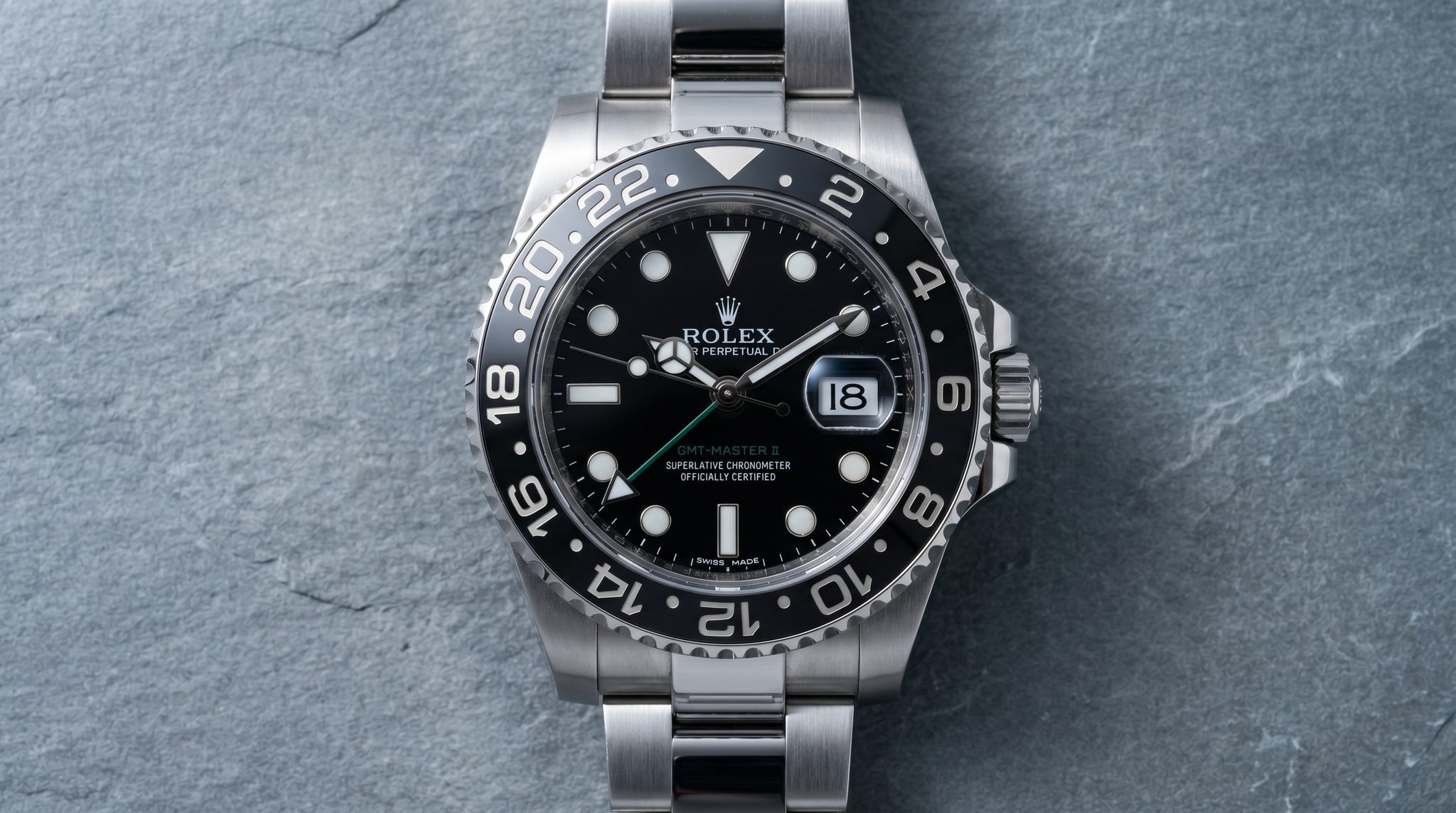
The Rolex GMT‑Master II 116710LN is the ceramic-era turning point in steel, a reference that stayed unusually stable in widely documented details, with one sharply defined outlier: the 2014 “Sea King” edition of about 123 pieces.
- Production
- 2007–2018/2019
- Case
- 904L steel
- Diameter
- 40 mm
- Lug width
- 20 mm
- Bezel
- Bidirectional 24h
- Insert
- Black Cerachrom
- Crystal
- Sapphire, Cyclops
- Water res.
- 100 m
- Dial
- Gloss black, maxi
- Lume
- Chromalight
- Movement
- Cal. 3186 (auto)
- Bracelet
- Oyster, PCL
The Rolex GMT-Master 116710LN was produced from 2007 to about 2018.
- Production years
- 2007–2018/2019
- Replaced
- 16710
- Replaced by
- 126710BLRO
- Movement
- Cal. 3186 (auto)
The Rolex GMT‑Master II 116710LN is the modern GMT that became a reference point by refusing to splinter into easy “marks.” Its calling card is instantly repeatable: in 2007 Rolex put a black Cerachrom bezel on a steel GMT‑Master II for the first time, with engraved numerals filled in platinum and a dial punctuated by green, the green 24‑hour hand and the green “GMT‑MASTER II” line.
That coherence is why the 116710LN reads differently from earlier GMTs that collectors date by dial signatures and bezel inserts. Here, the story is about a stable, high-definition execution of the travel watch concept: a 40 mm steel Super Case, a glossy black maxi dial with Chromalight, and caliber 3186 with an independently adjustable local hour hand for true dual-time use. The end of the run is less tidy than the watch itself, with secondary sources placing discontinuation in 2018 or in 2019 as the 126710 generation arrived.
Within that long, consistent production run, the only widely documented, sharply bounded variation is the 2014 “Sea King” commemorative edition, cited as about 123 examples and identifiable by its special dial motif and engraved caseback. Everything else that changes is either minor component evolution (bracelet and clasp codes) or a poorly documented transition point (rehaut engraving), the sort of detail that matters most when assessing correctness rather than collecting a named sub-variant.
“A GMT‑Master II built around one enduring look: 2007’s black Cerachrom steel debut, with the rare 2014 “Sea King” run (about 123 pieces) as the exception that proves the rule.”
Rolex GMT-Master 116710LN production years: 2007–2018/2019
The 116710LN arrives at a moment when Rolex’s GMT line pivots from the last aluminum-insert era into the ceramic one. Its defining change is documented and visual: a black Cerachrom insert whose numerals are engraved and then filled with platinum, paired with a glossy black maxi dial whose green GMT hand and green “GMT‑MASTER II” text become the reference’s signature.
Mechanically, the watch is anchored by caliber 3186 throughout its production run, with a jumping local hour hand that lets the wearer change time zones without stopping the watch, while the 24-hour hand continues to indicate home time against the bezel. The movement is also associated in dealer and editorial descriptions with the Parachrom (blue Parachrom) hairspring and improved resistance to shock and temperature changes.
Some details sit at the edge of what can be dated with confidence. Rehaut engraving is commonly seen on the model, and the broader Rolex transition from plain inner flanges to repeated ROLEX engravings places the 116710LN right in the rollout period, but authoritative, reference-specific cutoffs are not published. Bracelet and clasp codes also evolve as part of normal component updates, yet the look remains consistently the same on-wrist: an Oyster bracelet with polished center links and an Oysterlock clasp.
The watch’s unusual collector clarity comes from what does not happen. Where earlier GMT references are parsed into dial signatures and lume eras, the 116710LN is largely one stable execution, with a single cleanly documented detour in 2014: the “Sea King” commemorative edition, cited as 123 examples with special dial and caseback markings. By the time the 126710 generation arrives in 2018 and 2019 depending on how discontinuation is framed, the 116710LN has already fixed the modern template in steel, a ceramic bezel and a maxi dial that need no decoding to be recognized.
- 2007IntroducedBlack Cerachrom, green accents
- c. 2007Rehaut eraROLEXROLEX + serial at 6
- 2013Sibling appearsBlack/blue ceramic insert
- 2014Sea KingSpecial dial and caseback
- 2018 – 2019SucceededNew 1267xx references
116710LN against its neighbours
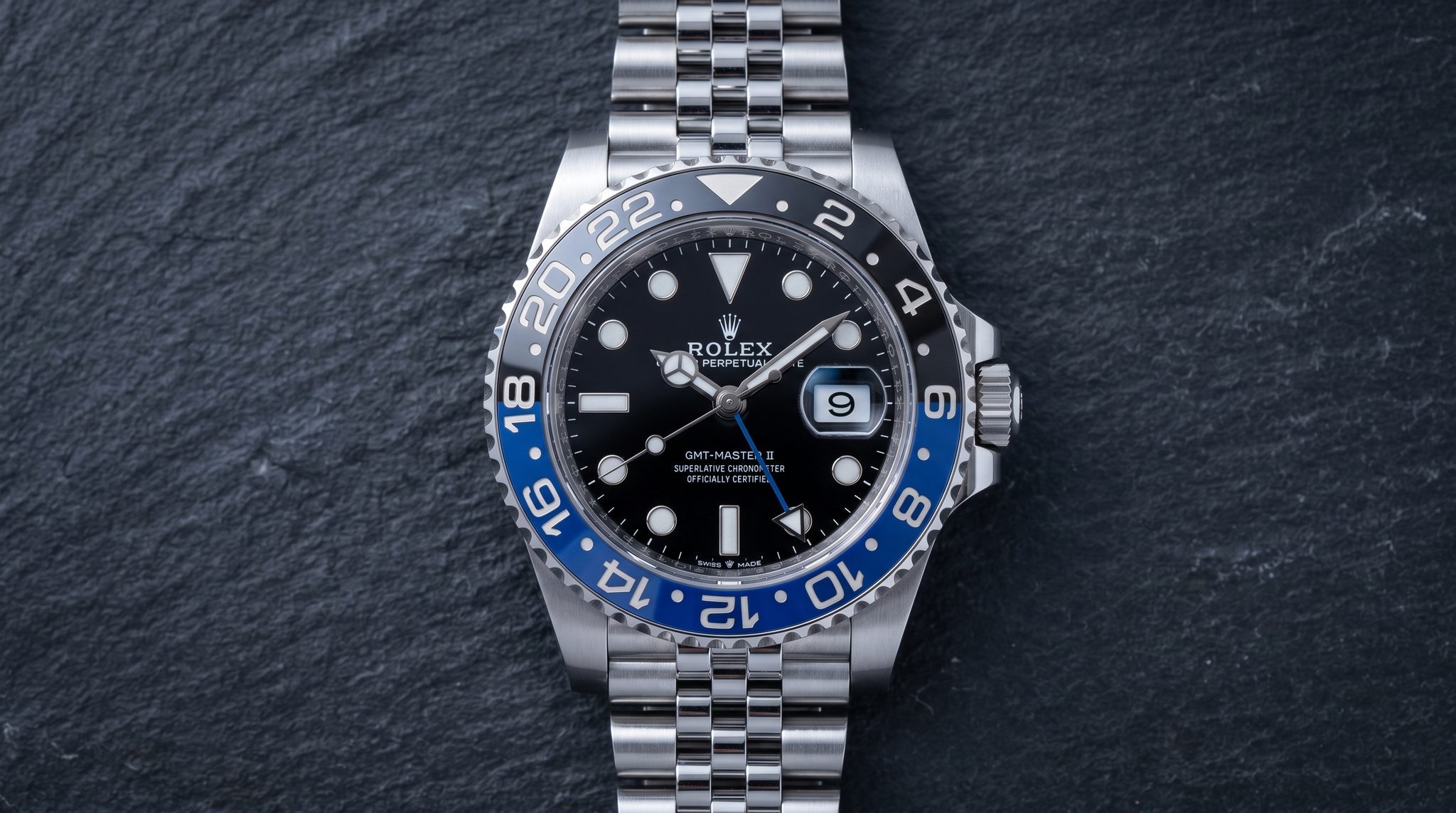
The 116710LN sits between two different ways of being a GMT. The five-digit 16710 is the last steel GMT‑Master II defined by aluminum inserts and slimmer pre-ceramic case proportions, while the later 126710 generation brings a new movement family and a shift toward two-color Cerachrom bezels in steel. The closest same-era alternative is the 116710BLNR, which is mechanically and structurally similar but changes the watch’s identity with a two-color bezel and different accent colors.
This reference 116710LN Rolex · focal 2007–2018/2019 | ||||
|---|---|---|---|---|
| Production | c. 1989–2007 | 2007–2018/2019 | 2013–c. 2019 | 2018–present |
| Case | 904L steel | 904L steel | Steel | Steel |
| Diameter | 40 mm | 40 mm | 40 mm | 40 mm |
| Lug width | 20 mm | 20 mm | 20 mm | 20 mm |
| Bezel | Bidirectional 24h | Bidirectional 24h | Bidirectional 24h | Red/blue Cerachrom |
| Insert | Anodized aluminum | Black Cerachrom | Cerachrom, black/blue | Cerachrom, red/blue |
| Crystal | Sapphire | Sapphire, Cyclops | Sapphire, Cyclops | Sapphire, Cyclops |
| Water res. | 100 m | 100 m | 100 m | 100 m |
| Dial | Gloss black | Gloss black, maxi | Black, maxi | Black |
| Lume | Tritium → SL | Chromalight | Chromalight | Chromalight |
| Movement | Cal. 3185 → 3186 | Cal. 3186 (auto) | Cal. 3186 | Cal. 3285 |
| Bracelet | Oyster or Jubilee | Oyster, PCL | Oyster | Jubilee (launch) |
Four variants and known sub-variants across the run
Most 116710LN watches look exactly like the mental picture the reference creates. The bezel is the first tell in hand: a deep black ceramic ring with numerals cut into the material rather than applied on top, then filled in platinum so they read as soft grey against the glossy surface. The dial continues the same theme, glossy black with larger maxi markers and a cool blue Chromalight glow, and it is signed in green, the green “GMT‑MASTER II” text echoed by a green 24‑hour hand.
Because major dealers and editorial guides do not formalize in-run dial “marks” for the 116710LN, correctness is typically judged by coherence of the whole set rather than by chasing a named dial variant. A plausible example has the steel Oyster bracelet with polished center links and an Oysterlock clasp, a sapphire crystal with Cyclops, and the expected modern case geometry with broad lugs and crown guards.
What to check before buying a 116710LN
Buying a 116710LN is less about decoding dial generations and more about judging honesty and coherence. The reference’s stable factory specification makes deviations stand out, but it also makes them tempting: one incorrect part can make the watch look “more valuable” to a casual eye. Condition matters unusually much on this model because the Super Case’s broad lugs advertise polishing, and the ceramic bezel and glossy dial reward close inspection.
The best examples feel like they have simply been kept, not rebuilt. That can mean a full set with its warranty card and accessories, or it can mean a watch-only piece whose case lines are still sharp and whose bezel, dial, and bracelet all make sense together. Either way, ownership is straightforward: a modern steel GMT‑Master II with a ceramic bezel and the travel-friendly caliber 3186 layout, built to be worn daily rather than curated by dial taxonomy.
Rolex GMT-Master 116710LN price and value
A Rolex GMT-Master 116710LN sells for about $12,000 at the median, typically $10,750 to $13,250 across 228 comparable sales.
Rolex GMT-Master 116710LN for sale
Indicative figures from recent dealer, auction, and Grey Market sales (updated this week). Every watch is verified before it sells here.
Each point is a recent dealer or auction sale, banded to an indicative figure. The range shown is not a valuation.
Adjacent in the GMT-Master family
Common questions about the 116710LN
The 116710LN is generally listed as produced from 2007 to 2019, but some secondary sources give the discontinuation as 2018. The end date is therefore best stated as 2007–2018/2019, with discontinuation tied to the arrival of the 126710 generation in 2018–2019.
- Sotheby’s: The Rolex GMT‑Master, a complete collector’s guidesothebys.com
- Bob’s Watches: Rolex 116710 (GMT‑Master II 116710 series overview)bobswatches.com
- Bob’s Watches Editorial: Rolex 116710LN reviewbobswatches.com
Show 7 more
- European Watch Company: Rolex GMT‑Master II 116710LN “Sea King”europeanwatch.com
- Chrono24: Rolex 116710LN reference pagechrono24.com
- Chrono24 Magazine: long‑term review of the 116710LNchrono24.com
- The Watch Observer: test of the GMT‑Master II 116710LNthewatchobserver.com
- BeckerTime: history of Rolex GMT‑Master and GMT‑Master II watchesbeckertime.com
- WatchGuys: Rolex GMT‑Master II 116710LN review (features and prices)watchguys.com
- Hodinkee: Reference Points, understanding the Rolex GMT‑Masterhodinkee.com