

Rolex Explorer II 16550
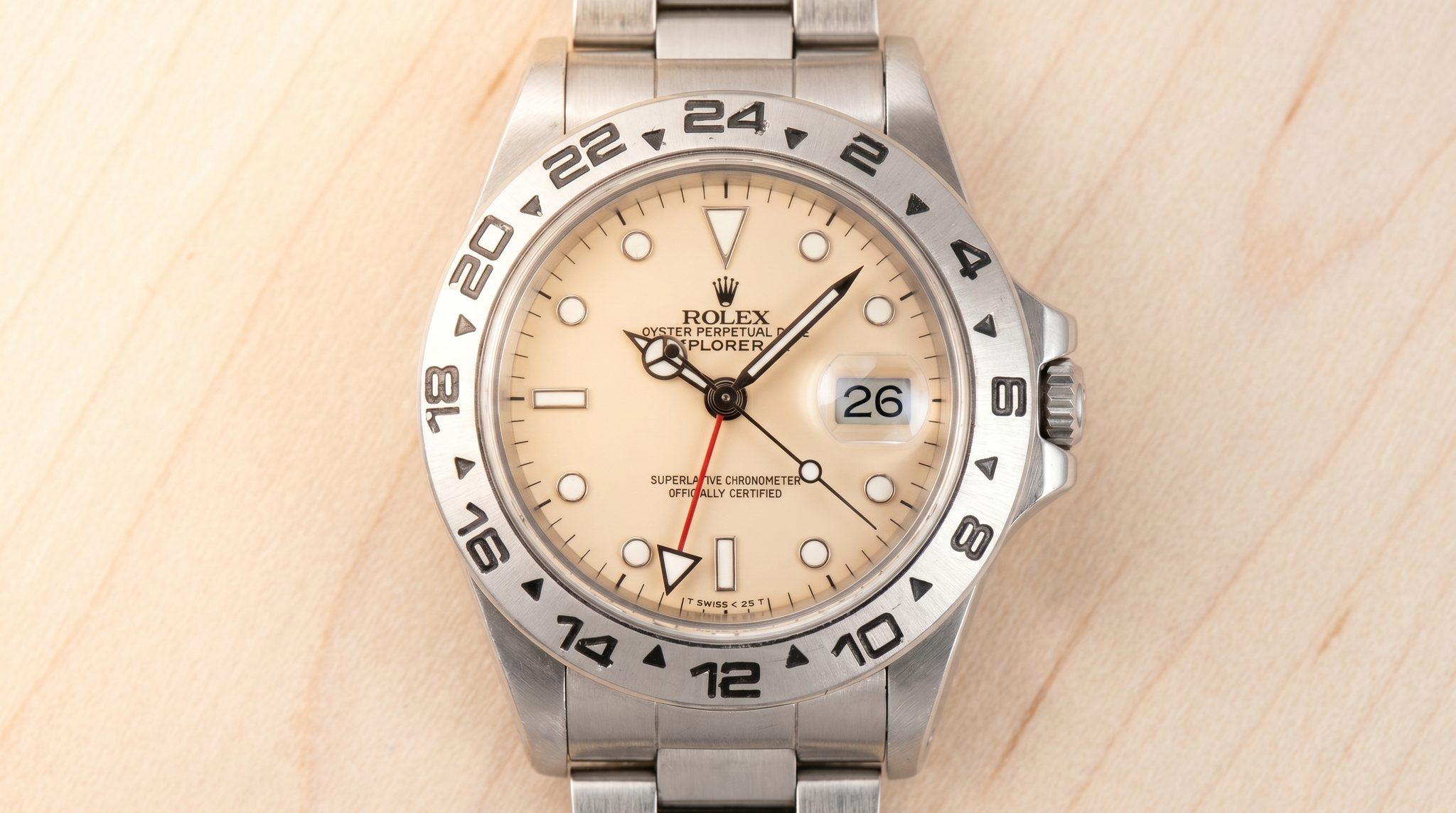
The Rolex Explorer II 16550 is the brief, mid-1980s hinge point that turned the Explorer II into a modern, true-GMT watch, then accidentally created its most famous collectible look when some white dials aged from bright white to cream.
- Production
- c. 1985–1989
- Case
- Stainless steel
- Diameter
- 40 mm
- Thickness
- ~13 mm
- Lug width
- 20 mm
- Bezel
- Fixed steel 24h
- Crystal
- Sapphire + cyclops
- Water res.
- 100 m
- Dial
- Black or white
- Movement
- Cal. 3085
- Power res.
- ~42h
- Lume
- Tritium
The Rolex Explorer II 16550 was produced from about 1985 to 1989.
The Rolex Explorer II 16550 is the Explorer II that became modern in one leap, and it did it in only a handful of years. Its defining movement, the Cal. 3085, brought a true dual-time layout with an independently adjustable local hour hand, plus quick-set date and hacking seconds, a very different proposition from the earlier Explorer II ref. 1655.
That technical jump is only half of why collectors linger on this reference. The other half is visual and accidental: a subset of white “Polar” dials, originally bright white, aged into a uniform cream or ivory tone, creating the look now nicknamed the “cream” (often paired with the early “rail” chronometer text layout). Dealer and collector literature attributes the color shift to a white dial paint formulation that discolored over time, and notes that later production used improved paint that stayed white, but Rolex never published a factory explanation or cutoff year.
Produced for a short mid-1980s window and sitting directly between the ref. 1655 and the long-running ref. 16570, the Explorer II 16550 is a reference where modern function, small typography changes, and one unusually photogenic aging outcome collide. It is also a reference where parts overlap and service swaps are common, which is why the best examples feel coherent, as if their dial, lume signature, bezel engraving, and bracelet era all belong to the same moment.
“A short mid-1980s run: the Explorer II’s first true-GMT movement, and the only era where some white dial paint can naturally mellow into cream.”
Rolex Explorer II 16550 production years: c. 1985–1989
The Explorer II ref. 16550 lands in the mid-1980s as a compact burst of change. Its headline shift is mechanical: Cal. 3085 brings the Explorer II into the “true GMT” era, with an independently adjustable local hour hand for travel and the practical additions of quick-set date and hacking seconds. The rest of the watch updates to match that modern intent, most visibly through the move to a 40 mm case and a sapphire crystal.
From there, the 16550’s story becomes one of overlapping production details rather than a single neat sequence. Early dials include the so-called rail layout, where the two “C”s in the chronometer lines stack cleanly in a straight vertical line. Later examples more often show non-rail printing, with the same words but subtly different spacing that breaks the visual column. In parallel, some white dials drift from white to cream, a change that collector and dealer writing ties to the stability of the dial paint rather than to lume aging. That paint behavior does not map perfectly to the rail change, which is why cream and rail often travel together in conversation but do not define each other.
Bezel engraving adds a final layer: both bold, squared numerals and finer “thin” numerals are seen within the reference, and some collectors associate thin fonts with late production near the 16570 transition. Because bezels can be replaced at service and the sources do not document factory cutoffs, the engraving style reads best as a descriptive trait, not a stand-alone dating key.
Zooming out, the 16550 is the rare Rolex sports reference where the line’s most practical modern upgrade and its most charismatic visual quirk arrive in the same narrow window. That compression is why so many of its details matter: the watch is not just a bridge between 1655 and 16570, it is the moment the Explorer II’s modern template was drawn, then briefly printed on dials that time itself helped finish.
- 1971 – 1984Ref. 1655 era39 mm case, acrylic crystal
- c. 198516550 introducedSapphire crystal, 5-digit case
- c. 1985 – 1986Rail dialsTwo “C”s form a vertical rail
- c. 1987 – 1989Non-rail dials“C”s no longer vertically aligned
- c. 1987 – 1989Thin bezelsSlimmer, less blocky numerals
- 1989Replaced16570 case and dial family
16550 against its neighbours
The Explorer II 16550 makes the most sense when bracketed by its immediate neighbors and its closest mechanical twin. The ref. 1655 shows the original Explorer II concept before sapphire and before the true-GMT jumping hour, the ref. 16570 shows what Rolex standardized once the 16550’s brief experiment ended, and the GMT-Master II ref. 16760 shares the same Cal. 3085 architecture in a rotating-bezel travel watch.
This reference 16550 Rolex · focal c. 1985–1989 | ||||
|---|---|---|---|---|
| Production | 1971–c. 1984/85 | c. 1983/84–1988 | c. 1985–1989 | c. 1989–2011 |
| Case | Stainless steel | Stainless steel | Stainless steel | Stainless steel |
| Diameter | 39 mm | 40 mm | 40 mm | 40 mm |
| Bezel | Fixed steel 24h | Rotating 24h | Fixed steel 24h | Fixed steel 24h |
| Crystal | Acrylic | Sapphire | Sapphire + cyclops | Sapphire |
| Water res. | 10 ATM | 100 m | 100 m | 100 m |
| Movement | Cal. 1575 | Cal. 3085 | Cal. 3085 | Cal. 3185 → 3186 |
| Power res. | – | ~42h | ~42h | – |
| Lume | Tritium | Tritium | Tritium | Tritium → LumiNova |
| Dial | Black only | Black | Black or white | Black or white |
Six dial generations across the run
The rail dial is the easiest 16550 nuance to spot once it has been pointed out. Look at the two chronometer lines above 6 o’clock and focus on the letter “C” in “Chronometer” and the “C” in “Certified”. On a rail dial, those two letters sit directly above one another, creating a tidy vertical column that makes the text block look unusually precise and evenly spaced.
Rail printing shows up on both black and white dials, and it is often paired in collectors’ minds with the cream-dial phenomenon because many of the best-known cream dials also happen to be rail dials. They are separate traits, though: rail describes typography, while cream describes how some white dial paint aged. All original examples are tritium dials, typically signed “T SWISS < 25” at 6 o’clock, with minor spacing and suffix variations across production and service history.
What to check before buying a 16550
Buying a Rolex Explorer II 16550 is less about choosing a specification and more about deciding which story you want the watch to tell. The reference is valuable precisely because it is short-run and transitional, and those are the same conditions that make later service parts and swapped components common.
The biggest price spread sits on the dial: black, white, and cream examples can trade in very different bands, and the cream premium creates incentives for refinishing, artificial aging, and outright dial swaps. A correct 16550 can still be an excellent daily watch thanks to the sapphire crystal, 100 m water resistance, and Cal. 3085’s practical travel setting, but it rewards buyers who treat originality as a physical thing you can see, not a promise in a listing.
At its best, owning a 16550 feels like wearing the moment the Explorer II learned to travel properly. The dial, whether black, white, or naturally cream, is the part you look at every time you check the time, and it is also the part most likely to have been changed, which is why patient shopping is part of the reference’s appeal.
Rolex Explorer II 16550 price and value
A Rolex Explorer II 16550 sells for about $12,000 at the median, typically $8,500 to $23,000 across 47 comparable sales.
Rolex Explorer II 16550 for sale
Indicative figures from recent dealer, auction, and Grey Market sales (updated this week). Every watch is verified before it sells here.
Each point is a recent dealer or auction sale, banded to an indicative figure. The range shown is not a valuation.
Adjacent in the Explorer II family
Stories that discuss the 16550
Common questions about the 16550
The Rolex Explorer II 16550 was produced from about 1985 to 1989. Examples are also documented as early as late 1984, so a practical collecting range is c. 1985–1989.
- Spelunking Into the Details: The Rolex Explorer II Reference 16550europeanwatch.com
- 1984 Rolex Explorer II Ref. 16550 With Cream 'Rail' Dialshop.hodinkee.com
- The History of the Rolex Explorer II, The Ultimate Adventure Watchmonochrome-watches.com
Show 8 more
- A Brief Guide to the Rolex Explorer II 'Polar'analogshift.com
- Vintage Rolex Explorer II 16550bobswatches.com
- Rolex Explorer II 16550 Cream Dialswisswatchexpo.com
- history and evolution of the Rolex Explorer IIgrayandsons.com
- Rolex 16550 - Explorer II watcheschrono24.com
- 1986 Rolex Explorer II Ref. 16550journal.craftandtailored.com
- Value Prop: 16550 Rolex Explorer II Black Dialhairspring.com
- Collector Guide The Rolex Explorer II (All References In Detail)beyondthedial.com