

Rolex Explorer II 1655
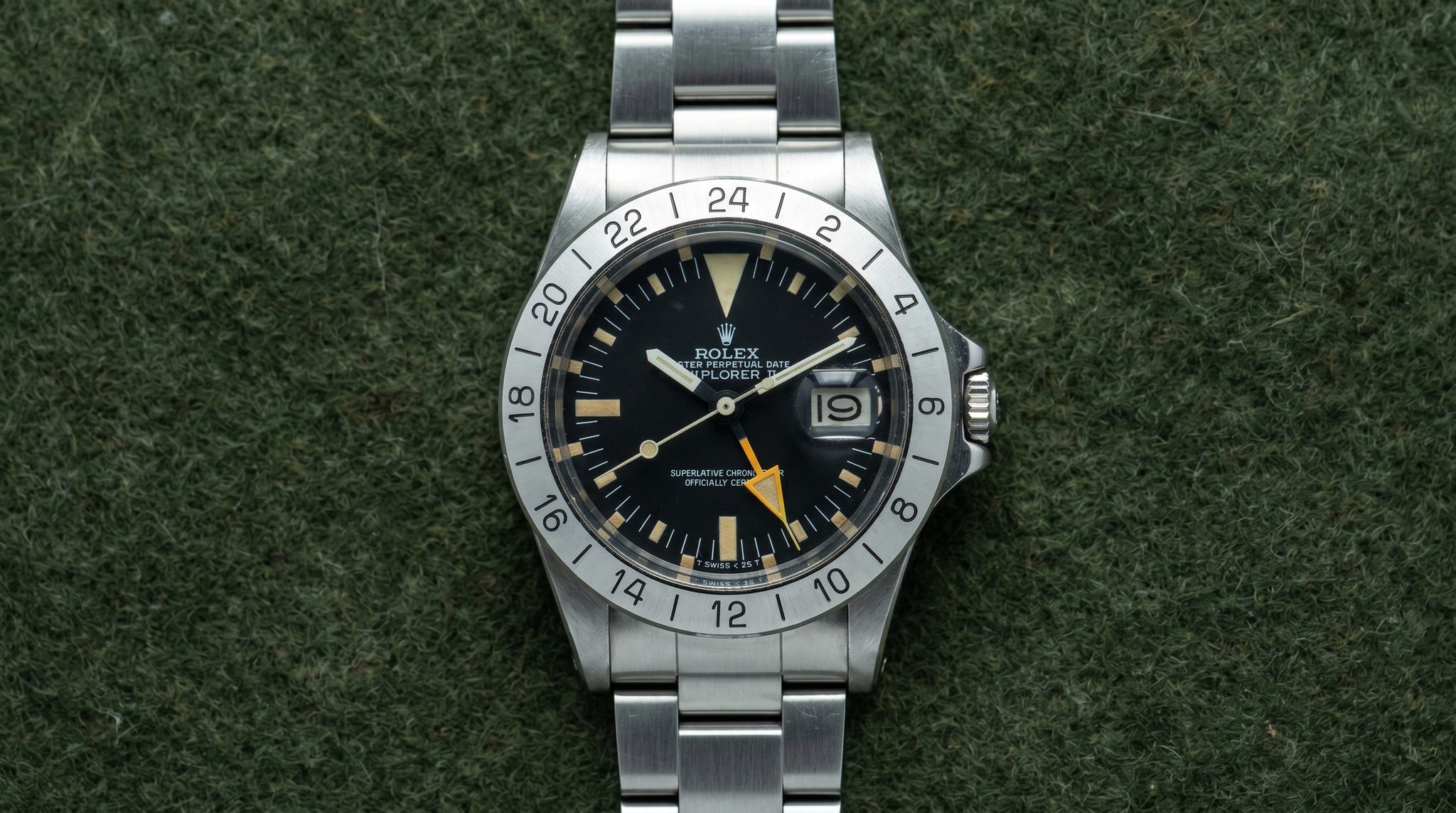
The Rolex Explorer II 1655 is the original Explorer II, a purpose-built “day or night” tool watch whose fixed 24-hour bezel and oversized orange hand made it unmistakable, even as Rolex quietly revised its dial, bezel, and hands into a map of the 1970s.
- Production
- 1971–c. 1984/85
- Case
- Stainless steel
- Diameter
- ~39 mm
- Lug span
- ~47 mm
- Bezel
- Fixed 24-hour steel
- Crystal
- Acrylic (plexiglass)
- Dial
- Matte black
- Water res.
- 10 ATM
- Movement
- Cal. 1575 (GMT)
- Functions
- Date, 24-hour hand
- Chronometer
- Yes (COSC)
- Lume
- Tritium
The Rolex Explorer II 1655 was produced from 1971 to about 1984.
- Production years
- 1971–c. 1984/85
- Replaced by
- 16550
- Movement
- Cal. 1575 (GMT)
The Rolex Explorer II 1655 is the only Explorer II that reads like an instrument first and a wristwatch second. Its clearest tell is the huge orange 24 hour “Freccione” hand, paired with a fixed steel 24 hour bezel that uses line markers between the numerals, not the arrows adopted by later generations.
Rolex introduced the reference 1655 in 1971 for cave explorers and other workers who could lose track of day and night. The idea was not a travel GMT. The 24 hour hand is mechanically coupled to the main hour hand and reads against the fixed bezel as an AM PM indicator, a layout chosen for clarity in darkness rather than time zone hopping. That functional choice is why the 1655 feels so different from every Explorer II that followed.
It also became the Explorer II that rewards close looking. Across a production run that ends around 1984 to 1985, the watch accumulated meaningful, collectible differences that do not line up neatly: collectors track multiple dial marks, more than one bezel execution, and at least two seconds hand eras. The result is a reference whose “correctness” lives in the harmony between parts. On a strong example, the matte dial, tritium lume, and orange hand look assembled by time, not assembled later.
“The 1655 is the Explorer II that never became a GMT: its orange 24-hour hand is tied to local time, and the rest of the reference is a trail of small, datable parts changes.”
Rolex Explorer II 1655 production years: 1971–c. 1984/85
Rolex launched the Explorer II 1655 in 1971 with a very specific problem in mind: keeping track of day and night when daylight disappears. That purpose explains the parts that make the reference instantly recognizable in the hand. The bezel is fixed and engraved, so it cannot be used like a traveler’s timing ring. Instead it acts as a permanent 24 hour scale, and the oversized orange 24 hour hand reads against it as a high contrast indicator of time of day.
The same decision shows up in the movement behavior. Sources describing the 1655 are explicit that it is not a dual time watch in the later sense. Its 24 hour hand is coupled to the main hour hand, so it does not jump independently, and the fixed bezel means there is no rotating reference for a second zone. What Rolex did, in effect, was take the GMT architecture of the era and tune it for legibility and certainty rather than flexibility.
Within that stable concept, the physical watch kept moving under the surface. Collectors divide the reference into multiple dial “Marks” because Rolex revised coronet geometry, font weight, and text layout over time, and the later dials add different tritium text at 6 o’clock. Separately, the seconds hand exists in straight and later “lollipop” forms, and the bezel itself has more than one execution with changes in numeral thickness and spacing. Rolex did not document these transitions publicly, and the published cutoffs do not align neatly, which is why the 1655 has become a reference where originality is judged by coherence.
Late in the run, the story becomes easiest to see from arm’s length. The overall design stays the same, but the parts get incrementally more standardized, and the range of late dials and bezels shows Rolex closing out a niche tool watch before the line’s 1980s reset. When the Explorer II returned as the ref. 16550 around 1984 to 1985, it kept the fixed bezel but pivoted hard toward the modern dual time idea with sapphire crystal and an independently adjustable 24 hour hand, making the 1655 the one Explorer II that belongs wholly to the acrylic, matte dial era.
- 1971IntroducedOrange 24-hour hand, fixed bezel
- 1971Core format24-hour hand not independent
- c. 1971 – early 1970sEarly dialsLarge coronet, early text
- c. early runSeconds handNo luminous lollipop dot
- c. mid-1970s24h hand tintFreccione looks redder
- c. later runSeconds handLuminous dot near tip
- c. 1984 – 1985DiscontinuedNext gen uses sapphire crystal
1655 against its neighbours
The 1655 makes the most sense when it is bracketed by what came next in its own line and by the Rolex travel watch it quietly borrows from. The ref. 16550 shows the Explorer II’s pivot into a sapphire crystal, independently adjustable 24 hour hand era, while the GMT-Master ref. 1675 highlights how unusual the 1655’s fixed bezel and dial-forward 24 hour scale really are.
This reference 1655 Rolex · focal 1971–c. 1984/85 | ||||
|---|---|---|---|---|
| Production | c. 1959–1980 | 1971–c. 1984/85 | c. 1985–1989 | c. 1989–2011 |
| Diameter | 40 mm | ~39 mm | 40 mm | 40 mm |
| Case | Stainless steel | Stainless steel | Stainless steel | Stainless steel |
| Bezel | Rotating 24-hour | Fixed 24-hour steel | Fixed 24-hour steel | Fixed 24-hour steel |
| Crystal | Acrylic | Acrylic (plexiglass) | Sapphire | Sapphire |
| Dial | Gilt → matte | Matte black | Black or white | Black or white |
| Movement | Cal. 1565 → 1575 | Cal. 1575 (GMT) | Cal. 3085 | Cal. 3185/3186 |
| Functions | Date, GMT hand | Date, 24-hour hand | Date, GMT | Date, GMT |
| Lume | Tritium | Tritium | Tritium | Tritium → LumiNova |
| Water res. | 50 m / 165 ft | 10 ATM | 100 m | 100 m |
11 dial generations across the run
The earliest dials are collected as MK1, and they are the ones that make the 1655 feel most like a prototype that escaped into the wild. On the wrist the matte black surface absorbs light, while the early coronet at 12 o’clock reads larger and bolder than later print. Collectors also associate this era with the “straight hand” configuration, though dial mark and hand style are separate traits and service history can scramble the expected pairing.
Because Rolex did not publish a factory dial-by-year map, the exact cutoff is debated. What is secure is the visual character: early MK1 printing looks more spacious and more emphatically drawn, and it is one of the easiest ways to spot a very early 1655 at a glance.
What to check before buying a 1655
Buying a Rolex 1655 is less about finding “a 1655” than finding a 1655 that has not been quietly rebuilt. The reference is famous for independent, collectible part timelines, and it is also a watch that often saw real tool use, which makes later service dials, replacement hands, and softened cases common.
The safest path is to decide what kind of correctness matters most, then let the watch prove it visually: matte dial printing that matches a known Mark family, tritium that ages consistently across plots and hands, and a bezel whose engraving style and sharpness make sense for the rest of the build. A sapphire crystal is a hard stop, because the 1655 is the only Explorer II made with acrylic.
At its best, owning an Explorer II 1655 feels like wearing Rolex’s most literal 1970s instrument, a 39 mm sports Oyster whose quirks are the point. The watch is still robust enough for regular wear if it is serviced properly, but its value is carried in fragile details like printing, patina, and untouched geometry, so the daily experience is equal parts tool watch and careful stewardship.
Rolex Explorer II 1655 price and value
A Rolex Explorer II 1655 sells for about $19,250 at the median, typically $16,000 to $24,250 across 115 comparable sales.
Rolex Explorer II 1655 for sale
Indicative figures from recent dealer, auction, and Grey Market sales (updated this week). Every watch is verified before it sells here.
Each point is a recent dealer or auction sale, banded to an indicative figure. The range shown is not a valuation.
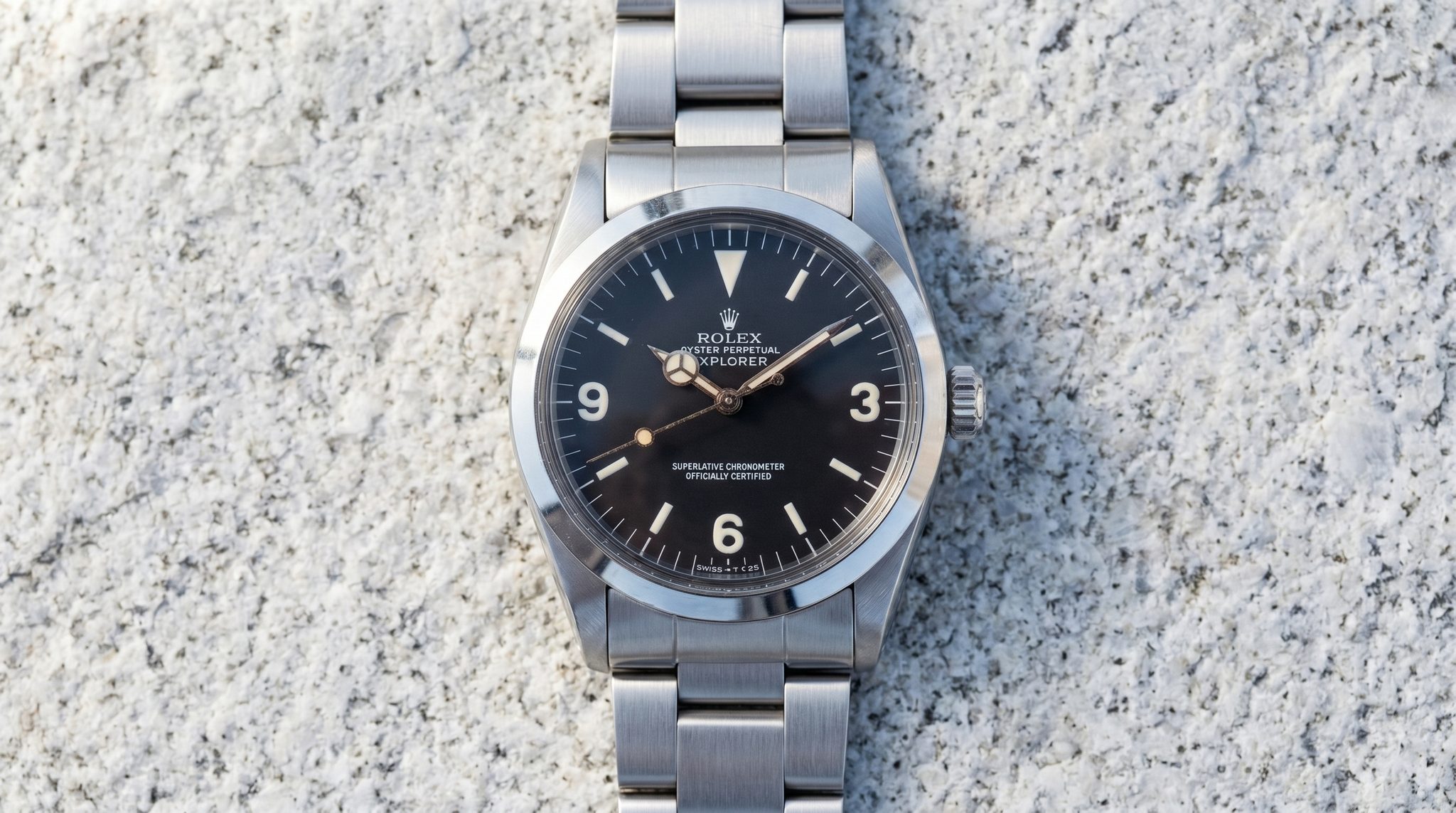
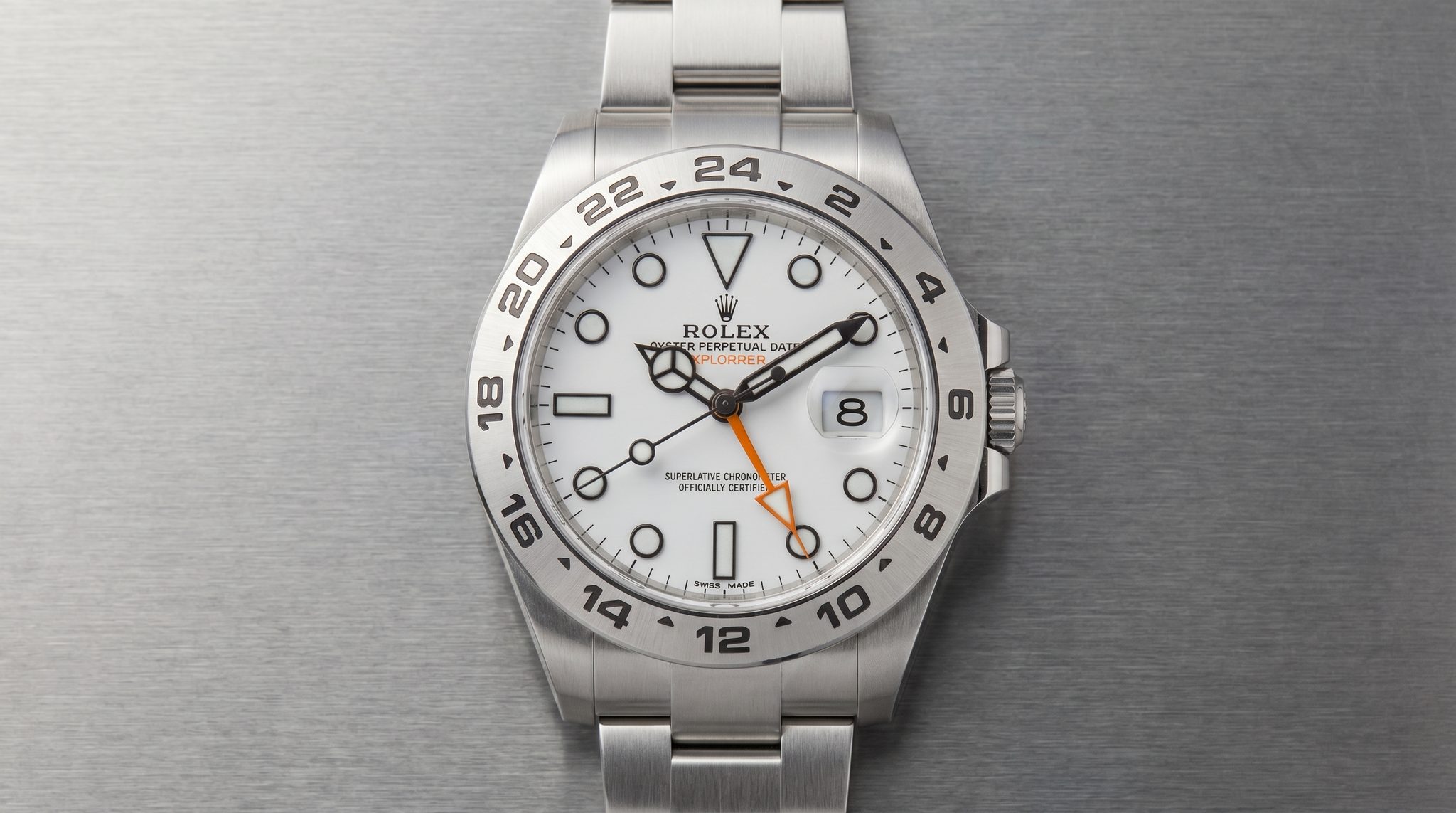
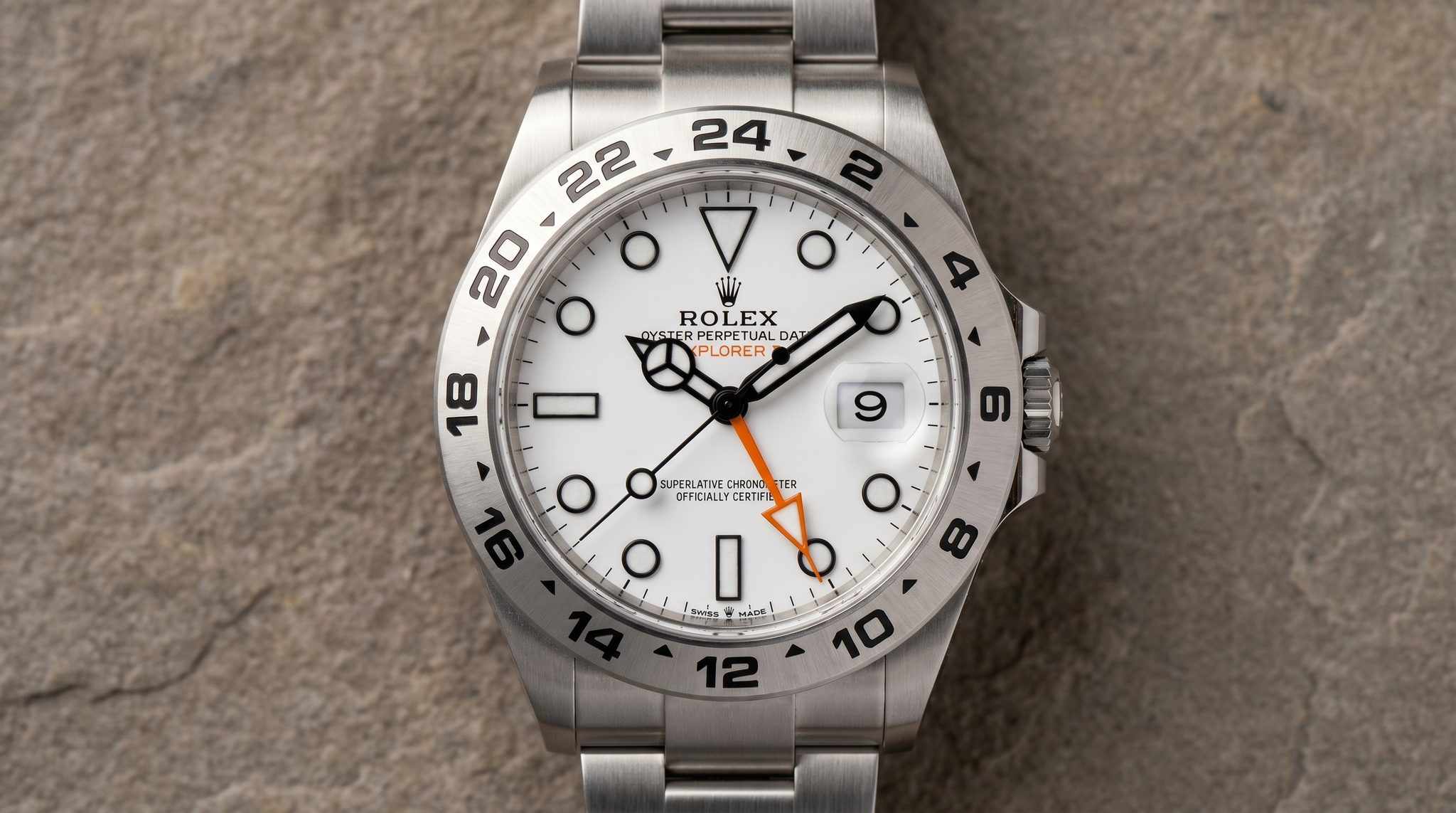
Adjacent in the Explorer II family
Stories that discuss the 1655
Common questions about the 1655
The Explorer II 1655 was introduced in 1971 and remained in production until about 1984–1985. Published specialist sources disagree on whether the final year is 1984 or 1985, and Rolex does not publish an official per-reference production cutoff.
- The Ultimate Sports Rolex: The Explorer II Reference 1655fratellowatches.com
- History and evolution of the Rolex Explorer IIgrayandsons.com
- Rolex Explorer II 1655, the "straight hand" reviewwatchprosite.com
Show 7 more
- A Love Letter to the Rolex Explorer II ref. 1655craftandtailored.com
- Meet the First Rolex Explorer II (and Why Collectors Love It Now)everestbands.com
- Mk1 "Straight Hand" 1655 Rolex Explorer IIhairspring.com
- Rolex Freccione 1655 | Ref. 1655 Watches on Chrono24chrono24.com
- Rolex 1655 Explorer IIschwanke-kasten.com
- Original Owners: Rolex Explorer II Ref. 1655youtube.com
- Inside the Rolex Explorer II 1655bobswatches.com