

Rolex Day-Date
The Rolex Day-Date is the calendar watch that turned a spelled-out weekday into Rolex’s flagship signal of both practicality and prestige.
The Rolex Day-Date is the calendar watch that made a full, spelled-out weekday a Rolex signature, then kept the design so consistent that collectors learned to read the line through setting convenience, size, and configuration rather than constant redesign. Rolex introduced the Day-Date in 1956 as a self-winding, waterproof chronometer wristwatch that displayed both the date and the day of the week written in full.
That choice solved a legibility problem at a time when a clear personal calendar mattered, and Rolex framed it, in period positioning and later archive language, as the Oyster Perpetual “watch of prestige” aimed at people needing “complete mastery” of their calendar. The result is a family that has always been easier to recognize than to summarize: day at 12, date at 3 under a Cyclops, and an Oyster case that Rolex has kept as precious-metal territory.
For collectors, the Day-Date’s history is best understood as a small number of platform decisions with outsized consequences. First, the watch’s 36 mm template hardened early and stayed dominant for decades. Within that stable silhouette, the line’s most important shifts were mechanical, not stylistic. The step from ref. 1803 to 18038 is not merely a new reference number, it is the moment the Day-Date leaves the acrylic-crystal, non-quickset ritual behind and becomes a sapphire-crystal watch with crown-driven calendar convenience. The later move to ref. 18238 and 18239 finishes the usability story by adding double quickset, so day and date can be corrected independently.
Second, once Rolex reached that modern behavior, the family’s “change” migrated outward. References such as 118238 and 118239 largely carry the same core movement generation as their late five-digit predecessors, but they are collected for what a wearer can see and feel, including the more modern six-digit execution and, in white gold especially, the dial programs that can make one watch read discreet and another read overtly decorative without any generational mechanical shift.
Third, the modern era ends the long 36 mm monopoly at the top of the line. In 2015 Rolex introduced the Day-Date 40, pairing a new 40 mm case with Cal. 3255 and replacing the bulkier 41 mm Day-Date II generation. From there, the modern Day-Date becomes a controlled platform: the mechanics and proportions stay fixed, and Rolex lets color, texture, and gem-setting do most of the visible work.
The zoomed-out lesson is that the Day-Date’s identity is built on continuity. In a family where the headline layout barely moves, the details that do change, quickset behavior, crystal material, and case size, become unusually meaningful, and configuration becomes a form of authorship.
What each Day-Date reference trades for
Median and typical range of recent dealer, auction and Grey Market sales, banded. Indicative, not a valuation; each reference page carries the detail.
10 references across 6 eras
Classic pre-quickset 36
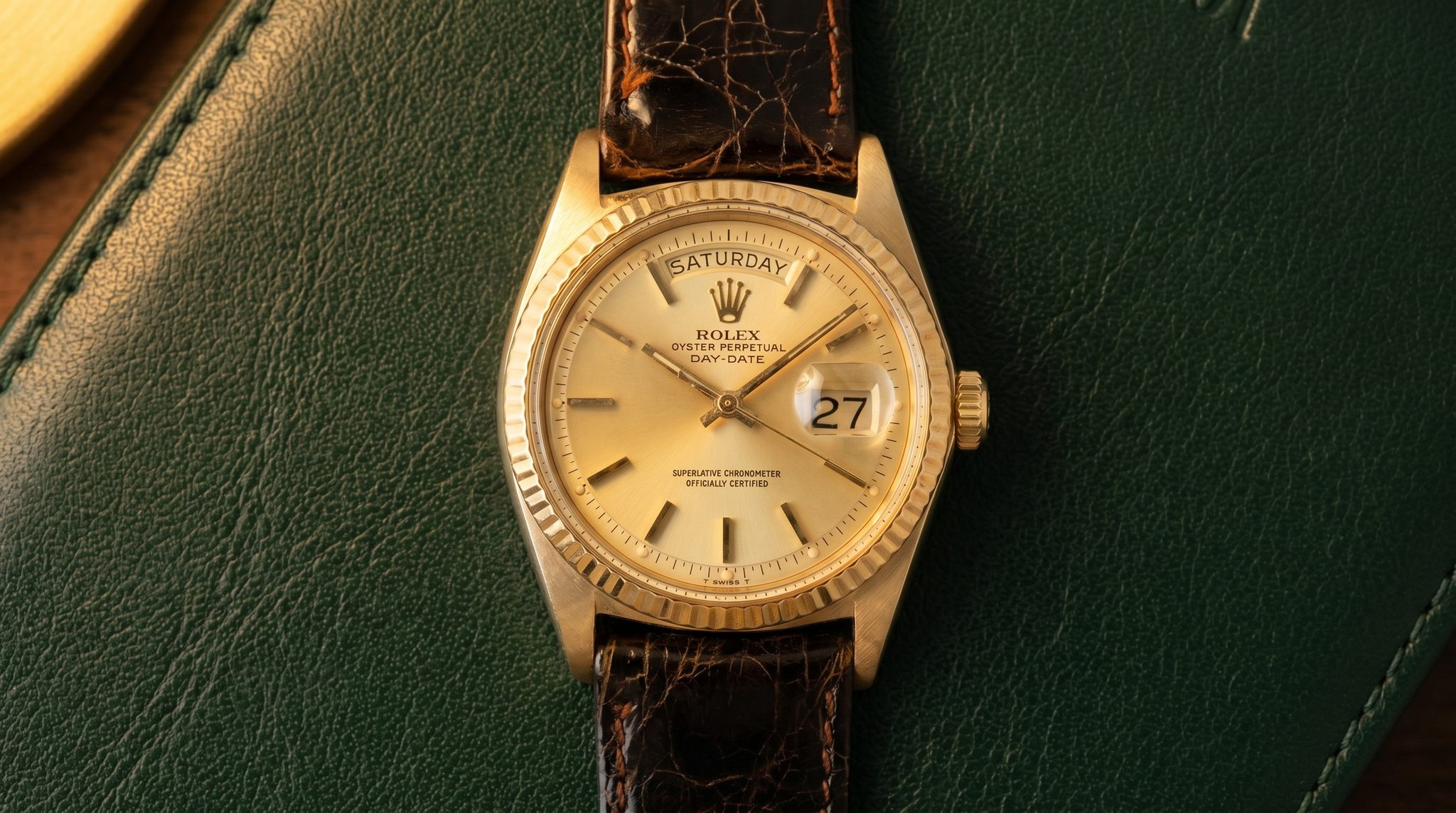
Ref. 1803 represents the stabilized vintage Day-Date formula: the familiar 36 mm precious-metal Oyster case with the day at 12 and date at 3, paired to the older setting ritual with no quickset. On the wrist, this generation reads as the “warm” Day-Date, because acrylic and a stepped pie-pan dial shape define the look more than any one dial color. Sources treat the long run as unusually consistent in silhouette, with changes largely driven by movement updates inside the same established architecture. It ends when Rolex modernizes the user experience and durability cues in the next generation, switching to sapphire crystal and introducing crown-driven quickset convenience.
Sapphire and quickset date
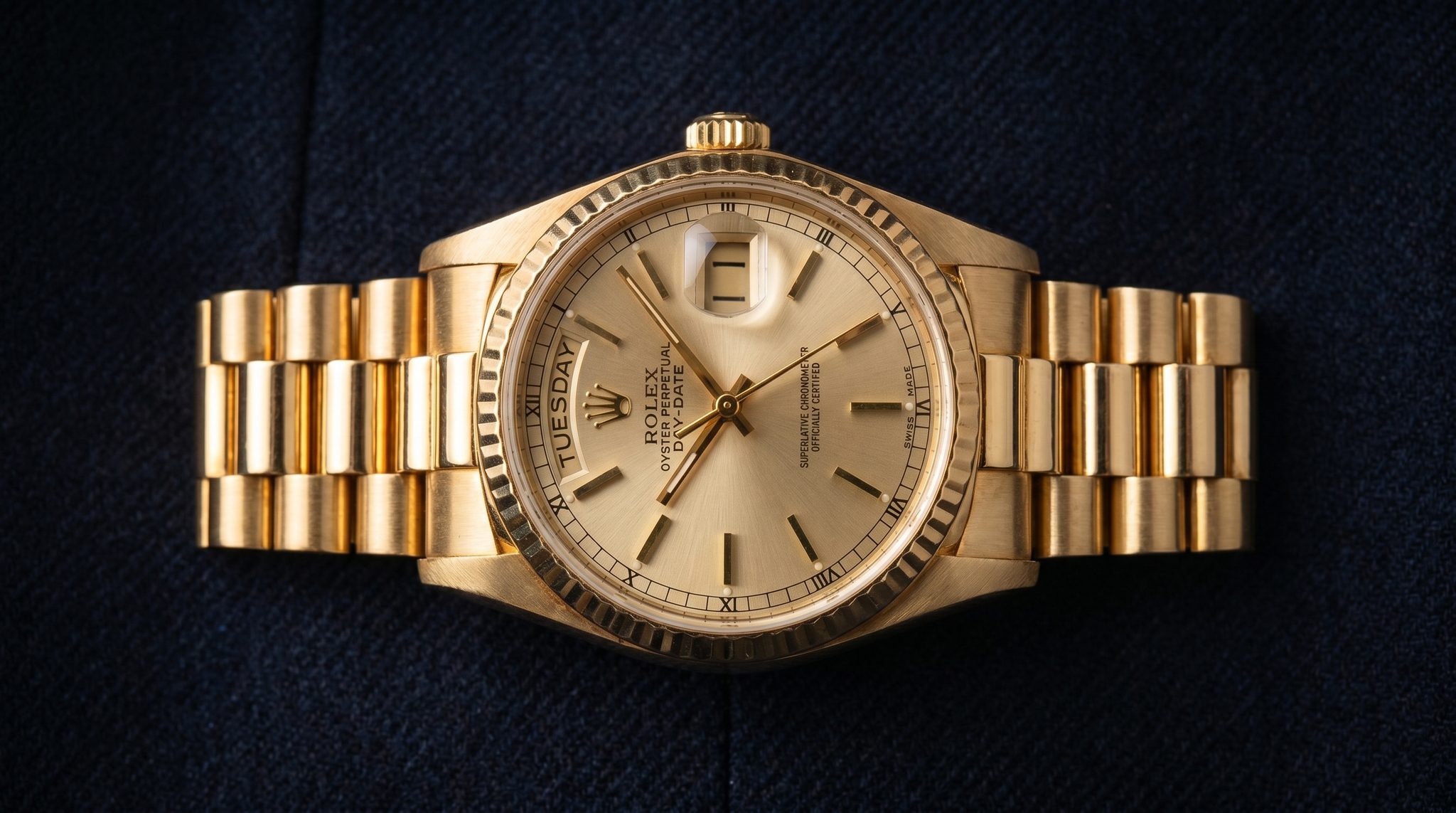
Ref. 18038 is the hinge between vintage behavior and modern usability. The outward language stays recognizably Day-Date, but what you notice in use changes first: sapphire replaces acrylic, the dial profile is no longer the earlier stepped pie-pan style, and the calendar becomes faster to live with because the date can be advanced directly from the crown. This era is defined by that partial modernization, since the day still advances by cycling the hands through midnight. The generation ends when Rolex completes the convenience story with a new movement family that adds independent correction for the weekday, making the day display as practical to set as the date.
Double-quickset 36 mm
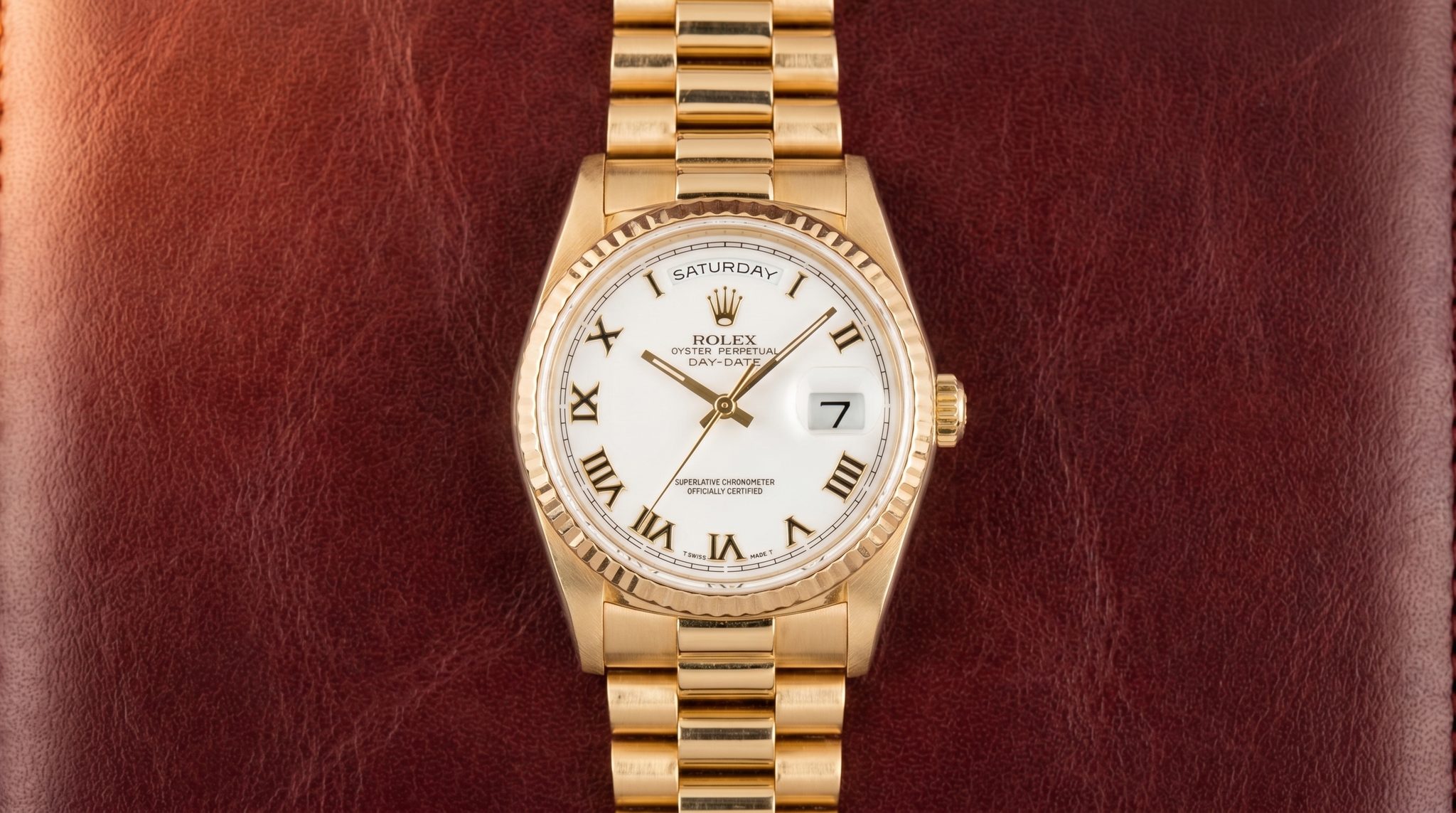
Refs. 18238 and 18239 are the late five-digit Day-Date once the flagship’s defining display becomes fully modern to set. The key distinction is functional rather than visual: Cal. 3155 brings double quickset, so the day and date can be corrected independently from the crown. With the platform now stable, collecting emphasis naturally shifts to configuration, including dial materials and gem-setting, because the reference itself is no longer a proxy for a changing case or movement era. This generation ends with Rolex’s move into the six-digit catalog structure, where the same underlying movement generation largely continues but the line’s execution is treated as the modern continuation of the 36 mm classic.
Updated 36 mm “118”
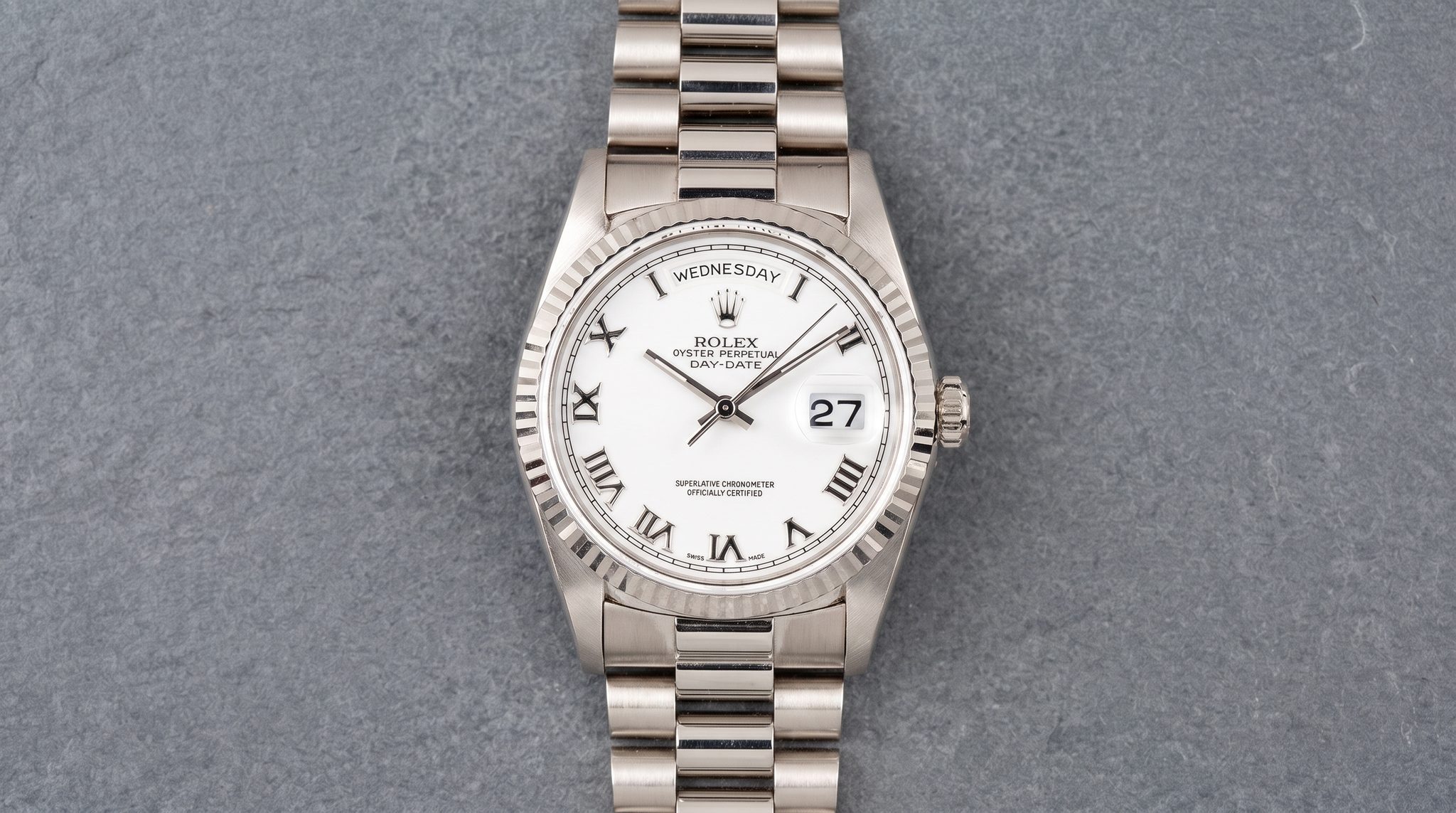
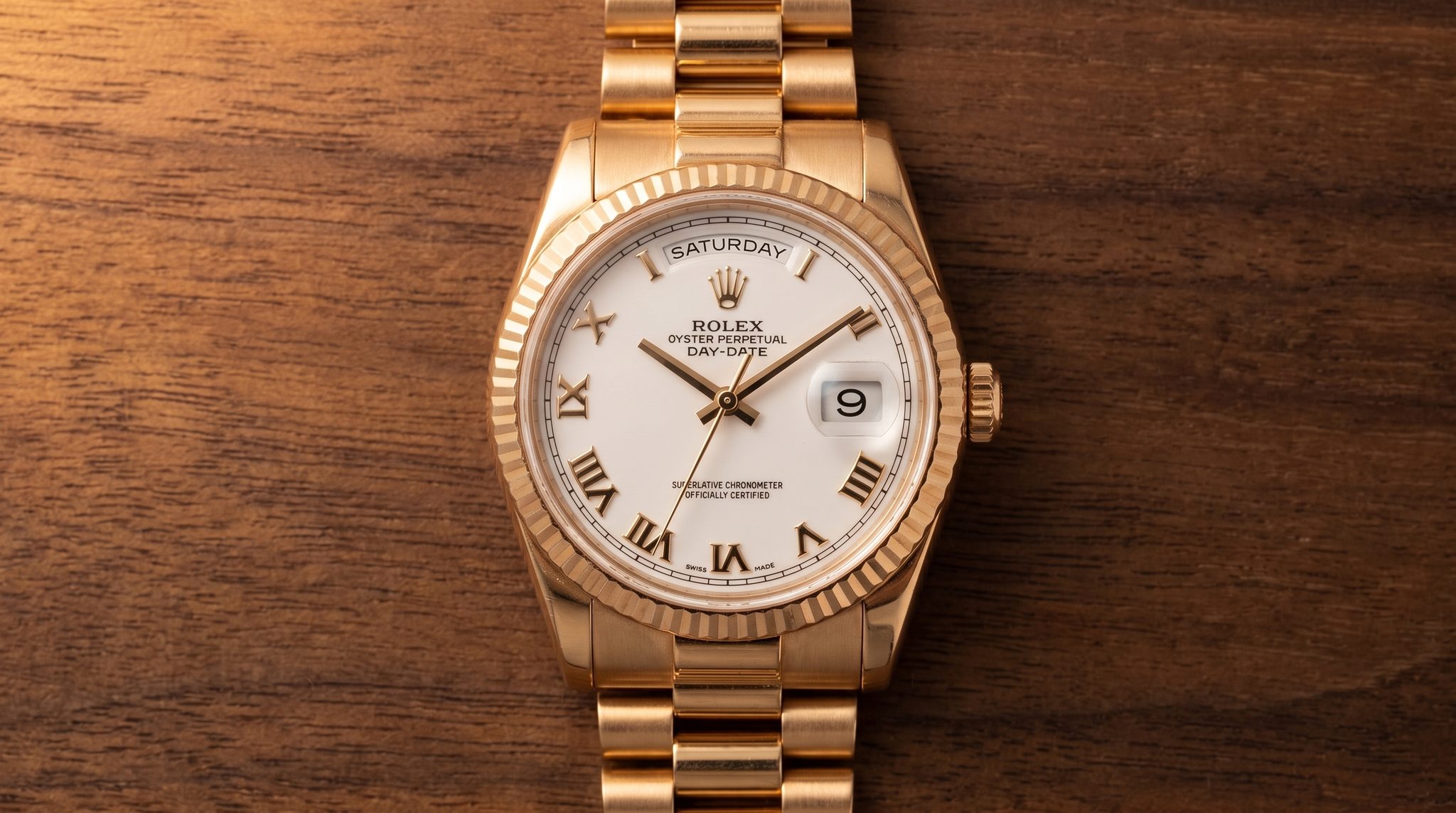
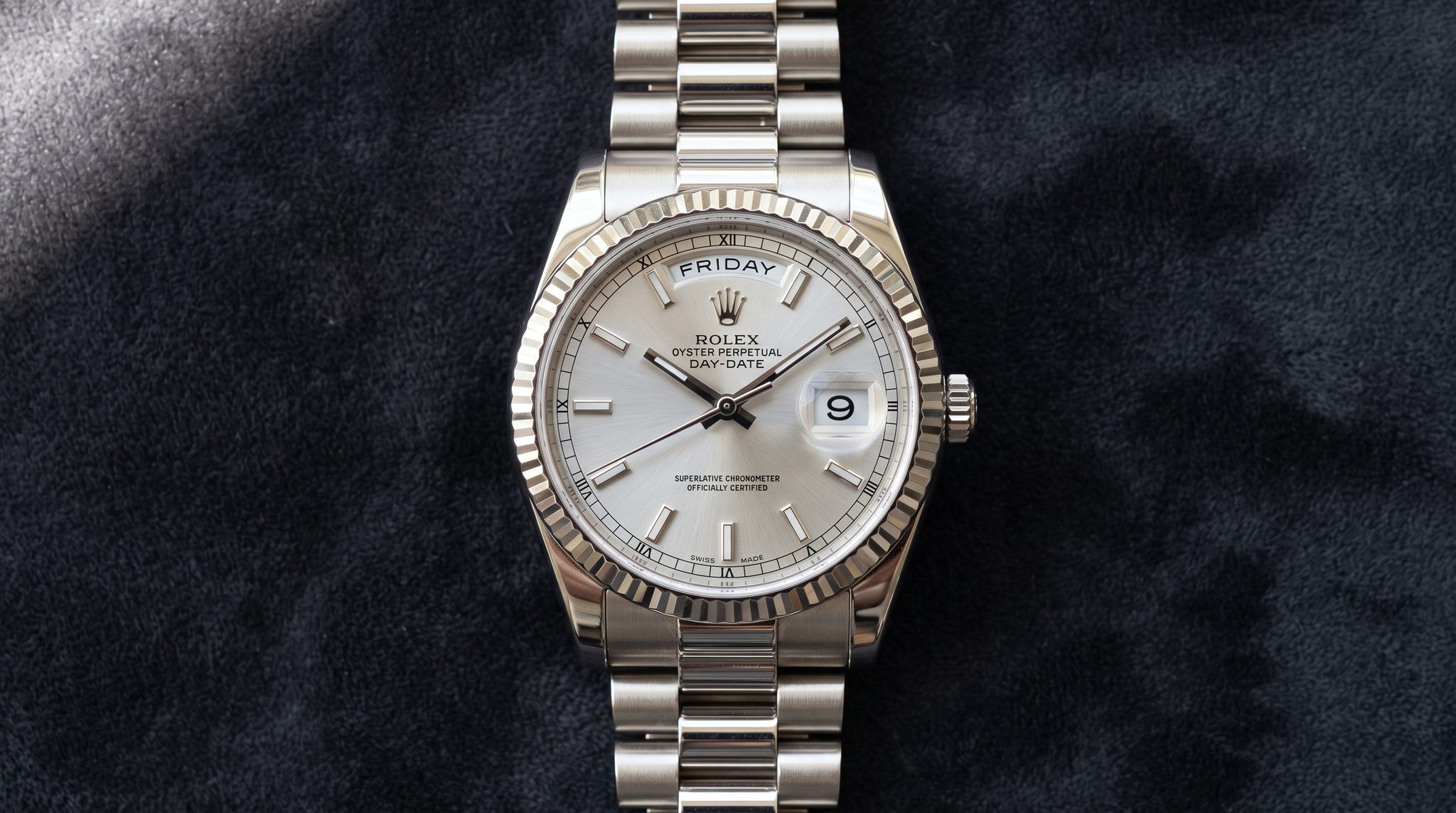
Refs. 118238 and 118239 are best read as the mature 36 mm Day-Date with modern catalog numbering rather than as a fresh mechanical era. Sources support that the core movement generation remains Cal. 3155, so the owning experience is defined less by a new capability and more by how Rolex presents and refines the established formula in the 2000s and 2010s. In yellow gold, this period often feels like the “modern classic” 36. In white gold, the reference becomes a canvas for factory dial variety, including late, high-saturation lacquer looks documented in the market. The era gives way when Rolex’s top-line Day-Date platform shifts to the 40 mm case and Cal. 3255 generation.
Day-Date 40 platform
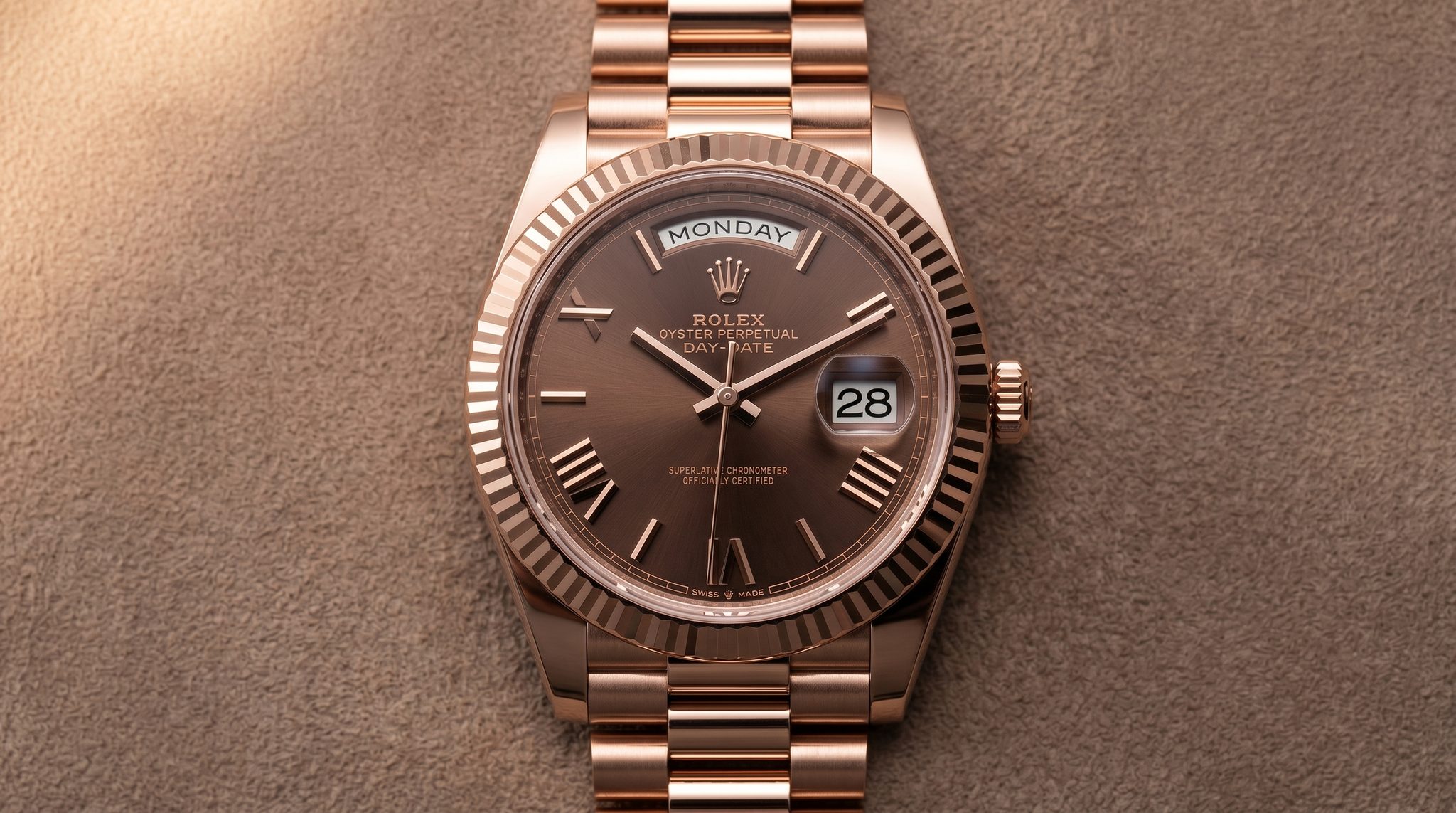
Refs. 228238, 228235, and 228239 define the modern Day-Date as a single platform in three metals. Rolex introduces the Day-Date 40 in 2015, replacing the earlier 41 mm Day-Date II generation and pairing the resized case with Cal. 3255. The family’s evolution here is intentionally controlled: the case proportions, bracelet type, and movement generation stay fixed, while the visible identity often comes down to dial execution, from classic sunburst looks to motif textures and ombré gradients that Rolex describes as a revived style in 2019. The reason this era has not “ended” is that it remains the current, standardized top-line Day-Date architecture.
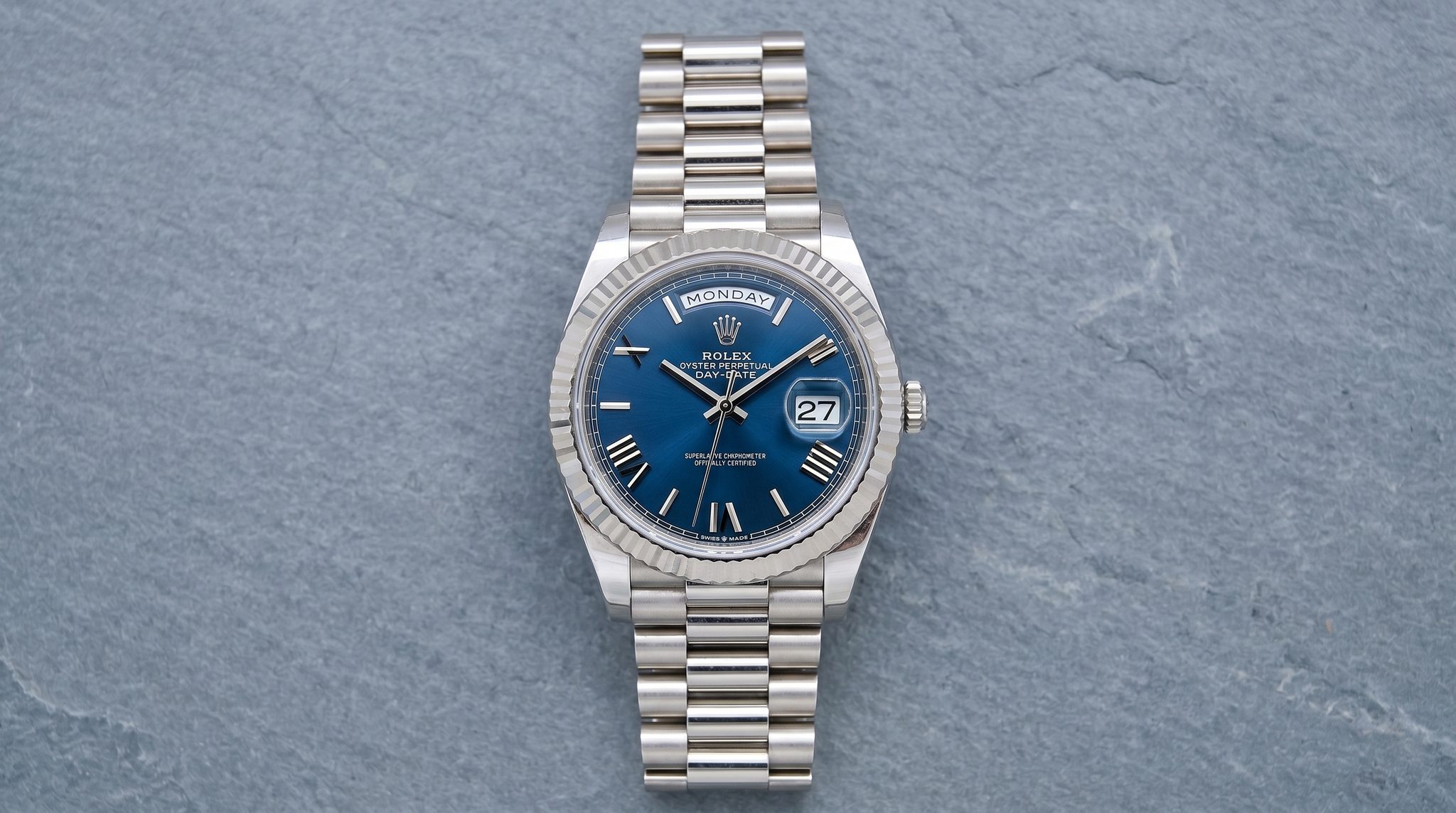
36 mm on Cal. 3255
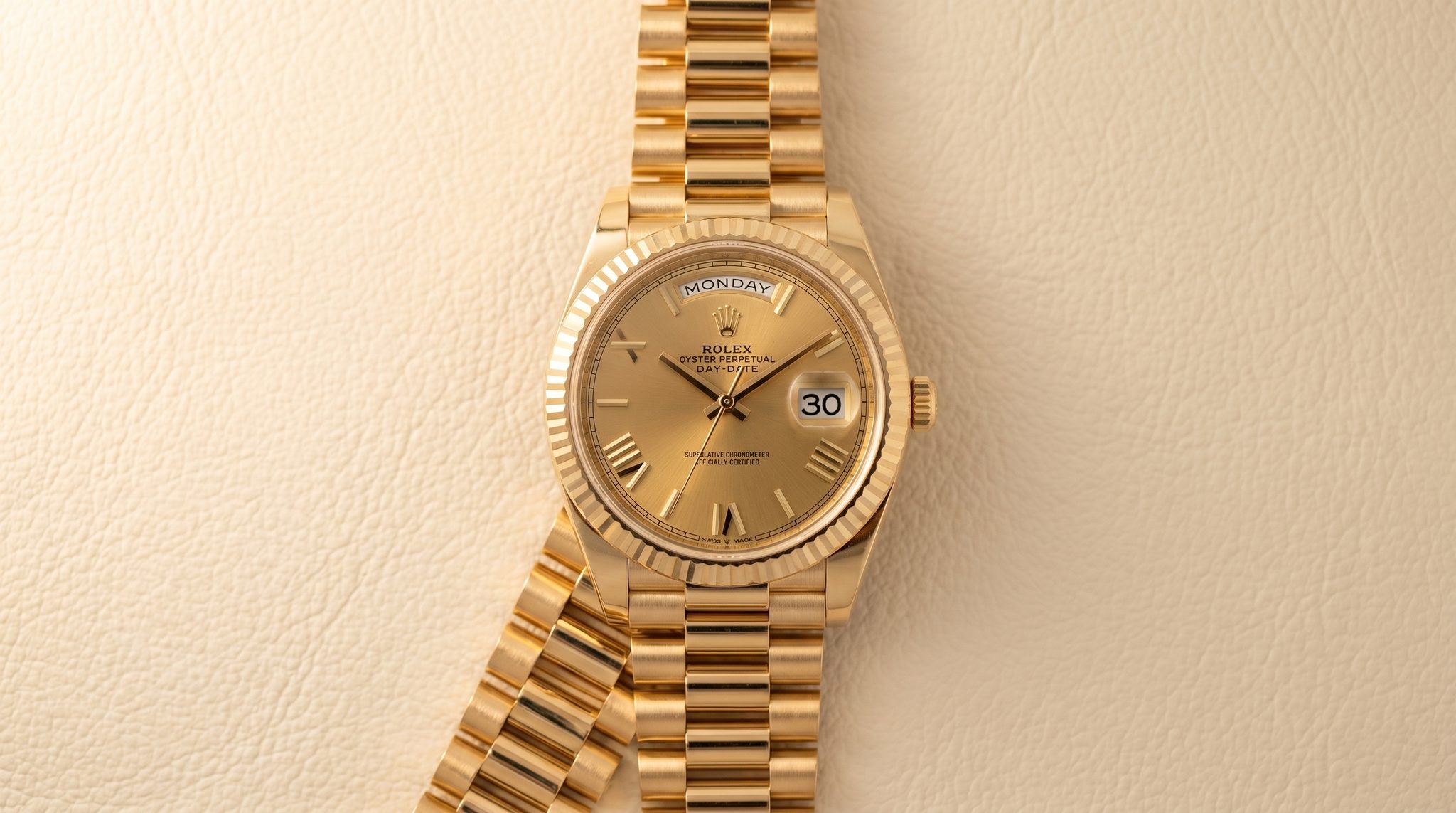
The 128 series brings the 36 mm Day-Date onto caliber 3255, the movement the 40 had carried since 2015, so the two sizes share one mechanical platform for the first time. The 128239 in white gold is the reference to know: a stable case and movement whose collecting story is written almost entirely in its changing dials. The era is open.
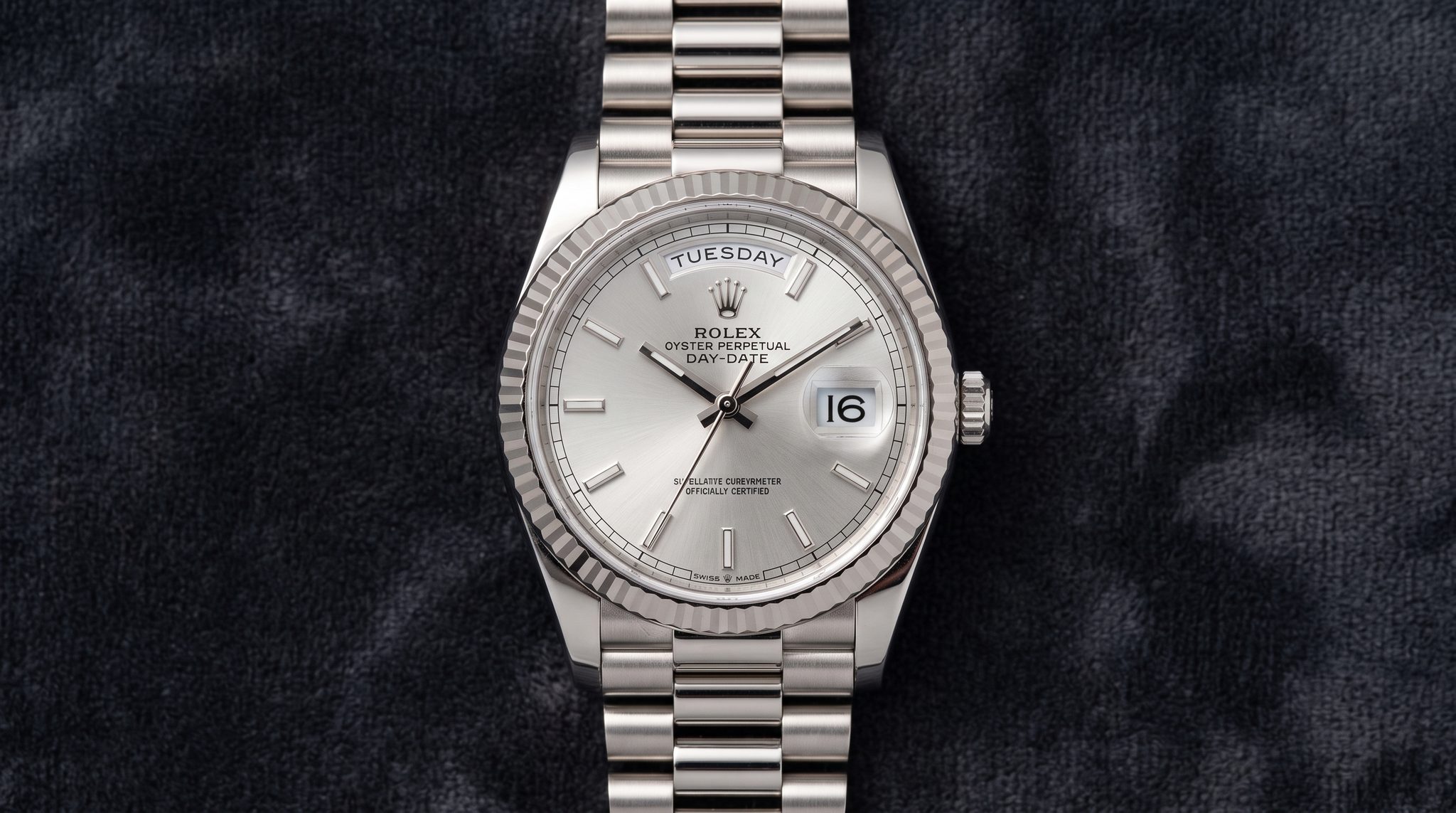
Which Day-Date to buy
For daily wear with minimal fuss, the late five-digit double-quickset era is the cleanest bridge between classic proportion and modern interaction. Ref. 18238 delivers the traditional yellow-gold President presence while letting both day and date be corrected from the crown, which is the Day-Date’s most practical generational dividing line.
For a first vintage Rolex Day-Date, ref. 1803 is the archetype because it preserves the acrylic and pie-pan-era character that later references deliberately leave behind. It is the choice for someone who wants the older setting ritual and the earlier visual architecture, not just an older serial era.
For the reference collector who wants one watch that expresses the family’s “platform plus configuration” idea most strongly, ref. 118239 is the tell. The mechanics are stable across its long run, so the collecting interest concentrates on factory dial outcomes and correctness.
For patience-rewarding modern collecting, ref. 228239 makes the point that the current Day-Date changes through dials more than through hardware. Finding a configuration that feels distinctly of its moment, while remaining coherent and original, is where the upside of waiting tends to live.
What to check on any Day-Date
Buying across the Rolex Day-Date family is less about finding the right complication, every Day-Date has day at 12 and date at 3, and more about proving the watch is correct for its era. The model’s value is unusually concentrated in visible parts that Rolex service and the secondary market can change, especially dials, hands, bezels, and the President bracelet. Frankenwatches assembled from genuine but mismatched components are a recurring risk, particularly on vintage and “modern-vintage” pieces.
Stories that discuss the Day-Date
Common questions about the Day-Date
The Rolex Day-Date is Rolex’s flagship calendar watch, defined by the day of the week spelled out in full at 12 o’clock and the date at 3 o’clock. In 1956 Rolex introduced it as a self-winding, waterproof chronometer with that dual-calendar display. “President” is commonly used as a nickname tied to the model’s prestige positioning and its association with the President bracelet style.
- Day-Date, 2022 information sheet (PDF)newsroom-content.rolex.com
- The Rolex Day-Date Modelsnewsroom.rolex.com
- Rolex Day-Date, those who shape the worldrolex.com
Show 9 more
- Rolex Day-Date, featuresrolex.com
- The Rolex Day-Date: A Complete Collector's Guidesothebys.com
- The Rolex Day-Date Across Erasphillips.com
- A Selection of Glamorous Rolex Day-Date Modelsphillips.com
- The History of the Rolex Day-Date, 1956–presentmonochrome-watches.com
- Rolex Day-Date Ultimate Buying Guidebobswatches.com
- Do Replacement Parts Affect a Rolex's Value?bobswatches.com
- Rolex Watch Market Reportbobswatches.com
- Day-Date (Wikipedia)en.wikipedia.org