

Rolex Day-Date 118238
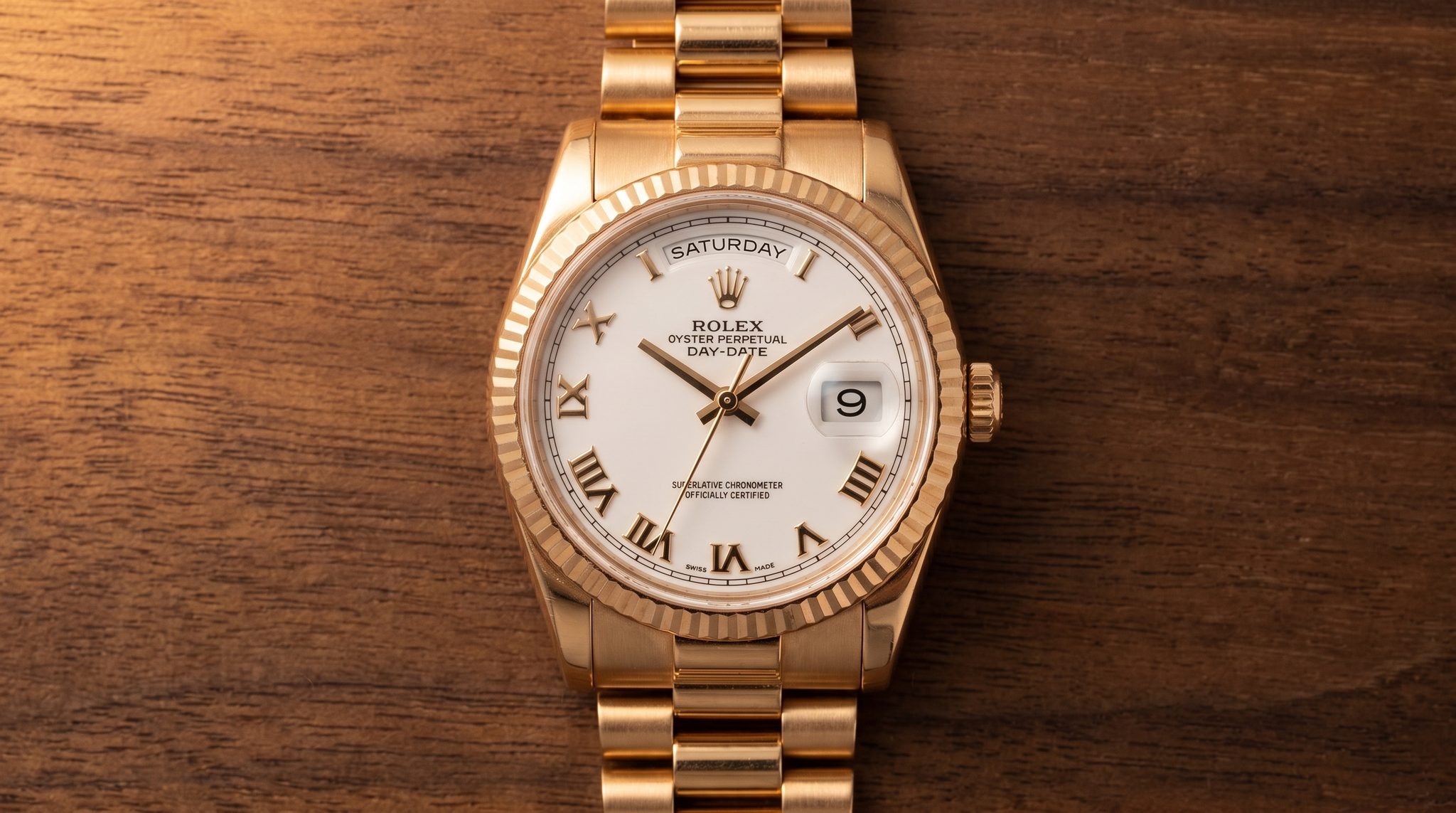
The Rolex Day-Date 118238 is the 36 mm yellow-gold “President” that made the classic format feel decisively newer on the wrist, while the Cal. 3155 remained the constant beneath it.
- Production
- 2000–c. 2019
- Case
- 18 ct yellow gold
- Diameter
- 36 mm
- Bezel
- Fluted (gold)
- Crystal
- Sapphire + Cyclops
- Water res.
- 100 m
- Movement
- Rolex Cal. 3155
- Power
- ~48h
- Jewels
- 31
- Chronometer
- Yes
- Bracelet
- President (solid links)
- Clasp
- Crownclasp
The Rolex Day-Date 118238 was produced from 2000 to about 2019.
- Production years
- 2000–c. 2019
- Replaced
- 18238
- Replaced by
- 128238
- Movement
- Rolex Cal. 3155
The Rolex Day-Date 118238 is the moment the 36 mm yellow-gold Day-Date stopped wearing like a vintage holdover and started wearing like a modern Rolex, without changing the movement that defines the era. The tell is tactile as much as visual: compared with the preceding 18238, the 118238 arrives with broader, fully polished lugs and a heavier-feeling President bracelet built with solid links, then later adds the engraved “ROLEX ROLEX ROLEX” rehaut that marks mid-2000s production.
Introduced in 2000 as the direct successor to the Day-Date 18238, the 118238 keeps the Cal. 3155 at its core, the automatic day-and-date movement known in the Day-Date line for its double quickset calendar and roughly 48-hour power reserve. The formula stays recognizably “President” in the traditional 36 mm size with a fluted bezel, sapphire crystal with Cyclops, and 100 m water resistance, but the execution shifts toward the denser, more integrated feel that collectors associate with Rolex’s six-digit era.
Production-year documentation is uneven in the open record, which is part of the reference’s modern character. Monochrome places the 118238 in a 2000–2009 window, while dated examples and dealer listings show the reference continuing into the 2010s, at least to 2015, with some estimates extending to about 2019. The result is a Day-Date whose defining story is not a new complication or a new size, but the way small, visible manufacturing choices, especially the rehaut, separate early-2000s pieces from later ones.
“The 118238 is the 36 mm Day-Date that feels newer by touch: solid-link President heft, broader polished lugs, and (later) the engraved rehaut that visually dates the era.”
Rolex Day-Date 118238 production years: 2000–c. 2019
The 118238’s history reads less like a reinvention and more like a change in physical language. It arrives in 2000 as the yellow-gold successor to the 18238, keeping the same fundamental engine, Rolex’s Cal. 3155, but translating the Day-Date into the six-digit era through what a wearer notices first: more wrist presence from broader, fully polished lugs, and a President bracelet whose solid-link construction adds mass and reduces the slack collectors associate with older hollow-link bracelets.
The most practical, genuinely datable shift within the reference is the inner rehaut. Early examples present a clean, polished ring between dial and crystal. Around 2004–2005, the same space becomes an identification feature: “ROLEX ROLEX ROLEX” engraving circles the rehaut and the serial moves to 6 o’clock on that ring. Rolex did not publish an exact changeover year for the Day-Date line, but surviving watches cluster in the mid-2000s and later with the engraving, which is why collectors treat it as an approximate transition rather than a hard cutoff.
Later in the run, descriptions of Day-Date 36 production note Rolex’s updated “Superlative Chronometer” standard of −2/+2 seconds per day and a five-year warranty on pieces from about 2015 onward, even though the movement remains Cal. 3155. The reason Rolex’s public-facing chronometer language changes at that point is documented; the exact boundary for the 118238 specifically is not.
One thing becomes clear after tracing these details: in the 118238 era, the Day-Date’s identity is no longer created mainly by case diameter or by the presence of the day window, which have been stable for decades. It is created by manufacturing decisions that live at the edges, the bracelet’s construction, the clasp execution, and even the blank or engraved millimeter of rehaut that frames the dial.
- 2000IntroducedBroader polished lugs
- 2000Cal. 3155Day and date set via crown
- c. 2004 – 2005Rehaut engraved“ROLEX ROLEX ROLEX” ring
- c. 2015Chronometer specVerified by paperwork/service info
- c. 2019SucceededNew ref. 128238 in catalog
118238 against its neighbours
The 118238 sits in a narrow but consequential slot: it is the 36 mm yellow-gold Day-Date that changes how the watch feels and looks at the edges, while the predecessor and successor define the movement bookends. Comparing it to the 18238 and 128238 shows what stayed constant (size, precious metal, the fluted-bezel President formula) and what actually moved the experience forward (bracelet construction, case stance, and later the rehaut era).
This reference 118238 Rolex · focal 2000–c. 2019 | 128238 Successor (36 mm YG) 2019–present | |||
|---|---|---|---|---|
| Production | 1988–2000 | c. 2000s–2010s | 2000–c. 2019 | 2019–present |
| Case | 18k yellow gold | 18k white gold | 18 ct yellow gold | 18 ct yellow gold |
| Diameter | 36 mm | 36 mm | 36 mm | 36 mm |
| Bezel | Fluted | Fluted | Fluted (gold) | Fluted (gold) |
| Crystal | Sapphire + Cyclops | Sapphire + Cyclops | Sapphire + Cyclops | Sapphire + Cyclops |
| Water res. | 100 m | 100 m | 100 m | 100 m |
| Movement | Cal. 3155 | Cal. 3155 | Rolex Cal. 3155 | Rolex Cal. 3255 |
| Power | ~48h | ~48h | ~48h | ~70h |
| Bracelet | President | President | President (solid links) | President (gold) |
What to check before buying a 118238
Buying a Rolex Day-Date 118238 is less about chasing a rare mechanical sub-reference and more about confirming that the watch still wears like the reference is meant to wear. The headline risks are configuration and condition: the 118238 was offered with a wide matrix of dials, including non-luminous, diamond-set, and stone executions, which means an attractive dial is not automatically an original dial.
The other practical dating and authenticity checkpoint is the rehaut. A smooth inner rehaut suggests early production; an engraved “ROLEX ROLEX ROLEX” rehaut with the serial at 6 points to mid-2000s or later. That case-era marker is independent of dial choice, so it helps anchor a watch whose dial offerings overlap across the entire run.
In ownership, the 118238 tends to reward buyers who want the traditional 36 mm Day-Date presence with a more modern feel. It keeps the Cal. 3155 and the classic day-and-date layout, but its broader-lug case and solid-link President bracelet shift the experience toward weight, shine, and density, the attributes many people associate with the six-digit Day-Date generation.
Rolex Day-Date 118238 price and value
A Rolex Day-Date 118238 sells for about $19,500 at the median, typically $15,000 to $25,500 across 69 comparable sales.
Rolex Day-Date 118238 for sale
Indicative figures from recent dealer, auction, and Grey Market sales (updated this week). Every watch is verified before it sells here.
Each point is a recent dealer or auction sale, banded to an indicative figure. The range shown is not a valuation.
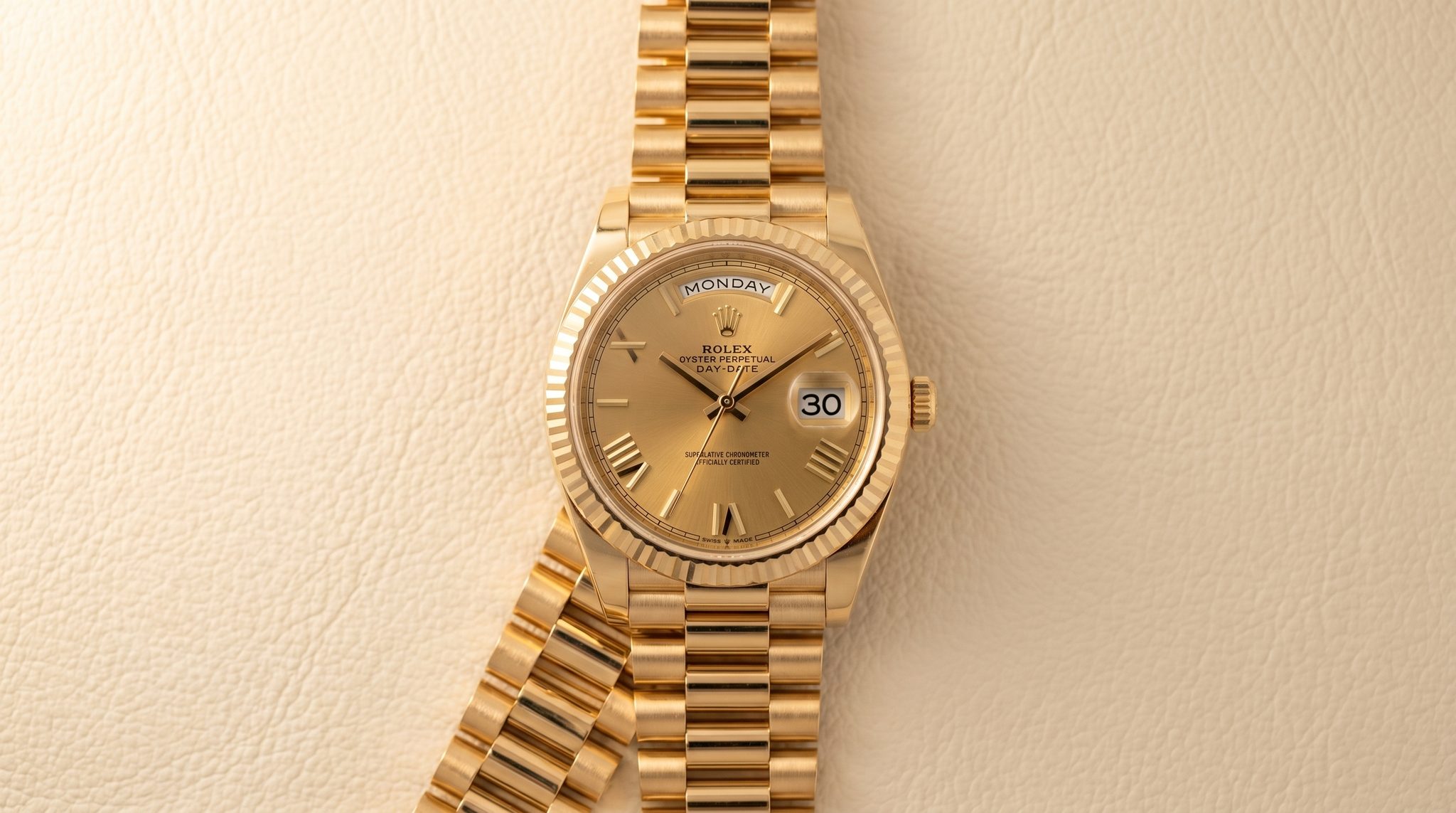
Adjacent in the Day-Date family
Common questions about the 118238
Ref. 118238 is documented as introduced in 2000. Its end date is not firmly documented in open sources: Monochrome cites 2000–2009, while dated examples and dealer listings show production continuing into the 2010s, at least to 2015, with some estimates extending to about 2019.
- In-Depth: The History of the Rolex Day-Date, The Presidential Watchmonochrome-watches.com
- Rolex 118238 Review: Deep Dive Into A Classic Day-Date Referencebobswatches.com
- Rolex Day-Date: The Ultimate Gold Watchswisswatchexpo.com
Show 7 more
- More Information About the Rolex 118238chrono24.com
- Rolex Day-Date 118238 Watches indexcollectorsquare.com
- Rolex Day-Date 36 watch: 18 ct yellow gold (m128238-0008)rolex.com
- Rolex Day-Date President 118238 - HODINKEE Shopshop.hodinkee.com
- Rolex Day-Date 118238: Buy Pre-Owned Watcheswatchguys.com
- What's the difference between Rolex reference code 18238, 118238...reddit.com
- Rolex Day-Date 118238 Review - YouTubeyoutube.com