

Rolex Day-Date 1803
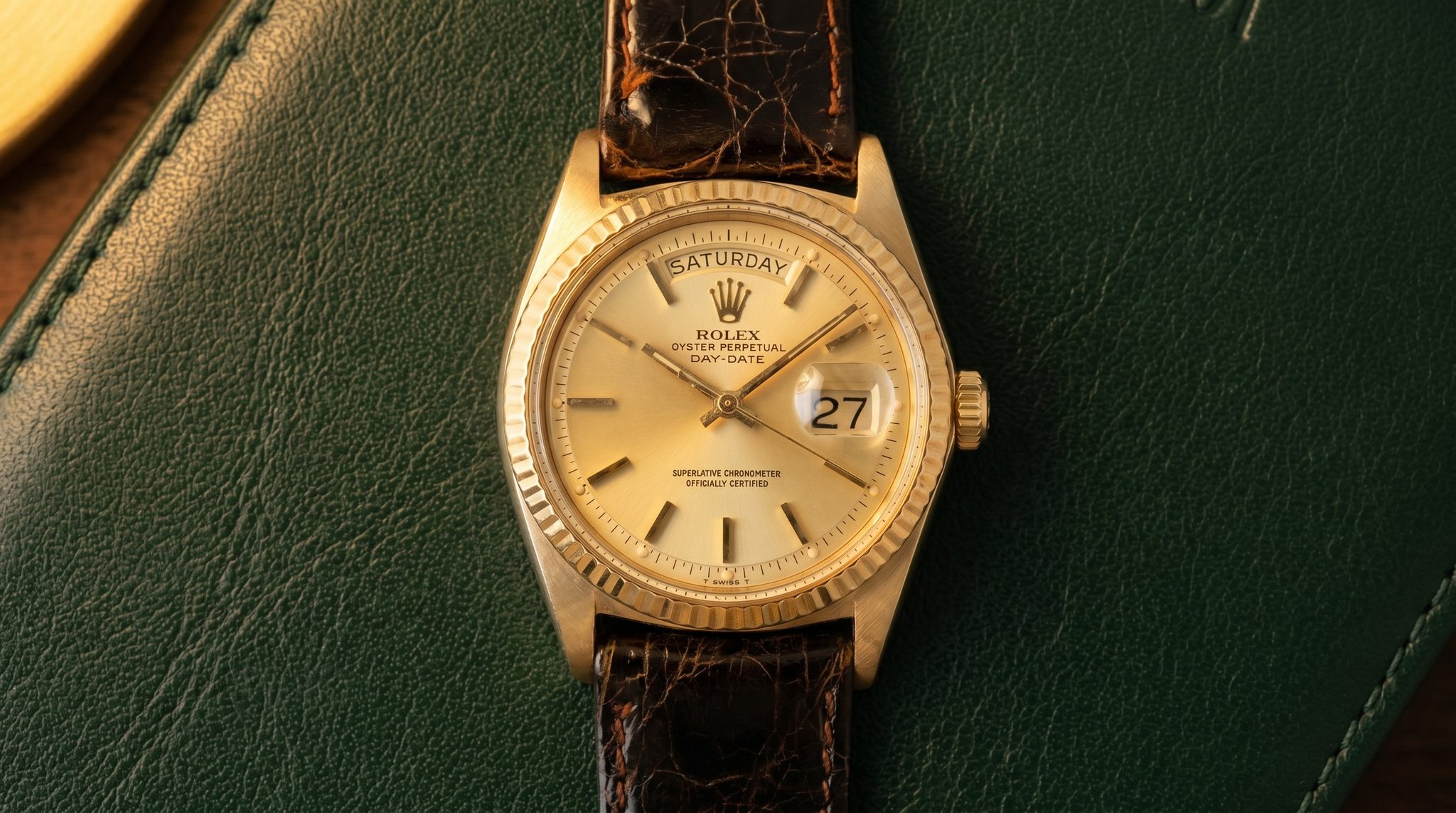
The Rolex Day-Date 1803 is the reference that fixed the “President” in collectors’ minds: fluted bezel, acrylic crystal, and the sharply stepped pie-pan dial, before the line turned modern with sapphire and quickset.
- Production
- c. 1959/60–1977/78
- Case
- 18k gold (yellow/white/rose)
- Diameter
- 36 mm
- Bezel
- Fluted
- Crystal
- Acrylic (plexi)
- Dial
- Pie-pan (typical)
- Movement
- Cal. 1555 → 1556
- Chronometer
- Yes
- Quickset
- None (day & date)
- Bracelet
- President (typical)
- Complications
- Day + date
The Rolex Day-Date 1803 was produced from about 1959 to about 1977.
- Production years
- c. 1959/60–1977/78
- Replaced by
- 18038
- Movement
- Cal. 1555 → 1556
The Rolex Day-Date 1803 is the Day-Date in its most definitive, most “vintage” form, the last of the line where the watch’s character is built from acrylic warmth and a true pie-pan step, not sapphire flatness and quickset convenience. The proof is structural: ref. 1803 sits at the end of the acrylic, pie-pan era, and the immediate successor ref. 18038 switches to sapphire crystal and a flat dial, and brings a quickset date movement.
That makes the 1803 more than a reference number. It is the point at which the Day-Date’s signature cues crystallized at full strength: a 36 mm gold Oyster case, a fluted bezel that catches light in hard facets, and the recessed, sloped perimeter of the pie-pan dial framing the day at 12 and the date under the cyclops at 3. Under the hood it stays resolutely old-school, with Rolex calibres 1555 and 1556 and the familiar non-quickset setting ritual. Even within its long run, the 1803 never turns into a different watch, it simply accumulates eras: early non-hacking movements, later hacking, radium-era “SWISS” dials, tritium T-marked dials, and the late, high-saturation Stella lacquers that now define an entire collecting niche.
Because so much of the Day-Date 1803’s value lives on the surface, the reference is also a lesson in seeing. A crisp pie-pan edge looks like a clean architectural step; a softened one reads flat. A correct tritium dial announces itself in a small line of text at 6 o’clock. The President bracelet can feel like the watch’s natural habitat, or like a tired add-on if it is stretched and repaired. In the 1803 market, those sensory details are not trivia, they are the difference between an honest period President and a watch rebuilt by service parts.
“Ref. 1803 is the Day-Date before the modern era: acrylic over a true pie-pan, fluted gold, and the non-quickset “President” feel that the sapphire, quickset references left behind.”
Rolex Day-Date 1803 production years: c. 1959/60–1977/78
The Day-Date 1803’s story is not a march of redesigns so much as a long stretch where the same silhouette absorbs changing Rolex practice. The reference appears around 1959/1960 and remains in production into the late 1970s, a span long enough for the movement to evolve from calibre 1555 to 1556, and for usability to change again when stop-seconds arrives on later 1556 movements around 1971–72. Rolex never tied those movement steps to a single dial or case change, so two watches that look nearly identical from across a room can behave differently when you pull the crown.
Dial text and luminous material run on their own track. Early examples can show simple “SWISS” at 6 o’clock, a signature associated with the radium-era transition in the early 1960s. Later in the 1960s and through the 1970s, tritium becomes the norm on luminous dials, and the watch announces it plainly with “T SWISS T” or “SWISS – T < 25.” The important part is visual, not theoretical: the plots and hands age together under acrylic, often turning creamy or yellowed, and the most convincing watches look internally consistent, like the dial and hands have shared the same decades.
Late in the run, the 1803 also becomes the bridge between conservative dress execution and the Day-Date’s most playful dial chapter. Stella lacquer dials belong to the 1970s Day-Date world, and they appear on late 1803s before becoming more common on successor references. Their appeal is partly color and partly fragility: the lacquer is glossy and enamel-like, and the same surface that makes them look liquid can also craze or crack over time.
The zoom-out view is what makes the reference satisfying to collect. The core cues stay constant, fluted bezel, 36 mm gold case, acrylic crystal, pie-pan architecture, while almost everything enthusiasts argue about happens in parallel layers: movement generation, hacking or not, T-marked or not, luminous or intentionally non-luminous, and ordinary sunburst metal dials versus the late lacquer outliers. The result is a reference that reads like a single archetype, but rewards close looking like a whole era.
- c. 1959/1960IntroducedPie-pan dial under acrylic
- c. 1964 – 1966Calibre shift1556 marked on bridge
- c. 1962 – 1964Lume era“SWISS” vs “T SWISS T”
- c. 1971 – 1972Hacking addedSeconds stops at setting
- c. 1970sStella eraGlossy saturated lacquer
- c. 1977/1978DiscontinuedSuccessor has sapphire crystal
1803 against its neighbours
The 1803 makes the most sense when framed by one peer and one descendant. Ref. 1802 is effectively the same watch mechanically, but swaps the 1803’s fluted bezel for a smooth one, making it the closest “same era, different expression” alternative. Ref. 18038 is the direct successor that marks the Day-Date’s technical and visual turn: sapphire crystal, flat dial, and a quickset date movement.
1802 Sibling (smooth bezel) c. 1959/60–1977/78 | This reference 1803 Rolex · focal c. 1959/60–1977/78 | |||
|---|---|---|---|---|
| Production | c. 1959/60–1977/78 | c. 1959/60–1977/78 | 1977–1988 | 1988–2000 |
| Case | – | 18k gold (yellow/white/rose) | 18k yellow gold | 18k yellow gold |
| Diameter | 36 mm | 36 mm | 36 mm | 36 mm |
| Bezel | Smooth | Fluted | Fluted | Fluted |
| Crystal | Acrylic (plexi) | Acrylic (plexi) | Sapphire | Sapphire |
| Dial | Pie-pan (typical) | Pie-pan (typical) | Flat | Flat |
| Movement | Cal. 1555 → 1556 | Cal. 1555 → 1556 | Cal. 3055 | Cal. 3155 |
| Chronometer | Yes | Yes | Yes (COSC) | Yes (COSC) |
| Quickset | None (day & date) | None (day & date) | Single (date) | Double (day & date) |
| Water res. | – | – | 100 m | 100 m |
| Bracelet | President (typical) | President (typical) | President | President |
| Complications | Day + date | Day + date | Day + date | Day + date |
Eight dial generations across the run
The earliest Day-Date 1803 dials can be identified by a simple “SWISS” at 6 o’clock, with no tritium “T” marking. On a watch in hand, this is a small detail that changes the whole mood of the dial: the printing feels sparer, and the luminous plots often show darker, granular aging consistent with the radium-to-tritium transition era. Day-Date-specific documentation for radium on 1803 is thinner than on many sport models, so the best use of this trait is as part of a coherent early watch rather than a standalone claim. An early-serial 1803 with a correct-looking “SWISS” dial, period hands, and consistent patina can be compelling; a “SWISS” dial on a later watch should trigger closer scrutiny for swaps.
What to check before buying a 1803
A Rolex Day-Date 1803 is often described as straightforward because the silhouette is so consistent, but the buying risk is concentrated in the parts that are easiest to swap. Dials, hands, bezels, and bracelets all carry a large share of the watch’s value, and service or aftermarket replacements are common enough that a single incorrect piece can quietly change what the watch is.
The biggest price lever is dial authenticity and condition. “Pie-pan” is routinely used as a sales term, so it is worth verifying the geometry with the same care you would give a movement photo. Lume is the next check: T-marked tritium dials should have plots and hands that look like they have aged together, while non-lume dials should look intentionally clean rather than stripped. Bracelet condition matters nearly as much as the head, since a correct, tight President bracelet commands a clear premium, and stretch or repairs are expensive to address.
The 1803 also rewards clarity about the kind of vintage you want to live with. A later hacking 1556 is easier to time precisely; an earlier non-hacking example leans into the period feel. Either way, the daily experience is the same essential ritual, because the day and date are non-quickset. For many owners that is exactly the point: the Day-Date 1803 wears like a dress watch with a little ceremony built in, and in return it gives you the last generation where acrylic and a true pie-pan step are not nostalgic styling, they are the original construction.
Rolex Day-Date 1803 price and value
A Rolex Day-Date 1803 sells for about $9,300 at the median, typically $7,100 to $12,250 across 393 comparable sales.
Rolex Day-Date 1803 for sale
Indicative figures from recent dealer, auction, and Grey Market sales (updated this week). Every watch is verified before it sells here.
Each point is a recent dealer or auction sale, banded to an indicative figure. The range shown is not a valuation.
Stories that discuss the 1803
Common questions about the 1803
The Rolex Day-Date 1803 was produced from about 1959 to about 1977, with exact start and end cutoffs not documented to a single universally agreed year.
- The Rolex Day-Date: A Complete Collector's Guidesothebys.com
- Vintage Rolex Day-Date 1803 Ultimate Buying Guidebobswatches.com
- Rolex 1803 (Day-Date) » Check Prices & Morewristler.eu
Show 7 more
- Rolex 1803 - Day-Date 36 watcheschrono24.com
- Rolex Day-Date reference 1803: an in-depth looktimelessvintage.watch
- An owner's review of the vintage Rolex Day-Date ref. 1803timeandtidewatches.com
- A brief history of the Rolex Day-Datethebeautifulwatch.com
- Rolex 1803 Presidential Day-Date History | Inside Watches Bob's...youtube.com
- Rolex Day-Date Ref. 1803 - Non-Luminous Sunburst Champagne Dial (example listing)oliverandclarke.com
- Vintage Rolex Day-Date 1803 Buying Guideswisswatchexpo.com