

Rolex Day-Date 228239
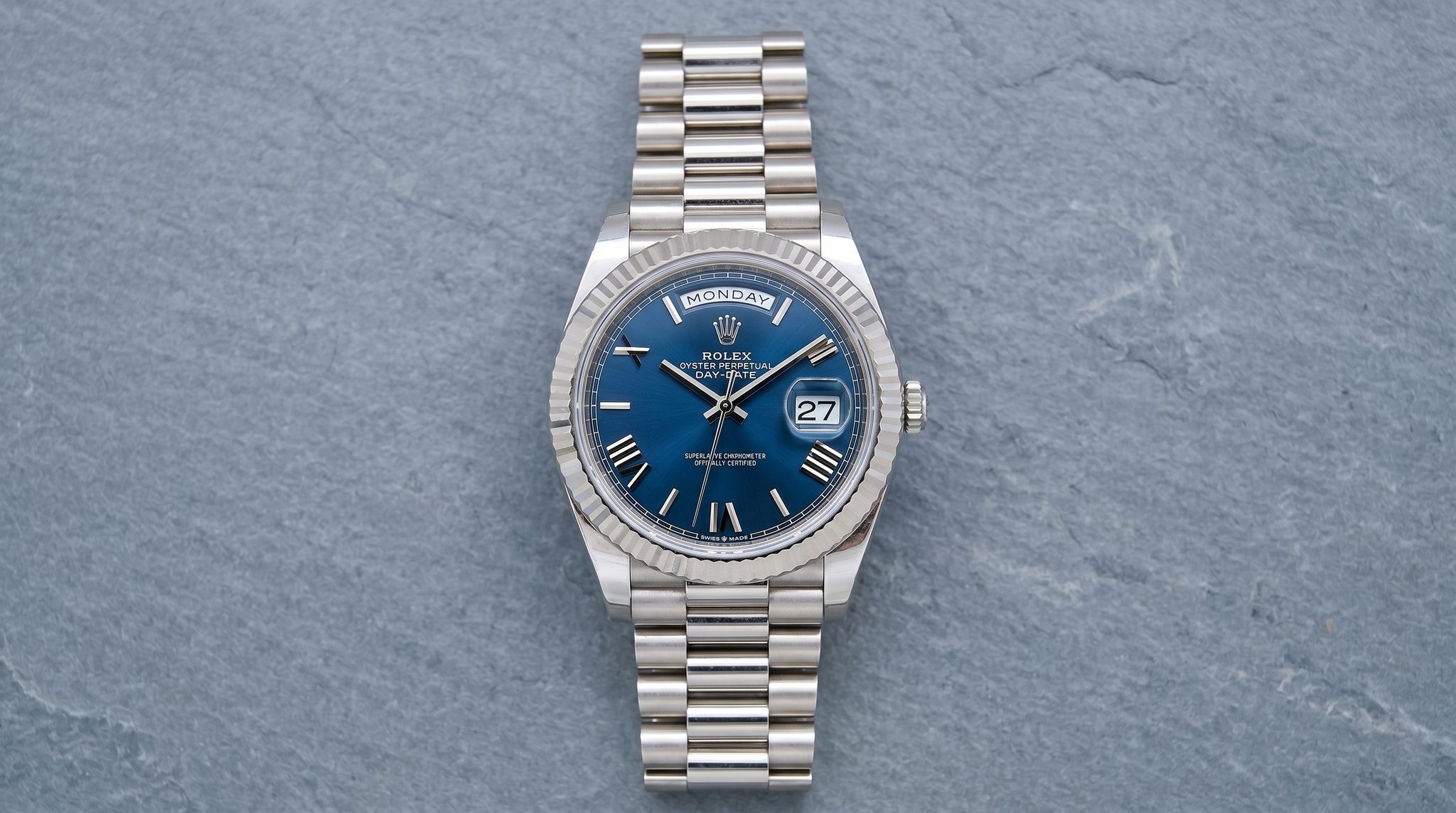
The Rolex Day-Date 40 ref. 228239 is a mechanically single-generation President that stays constant in white gold and Cal. 3255, while Rolex’s rolling dial program does most of the talking.
- Production
- 2015–present
- Case
- 18 ct white gold
- Diameter
- 40 mm
- Thickness
- ~12 mm
- Lug span
- ~47.4–47.5 mm
- Lug width
- 21 mm
- Bezel
- Fluted
- Crystal
- Sapphire + Cyclops
- Water res.
- 100 m
- Movement
- Cal. 3255
- Power
- ~70h
- Chronometer
- Yes (−2/+2 s/d)
The Rolex Day-Date 228239 has been in production since 2015.
- Production years
- 2015–present
- Replaced
- 218239
- Movement
- Cal. 3255
The Rolex Day-Date 228239 is the modern President in its most literal form: one fixed white-gold platform, introduced in 2015 with Cal. 3255 and still in the catalogue, that lets the dial carry nearly all the variation collectors argue about. The vivid tell is how little the hardware needs to change to keep it current. At roughly 40 mm across and about 12 mm thick, with the same fluted bezel and President bracelet throughout the run, the reference is defined less by “which generation” and more by “which dial.”
Rolex positions the Day-Date 40 as the post-2015 large-case Day-Date, replacing the 41 mm Day-Date II era. In ref. 228239, that shift paired the new Day-Date 40 case with Rolex’s new-generation day-date movement, Cal. 3255, built around the Chronergy escapement and a 70-hour power reserve. Rolex also applies its Superlative Chronometer standard, regulating the cased watch to −2/+2 seconds per day.
Because the case and movement are stable, the most meaningful differences inside “Rolex 228239” show up on the wrist: a dial that breaks into subtle quadrant sectors, an olive-green sunray that changes with light, a meteorite slice with natural Widmanstätten pattern, or a newer blue ombré gradient that darkens toward the edge. Rolex does not publish a complete dial-by-dial timeline for the 228239, so exact start and end dates for many colors and materials are not documented. That uncertainty is part of how the reference is collected: the watch is straightforward to define mechanically, and surprisingly nuanced to pin down aesthetically.
“Ref. 228239 is a single, stable Day-Date 40 platform in white gold; the collecting story is almost entirely written on the dial.”
Rolex Day-Date 228239 production years: 2015–present
In the Day-Date line, ref. 228239 is notable for how cleanly it separates “platform” from “presentation.” When Rolex introduced the Day-Date 40 in 2015, it effectively drew a line under the Day-Date II generation and installed a new mechanical baseline at the top of the range: Cal. 3255, with its 70-hour reserve and Rolex’s in-case −2/+2 seconds-per-day standard. From that point forward, the reference’s identity is easy to state and hard to confuse: 18 ct white gold, fluted bezel, President bracelet, day at 12 and date at 3 under a Cyclops, and 100 m water resistance.
What moves, instead, is the surface. Over the 2015–present run, Rolex has treated the 228239 as a canvas for shifting dial executions, from conservative sunray and lacquer looks to more explicit statements like quadrant motifs, olive-green sunray dials, and later ombré gradients that visibly deepen toward the perimeter. Special-material dials such as meteorite are documented in dealer and auction listings in the late 2010s through the early 2020s, but Rolex does not confirm start and end dates for those configurations, and tighter dating remains disputed.
The zoomed-out view is that the modern Day-Date can change quickly without ever changing its fundamentals. The 228239 makes that visible: the same white-gold case and the same 3255 movement can read traditional, contemporary, or maximalist, depending on a dial choice that Rolex can rotate independently of the underlying watch. It is a reference that rewards learning what you are looking at, not hunting for hidden mechanical sub-generations.
- 2015Introduced40 mm DD40; ref. 228239
- 2015Cal. 3255Cal. 3255 (verify by watchmaker)
- c. 2016Dial programCatalogue dial changes
- c. 2018 – 2022Special dialsMeteorite dial option
- c. 2020sOmbré dialsBlue ombré catalogue dial
- 2025Still currentRolex lists 228239
228239 against its neighbours
The most useful comparisons for the Day-Date 228239 are the watch it replaced in the large-case slot, and the same Day-Date 40 platform in other precious metals. The contrast highlights what actually changes in this era: case size and movement generation at the 2015 handoff, and then metal choice across siblings that otherwise share the same architecture and Cal. 3255.
218239 Predecessor (Day-Date II) 2008–2015 | This reference 228239 Rolex · focal 2015–present | |||
|---|---|---|---|---|
| Production | 2008–2015 | 2015–present | 2015–present | 2015–present |
| Case | 18 ct white gold | 18 ct Everose gold | 18 ct yellow gold | 18 ct white gold |
| Diameter | 41 mm | 40 mm | 40 mm | 40 mm |
| Bezel | Fluted | Fluted | Fluted | Fluted |
| Crystal | Sapphire + Cyclops | Sapphire + Cyclops | Sapphire + Cyclops | Sapphire + Cyclops |
| Water res. | 100 m | 100 m | 100 m | 100 m |
| Movement | Cal. 3156 | Cal. 3255 | Cal. 3255 | Cal. 3255 |
| Power | ~48h | ~70h | ~70h | ~70h |
| Chronometer | Superlative (COSC) | Yes (−2/+2 s/d) | Yes (−2/+2 s/d) | Yes (−2/+2 s/d) |
Six dial generations across the run
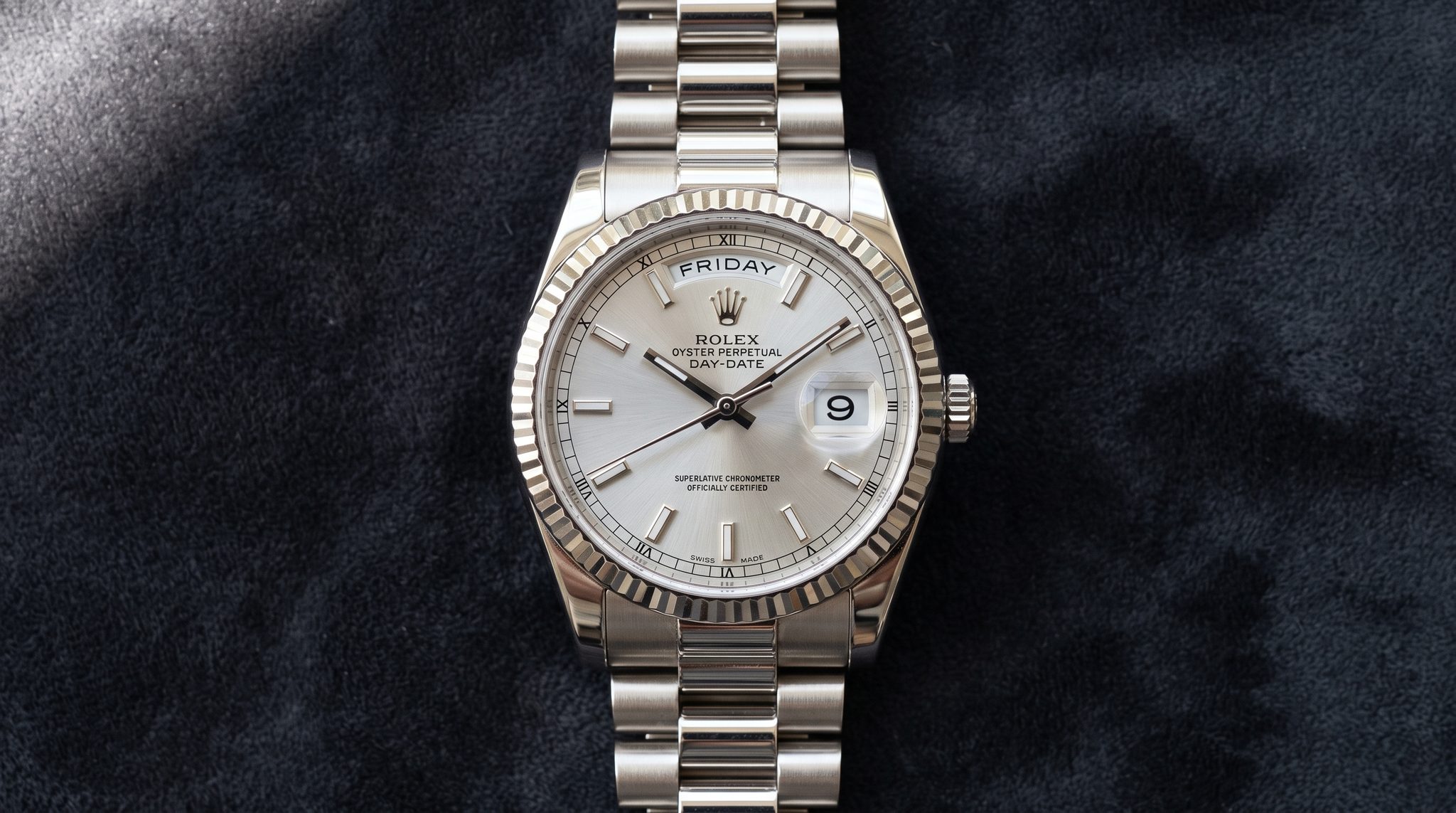
For ref. 228239, the most common “baseline” is not a single frozen configuration but a family of conventional dials that Rolex can rotate without changing the watch itself. In listings and reviews these appear as simple sunray or lacquer dials in conservative colors such as silver, black, blue, or white, paired with different marker styles (batons, Romans, or diamonds). Rolex does not publish start and end dates for each color and marker combination on the 228239, so these dials are best understood as recurring catalogue types whose exact line-up changes by period.
In hand, these are the dials that emphasize the Day-Date’s architecture: the long, fully spelled day aperture at 12, the Cyclops at 3, and the way the sharply cut fluted bezel catches light around an otherwise restrained face. Because the hardware is constant, the practical collector focus is simply correctness for the specific configuration being offered: dial type and marker set should match paperwork when available, and the finishing should look factory-crisp rather than reworked.
What to check before buying a 228239
Buying a Day-Date 228239 is less about choosing the “right year” and more about buying the right configuration. The platform itself is stable, which narrows mechanical surprises, but it also makes dial correctness the main value risk: the 228239 has numerous official dial executions, and the secondary market includes dial-swapped watches where a more desirable dial has been fitted later.
Condition matters in ways that are specific to this reference’s materials. The 18 ct white-gold President bracelet is a major part of the value, and stretch, link loss, and heavy polishing can change the feel of the watch as much as any dial choice. The fluted bezel is another tell: its facets should look sharply defined, and soft, rounded flutes are a warning sign of aggressive refinishing.
A well-bought 228239 is a particular kind of ownership experience. It wears as a substantial precious-metal daily watch, with modern 100 m water resistance and a long-running Cal. 3255, and it lets a buyer choose between restraint and showmanship without changing references. In practice, the best examples are the ones that look “of a piece”: a dial, bracelet, and case finish that make sense together, supported by paperwork that matches what is on the wrist.
Rolex Day-Date 228239 price and value
A Rolex Day-Date 228239 sells for about $41,500 at the median, typically $38,500 to $49,000 across 44 comparable sales.
Rolex Day-Date 228239 for sale
Indicative figures from recent dealer, auction, and Grey Market sales (updated this week). Every watch is verified before it sells here.
Each point is a recent dealer or auction sale, banded to an indicative figure. The range shown is not a valuation.
Adjacent in the Day-Date family
Common questions about the 228239
Rolex introduced the Day-Date 40 ref. 228239 in 2015 and it remains in production at least through 2025, with no documented successor reference yet.
- Rolex Day-Date 40 watch: 18 kt white gold - m228239-0076 (US)rolex.com
- Rolex Day-Date 40 watch: 18 kt white gold - m228239-0033 (US)rolex.com
- Hands-On: The Rolex Day-Date 40 Refs. 228239 And 228235fratellowatches.com
Show 7 more
- Rolex Day-Date 228239-0004 - Rolex Certified Pre-Owned Reviewyoutube.com
- Rolex Day-Date 40 GREEN Dial White Gold 228239... - YouTubeyoutube.com
- Rolex 228239 Watches - Prices, Models, Details | Covetedcoveted.com
- Pre-Owned Rolex Day-Date 40 Ref 228239 Black Diamond Dialbobswatches.com
- Rolex Day-Date 40 228239 White Gold Blue Roman Numeral Dial...wristaficionado.com
- SwissWatchExpo Ultimate Guide to the Rolex Day-Dateswisswatchexpo.com
- Rolex Introduces Day-Date 228239 Model at Baselworld 2016rubberb.com