

Rolex Day-Date 18239
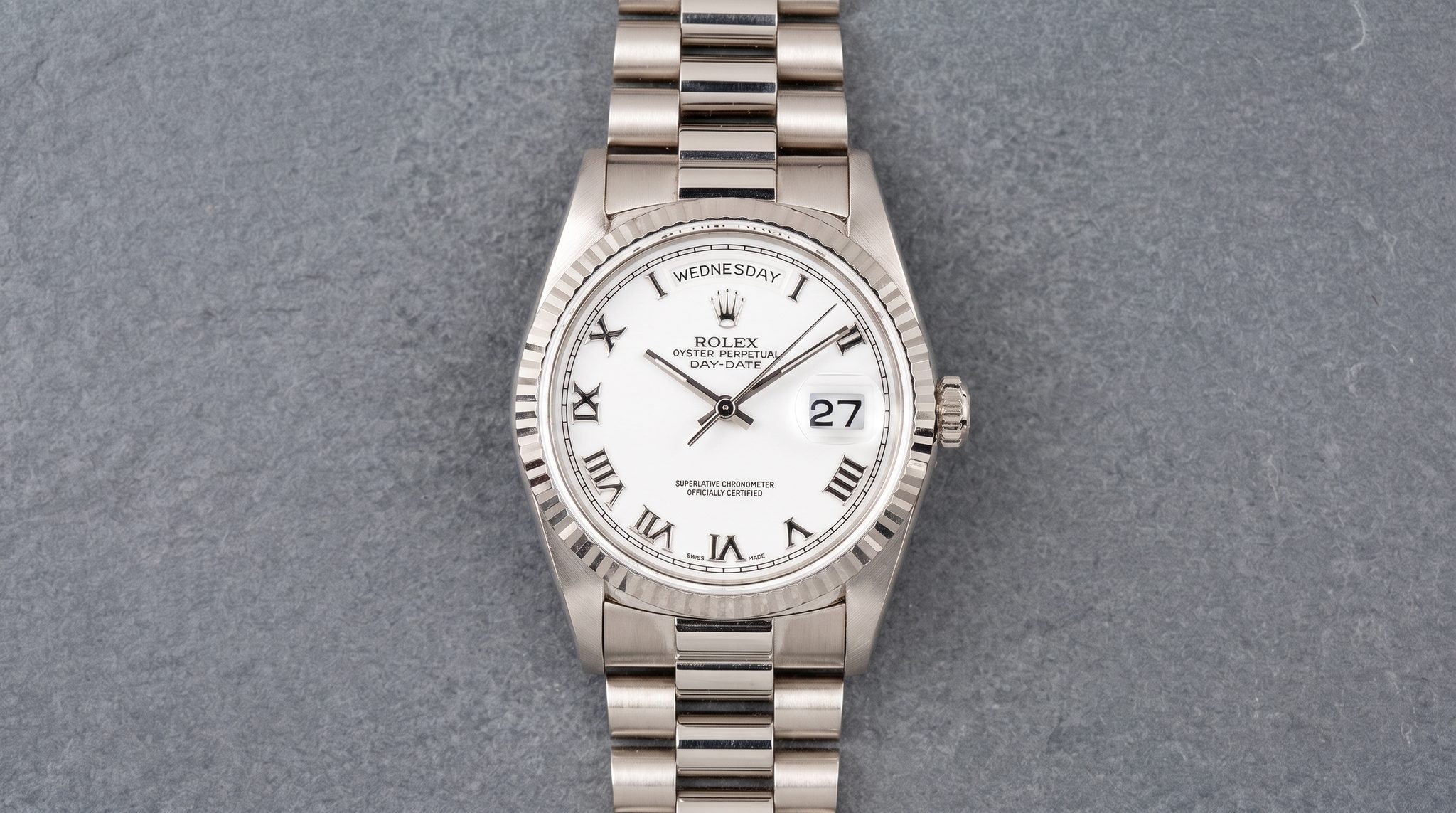
The Rolex Day-Date 18239 is the five-digit white-gold President that turned the Day-Date’s calendar into a modern, use-it-everyday feature, then used that stability to make dial choice the whole story.
- Production
- c. 1988–2000/2002
- Case
- 18k white gold
- Diameter
- 36 mm
- Bezel
- Fluted (white gold)
- Crystal
- Sapphire + Cyclops
- Water res.
- 100 m
- Movement
- Rolex Cal. 3155
- Power
- ~48h
- Jewels
- 31
- Chronometer
- Yes
- Calendar
- Double quickset
- Bracelet
- President (white gold)
The Rolex Day-Date 18239 is the point where the white-gold President stops feeling like a beautiful ritual and starts behaving like a modern daily watch. Its defining fact is mechanical and practical: it introduces caliber 3155 with Rolex’s double quickset, letting the day and the date be set independently from the crown instead of nudged forward by hours at a time.
That one change is why the 18239 reads differently from its predecessor, even though the outline stays reassuringly familiar. The case remains the Day-Date’s 36 mm white-gold form with a fluted bezel, sapphire crystal and a 100 m water-resistance rating, typically paired to a white-gold President bracelet. Rolex kept that platform steady through the reference’s run, which most specialist guides place in the late 1980s through about 2000, with some databases extending the end of production to 2002.
Because the architecture barely moves, collectors end up meeting the 18239 through its faces. A conservative silver or champagne dial with baton or Roman markers can look almost austere in white gold, while the same reference can turn unapologetically decorative with vignette dials, wood veneers, hard-stone dials like lapis lazuli, or diamond-setting that ranges from restrained hour markers to full jewelry executions. In other words, the 18239 is not a hunt for the “right generation” of case or movement. It is a stable, late five-digit Day-Date whose personality is decided at the dial.
“A stable white-gold Day-Date platform, made modern by the double-quickset 3155, and made collectible by whatever dial you dare to choose.”
18239 across c. 1988–2000/2002
The 18239 belongs to the last stretch of five-digit Day-Dates, and its story is less about redesign than about making the flagship easier to live with. The mechanical anchor is the shift from the earlier 18039’s caliber 3055 to the 18239’s caliber 3155, bringing double quickset so the day and date can be corrected quickly and independently. The case definition stays fixed: 36 mm in 18k white gold, fluted bezel, sapphire crystal and 100 m water resistance.
Once Rolex had that stable chassis, the variability moved to what the wearer sees. Early examples often surface with straightforward silver or champagne dials and simple applied markers, but there is no documented cutover because those conservative dials continue across the run. In the early to mid 1990s, the reference is frequently encountered with more expressive dial families that are easier to identify at a glance than to date precisely: vignette dials that fade from a lighter center to a darker rim, wood dials whose grain is the pattern, and hard-stone dials such as lapis lazuli whose flecks make every dial slightly different. A reader can recognize these instantly in hand, yet Rolex did not publish dial-by-dial timelines for the reference, so exact start and stop years for each material remain uncertain.
Toward the end of production, the most tangible “late” tell that is actually discussed in the trade is the 6 o’clock signature on luminous dials. A-series examples around 2000 are described with “Swiss Made,” signaling the transition to Super-LumiNova, while earlier pieces are associated with tritium signatures. Many dress Day-Date dials carry no luminous material at all, which is why the 18239’s most reliable dating cues often come from paperwork, serial-era context, and originality checks rather than lume alone.
The zoomed-out view is simple: the 18239 is what happens when Rolex finishes the Day-Date’s core engineering and then spends the rest of the 1990s experimenting with surfaces. The reference looks consistent from across a room, but up close it can feel like a restrained white-gold dress watch or a full-expression jewelry piece, all without changing the underlying watch.
- c. 1988Introduced3155 double quickset at crown
- c. 1988Sapphire eraSapphire with Cyclops date
- c. 1994Decorative dialsGradient edge or wood grain
- c. 1996Stone dialsLapis texture and flecks
- c. 1999 – 2000SWISS MADE“SWISS MADE” at 6 o’clock
- c. 2000/2002SucceededSix-digit reference system
18239 against its neighbours
The 18239 makes most sense when framed by the watches immediately around it: the 18039 that came before, the 118239 that followed, and the yellow-gold 18238 that shares its entire mechanical generation. Against that backdrop, the 18239’s identity sharpens into one clear idea, white gold plus the 3155 double-quickset era, with dial choice doing the differentiating heavy lifting.
18039 Predecessor (white gold) 1977–1988 | This reference 18239 Rolex · focal c. 1988–2000/2002 | |||
|---|---|---|---|---|
| Production | 1977–1988 | 1988–2000 | c. 1988–2000/2002 | c. 2000–at least 2018 |
| Case | 18k white gold | 18k yellow gold | 18k white gold | 18k white gold |
| Diameter | 36 mm | 36 mm | 36 mm | 36 mm |
| Bezel | Fluted | Fluted | Fluted (white gold) | Fluted |
| Crystal | Sapphire + Cyclops | Sapphire + Cyclops | Sapphire + Cyclops | Sapphire + Cyclops |
| Water res. | 100 m | 100 m | 100 m | 100 m |
| Movement | Rolex Cal. 3055 | Rolex Cal. 3155 | Rolex Cal. 3155 | Rolex Cal. 3155 |
| Power | ~48h | ~48h | ~48h | ~48h |
| Chronometer | Yes | Yes | Yes | Yes |
| Calendar | Single quickset | Double quickset | Double quickset | Double quickset |
| Bracelet | President | President | President (white gold) | President |
Seven dial generations across the run
These are the “quiet” 18239s: silver or champagne-toned metal dials with applied baton markers or applied Roman numerals. In hand, the appeal is how white gold mutes the usual Day-Date flash. The fluted bezel still catches light, but the head reads cooler and more monochrome than yellow gold, especially on a silver dial.
The important nuance is that this is not an early-only look. Dealers show late-1990s and even 1999–2001 examples with classic Roman or stick dials, so marker style is best treated as an option that runs through the reference rather than a date stamp. For identification, the watch should still present the defining 18239 traits: fluted white-gold bezel, sapphire crystal with Cyclops, and the 3155 double-quickset calendar action.
What to check before buying a 18239
Buying a Rolex Day-Date 18239 is less about hunting for the right mechanical version and more about proving that the visible luxury is honest. The reference is simple at its core, a 36 mm white-gold Day-Date with a fluted bezel and caliber 3155, so the price spread comes from dials, diamonds, and condition rather than from hidden generational differences.
The first practical risk is jewelry work. The 18239 exists in factory diamond configurations, but it also appears with aftermarket setting, including pieces described as “after-set” variants in the market. Because dials and even bezels can be changed, a watch that looks like a late, high-jewelry 18239 can be an earlier watch dressed up later. Documentation and a watchmaker inspection matter more here than with a steel sports model.
The second risk is the President bracelet itself. White-gold President bracelets are expensive to restore or replace, and listings repeatedly foreground bracelet tightness and even overall length as value drivers. A sharp, crisp fluted bezel and strong case profile are also repeatedly treated as positives, because heavy polishing softens the fluting that is supposed to sparkle.
In practice, the 18239 suits the buyer who wants the Day-Date’s most traditional proportions but refuses the fussy calendar-setting of earlier generations. It wears as a discreet 36 mm white-gold dress watch until the dial tells another story, and that freedom of expression is the point of the reference.
Rolex Day-Date 18239 for sale
Indicative market value from recent dealer, auction, and Grey Market sales: median ≈ $17,250, with a typical $14,000–$21,000 range across 82 comparable sales (updated this week).
Each point is a recent dealer or auction sale, banded to an indicative figure. The range shown is not a valuation.
Common questions about the 18239
Most specialist guides place the Rolex Day-Date 18239 in roughly 1988–2000. Some collector databases extend the end of production to 2002, so the safest summary is late 1980s to about 2000/2002.
- Rolex Caliber 3155reference.grail-watch.com
- All Rolex Day-Date References 1956–2026 (reference guide)wristbuzz.com
- Rolex Day-Date 18239 (reference overview)vericog.io
Show 7 more
- Rolex Day-Date 18239 listings (reference page)chrono24.com
- Rolex Day-Date in White Gold, A-series with Arabic discs (example and commentary)fratellowatches.com
- Rolex Day-Date 18239 ‘Birch wood’ (dated example)amsterdamvintagewatches.com
- Rolex Day-Date 18239 ‘Lapis Lazuli’ (dated example)amsterdamvintagewatches.com
- Rolex Day-Date buying guide (dial and diamond context)bobswatches.com
- Rolex Day-Date 36 ref. 18239 market value snapshotcollectorsquare.com
- Rolex Day-Date 18239 tropical 1990 (example and service-dial discussion)timelessvintage.watch