

Rolex Day-Date 118239
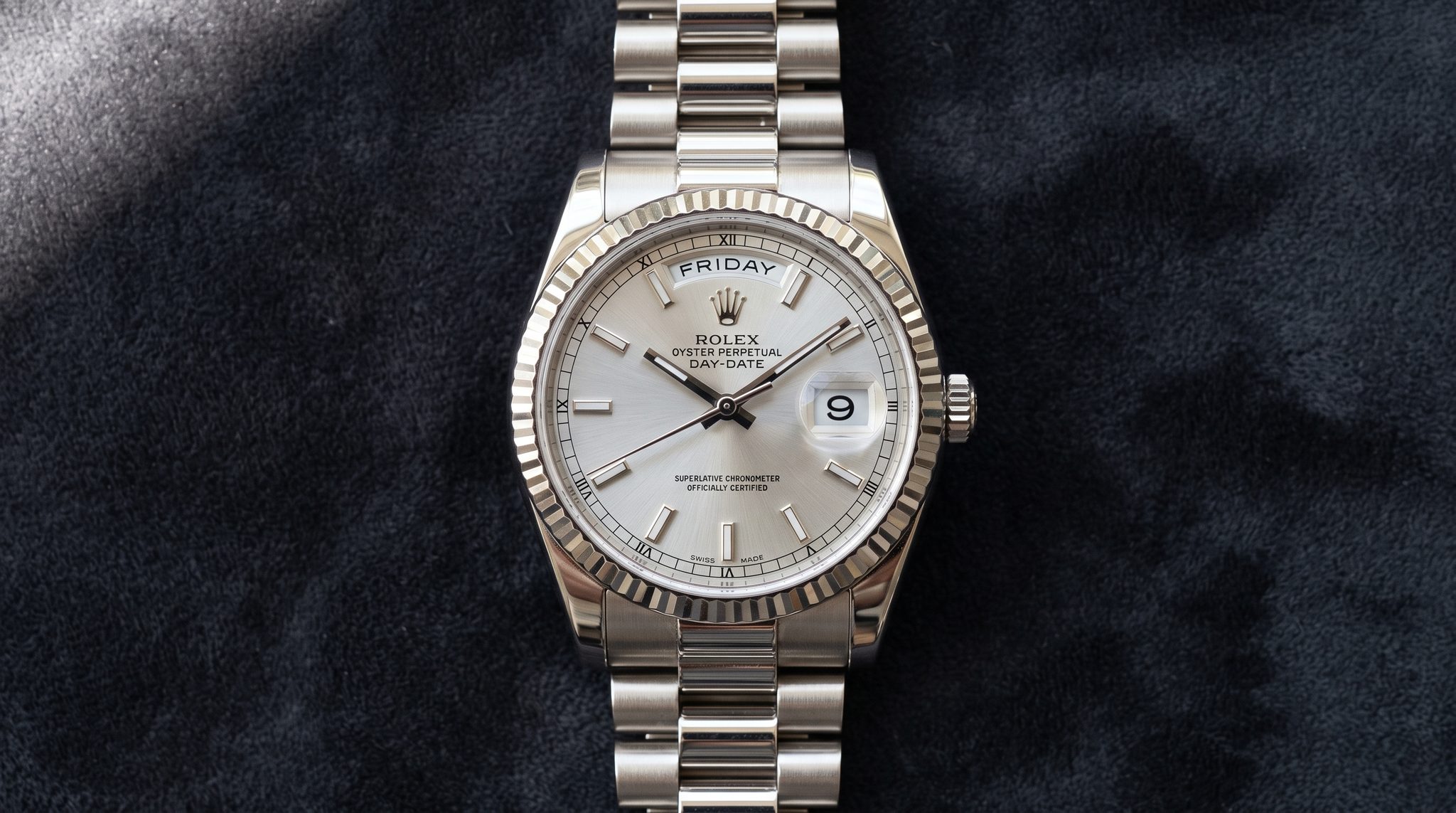
Rolex Day-Date 118239 is the white-gold Day-Date 36 whose identity is written on its dial choices, not in generational mechanical change, with dated examples spanning from c. 2000 to at least c. 2018.
- Production
- c. 2000–at least 2018
- Case
- 18 ct white gold
- Diameter
- 36 mm
- Thickness
- ~12 mm
- Bezel
- Fluted (white gold)
- Crystal
- Sapphire
- Water res.
- 100 m
- Movement
- Rolex Cal. 3155
- Power
- ~48h
- Jewels
- 31
- Chronometer
- Yes
- Lug width
- 20 mm
Rolex Day-Date 118239 is the Day-Date 36 that makes its point without changing its mechanics: it stayed a 36 mm, white-gold President on caliber 3155, yet it produced some of the most visually distinctive late-era Day-Dates, including bright lacquer “modern Stella” style dials documented around c. 2018. That split between a stable platform and highly varied factory dial execution is why collectors treat the reference less like a single “generation” to memorize and more like a catalog of dial outcomes to recognize.
Rolex does not publish reference-by-reference start and end dates for modern Day-Dates, so the cleanest way to situate the 118239 is by dated examples. Listings and dealer descriptions document the reference in the market by 2000, with examples described around 2003, continuing through the later 2000s, and appearing again very late in the decade with watches described circa 2018. Across that span, the constants remain easy to spot in hand: fluted white-gold bezel, President bracelet, sapphire crystal, 100 m water resistance, and the Day-Date layout with the fully spelled day at 12 and the date at 3. What changes is what your eye meets first: metallic dials with sticks or Romans, factory diamond-marker “Serti” dials, mother-of-pearl and other exotic materials, the warm sunburst brown nicknamed “Havana,” and finally the saturated solid colors that look like a deliberate throwback to the vintage Stella idea, executed on a modern 3155-powered watch.
“On ref. 118239, the case and movement stay put; the collectible story lives on the dial.”
118239 across c. 2000–at least 2018
The 118239 belongs to the long-running Day-Date 36 tradition of pairing a precious-metal Oyster case with the day aperture at 12 and date at 3, but its collecting logic is distinctly modern. Public documentation does not provide an official launch year for the reference, so the most defensible anchors are dated watches in the market: examples are described as 2000 production, others are described around 2003, additional listings place the reference in 2006–2008, and late examples appear described circa 2018. Those bookends matter because they show how long the reference existed without needing a movement handoff to define “early” and “late.”
Mechanically, the reference is consistent in the way many buyers expect a modern Day-Date to be. It uses Rolex caliber 3155, introduced for the Day-Date line in 1988, with 28,800 vph frequency, roughly 48 hours of power reserve, 31 jewels, stop-seconds, and the defining convenience feature for the line: double quickset, meaning the day and date can be advanced via the crown rather than by cycling the hands through 24-hour turns. The one meaningful internal evolution documented within the 3155 family is hairspring technology, from a Nivarox hairspring with Breguet overcoil in earlier production to Parachrom Bleu in later production. The rollout timing is not documented by Rolex, and sources place it around 2005, which is why it is not a safe year-based identifier for an 118239 without inspecting the movement.
Where the 118239 becomes its own subject is the dial program. In the early 2000s the reference appears with conventional metallic dials, with either applied baton indices or full Roman numerals, alongside factory diamond-marker configurations. In the same broad period, special materials such as mother-of-pearl are documented, and the warm brown sunburst dial that dealers call “Havana” shows up on early-2000s examples. By the mid to late 2010s, the reference is documented with bright, solid-color lacquer dials in shades such as blue and “cherry,” often described with stick indices and lume, a look that reads as a late-era stylistic statement rather than a mechanical revision.
Taken as a whole, the 118239 is a reminder that the Day-Date’s “reference number” can be the stable part of the story, not the changing part. Over roughly two decades of dated examples, the watch stays recognizably the same white-gold President, but the factory dials range from discreet metallic classics to saturated lacquer colors. That is why condition and originality are scrutinized so closely here: when the dial is the point, the dial has to be right.
- c. 2000Earliest datedListings/papers dated 2000
- c. 2003Early runY-series described c. 2003
- c. 20053155 updateRequires movement inspection
- 2008Still activeListings described 2008
- c. 2018Late dated“Cherry” dial described c. 2018
- c. 2019Era turns12xxxx references with 3255
118239 against its neighbours
Ref. 118239 makes the most sense when framed by the white-gold Day-Date that came just before it and the modern 36 mm white-gold Day-Date that followed it, plus a same-era sibling in another metal. The predecessor shows the same 3155-era Day-Date concept in an earlier reference generation, the successor formalizes the movement transition to the 3255 generation, and the sibling highlights how much of the 1182xx story is shared platform with different metal and bezel codes.
This reference 118239 Rolex · focal c. 2000–at least 2018 | 128239 Successor (white gold, 3255 era) 2019–present | |||
|---|---|---|---|---|
| Production | c. 1988–2000 | c. 2000–2015 | c. 2000–at least 2018 | 2019–present |
| Case | 18k white gold | 18 ct yellow gold | 18 ct white gold | 18 ct white gold |
| Diameter | 36 mm | 36 mm | 36 mm | 36 mm |
| Bezel | Fluted (white gold) | Fluted (gold) | Fluted (white gold) | Fluted (white gold) |
| Crystal | Sapphire + Cyclops | Sapphire + Cyclops | Sapphire | – |
| Water res. | 100 m | 100 m | 100 m | – |
| Movement | Rolex Cal. 3155 | Rolex Cal. 3155 | Rolex Cal. 3155 | Rolex Cal. 3255 |
| Power | ~48h | ~48h | ~48h | – |
| Jewels | 31 | 31 | 31 | – |
| Chronometer | Yes | Yes | Yes | – |
| Lug width | 20 mm | – | 20 mm | – |
Six dial generations across the run
The most common early look for the Day-Date 118239 is also the one that best explains the reference’s personality: a modern, mechanically settled white-gold President whose appearance is set almost entirely by the dial. Period examples are documented with silvered, rhodium-toned, white, and slate metallic dials, paired with either applied baton indices or full Roman numerals. Some configurations are described as non-luminous, including slate Roman-dial examples, which shifts the watch’s character toward dress watch clarity rather than night-readability.
In hand, these dials read as “standard” only until they are compared side-by-side. The fluted bezel throws bright reflections, the President bracelet adds mass, and the dial furniture decides whether the watch feels restrained or graphic. That is why these are better treated as parallel options rather than a single generation: stick-index and Roman dials, and luminous and non-luminous executions, overlap in the same early-2000s period.
What to check before buying a 118239
Buying a Rolex Day-Date 118239 is less about decoding a succession of case and movement generations and more about confirming that the specific watch in front of you is coherently factory-correct. The reference is consistently described as a 36 mm white-gold Day-Date with fluted bezel, President bracelet, and caliber 3155, so the largest value and authenticity swings come from the dial, from gem-setting, and from condition of the case and bracelet.
The first risk is the simplest: a dial that is not correct, not original, or not as described. The market contains refinished and aftermarket dials, and the 118239’s most celebrated looks, Havana brown and late lacquer colors, are exactly the kinds of dials that can tempt imitation or later modification. Diamond setting requires the same caution, since later-added diamonds are a known pitfall.
The second risk is wear that is easy to underestimate at listing distance. Over-polishing can soften case geometry and blur the fluted bezel’s definition, and President bracelets can develop stretch that affects both feel and long-term cost. Box and papers improve liquidity, but they do not replace a careful check of the watch itself.
In practice, the 118239 suits the buyer who wants the traditional Day-Date format in white gold, but who cares most about dial execution and overall integrity rather than chasing a specific “year.” It is a modern Day-Date that rewards patient looking: when the dial is the feature, ownership is living with that chosen surface every day.
Rolex Day-Date 118239 for sale
Indicative market value from recent dealer, auction, and Grey Market sales: median ≈ $21,250, with a typical $18,750–$25,000 range across 35 comparable sales (updated this week).
Each point is a recent dealer or auction sale, banded to an indicative figure. The range shown is not a valuation.
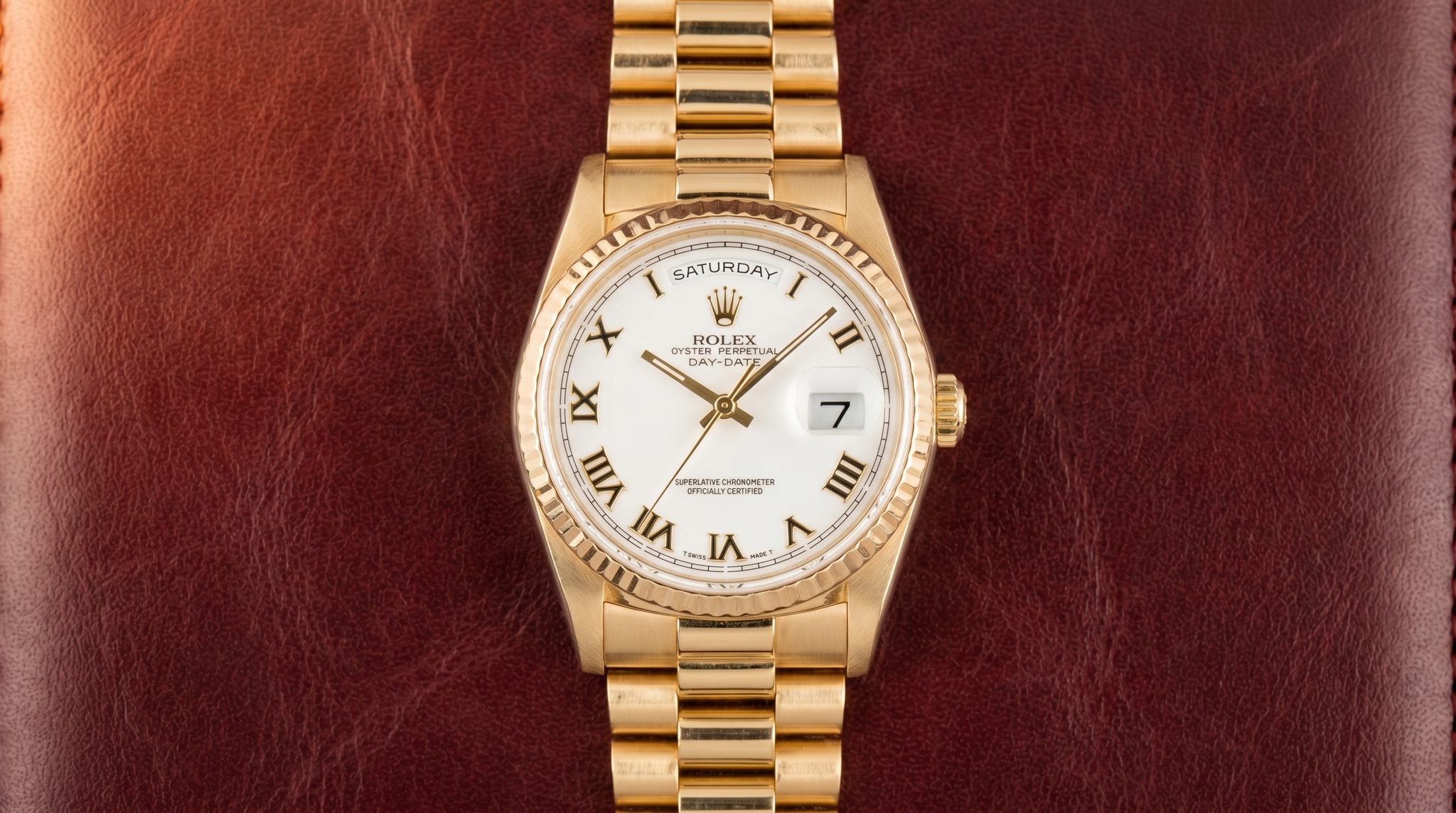
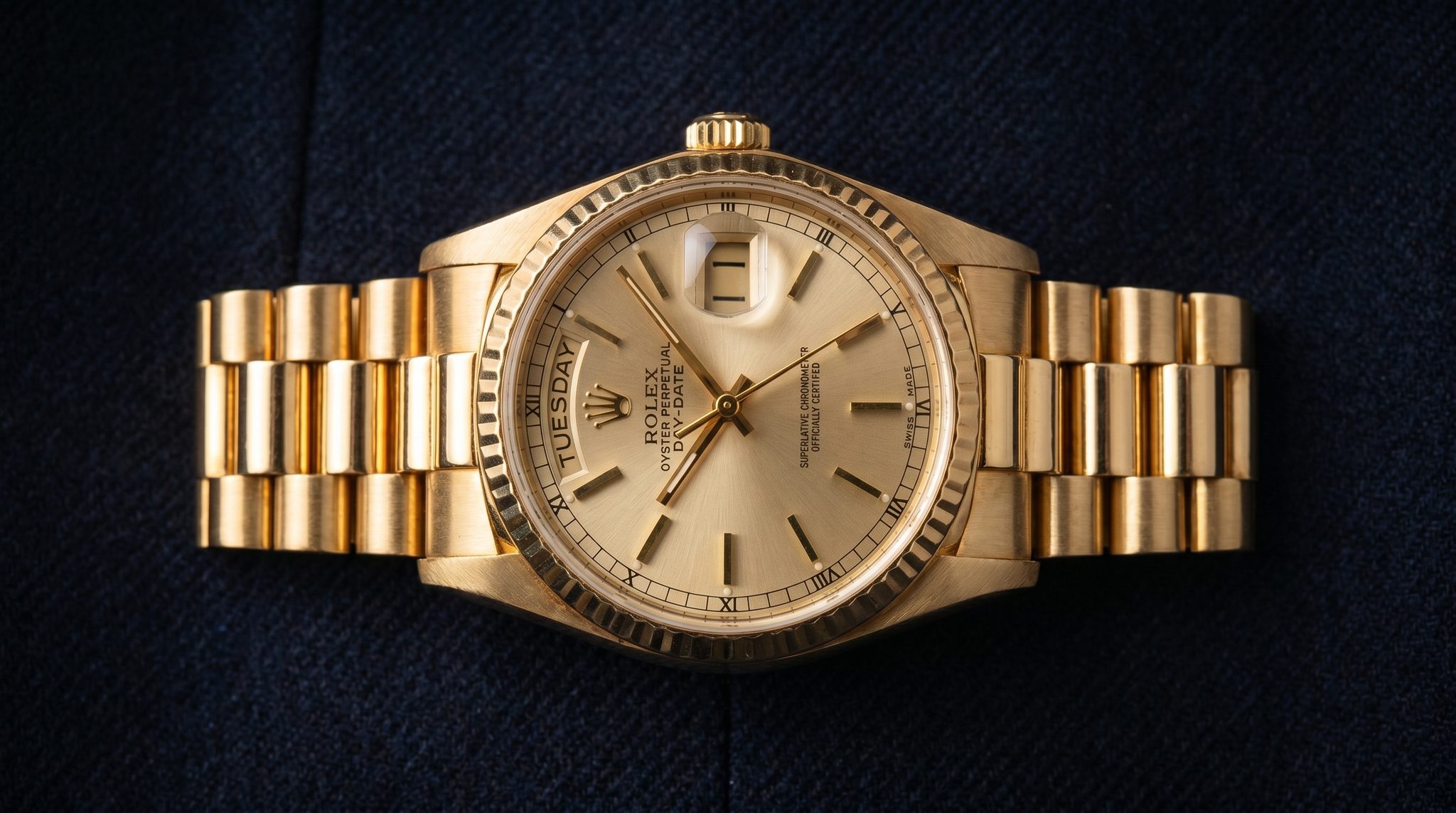
Adjacent in the Day-Date family
Common questions about the 118239
Rolex does not publish official reference-by-reference production spans for the 118239. Dated market examples document the reference by c. 2000 and at least as late as c. 2018, so the most defensible statement is c. 2000–at least 2018.
- Rolex Day-Date 36 118239 (reference overview and dated listings)chrono24.com
- Rolex Day-Date 118239 listing (Y-series, thickness and lug width details)chrono24.com
- European Watch Company: Rolex 118239 Day-Date President (2018 example, dimensions)europeanwatch.com
Show 7 more
- Rolex Day-Date 118239 “Cherry” dial (c. 2018 example)chrono24.com
- Collector Square: Rolex Day-Date ref. 118239 (includes mother-of-pearl examples circa 2000)collectorsquare.com
- WatchWorks Haarlem: Day-Date 36 “Havana Brown” ref. 118239 (2001 example)watchworkshaarlem.com
- Bob’s Watches: Rolex Day-Date 118239 Havana Brown Dialbobswatches.com
- Millenary Watches: Rolex caliber 3155 guide (specifications and features)millenarywatches.com
- WatchBase: Rolex caliber 3155 (technical specs)watchbase.com
- Watch Wiki: Rolex 3155 (production window and lineage)watch-wiki.net