

Rolex Day-Date 18238
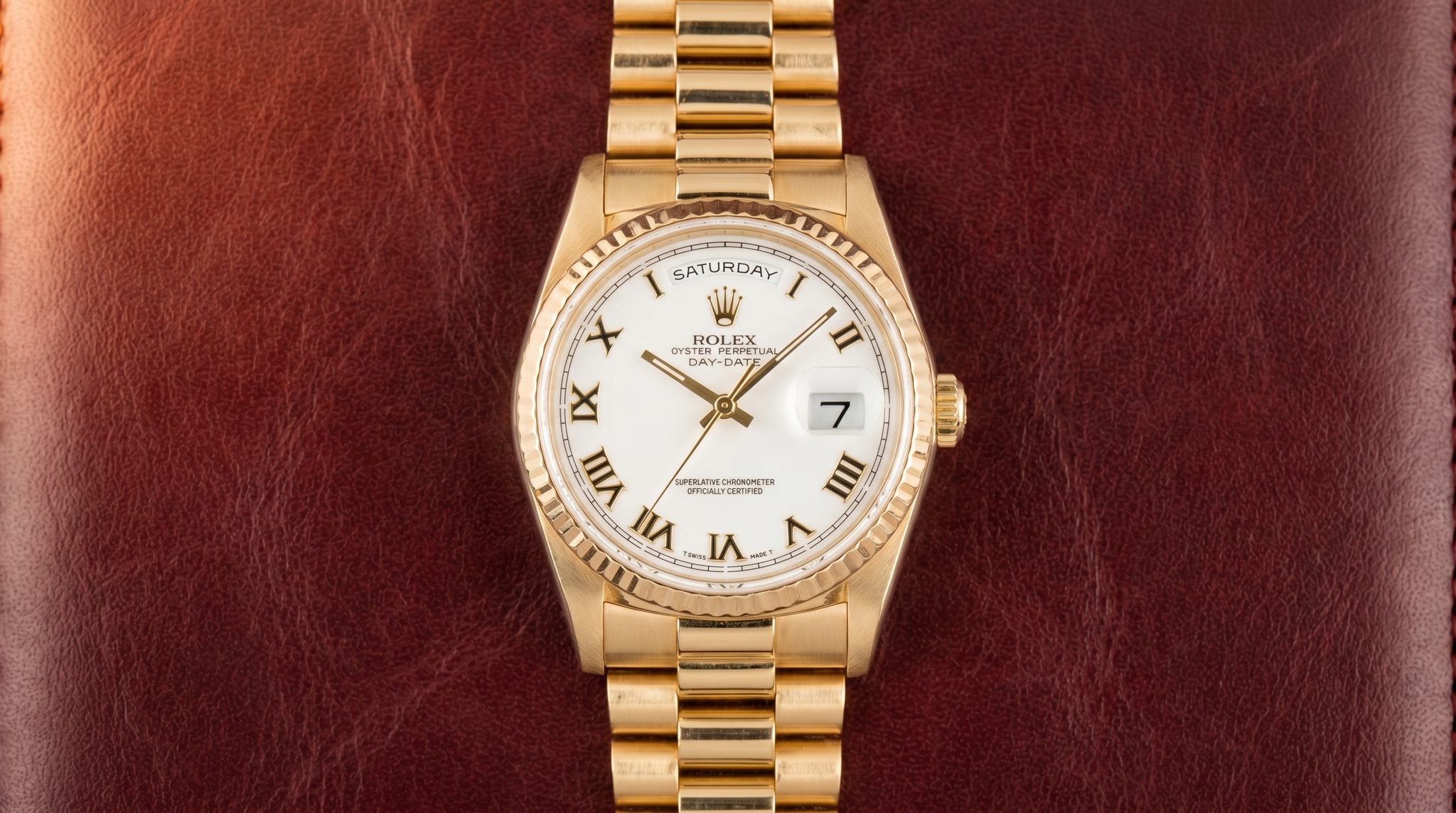
The Rolex Day-Date 18238 is the yellow-gold, 36 mm Day-Date that introduced the Cal. 3155 and its double-quickset day and date, turning the model’s signature calendar into something you can correct directly from the crown.
- Production
- 1988–2000
- Case
- 18k yellow gold
- Diameter
- 36 mm
- Thickness
- ~12 mm
- Lug width
- 20 mm
- Bezel
- Fluted
- Crystal
- Sapphire
- Water res.
- 100 m
- Movement
- Cal. 3155
- Power
- ~48h
- Chronometer
- Yes
- Lume
- Tritium → Luminova
The Rolex Day-Date 18238 was produced from 1988 to 2000.
The Rolex Day-Date 18238 is the reference that made the Day-Date’s calendar easier to live with, because it paired the classic 36 mm yellow-gold “President” format with the Caliber 3155 and its double-quickset day and date, both corrected directly from the crown. Produced from 1988 to 2000, it replaced the outwardly similar ref. 18038 and was later superseded by the ref. 118238, but its meaning in the line is internal: the moment the Day-Date’s defining display caught up to modern expectations of usability.
In hand, the watch reads like the late 20th-century archetype: a 36 mm Oyster case with a fluted bezel, a sapphire crystal with Cyclops over the date, and the President bracelet that tapers into a concealed clasp. The dimensions that are consistently documented, about 12 mm thick with a 43 mm lug-to-lug span and 20 mm between the lugs, keep it compact on the wrist even in solid gold.
Collectors care about the 18238 for a different reason than they do with many Rolex sport references. There is no internal “Mk1 to Mk2” movement story here, because every 18238 is a Cal. 3155. Instead, the reference became a platform for combinations: standard sunburst dials, factory diamond dials, hard-stone dials such as onyx, and finishing options like the bark texture on bezel and bracelet center links. The useful way to understand a given 18238 is as a stable mechanical core surrounded by independent choices in dial material, luminous era markings, bracelet finish, and day-wheel language.
“A stable 36 mm yellow-gold Day-Date on the outside, and the Cal. 3155 double-quickset Day-Date on the inside: the 18238 is the reference where the day and date finally became crown-set conveniences, not just a display.”
Rolex Day-Date 18238 production years: 1988–2000
The 18238 arrives in 1988 as the yellow-gold Day-Date 36 that replaces the ref. 18038, and nearly everything that matters about that change is under the dial. The Caliber 3155 brings double quickset, so both the day aperture at 12 o’clock and the date at 3 o’clock can be corrected via the crown. The predecessor’s Cal. 3055 could quickset the date, but not the day, and that functional distinction is the cleanest dividing line between these otherwise similar five-digit Day-Dates.
Across the run, the most visible dating cues are not case redesigns but the small text at 6 o’clock that reflects Rolex’s luminous material transitions. Early and mid-production luminous dials commonly show tritium markings, either “T SWISS T” or “T SWISS < 25 T.” Near the end of the 1990s, some dials appear with “SWISS” only, a short-lived signature typically associated with Luminova-era production around 1998–1999, and later examples move to “SWISS MADE,” associated with Super-Luminova around 1999–2000. Rolex did not publish a formal cutover schedule for these signatures by reference, so the boundaries are collector-inferred from surviving watches rather than factory-documented.
That relative mechanical stability is what makes the 18238 unusually revealing: while the reference stays constant, the watch was sold in many different guises, from straightforward champagne sunburst to factory diamond-marker dials to hard-stone executions like onyx, and it could be ordered with the bark texture on bezel and center links for a more jewelry-forward surface. Seen as a whole, the 18238 shows how the late 20th-century Day-Date worked as a single, dependable platform for personalization, with the Cal. 3155 ensuring that every version, conservative or extravagant, shares the same modern calendar behavior.
- 1988Launch18238 between the lugs
- 1988Cal. 3155Day and date set via crown
- 1988Tritium eraT marking at 6 o’clock
- c. 1998 – 1999SWISS dials“SWISS” at 6 o’clock
- c. 1999 – 2000SWISS MADE“SWISS MADE” at 6
- 2000DiscontinuedSix-digit successor ref.
18238 against its neighbours
The Day-Date 18238 is easiest to place by bracketing it between the nearly identical-looking ref. 18038 that came before it and the ref. 118238 that followed. The predecessor shows what changed, the move from Cal. 3055 to Cal. 3155 and the jump to double quickset, while the successor shows what stayed the same mechanically as Rolex moved the yellow-gold Day-Date into its later reference series.
This reference 18238 Rolex · focal 1988–2000 | ||||
|---|---|---|---|---|
| Production | 1977–1988 | c. 1988–2000/2002 | 1988–2000 | 2000–c. 2019 |
| Case | 18k yellow gold | 18k white gold | 18k yellow gold | 18k yellow gold |
| Diameter | 36 mm | 36 mm | 36 mm | 36 mm |
| Bezel | Fluted | Fluted | Fluted | Fluted |
| Crystal | Sapphire | Sapphire | Sapphire | Sapphire |
| Water res. | 100 m | 100 m | 100 m | 100 m |
| Movement | Cal. 3055 | Cal. 3155 | Cal. 3155 | Cal. 3155 |
| Power | ~48h | ~48h | ~48h | ~48h |
| Chronometer | Yes (COSC) | Yes (COSC) | Yes | Yes (COSC) |
Four dial generations across the run
On luminous 18238 dials from the earlier part of the run, the quickest tell is the small line of text at 6 o’clock: “T SWISS T” or “T SWISS < 25 T.” When the watch is in hand, it is a detail you notice only after the broader impression, a warm yellow-gold case and a metallic dial that catches light in a tight, radial sunburst. The tritium signature matters because it anchors the watch to the late 1980s and much of the 1990s, before Rolex phased tritium out across the line.
These signatures sit on top of many dial designs rather than defining one. A champagne baton dial can be tritium, and so can certain diamond-marker layouts with small luminous plots. Stone dials often sit outside this luminous story by design, because many have no lume plots at all, even when the watch is of the same era.
What to check before buying a 18238
Buying a Rolex Day-Date 18238 is less about finding the “right” movement generation and more about verifying a coherent configuration. Every example should be an 18k yellow-gold 36 mm Day-Date with a fluted bezel and the Cal. 3155, and the defining functional check is that both the day and the date can be corrected via the crown as a true double quickset.
Condition drives value because so much of the 18238’s character is surface: the sharpness of the fluted bezel, the definition of the lugs, and especially the state of the solid-gold President bracelet. Bracelet stretch and missing links are repeatedly cited as practical price levers, and complete sets with box and papers trade higher than watch-only examples.
Dial choice is where the reference becomes complicated. The 18238 was sold with a wide array of dials, including factory diamond layouts and hard-stone options such as onyx, and those premium configurations attract swaps and refinishing. Owning a good 18238 is often about accepting the reference’s basic truth: the mechanics are consistent, so the safest value is usually in originality, crisp metal, and a dial whose details and era markings make sense together.
Rolex Day-Date 18238 price and value
A Rolex Day-Date 18238 sells for about $17,500 at the median, typically $13,750 to $20,000 across 277 comparable sales.
Rolex Day-Date 18238 for sale
Indicative figures from recent dealer, auction, and Grey Market sales (updated this week). Every watch is verified before it sells here.
Each point is a recent dealer or auction sale, banded to an indicative figure. The range shown is not a valuation.
Common questions about the 18238
Specialist histories consistently place the Rolex Day-Date 18238 in 1988–2000, replacing the ref. 18038 and later giving way to the ref. 118238.
- Exploring Evergreens: The Rolex Day-Date 18238fratellowatches.com
- In-Depth: The History of the Rolex Day-Date, The Presidential Watchmonochrome-watches.com
- Rolex Day-Date 18238 Presidential – Solid Gold Luxury Watch (video)youtube.com
Show 7 more
- Review Video: Rolex Day-Date Yellow Gold Tapestry Dial Ref. 18238youtube.com
- Rolex 18238 Reviewbobswatches.com
- Rolex 118238 Reviewbobswatches.com
- Rolex 18238 for Sale – 18k Yellow Gold Presidentluxurywatchesusa.com
- Rolex 18238 - Day-Date 36 watcheschrono24.com
- Your Ultimate Guide to the Iconic Rolex Day Datethewatchcompany.com
- Rolex Day-Date President 18238 champagne dial (dealer page)bernardwatch.com