

Rolex Day-Date 18038
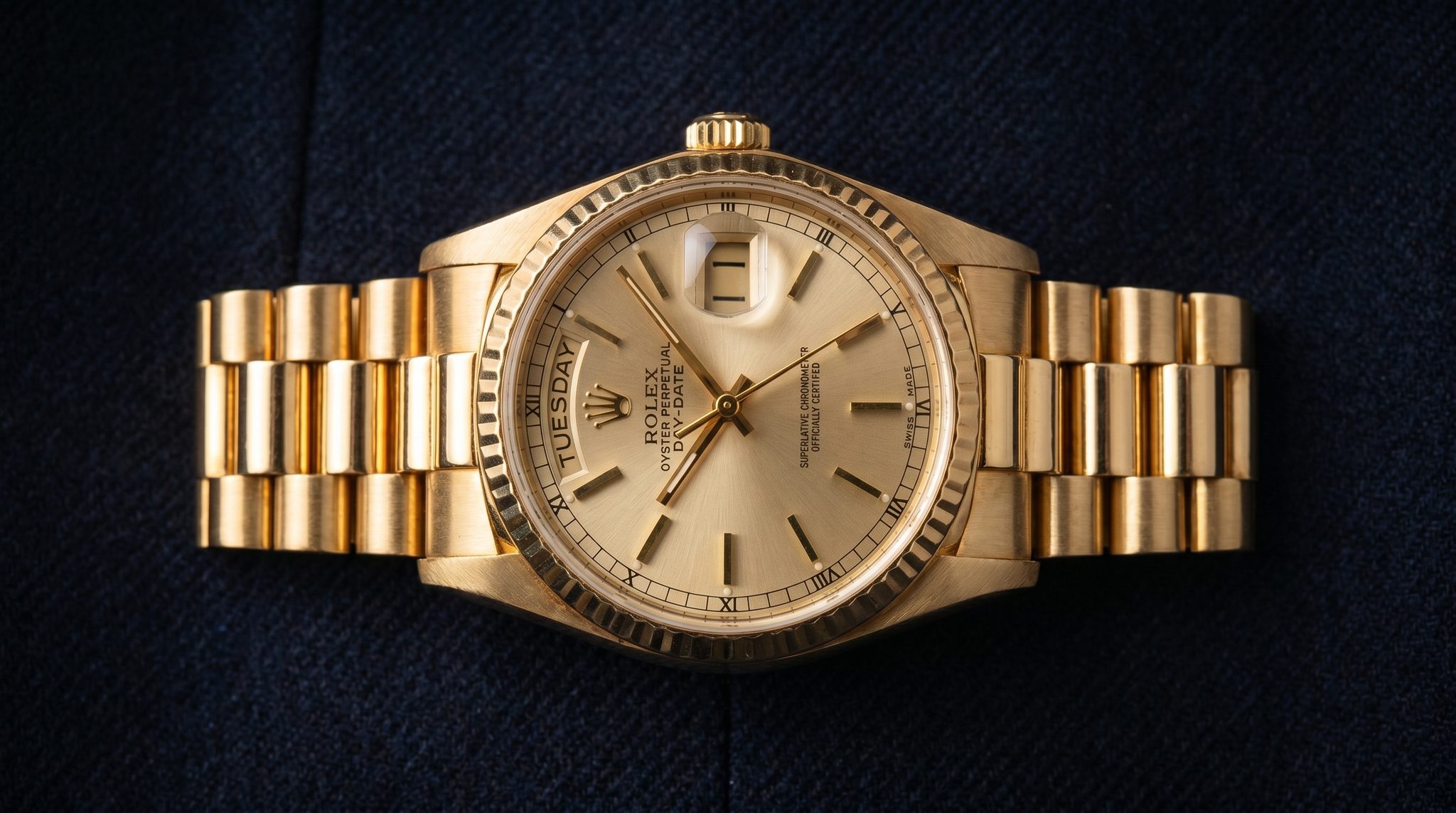
The Rolex Day-Date 18038 is the Day-Date that turns the President into a practical, high-beat, sapphire-crystal daily watch, while keeping the era’s unmistakable 36 mm gold presence.
- Production
- 1977–1988
- Case
- 18k yellow gold
- Diameter
- 36 mm
- Crystal
- Sapphire
- Water res.
- 100 m
- Movement
- Rolex Cal. 3055
- Winding
- Automatic
- Calendar
- Single quickset
- Power
- ~48h
- Chronometer
- Yes (COSC)
- Lugs
- 20 mm
- Dial
- Flat (not pie-pan)
The Rolex Day-Date 18038 was produced from 1977 to 1988.
The Rolex Day-Date 18038 is the President that finally behaves like a modern watch, the one that pairs a sapphire crystal with a high-beat Cal. 3055 and a quickset date you can change from the crown. That single convenience is the tell: the date jumps in quickset, but the day still only advances by cycling the hands through midnight, a very late-1970s idea of progress that makes the 18038 its own distinct era.
Positioned between the acrylic-crystal, non-quickset ref. 1803 and the double-quickset ref. 18238, the 18038 is widely cited as the first five-digit yellow-gold Day-Date generation. The literature consistently frames it as a late-1970s reset of the Day-Date’s day-to-day usability, while leaving Rolex’s visual abundance intact: 36 mm of solid 18k yellow gold on a President bracelet, with a dial that sits flat rather than in the earlier pie-pan shape.
“A sapphire-crystal Day-Date with a quickset date, and a day that still makes you earn it: the 18038 is the President’s bridge into modern use.”
Rolex Day-Date 18038 production years: 1977–1988
Collectors tend to remember the Day-Date 18038 as a single step into the “modern” President, but the record around its start is more nuanced. It is consistently described as introduced in 1977, while some retail narratives talk about the broader next generation appearing in 1978. Rolex does not publish a factory changeover date, so the most defensible way to understand the 18038 is as the late-1970s break point: the Day-Date moves to a sapphire crystal, adopts a flatter dial profile than the earlier pie-pan style, and changes its day-to-day interaction via the new Cal. 3055.
That movement is the mechanical heart of the reference’s personality. Cal. 3055 raises the beat rate to 28,800 vph, adds stop-seconds, and stretches power reserve to about 48 hours. More importantly for lived experience, it introduces the quickset date. The day remains non-quickset, so the watch still carries a ritual from earlier Day-Dates: if you land on the wrong language or the wrong weekday, you advance the hands through midnight until it catches up.
Those few facts explain why the 18038 sits so neatly between two worlds. Compared with an 1803, it feels less fragile and less fussy, sapphire replaces acrylic and the calendar is faster to set. Compared with an 18238, it keeps one foot in the older logic, because the day still cannot be jumped independently. The result is a reference that reads like an era captured in hardware: modernizing in the ways that matter every month, but not yet fully optimized.
Late in the 18038’s run, the Day-Date’s identity becomes clearer in hindsight. The improvements are not about making it louder or more complicated, they are about making a precious-metal flagship easier to live with. Once you see the 18038 as the “useability” Day-Date, the way collectors obsess over dials and bracelets makes sense: the underlying platform is stable, so originality and condition become the story.
- 1977IntroducedQuickset date, day not quickset
- 1977Cal. 3055Seconds stops when setting time
- 1977Single quicksetDate jumps; day needs hand-cycling
- 1977Flat dialsDial surface reads flatter
- 1988SucceededDouble quickset day and date
18038 against its neighbours
The 18038 makes the most sense when it is bracketed by the Day-Date it replaced and the one that replaced it. Ref. 1803 explains what Rolex was leaving behind, acrylic and a non-quickset calendar, while ref. 18238 shows the last missing convenience, a day display that can be set independently.
19018 Strap sibling Late 1970s–1980s | This reference 18038 Rolex · focal 1977–1988 | |||
|---|---|---|---|---|
| Production | c. 1959/60–1977/78 | Late 1970s–1980s | 1977–1988 | 1988–2000 |
| Case | Precious metal | 18k yellow gold | 18k yellow gold | 18k yellow gold |
| Diameter | 36 mm | 36 mm | 36 mm | 36 mm |
| Crystal | Acrylic | Sapphire | Sapphire | Sapphire |
| Water res. | – | 100 m | 100 m | 100 m |
| Movement | Rolex Cal. 1556 | Rolex Cal. 3055 | Rolex Cal. 3055 | Rolex Cal. 3155 |
| Calendar | Non-quickset | Single quickset | Single quickset | Double quickset |
| Power | – | ~48h | ~48h | ~48h |
| Jewels | – | 27 | – | – |
| Dial | Pie-pan (typical) | Flat | Flat (not pie-pan) | Flat |
Five dial generations across the run
Early 18038s are best understood by what they are, rather than by a single dial code. They share the reference’s fixed architecture: a 36 mm 18k yellow-gold Day-Date with sapphire crystal and Cal. 3055 single-quickset behavior. Within that platform, period dials span straightforward champagne and silver looks as well as more elaborate executions, and the supplied literature does not provide a clean, factory-documented cutoff that would let any one early dial printing style be treated as a dated “generation.”
In hand, the most honest cue is coherence. The dial furniture, hands, and any luminous material should look like they were meant to be together, and like they have aged together. When they do, the watch reads as a single late-1970s object, not an assortment of later upgrades.
What to check before buying a 18038
Buying a Day-Date 18038 is less about chasing a rare movement and more about protecting the reference’s two biggest value levers: the dial and the President bracelet. The 18038’s platform is consistent, sapphire crystal and Cal. 3055 single-quickset, so the spread in value comes from what is bolted to that platform, and how much honest gold remains.
Dial swapping is the central risk, especially because Stella lacquer, hard-stone, wood, vignette, and correct factory gem-setting can carry large premiums. Bracelet stretch is the other: 18k President links are soft, and a tired bracelet can turn an otherwise appealing watch into a costly project.
The irony of the 18038 is that it really is more usable than its acrylic, non-quickset predecessor, and it was rated to 100 m when new. At the same time, it is still a vintage gold watch, so water resistance should be treated as conditional on recent service and an actual pressure test.
Owned well, the 18038 is the kind of Day-Date that disappears into routine. You set the date quickly, you accept that the day takes a little longer, and you end up wearing a solid-gold flagship that was engineered to be lived with, not kept as a fragile mid-century artifact.
Rolex Day-Date 18038 price and value
A Rolex Day-Date 18038 sells for about $13,750 at the median, typically $10,250 to $18,000 across 367 comparable sales.
Rolex Day-Date 18038 for sale
Indicative figures from recent dealer, auction, and Grey Market sales (updated this week). Every watch is verified before it sells here.
Each point is a recent dealer or auction sale, banded to an indicative figure. The range shown is not a valuation.
Common questions about the 18038
The Rolex Day-Date 18038 was produced from 1977 to 1988. Rolex does not publish official cutoff dates for this era, and some retail narratives describe a 1978 market rollout for the broader generation, so 1977–1988 is best treated as the widely accepted range rather than a factory-documented stop date.
- In-Depth: The History of the Rolex Day-Date, The Presidential Watchmonochrome-watches.com
- Review: The Rolex Day-Date ref. 18038beckertime.com
- Rolex 18038 Review: Ultimate Buying and Collecting Guidebobswatches.com
Show 7 more
- Rolex 18038 - Day-Date 36 watcheschrono24.com
- Rolex Day-Date 36 ref. 18038 - Silver dial - Full Setdebonarwatches.com
- Rolex Day-Date 18038: Buy Pre-Owned Watcheswatchguys.com
- Rolex Daydate 18038 Single Quick Reviewyoutube.com
- Rolex Day-Date President 18038shop.hodinkee.com
- The Rolex Day-Date: A Complete Collector's Guidesothebys.com
- Rolex President: Best Value Referencesswisswatchexpo.com