

Rolex Submariner 16808
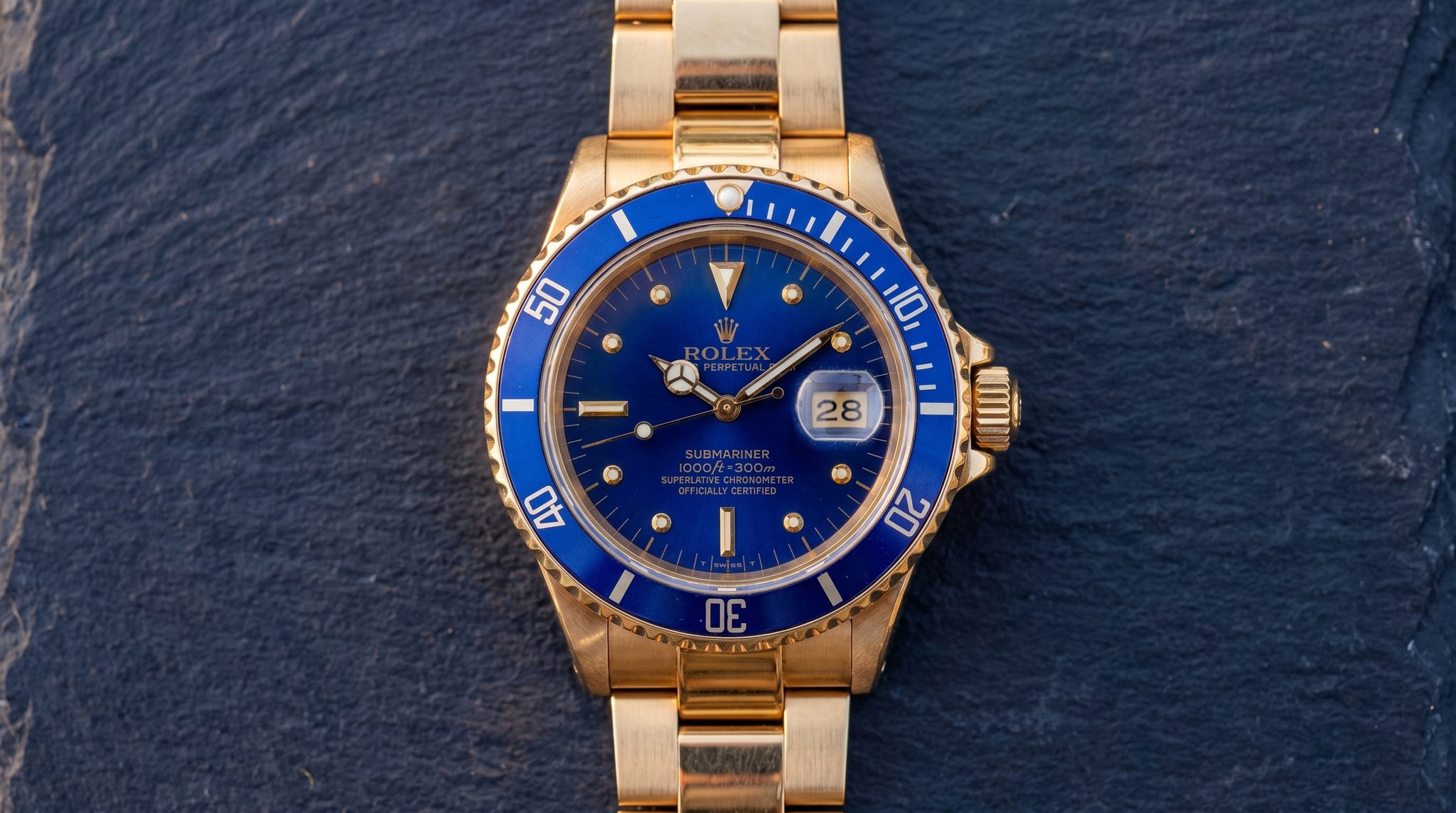
The Rolex Submariner 16808 is the hinge-point gold Submariner Date: it brings sapphire crystal, 300 m capability, and the quick-set Cal. 3035, yet it is also the last Submariner generation that can still wear the raised “nipple” dial of the 1970s.
- Production
- c. 1979–1987/88
- Case
- 18k yellow gold
- Diameter
- 40.0 mm
- Bezel
- Rotating, 60-min
- Insert
- Aluminum (black/blue)
- Crystal
- Sapphire, Cyclops
- Water res.
- 300 m / 1,000 ft
- Dial
- Black or blue (var.)
- Movement
- Rolex cal. 3035
- Power
- 42h
- Lume
- Tritium
- Date
- Quickset
The Rolex Submariner 16808 is the gold Submariner that refuses to choose between decades. It is documented as the last Submariner generation to carry the raised, conical “nipple” hour markers associated with the 1970s gold Submariner, yet it is built around the defining technical upgrades of the modern era: a sapphire crystal, a 300 m depth rating, and the quick-set Cal. 3035.
That mixture is not just aesthetic. The 16808 replaces the plexiglass-era gold ref. 1680/8 and shares its underlying platform with the steel transitional ref. 16800, including case construction that is sometimes stamped “16800” inside the caseback. In other words, the 16808 is best understood as a modern Submariner Date in 18k yellow gold that still allowed Rolex to sell a distinctly older visual language, at least for part of its run.
The result is a reference whose collector story is written almost entirely on the dial. Index type (nipple versus flat indices with white-metal surrounds), dial finish (matte versus glossy lacquer or sunburst), and optional gem-setting (Serti) do not move in lockstep and cannot be dated by a single, neat cutoff. Surviving watches show overlap, including nipple-dial examples dated into the mid-1980s, which is why the most trustworthy way to approach any “Submariner 16808 review” is to judge each dial trait on its own evidence rather than assuming every early watch is matte and every late watch is glossy.
“A sapphire-crystal, 300 m Submariner powered by the quick-set Cal. 3035, and the last gold Sub that can still be a nipple-dial watch.”
16808 across c. 1979–1987/88
Ref. 16808 enters the record as a late-1970s to early-1980s introduction and is generally summarized as running to about 1987/88, with surviving examples commonly dated in the early and mid-1980s. Its technical identity is stable across that span: an 18k yellow-gold 40.0 mm Oyster case, sapphire crystal, 300 m depth rating, and Rolex’s Cal. 3035, a 28,800 vph movement with a quick-set date and an often-cited 42-hour power reserve.
What makes the reference feel alive, rather than merely “gold and sapphire,” is that Rolex was changing what a Submariner dial looked like while keeping the chassis constant. Early watches can present the older gold Submariner vocabulary: nipple indices that stand proud of the dial, catching light like tiny cones, and a more tool-like matte surface. Later pieces adopt the direction that would define the next decades of Submariners, with glossy lacquer dials and larger, flat luminous plots held inside white-metal surrounds similar to the contemporaneous steel ref. 16800.
The reason collectors argue about cutoffs is visible on the wrist. Nipple indices do not disappear cleanly at one calendar year, and the boundary between matte and gloss can be subjective on watches that have lived in sun and salt for decades. One specialist database places the nipple configuration from around 1979 to approximately 1984, yet auction-index material documents nipple-dial 16808 examples dated circa 1986. That overlap is the point of the 16808: it is the gold Submariner Date built on modern specifications, while Rolex was still willing to sell a 1970s dial language to buyers who wanted the old look.
Late in the run, the 16808 also shows how quickly “luxury Submariner” stopped being a contradiction. Alongside standard black and blue tool-style dials, sources describe Serti options with diamond and sapphire hour markers on champagne or dark rhodium backgrounds. Seen as a whole, the reference compresses a decade of Rolex dial philosophy into one model number: from matte, raised-marker utilitarianism to glossy, framed indices and gem-set decoration, without changing the case size, the crystal, or the depth rating.
- c. 1979IntroducedSapphire crystal with Cyclops
- c. 1979Cal. 30353035 movement at service check
- c. 1984Dial shiftLume plots in metal frames
- c. mid-1980sNipple overlapRaised conical hour markers
- c. mid – late 1980sSerti optionDiamond and sapphire markers
- c. 1987/88DiscontinuedLater 5-digit successor reference
16808 against its neighbours
Ref. 16808 makes the most sense when framed by the gold watch it replaces and the steel watch it parallels. The 1680/8 shows the older plexiglass, non-quickset gold Submariner Date that established the nipple-dial look. The steel 16800 shares the same sapphire-and-3035 architecture, which explains why late 16808 dials increasingly resemble the steel line, and why some 16808 casebacks are stamped for 16800 internally.
This reference 16808 Rolex · focal c. 1979–1987/88 | 16618 Successor (gold Date line) late 1980s–2000s | |||
|---|---|---|---|---|
| Production | late 1960s/1970s–late 1970s | c. 1977–1985 | c. 1979–1987/88 | late 1980s–2000s |
| Case | 18k yellow gold | Stainless steel | 18k yellow gold | 18k yellow gold |
| Diameter | 40 mm | 40 mm | 40.0 mm | 40 mm |
| Crystal | Acrylic, Cyclops | Sapphire, Cyclops | Sapphire, Cyclops | Sapphire, Cyclops |
| Water res. | 200 m | 300 m | 300 m / 1,000 ft | 300 m |
| Bezel | Rotating, 60-min | Rotating, 60-min | Rotating, 60-min | Rotating, 60-min |
| Insert | Aluminum (black/blue) | Black aluminum | Aluminum (black/blue) | Aluminum (black/blue) |
| Dial | Black/blue “nipple” | Matte → gloss | Black or blue (var.) | Gloss, WG surrounds |
| Movement | Cal. 1575 | Cal. 3035 | Rolex cal. 3035 | – |
| Power | – | – | 42h | – |
| Lume | Tritium | Tritium | Tritium | – |
| Date | Non-quickset | Quickset | Quickset | Quickset |
Four dial generations across the run
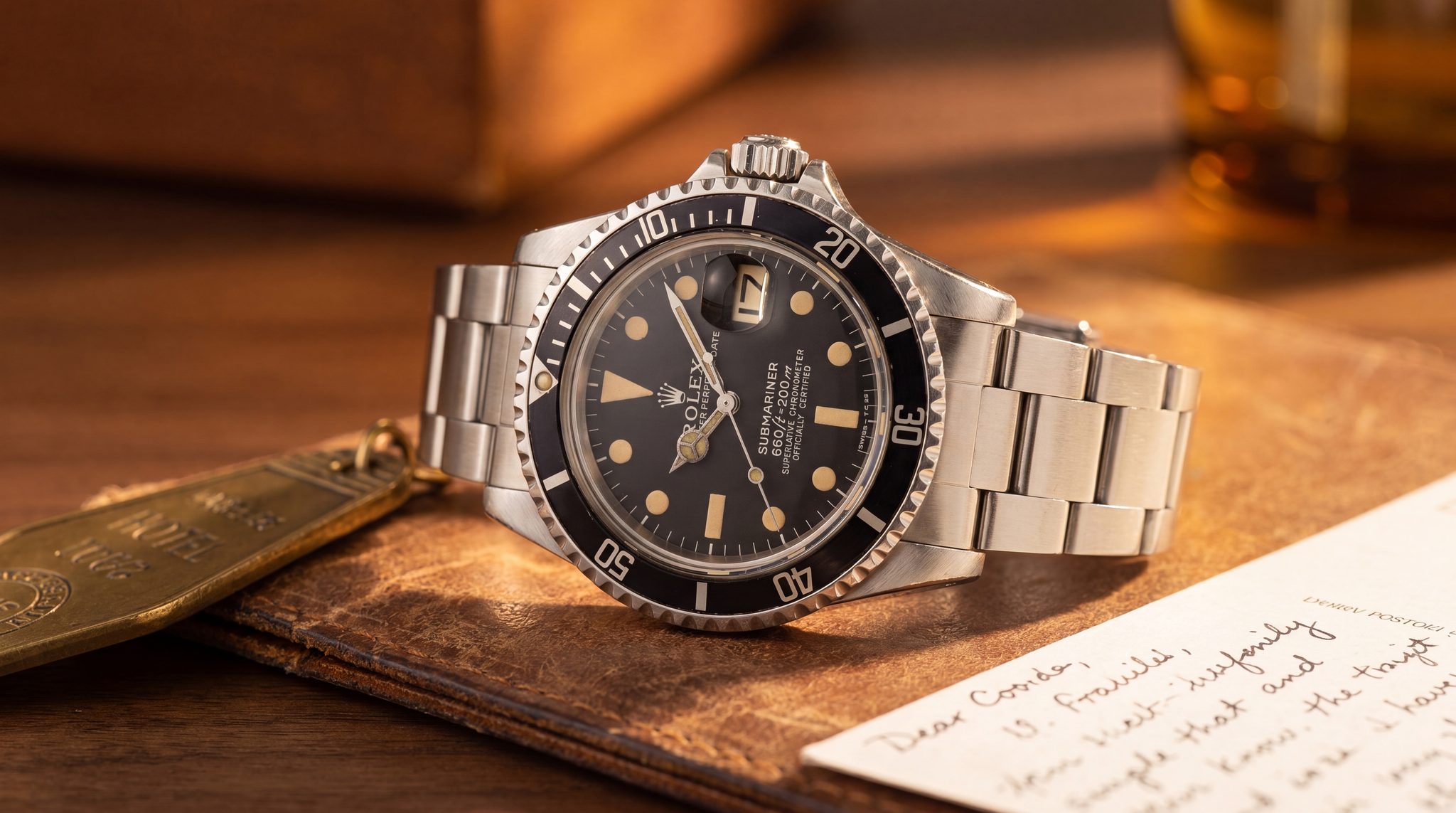
This is the look most people mean when they say “gold nipple-dial Submariner,” but ref. 16808 is where that look meets modern engineering. The hour markers are small, raised cones in yellow gold, each topped with a tritium plot, so the dial reads as three-dimensional even at arm’s length. On matte black examples the surface absorbs light and pushes the gold printing and markers forward; on blue examples the color can read more metallic and sunburst-like while still keeping the nipple index architecture.
Specialist summaries associate this configuration with the early years of the reference, and one reference table places the nipple-dial configuration from around 1979 to approximately 1984. The complication is that dated examples show the style lasting longer, including nipple-dial 16808s catalogued circa 1986. For collectors, that persistence is part of the charm: the 16808 is documented as the last Submariner generation where these raised markers remain on the menu at all.
What to check before buying a 16808
Buying a Rolex 16808 is mostly about buying the correct dial, because the platform itself is consistent: 18k yellow gold, sapphire crystal, Cal. 3035, and 300 m water resistance. The risk is that those stable, modern specifications made the watch an easy candidate for service-era “upgrades,” especially dial replacement.
A period-correct nipple dial is the defining collectible prize for many buyers, in part because sources emphasize that the 16808 is the last Submariner generation to offer it, and because nipple-dial examples are documented to trade at a premium over later lacquer, flat-marker versions. At the same time, the reference also rewards careful eyes in the opposite direction: late glossy dials with crisp white-metal surrounds are the direct bridge to the following decades of Submariner design, and unusual aging, including blue dials marketed as “purple,” can push an individual watch to the top of the price band.
The telltale mistakes are rarely subtle once you know where to look. A nipple dial should read as sculpted, with each marker rising above the dial plane; a later flat-surround dial reads flatter and more graphic. Tritium-era signing at 6 o’clock is expected for the period, while later service dials without tritium cues are typically treated as less desirable by vintage-focused buyers. Inside the case, some 16808s are documented with “16800” stamped on the inside caseback, a quirk that can be reassuring when it matches a coherent, correct watch, and concerning when it arrives alongside other mismatched parts.
The human reality of living with a 16808 is that it is both tougher and more delicate than it looks. Mechanically it is a modern-spec Submariner with quick-set convenience and a sapphire crystal, but cosmetically it is 18k gold, and decades of polishing can erase the sharp case lines that make the reference look purposeful instead of soft. The best examples feel like they have simply lasted, not like they have been rebuilt to look newer.
Rolex Submariner 16808 for sale
Indicative market value from recent dealer, auction, and Grey Market sales: median ≈ $21,750, with a typical $18,750–$27,000 range across 41 comparable sales (updated this week).
Each point is a recent dealer or auction sale, banded to an indicative figure. The range shown is not a valuation.
Adjacent in the Submariner family
Common questions about the 16808
Collector and specialist summaries commonly place the Rolex Submariner 16808 at circa 1979 to 1987/88, but sources disagree on exact cutoffs. Dated examples frequently cluster in the early-to-mid 1980s, and some listings and inventories show years into 1988.
- History of the Rolex Submariner Part 3 (5-digit references)monochrome-watches.com
- The Complete Rolex Submariner Historybobswatches.com
- Gold Rolex Submariner Watches Buying Guidebobswatches.com
Show 9 more
- Rolex Submariner Evolution 1680, 16800, and 168000bobswatches.com
- Rolex 16808 Nipple Tiffany (reference entry)watchbase.com
- Rolex Submariner Date 16808 (reference market page)chrono24.com
- Rolex Submariner Date 16808 (DE market page)chrono24.de
- Rolex Submariner Ref. 16808: The Quintessential Blue Submariner (editorial)watchprosite.com
- Rolex Vintage Nipple Dial Watches (overview)watchprosite.com
- Rolex 16808 18k gold Submariner (overview)hongkongwatchblog.com
- 1983 Rolex Submariner Reference 16808 In Gold (example listing)shop.hodinkee.com
- ChronoCheck market value entry for Rolex 16808chronocheck.de