

Rolex Submariner 16618
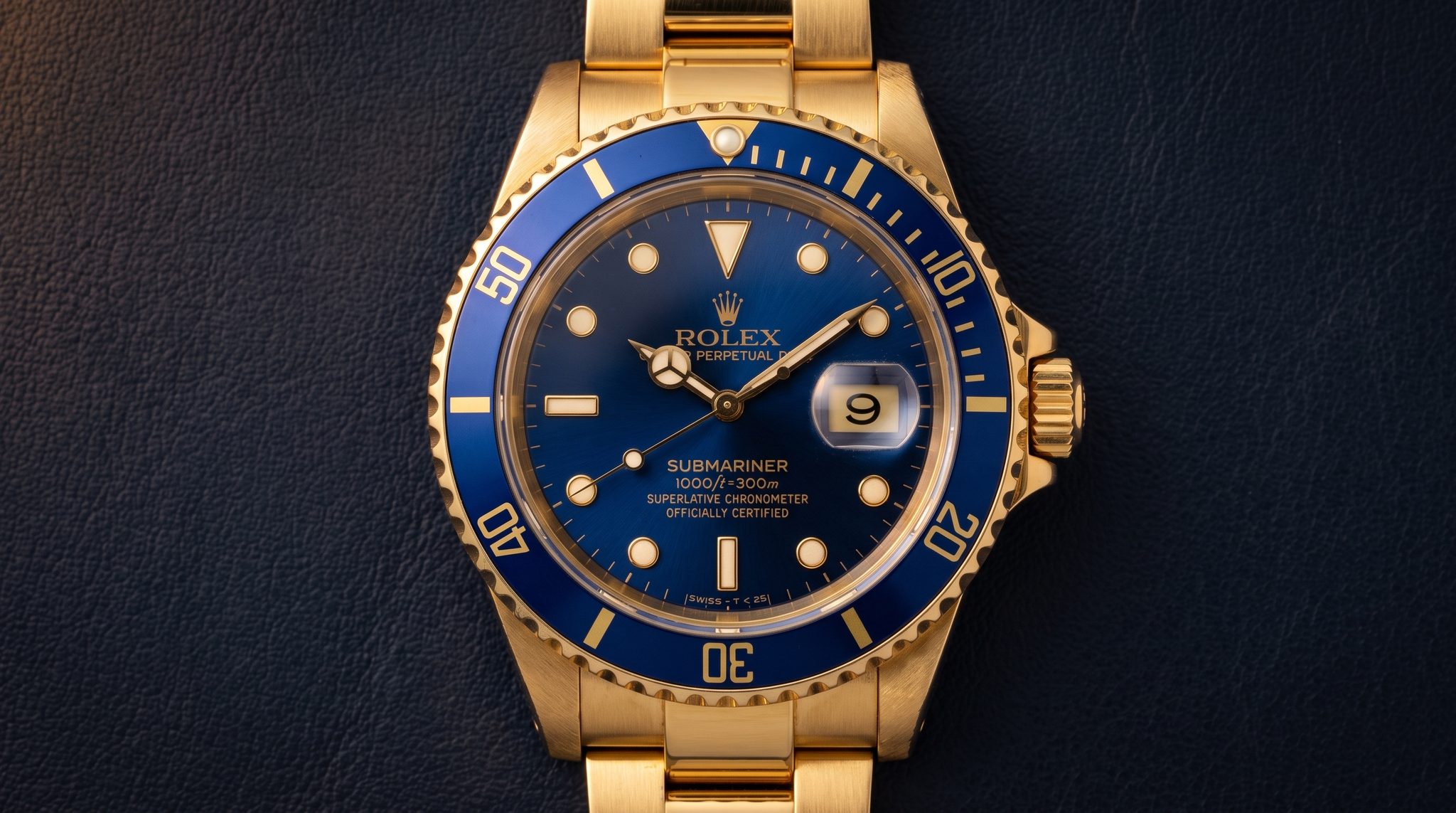
The Rolex Submariner 16618 is the full yellow-gold Submariner Date that preserves the classic 5-digit aluminum-bezel look right up to the ceramic-era handover.
- Production
- c. 1988–c. 2008/2010
- Case
- 18k yellow gold
- Diameter
- 40 mm
- Thickness
- ~12 mm
- Lug width
- 20 mm
- Bezel
- Unidirectional, 60-min
- Insert
- Aluminum (black/blue)
- Crystal
- Sapphire, Cyclops
- Water res.
- 300 m
- Dial
- Black or blue (var.)
- Movement
- Cal. 3135
- Chronometer
- Yes (COSC)
The Rolex Submariner 16618 was produced from about 1988 to about 2008.
- Production years
- c. 1988–c. 2008/2010
- Replaced
- 16808
- Replaced by
- 116618
- Movement
- Cal. 3135
The Rolex Submariner 16618 is the last full yellow-gold Submariner Date that still belongs to the aluminum-insert, classic-case era. The quickest way to feel that difference is to look at what it is not: it never received the ceramic Cerachrom bezel and broader “Super Case” proportions that define its successor, the ref. 116618.
That makes the Rolex 16618 a bridge watch in the most literal sense. It arrives around 1988 as the 5-digit update to the earlier gold Submariner Date ref. 16808, swapping in the Caliber 3135. It then runs for roughly two decades into the late 2000s, with sources disagreeing on whether the reference ends around 2008 or extends through a 2009–2010 overlap period as the ceramic generation takes over.
Within that long span, the case and movement are notably stable. Every 16618 is a 40 mm, 300 m Submariner Date in 18k yellow gold on an Oyster bracelet, powered by the chronometer-certified caliber 3135 with quick-set date. The changes that matter to collectors are the ones you can actually see at arm’s length: the dial’s hour-marker style and the small line of text at 6 o’clock. Early dials can appear with raised “nipple” markers, a carry-over look from older gold Submariners, while the mainstream execution uses applied gold surrounds with luminous plots. Separately, the dial signature evolves from tritium “SWISS-T<25” to a short “SWISS” phase and then “SWISS MADE” as Rolex moved from tritium to non-tritium luminous compounds.
Because those traits do not change in perfect lockstep, the most reliable way to place a Submariner 16618 in its era is to read them independently. A tritium-signed dial tells one story; a nipple-marker dial tells another; bracelet and end-link style can tell a third. The reward for that careful looking is a watch that wears like a precise snapshot of the moment before the modern gold Submariner became a different object altogether, visually harder, more angular, and defined by ceramic and maxi-era proportions.
“16618 is the gold Submariner Date that keeps the classic 5-digit silhouette and aluminum bezel right up to the ceramic handover.”
Rolex 16618 production years: c. 1988–c. 2008/2010
Ref. 16618 enters the Submariner line around 1988 as the full yellow-gold expression of the new 1661x generation, and its single most important mechanical fact is also its simplest: it is caliber 3135 from start to finish. Rolex had already established the modern Submariner Date architecture in the preceding gold ref. 16808, including sapphire crystal and 300 m water resistance, but the 16618 is defined by the 3135 era, with quick-set date and the chronometer-certified execution that became the backbone of Submariner Date production.
What changes within the reference are mostly about surface and signature, not structure. Early production overlaps visually with the older gold Submariner tradition through “nipple” hour markers that rise from the dial as small gold cones, a look that reads more like jewelry than instrument. Most watches, however, show the more familiar late-5-digit layout: applied gold surrounds with luminous plots, paired with black (LN) or blue (LB) dials and matching aluminum inserts.
The most dependable dating clues sit at 6 o’clock. Tritium dials announce themselves with “SWISS-T<25,” then later examples move into non-tritium signatures: a short “SWISS” phase and then “SWISS MADE.” For the 16618 specifically, the exact calendar cutoffs are not fixed by factory publication, so the safest way to use these signatures is as era markers rather than hard endpoints.
By the late 2000s, the reference’s identity is defined as much by what stayed put as by what evolved. In a family where the ceramic-era successor ref. 116618 arrives with Cerachrom, maxi proportions, and a modern clasp system, the 16618 reads as the last gold Submariner that still looks like the classic 5-digit template, only executed entirely in yellow gold.
- c. 1988IntroducedRef. 16618 between lugs
- c. 1988 – early 1990sNipple carryoverConical gold hour markers
- c. 1990sSerti optionDiamonds plus baguettes at 6/9
- c. late 1990sTritium fades6 o’clock text loses T<25
- c. 1998 – 2000SWISS-only“SWISS” only at 6
- c. 2000 – c. 2008/2010SWISS MADE“SWISS MADE” at 6
- c. 2008/2010ReplacedCerachrom bezel, maxi case
16618 against its neighbours
The 16618 makes the most sense when it is framed by the gold reference it replaced and the gold reference that replaced it. Ref. 16808 shows the earlier sapphire-era gold Submariner Date with caliber 3035; ref. 116618 shows how dramatically the same idea changes once Rolex shifts to ceramic and maxi-era proportions. Together they define 16618 as the stable, long-running middle chapter: the 3135-era gold Submariner with an aluminum insert and classic-case silhouette.
This reference 16618 Rolex · focal c. 1988–c. 2008/2010 | 116618 Successor (yellow gold, ceramic) c. 2008–2020 | |||
|---|---|---|---|---|
| Production | c. 1979–1987/88 | 1988–2010 | c. 1988–c. 2008/2010 | c. 2008–2020 |
| Case | 18k yellow gold | Yellow Rolesor | 18k yellow gold | 18k yellow gold |
| Diameter | 40 mm | 40 mm | 40 mm | 40 mm |
| Insert | Aluminum (black/blue) | Aluminum (blue/black) | Aluminum (black/blue) | Cerachrom (black/blue) |
| Crystal | Sapphire, Cyclops | Sapphire, Cyclops | Sapphire, Cyclops | Sapphire, Cyclops |
| Water res. | 300 m | 300 m | 300 m | 300 m |
| Dial | Black or blue (var.) | Black or blue (var.) | Black or blue (var.) | Maxi dial (black/blue) |
| Movement | Cal. 3035 | Cal. 3135 | Cal. 3135 | Cal. 3135 |
| Chronometer | Yes | Yes (COSC) | Yes (COSC) | Yes |
Six dial generations across the run
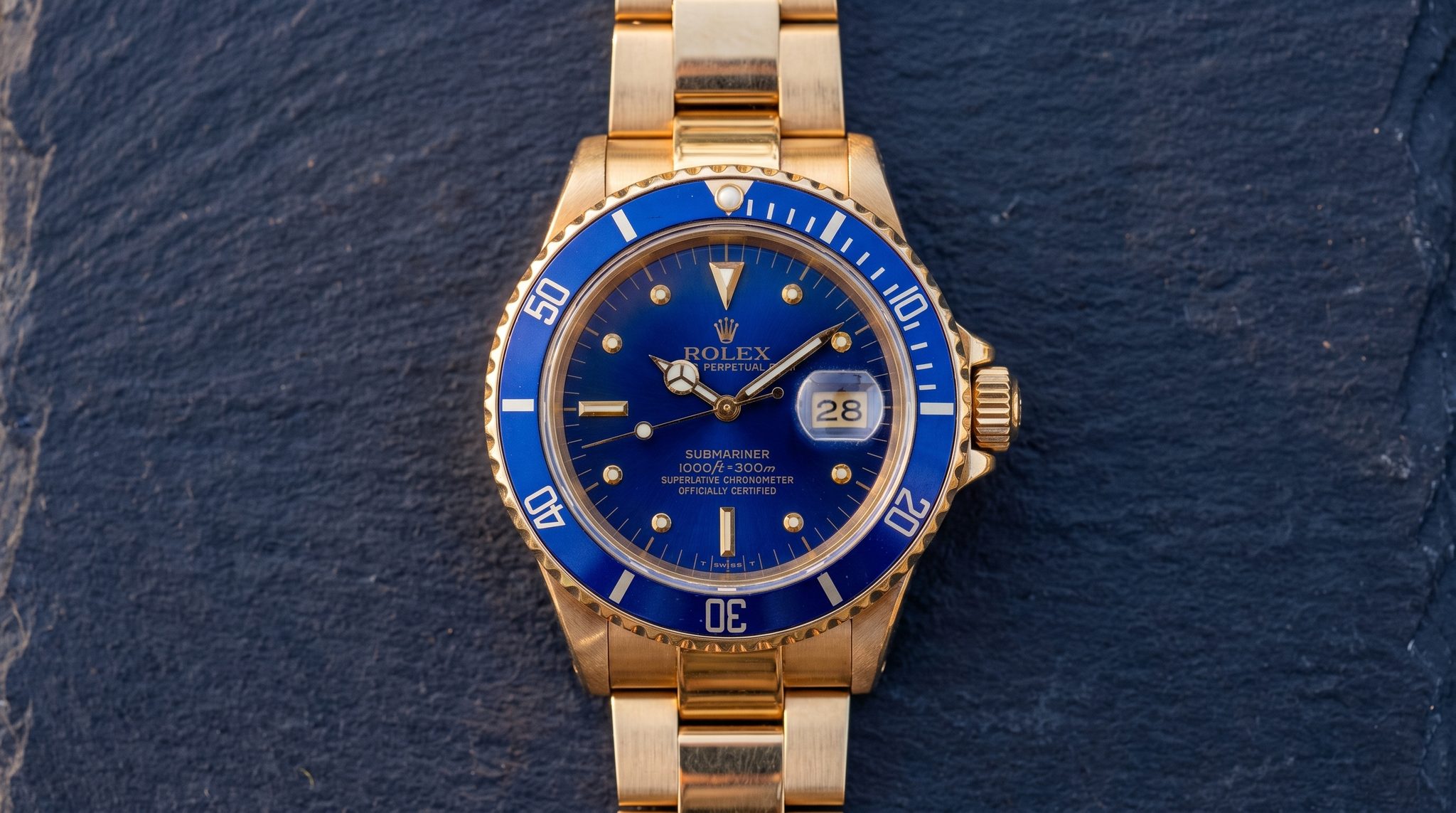
The earliest 16618LBs can carry the gold Submariner’s older jewelry-coded signature: raised “nipple” markers. Instead of flat surrounds holding lume, each hour marker stands proud of the dial as a small gold cone, set against a sunburst blue base that catches light in radial bands. On these early pieces the 6 o’clock line reads “SWISS-T<25,” tying the look to the tritium era. Published coverage agrees this is an early execution that overlaps with late 16808 production, but it does not fix a single last year for the nipple dial on 16618.
What to check before buying a 16618
Buying a Submariner 16618 is less about hunting for rare mechanical sub-variants and more about verifying that the visible parts agree with each other. The reference stayed on caliber 3135 and the same basic case concept throughout, so the value sits in originality: the right dial signing, the right dial type, and the right bracelet configuration for the period.
16618 price and value
Rolex Submariner 16618 for sale
Indicative market value from recent dealer, auction, and Grey Market sales: median ≈ $22,000, with a typical $18,000–$27,250 range across 68 comparable sales (updated this week).
Each point is a recent dealer or auction sale, banded to an indicative figure. The range shown is not a valuation.
Adjacent in the Submariner family
Common questions about the 16618
Published specialist and trade sources place the Rolex Submariner 16618 beginning around 1988, with discontinuation and replacement by the ceramic-era ref. 116618 described around 2008 and, in some accounts, extending into a 2009–2010 changeover period. Rolex did not publish a single factory start and stop date for the reference, so the safest description is late 1980s to late 2000s.
- Rolexopedia, Reference 16618 (production and dial guide)rolexopedia.net
- Monochrome Watches, Rolex Submariner history Part 3 (5-digit references)monochrome-watches.com
- Bob's Watches, Rolex Submariner 16618 reviewbobswatches.com
Show 7 more
- Bob's Watches, Submariner 16618 buying guidebobswatches.com
- Rolexopedia, Reference 116618 (yellow gold ceramic era)rolexopedia.net
- Rolexopedia, Reference 16808 (predecessor, cal. 3035)rolexopedia.net
- Raymond Lee Jewelers, hands-on review of 16618LNraymondleejewelers.net
- The 1916 Company, Submariner 16618 video reviewwatch.the1916company.com
- Bernard Watch, Submariner Date 16618 Serti listing with measurementsbernardwatch.com
- WristBuzz, complete list of Submariner references (collecting checks)wristbuzz.com