

Rolex Submariner 16803
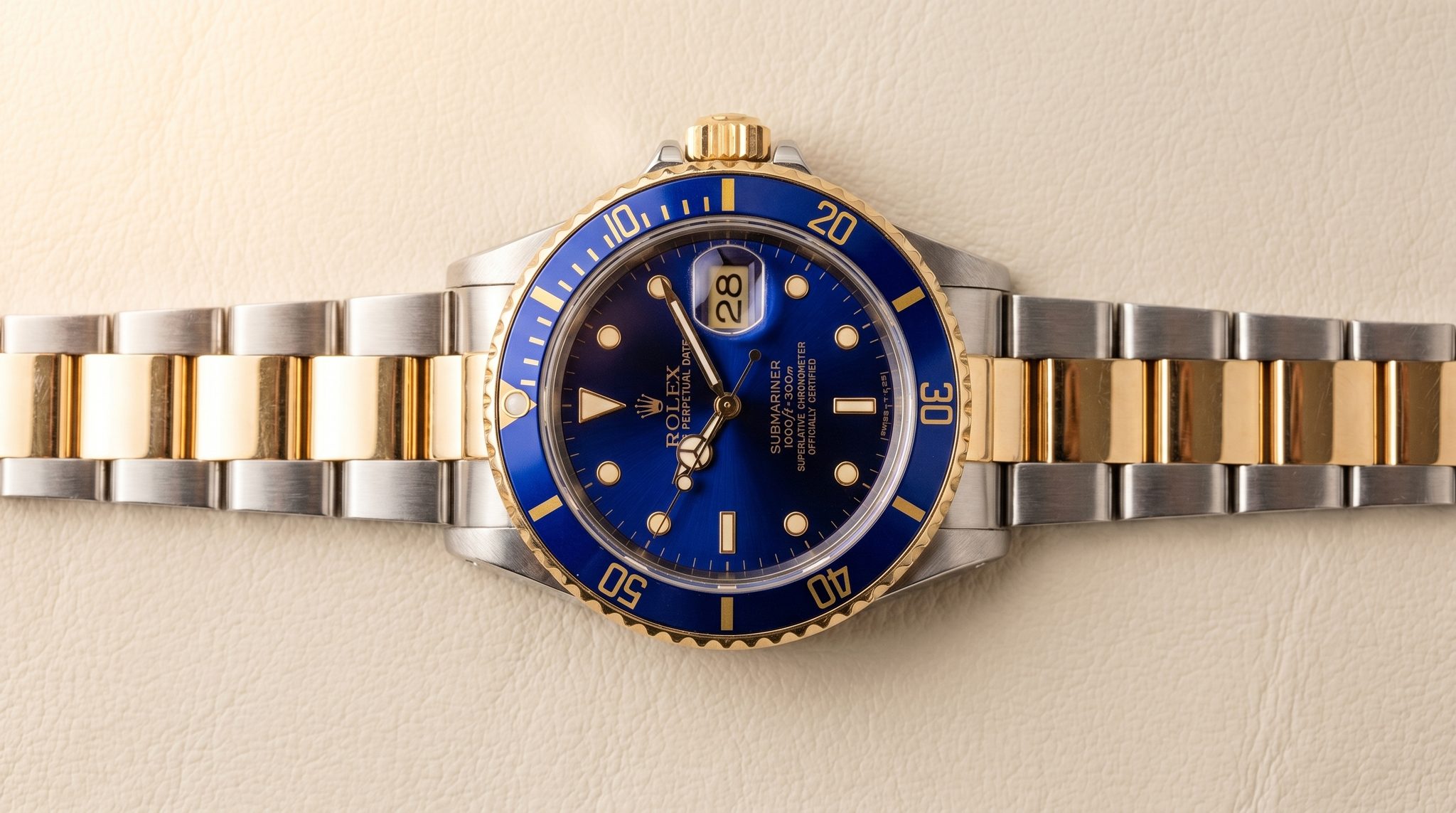
The Rolex Submariner 16803 is the short-lived hinge between tool-watch Submariners and the long-run two-tone era, the first Rolesor Submariner Date built around the high-beat caliber 3035.
- Production
- c. 1984–1988
- Case
- Steel + 18k yellow gold
- Diameter
- 40 mm
- Thickness
- ~12–12.6 mm
- Lug width
- 20 mm
- Lug-to-lug
- ~47–47.5 mm
- Crystal
- Sapphire, Cyclops
- Bezel
- Unidirectional timing
- Insert
- Aluminum (blue/black)
- Water res.
- 300 m / 30 ATM
- Movement
- Rolex Cal. 3035
- Lume
- Tritium
The Rolex Submariner 16803 was produced from about 1984 to 1988.
- Production years
- c. 1984–1988
- Replaced by
- 16613
- Movement
- Rolex Cal. 3035
The Rolex Submariner 16803 is the watch that turned two-tone from a curiosity into a permanent Submariner category. Its most repeatable proof is simple: it is consistently described as the first Rolesor (steel and yellow gold) Submariner, and it did it on a thoroughly modern platform for its moment, a sapphire-crystal, 300-meter Submariner Date driven by the high-beat caliber 3035.
That combination is why the 16803 reads like a hinge in the lineup rather than a mere colorway. It borrows the late transitional architecture associated with the 16800 generation, then adds the gold bezel ring, crown, and bracelet center links that would define the long-running two-tone 16613 that followed. Because production is reconstructed from serial ranges and period material rather than a single published factory record, the Submariner 16803 production years are usually given as a tight mid-1980s span, most defensibly c. 1983/84 through roughly 1987–1989, with examples clearly documented in the 1985–1987 band.
On the wrist it wears like a familiar five-digit Submariner, but with just enough era-specific detail to keep it from blending into later decades. Measured examples cluster around 12 to 12.6 mm thick with roughly a 47 to 47.5 mm lug-to-lug and 20 mm lug spacing, numbers that help explain why it remains easy to wear despite the added visual weight of yellow gold.
“A brief mid-1980s run, one enduring idea: the first Rolesor Submariner Date, built on the sapphire-and-300-meter 3035 platform that made two-tone a permanent Submariner lane.”
Rolex Submariner 16803 production years: c. 1984–1988
What makes the 16803 historically legible is not a pile of one-off tweaks but a clear repositioning: Rolex took the newly modernized Submariner Date formula of the era, sapphire crystal, unidirectional timing bezel, and a 300 m rating, then made it available in yellow Rolesor. The reason for the broader modernization is not documented in these sources, but the result is measurable: the 16803 carries a caliber 3035 described as Rolex’s first high-beat Submariner movement, running at 28,800 vph with quickset date and hacking seconds, and paired with a modern 300 m case.
The production boundaries are less clean. One detailed review places the debut in 1983, while another states it did not reach market until 1984; that difference likely reflects the gap between first production and broad retail availability, but the sources do not document a single definitive cutoff. The same pattern appears at the end of the run: late-1980s discontinuation is clear, a late example is described as near the end around 1987, and dated examples appear into 1989 in marketplace tracking. In practice, the 16803 is best understood as a short mid-1980s bridge that existed long enough to establish the two-tone Submariner Date, then quickly stepped aside for the 16613.
Late in the run, the lesson becomes visible from a distance: the two-tone Submariner that many people think of as a stable, long-running type was still being decided in real time. The 16803 is the brief moment when the formula locks in, modern specs, two-tone materials, black or blue executions, before the successor reference turns that formula into a long production standard.
- c. 1983/84IntroducedRolesor case with cal. 3035
- c. 1984Retail presencePeriod-correct serial dating
- 1985 – 1987Mid-run examplesSerial-dated pieces in this band
- c. 1987Late-run notedLate serial example described as end
- c. late 1980s16613 replaces3135-era 16613 reference stamp
- c. 1987/89Phased outExamples dated up to 1989
16803 against its neighbours
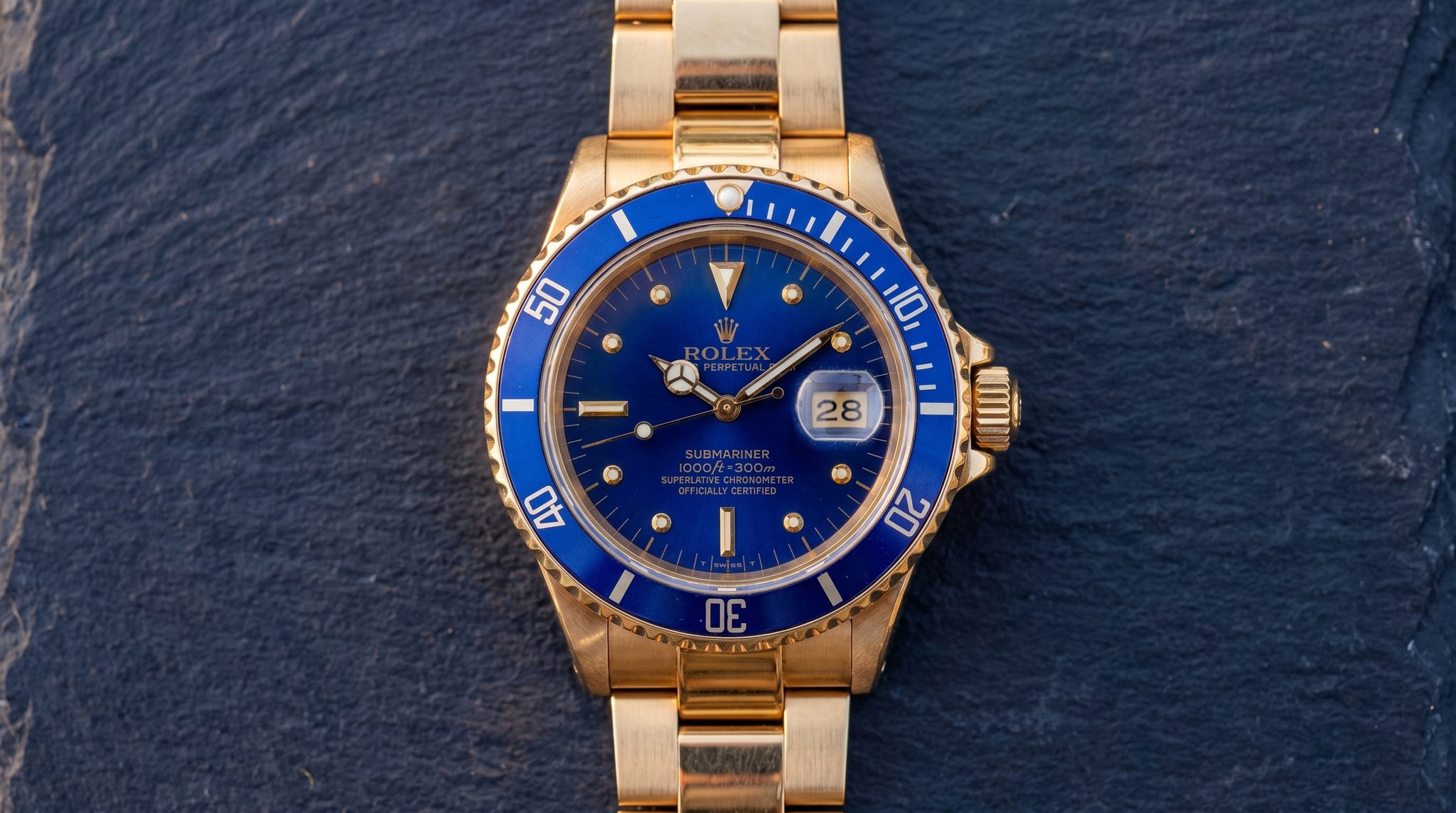
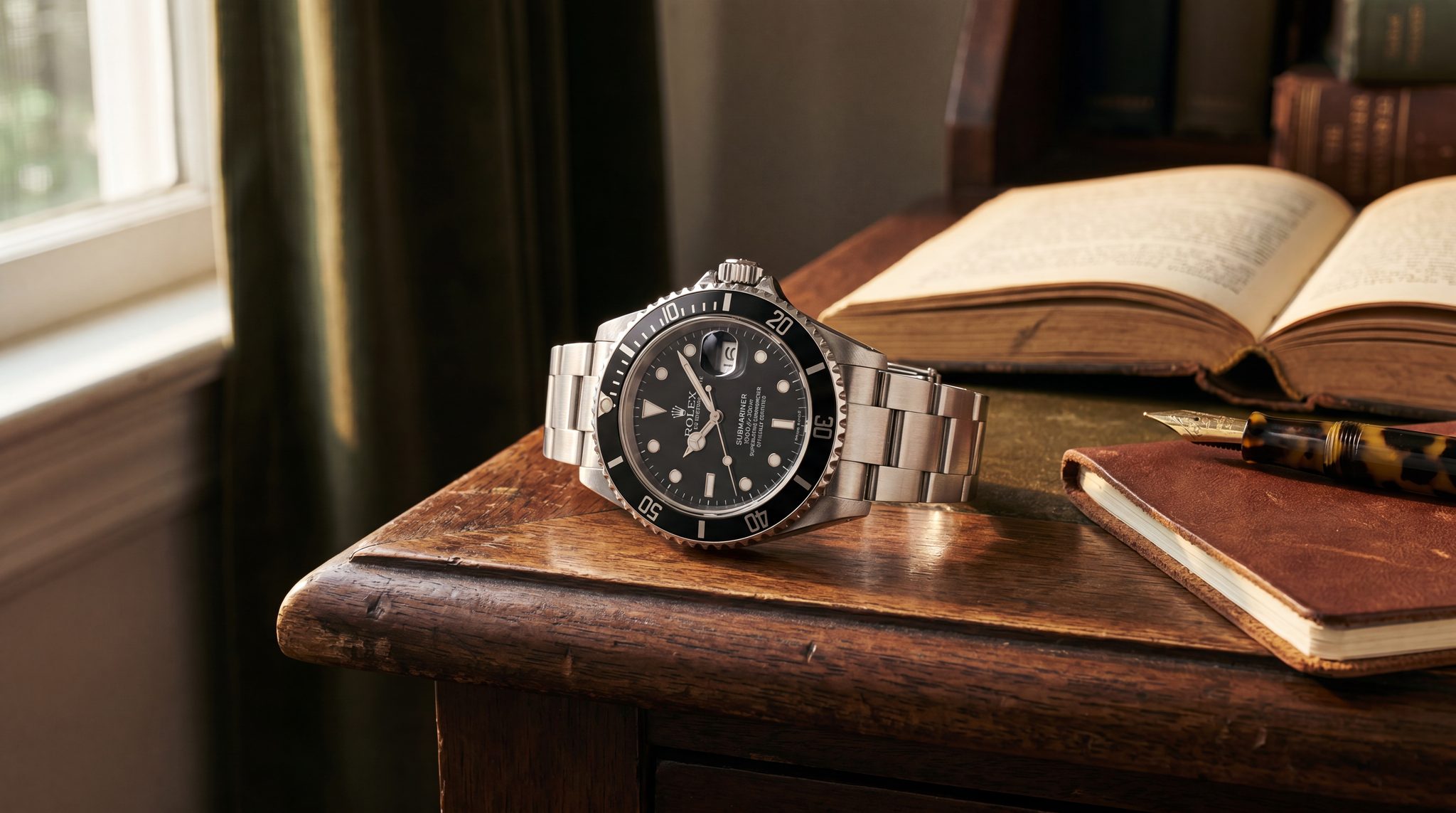
The 16803 only makes sense when it is bracketed by what came immediately before and after. The 16800 supplies the modern Submariner Date architecture that the 16803 adopts in Rolesor form, while the 16613 is the long-run successor that keeps the two-tone idea but replaces the 3035 with the later movement generation and settles into a mainstream production life. The solid-gold 16808 sits closest in spirit: same transitional era, same 3035 foundation, but executed in full yellow gold instead of steel and gold.
This reference 16803 Rolex · focal c. 1984–1988 | ||||
|---|---|---|---|---|
| Production | 1979–1988 | Late 1980s–2000s | Early 1980s–late 1980s | c. 1984–1988 |
| Case | Stainless steel | Rolesor (YG/steel) | 18k yellow gold | Steel + 18k yellow gold |
| Diameter | 40 mm | 40 mm | 40 mm | 40 mm |
| Crystal | Sapphire, Cyclops | Sapphire, Cyclops | Sapphire, Cyclops | Sapphire, Cyclops |
| Insert | Aluminum (black) | Aluminum (blue/black) | Aluminum (blue/black) | Aluminum (blue/black) |
| Water res. | 300 m | 300 m | 300 m | 300 m / 30 ATM |
| Movement | Cal. 3035 | Cal. 3135 | Cal. 3035 | Rolex Cal. 3035 |
| Chronometer | Yes | Yes | Yes (COSC) | – |
| Lume | Tritium | Tritium → LumiNova | Tritium | Tritium |
What to check before buying a 16803
Buying a Rolex Submariner 16803 is mostly an originality exercise, because the reference itself is mechanically consistent. It is documented with caliber 3035 throughout, so value swings far more on dial correctness, condition, and whether the watch still wears coherent mid-1980s parts than on chasing a rare movement or case subtype.
The two-tone format also makes mismatches easier to create and harder to spot at a glance: a replaced bezel insert, swapped dial, or later service parts can leave a watch that looks plausible in photos but reads wrong in hand. Even when the 300 m depth rating is part of the model’s identity, a vintage example should never be treated as water-ready without recent professional sealing and pressure testing.
For most owners, the appeal is straightforward. The 16803 delivers the feel of a five-digit Submariner Date with sapphire and quickset convenience, but adds the warmer, period-correct two-tone vocabulary that later references continued for decades. It suits a buyer who wants the first chapter of that story rather than the longest one, and who is willing to pay for consistency and condition over mere age.
Rolex Submariner 16803 price and value
A Rolex Submariner 16803 sells for about $8,500 at the median, typically $7,300 to $9,300 across 37 comparable sales.
Rolex Submariner 16803 for sale
Indicative figures from recent dealer, auction, and Grey Market sales (updated this week). Every watch is verified before it sells here.
Each point is a recent dealer or auction sale, banded to an indicative figure. The range shown is not a valuation.
Adjacent in the Submariner family
Stories that discuss the 16803
Common questions about the 16803
The Submariner 16803 production years are usually reconstructed as a short mid-1980s span rather than a single documented factory range. The most defensible description is approximately c. 1983/84 through roughly 1987–1989, with sources citing a 1983 debut, a 1984 market arrival, and examples dated into the late 1980s.
- Rolex 16803 - Submariner Date watcheschrono24.com
- Rolex 16803 Review: The First Two-Tone Submariner Watchyoutube.com
- Pre-Owned Rolex Submariner 16803 Luxury Watch Reviewyoutube.com
Show 6 more
- Rolex Submariner 16803 Rolex Watch Reviewyoutube.com
- The History and Evolution of the Rolex Submariner Dategrayandsons.com
- The Complete Rolex Submariner Historybobswatches.com
- Rolex Submariner Date 16803 Review: Buying & Collecting Guidebobswatches.com
- The Evolution of the Rolex Submariner Datetherake.com
- History of the Rolex Submariner - Part 3, The 5-Digit Referencesmonochrome-watches.com