

Rolex Submariner 16800
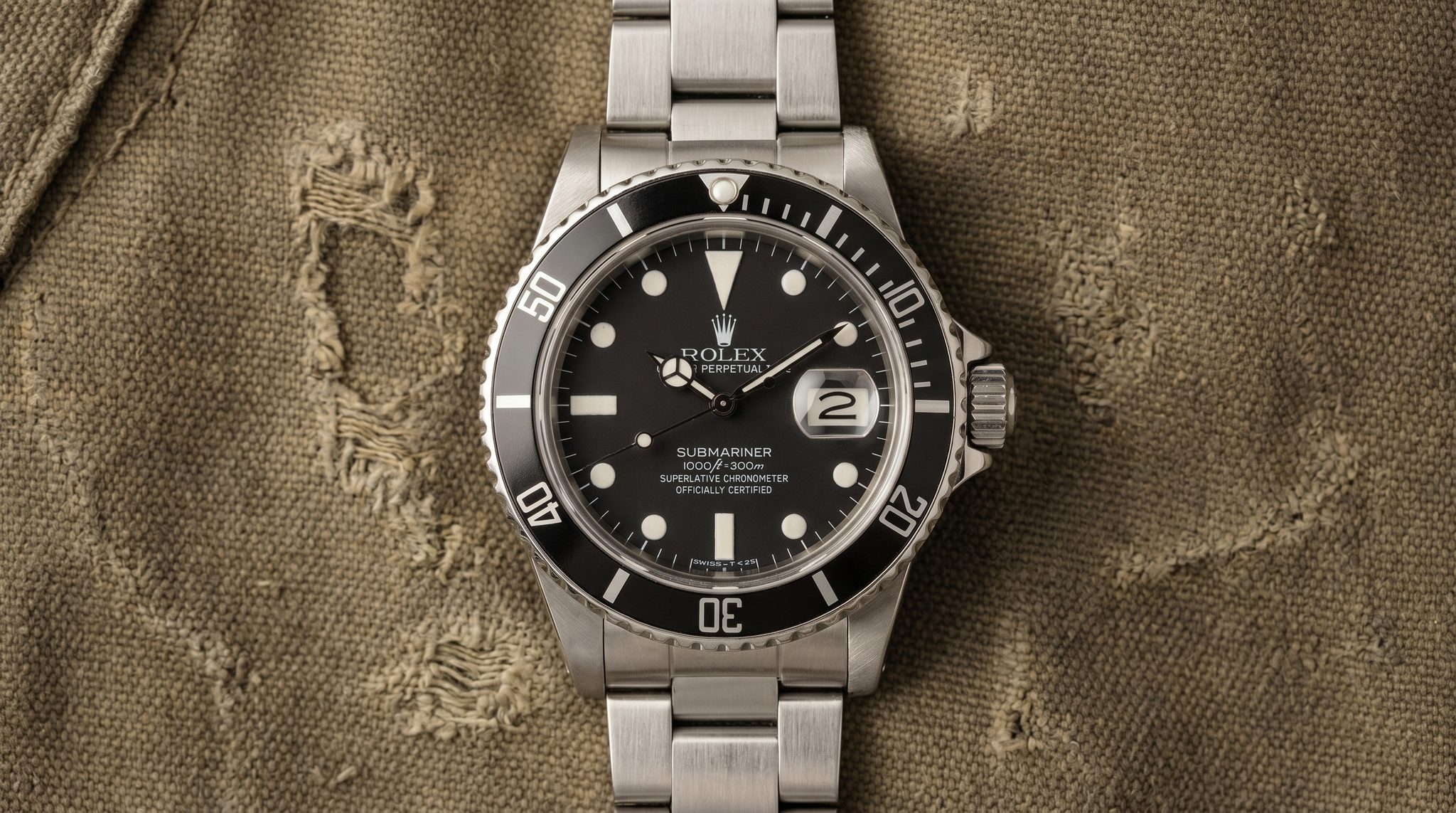
Rolex Submariner Date ref. 16800 is the bridge reference that brought sapphire crystal, a 300 m rating, and the Cal. 3035 quickset era to the Submariner while still offering an early run with matte tritium dials.
- Production
- 1979–1988
- Case
- Stainless steel
- Diameter
- 40 mm
- Lug width
- 20 mm
- Thickness
- ~12.5–12.75 mm
- Crystal
- Sapphire, Cyclops
- Bezel
- Unidirectional, aluminum
- Water res.
- 300 m / 1,000 ft
- Dial
- Matte tritium or gloss WG surrounds
- Movement
- Cal. 3035
- Power reserve
- ~48h
- Lume
- Tritium
Rolex Submariner Date ref. 16800 is the Submariner that turns a single model line into two eras at once, modern in its engineering and still visibly vintage in its earliest dials. The concise proof is printed on the watch itself: “1000ft = 300m” sits on a sapphire-crystal Submariner for the first time, and early examples pair that modern depth rating with a matte black tritium dial whose hour plots are painted directly onto the surface.
Most collector references place the 16800’s production at 1979–1988, between the acrylic-crystal ref. 1680 and the short-lived ref. 168000 that follows. Across that roughly decade-long run the technical platform stays consistent: a 40 mm stainless steel case, a unidirectional bezel with aluminum insert, and the Cal. 3035 automatic with a quickset date (28,800 vph and about 48 hours of power reserve). What changes, and what collectors care about most, is the dial construction. Early 16800s use matte dials with painted tritium markers and no white-gold surrounds, while later examples adopt glossy dials with applied markers framed in white gold, a look that points forward to the next generation.
“Ref. 16800 is the moment the Submariner Date gains sapphire, 300 m, and quickset convenience while the earliest examples still wear matte tritium dials.”
16800 across 1979–1988
Ref. 16800 is most often described as a late-1970s to late-1980s bridge reference because it stacks several line-defining upgrades into one model: sapphire crystal replaces the acrylic crystal of the ref. 1680, water resistance rises to 300 m, the bezel becomes unidirectional, and the Cal. 3035 brings a quickset date. Those changes can be read directly off the watch without opening anything: the sapphire crystal has a different look and feel than acrylic, and the depth rating itself updates to “1000ft = 300m” on the dial.
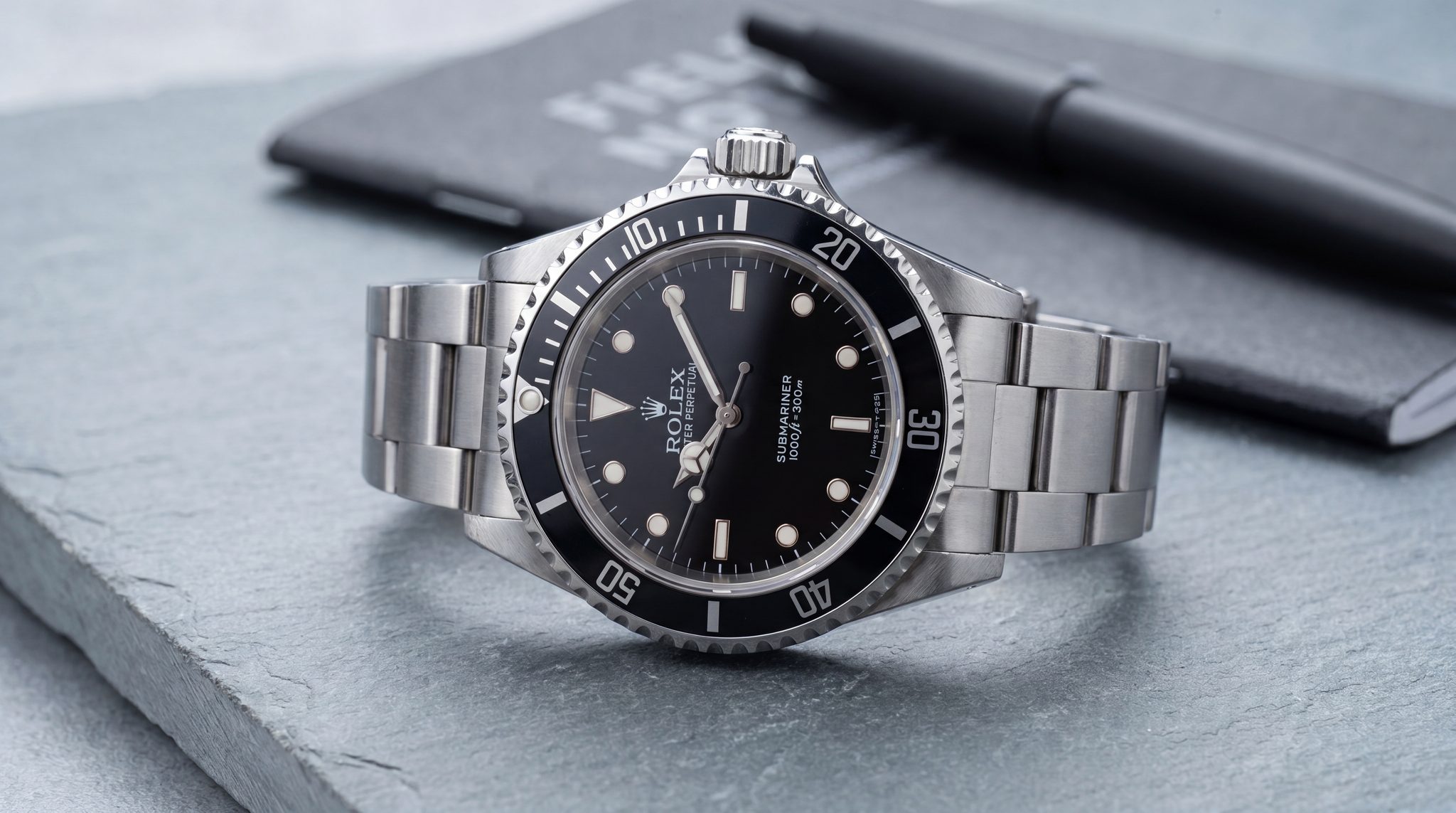
Within that stable technical platform, the dial is where the reference shows its split personality. Early production uses matte black dials with painted tritium markers, so the luminous plots sit flat, like inked shapes filled with aging tritium. Around late 1984, the dial construction shifts to glossy black with applied markers framed in white gold, giving the hour plots a crisp, edged outline that stays visually separate from the dial even as the tritium warms with age. Rolex did not publish a factory cutover, and overlap is possible, but the matte-to-gloss change is consistently treated as the decisive dividing line for collecting.
Near the end of the run, confusion comes not from design but from a reference change: around 1988 Rolex introduces ref. 168000, a near-identical Submariner Date that is chiefly distinguished in the literature by a switch to 904L stainless steel. The result is a brief period where very late glossy-dial 16800s and early 168000s can look the same on the wrist, yet belong to different references. The zoomed-out lesson of the 16800 is how quickly the Submariner’s “modern” template arrived: in one reference, the line moves from acrylic and bidirectional bezels to sapphire, 300 m, quickset convenience, and the glossy, white-gold-surround dial language that defines the decades that follow.
- 1979IntroducedDial reads “1000ft = 300m”
- 1979 – c. 1984/85Matte eraNo white-gold surrounds
- c. 1984/85Gloss changeApplied markers in WG rings
- c. 1988168000 overlapBetween lugs reads “16800” vs “168000”
- 1988DiscontinuedBetween lugs stamped “168000” (not “16800”)
16800 against its neighbours
The 16800 makes the most sense when it is bracketed by the watch it replaces and the watch that almost duplicates it. Ref. 1680 shows the older Submariner Date formula with acrylic crystal and the Cal. 1575, while ref. 168000 is the short-run “Triple Zero” successor whose main headline change is the steel alloy, not the outward design language. Together they explain why the 16800 is collected less as a single configuration and more as two distinct dial eras within one technical platform.
This reference 16800 Rolex · focal 1979–1988 | ||||
|---|---|---|---|---|
| Production | c. late 1960s–late 1970s | 1979–1988 | c. 1987/88–1988/89 | 1989–2010 |
| Case | Stainless steel | Stainless steel | 904L stainless steel | 904L stainless steel |
| Diameter | 40 mm | 40 mm | 40 mm | 40 mm |
| Crystal | Acrylic, Cyclops | Sapphire, Cyclops | Sapphire, Cyclops | Sapphire, Cyclops |
| Bezel | Bidirectional, friction | Unidirectional, aluminum | Unidirectional, aluminum | Unidirectional, aluminum |
| Water res. | 200 m | 300 m / 1,000 ft | 300 m | 300 m |
| Dial | Matte; red or white | Matte tritium or gloss WG surrounds | Gloss with WG surrounds | Gloss with WG surrounds |
| Movement | Cal. 1575 | Cal. 3035 | Cal. 3035 | Cal. 3135 |
| Lume | Tritium | Tritium | Tritium | Tritium → LumiNova → S-LN |
Two dial generations across the run
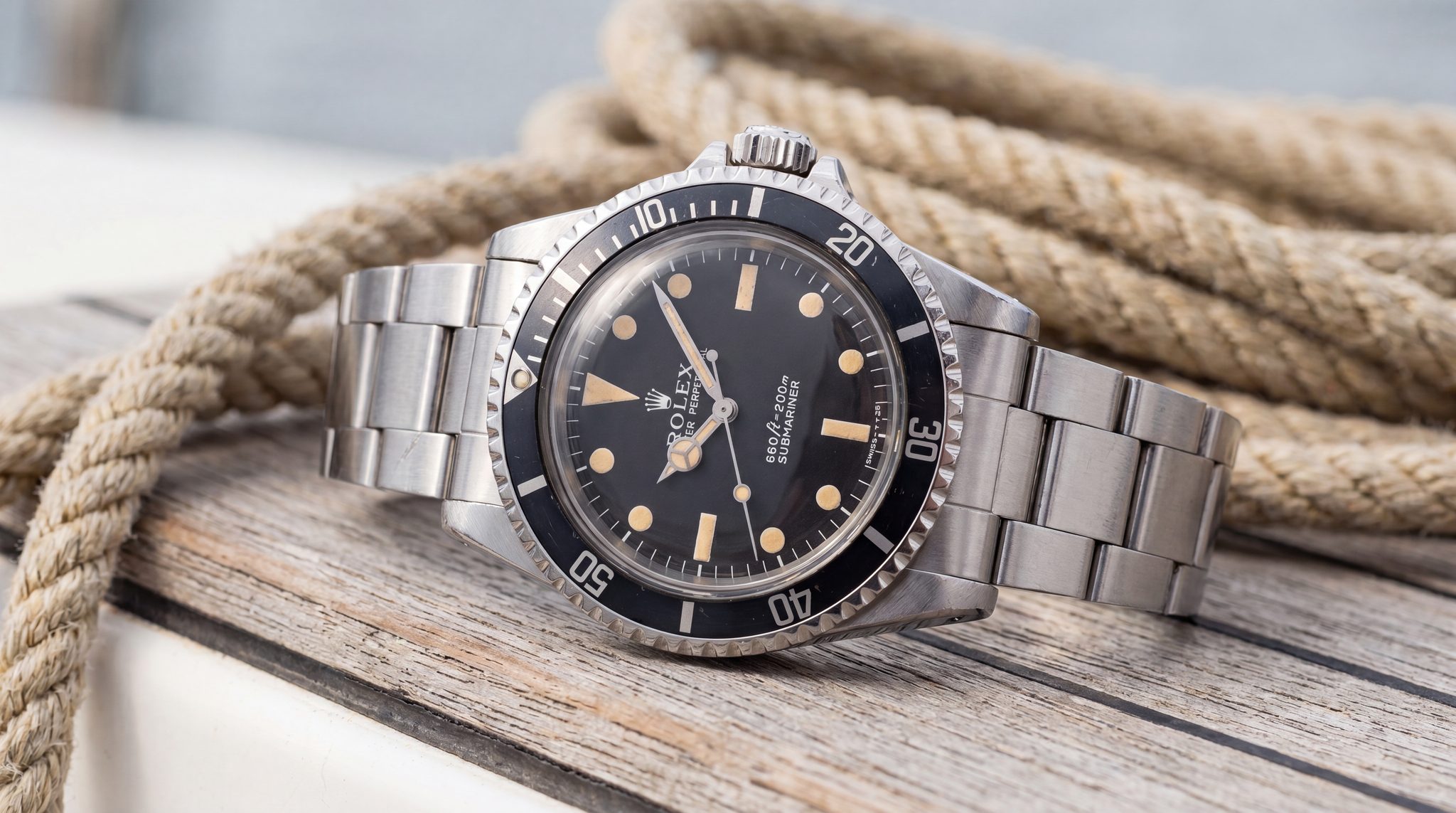
The early Submariner 16800 that collectors call “matte” is recognizable the moment light hits the dial surface. Instead of a reflective lacquer, the black looks flat and slightly grainy, and the hour markers are not framed or applied. Each plot is painted directly onto the dial and filled with tritium, so the luminous material ages as a continuous, soft-edged shape rather than as a bright dot set inside metal.
This is the configuration that makes the 16800 feel historically specific: the watch already carries sapphire crystal, a 300 m depth rating printed as “1000ft = 300m,” a unidirectional bezel, and the Cal. 3035 quickset date, yet the dial still belongs visually to the earlier matte-dial era. Patina is part of the appeal here because tritium on matte dials often shifts to warm cream or deeper tones; “tropical” brown dials and strong pumpkin patina are treated as aging outcomes rather than separate factory variants.
What to check before buying a 16800
Buying a Submariner 16800 is mainly about buying the right dial era and then protecting its originality. The reference is mechanically consistent in the sources, centered on the Cal. 3035 quickset movement, so most value differences come from the matte-versus-gloss split, the state of the tritium, and how many service parts have been fitted over decades of maintenance.
Rolex Submariner 16800 for sale
Indicative market value from recent dealer, auction, and Grey Market sales: median ≈ $7,900, with a typical $6,900–$10,250 range across 219 comparable sales (updated this week).
Each point is a recent dealer or auction sale, banded to an indicative figure. The range shown is not a valuation.
Adjacent in the Submariner family
Common questions about the 16800
Most collector references document Rolex Submariner ref. 16800 as a 1979–1988 production reference, often described broadly as late 1970s through the 1980s.
- The Crossroads of Vintage and Contemporary: The 16800 Submarinerjournal.craftandtailored.com
- Rolex Submariner Evolution 1680, 16800, and 168000bobswatches.com
- Rolex Submariner Stainless Steel 16800 (review)bobswatches.com
Show 7 more
- Rolex Submariner 16800 vs. 168000: What's the Difference?everestbands.com
- 1986 Rolex Submariner Ref. 16800 (HODINKEE Shop listing)shop.hodinkee.com
- 1982 Rolex Submariner Matte Dial Ref. 16800 (example listing)cwwatchshop.com
- 1982 Rolex Submariner ref. 16800 Matte Dial (example listing)craftandtailored.com
- Rolex Submariner Date Ref. 16800, Transitional Matte Dial (example listing)oliverandclarke.com
- Bob’s Watches: Vintage Rolex Submariner 16800 (YouTube)youtube.com
- Rolex Submariner Date 16800 listingschrono24.com