

Rolex Submariner 16613
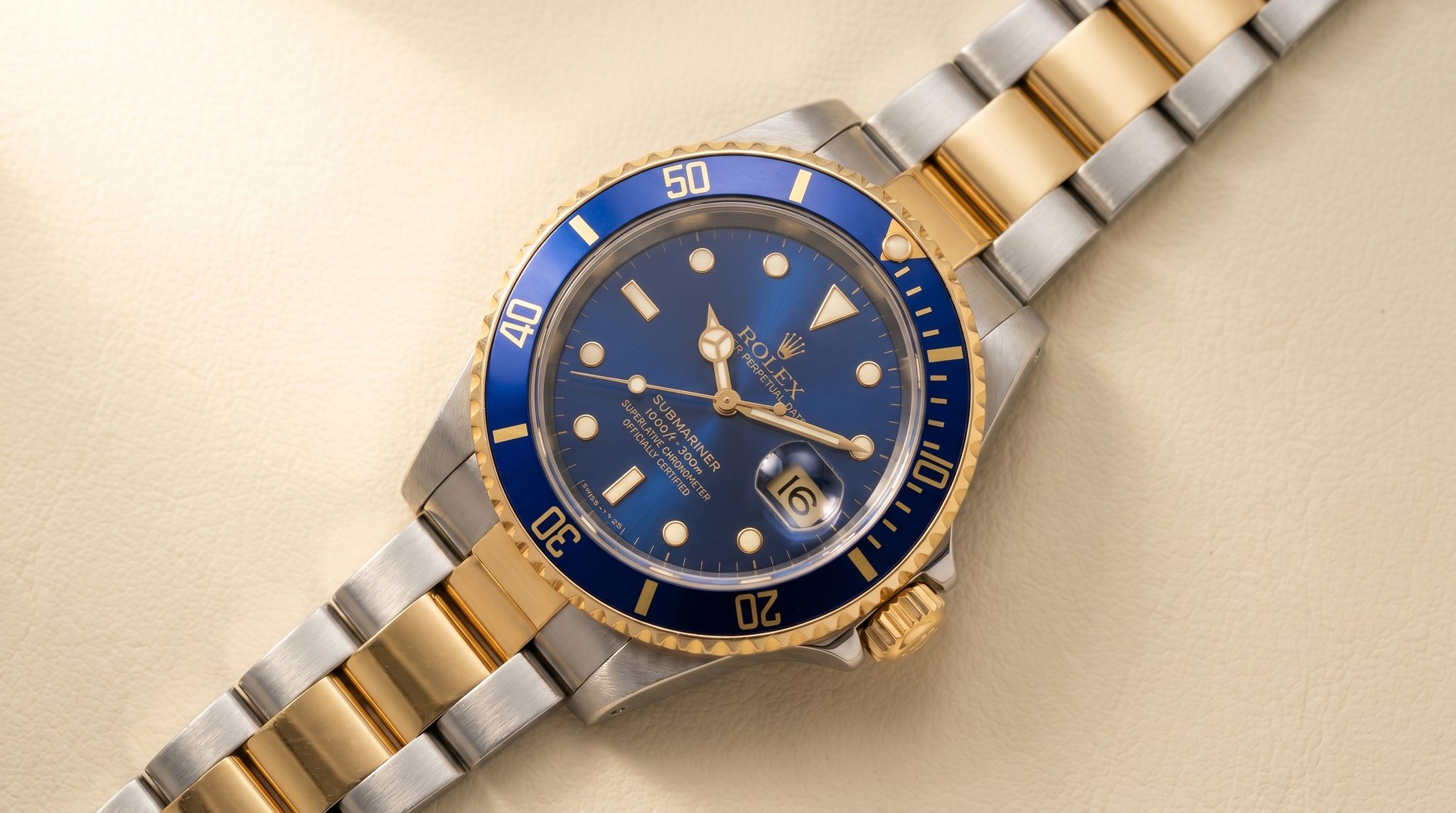
The Rolex Submariner 16613 is the last two-tone Submariner Date whose character is still written by aluminum and tritium, a reference where originality is often visible at a glance in the tiny line of text at 6 o’clock.
- Production
- 1988–2010
- Case
- Yellow Rolesor
- Diameter
- 40 mm
- Bezel
- Unidirectional
- Insert
- Aluminum (blue/black)
- Crystal
- Sapphire, Cyclops
- Water res.
- 300 m / 1,000 ft
- Movement
- Rolex Cal. 3135
- Power
- ~48h
- Chronometer
- Yes (COSC)
- Bracelet
- Rolesor Oyster
- Crown
- Triplock, screw-down
The Rolex Submariner 16613 is the two-tone Submariner that rewards close looking more than most modern Rolex sports watches. On early examples the dial can literally announce its era in one line of text, “T SWISS – T<25” at 6 o’clock, and that tritium signature is the start of the reference’s most compelling story: the same watch can feel like a late tool watch or a polished luxury diver depending on which parts of its long production run you are holding.
Introduced in 1988 and produced until 2009, the Submariner 16613 replaced the earlier two-tone ref. 16803 and was itself replaced by the ceramic-bezel ref. 116613 in 2009. Throughout, Rolex kept the core formula stable: a 40 mm Oyster case in yellow Rolesor, a unidirectional timing bezel with an aluminum insert in blue or black, and the caliber 3135 with date and quickset functionality.
What changed, and what collectors watch for, happened in overlapping layers. Luminous material moved from tritium to Luminova and then Super-Luminova, leaving behind a clear trail of dial signatures (“T SWISS – T<25,” then “SWISS,” then “SWISS MADE”). The case and bracelet evolved more quietly, from drilled lug holes and hollow end links toward smooth case flanks and solid end links. Rolex also updated the caliber 3135 over the years, with later watches benefiting from a blue Parachrom hairspring, although the exact cutover year within 16613 production is not crisply documented.
This is why the most convincing 16613s look assembled by time, not assembled later. When the lume text, case style, bezel insert, and bracelet construction all belong to the same slice of the run, the watch reads as coherent in the hand, whether it is a sharp late example or an early “Bluesy” whose blue has drifted toward violet with age.
“On a Submariner 16613, the smallest line of dial text can be the most truthful piece of history.”
16613 across 1988–2010
Rolex launched the Submariner 16613 in 1988 as the long-run successor to the two-tone ref. 16803. The headline change is simple and durable: the caliber 3135 becomes the engine for the two-tone Submariner Date and stays there, bringing the familiar Rolex high-beat architecture, quickset date, and chronometer certification that defined the five-digit era.
The reference’s visible evolution is best read in two separate places: at the very bottom of the dial, and on the sides of the case. Early dials are tritium, signed with the “T SWISS – T<25” line that often develops a warmer tone with time. Around 1998 Rolex moves away from tritium and the 16613 follows the broader Rolex sports-watch pattern: a short-lived “SWISS” signature marks Luminova, then “SWISS MADE” becomes the stable late signature associated with Super-Luminova.
In parallel, the 16613’s case and bracelet move from a more overtly utilitarian presentation toward the smoother look associated with later Rolex sports models. Early watches commonly show drilled lug holes and hollow end links, while later examples tend to be no-holes cases with solid end links. Rolex also made technical running updates within the caliber 3135, including later examples that use a blue Parachrom hairspring, but Rolex did not publish a clean, reference-specific switchover date.
The zoomed-out lesson of the 16613 is that a Submariner could still change meaning without changing its name. By the time the ceramic-bezel 116613 replaced it in 2009, the same reference number had already lived two lives: one that still ages like a late-vintage tool watch, and one that looks and feels like the modern luxury diver Rolex would formalize next.
- 1988IntroducedTwo-tone 40 mm, cal. 3135
- c. 1998Tritium ends“T SWISS – T<25” at 6
- c. 1998 – 2000Luminova era“SWISS” only at 6
- c. 1999 – 2000Super-LumiNova“SWISS MADE” at 6
- c. 2000 – 2003No-holes caseSmooth case flanks
- c. early 2000sSEL commonSolid end-link fit
- 2009ReplacedCerachrom bezel, Super Case
16613 against its neighbours
The 16613 is easiest to understand when it is bracketed by the references on either side of it. The 16803 shows what Rolex carried forward into the modern two-tone Submariner Date concept, the 116613 shows what Rolex changed when the line turned ceramic, and the 16610 shows how much of the five-digit Submariner experience is shared across metals in the same era.
This reference 16613 Rolex · focal 1988–2010 | 116613 Successor c. 2009–2020 | |||
|---|---|---|---|---|
| Production | c. 1984–1988 | 1988–2010 | 1989–2010 | c. 2009–2020 |
| Case | Yellow Rolesor | Yellow Rolesor | Stainless steel | Yellow Rolesor |
| Diameter | 40 mm | 40 mm | 40 mm | 40 mm |
| Insert | Aluminum | Aluminum (blue/black) | Aluminum (black) | Cerachrom (ceramic) |
| Crystal | Sapphire, cyclops | Sapphire, Cyclops | Sapphire, Cyclops | Sapphire, cyclops |
| Water res. | 300 m | 300 m / 1,000 ft | 300 m | 300 m |
| Movement | Cal. 3035 | Rolex Cal. 3135 | Rolex Cal. 3135 | Rolex Cal. 3135 |
| Chronometer | Yes (COSC) | Yes (COSC) | Yes (COSC) | Yes (COSC) |
| Bracelet | Oyster (two-tone) | Rolesor Oyster | 93150 / 93250 Oyster | Oyster (two-tone) |
Ten dial generations across the run
The earliest Submariner 16613 dials announce themselves at 6 o’clock with “T SWISS – T<25.” In the hand, these are the pieces that can feel closest to the older Submariner tradition: the luminous plots and hands often soften in tone over time, and early blue dials can shift toward a purple or violet cast with long UV exposure. That color drift is not damage when it is even and clean; it is a manufacturing-and-time collaboration that later service parts cannot recreate.
These tritium dials are often paired with the more overtly practical case style of the early run, drilled lug holes and bracelets with hollow end links, but the pairing is not guaranteed. Rolex used parts across transitions, so the dial signature should be treated as its own clue rather than as proof of a specific case type.
What to check before buying a 16613
Buying a Rolex 16613 is less about chasing a single “correct” version than it is about making sure the watch’s story is internally consistent. The aluminum bezel insert is easy to replace, dials can be swapped to simulate rarer configurations, and two-tone bracelets age in ways that are not obvious in photos.
Start with the one detail that Rolex left in plain sight: the 6 o’clock dial signature. “T SWISS – T<25” should come with tritium hands that have aged in the same direction, “SWISS” should look like a transitional Luminova dial rather than a service mix, and “SWISS MADE” should not be paired with an obviously earlier tritium handset. Then confirm case architecture separately: drilled lugs versus smooth flanks, and hollow end links versus solid end links.
The biggest value swings inside the Submariner 16613 ecosystem come from dials. Early blue tritium examples that have shifted evenly toward purple can command a premium, and confirmed factory Serti executions typically trade above standard dials when originality is clear. At the same time, the most satisfying 16613 ownership often comes from restraint: a sharp, coherent later watch with Super-Luminova and solid end links offers the full five-digit wearing experience with fewer originality questions.
In practice the 16613 suits people who like their Submariner with warmth. Yellow Rolesor makes the familiar 40 mm Submariner case read differently, and the reference’s long run means buyers can choose how much time they want to see on the dial, from tritium character to crisp late-production brightness, without leaving the same fundamental 300 m, caliber 3135 platform.
Rolex Submariner 16613 for sale
Indicative market value from recent dealer, auction, and Grey Market sales: median ≈ $9,500, with a typical $8,200–$10,750 range across 432 comparable sales (updated this week).
Each point is a recent dealer or auction sale, banded to an indicative figure. The range shown is not a valuation.
Adjacent in the Submariner family
Common questions about the 16613
The Submariner 16613 is widely documented as being produced from 1988 to 2009, introduced as the successor to the two-tone ref. 16803 and replaced in 2009 by the ceramic-bezel ref. 116613.
- Rolex Submariner 16613 listing and specificationsbobswatches.com
- Two-tone Rolex Submariner history and evolution (16803 → 16613 → 116613)bobswatches.com
- The Complete Guide to the Rolex Submariner 16613swisswatchexpo.com
Show 7 more
- Rolex Submariner 16613 buyer guide video (variants, Parachrom note)youtube.com
- 16613 vs 116613 comparison review (platform differences, 3135 context, purple dial mention)youtube.com
- Rolex 16613 review (early tritium, lug holes, bracelet construction)luxurywatches635.wordpress.com
- Chrono24 reference hub for Rolex 16613 (including “Sultan”/Serti descriptors and alternate codes)chrono24.com
- BQ Watches: Rolex 16613 production span and dealer pricing commentarybqwatches.com
- WatchGuys: 16613 overview including lume-signature progressionwatchguys.com
- Watchfinder: pre-owned 16613 listings context (condition and verification emphasis)watchfinder.com