

Rolex Submariner 168000
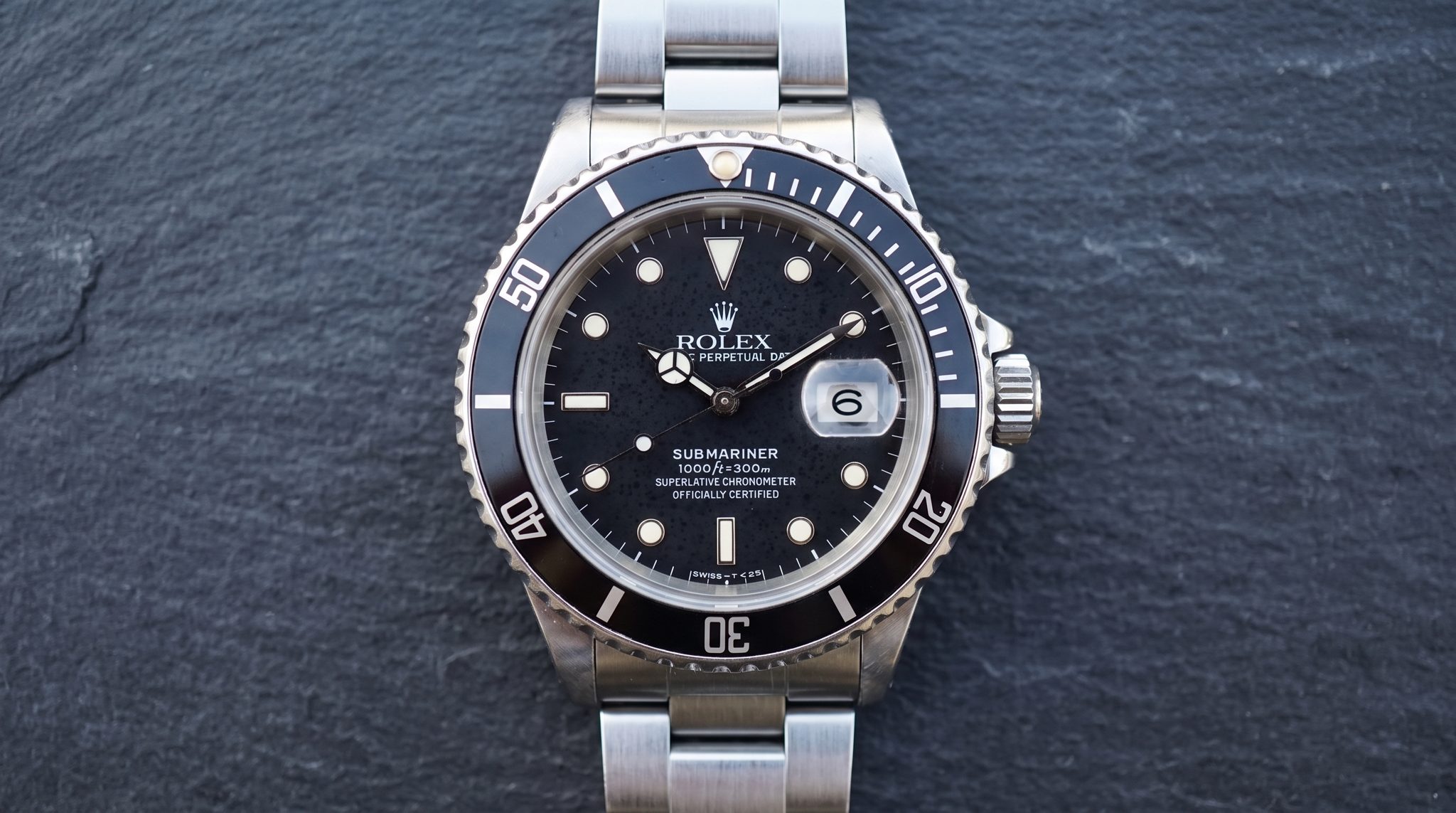
The Rolex Submariner 168000 is the late-1980s “Triple Zero” Submariner Date, remembered for a very short, disputed production window and for changes you mostly confirm by paperwork and dial typography rather than by wrist feel.
- Production
- c. 1987/88–1988/89
- Case
- Steel (alloy update)
- Diameter
- 40 mm
- Thickness
- ~12.5–13 mm
- Lug width
- 20 mm
- Bezel
- Unidirectional, 60-min
- Insert
- Black aluminum
- Crystal
- Sapphire, Cyclops
- Water res.
- 300 m / 1,000 ft
- Dial
- Black, tritium
- Movement
- Rolex cal. 3035
- Chronometer
- Yes
The Rolex Submariner 168000 is the Submariner Date that exists to be missed: collector reconstructions often compress it into a 7–9 month run, yet its most consequential change is one you cannot see from across a room, a steel-alloy update that helped bridge the ref. 16800 to the long-running ref. 16610.
Searched as the Rolex 168000 or Submariner 168000, the “Triple Zero” keeps the late 16800’s overall look and the same caliber 3035 architecture, including its quickset date. What gives the reference its identity is the way several independent details can sit slightly out of step with one another during the changeover: dial construction can be matte or glossy, hour markers can be painted plots or applied plots framed by white-gold surrounds, and the printing itself can shift between a more traditional curving “S” in “Submariner” and the later angular “flat-S” nicknamed “Zorro.” Those are different traits with different clocks, which is why the 168000 is collected less as a single “configuration” than as a narrow slice of late-1980s Rolex production caught mid-transition.
“A Submariner Date defined by a brief, debated late-1980s run, a largely invisible steel update, and dial printing that previews the 16610 era.”
168000 across c. 1987/88–1988/89
In purely functional terms, the 168000 sits on familiar ground: the 40 mm Submariner Date silhouette with sapphire crystal, Cyclops magnifier, 300 m depth rating, and an aluminum bezel insert. The mechanism is equally straightforward across the run. Every 168000 uses Rolex caliber 3035, a 28,800 vph movement whose everyday calling card is its quickset date, and there is no documented in-reference movement change.
The interesting part is what changed without a clean, public dividing line. The reference itself is repeatedly described as Rolex’s step into a more corrosion-resistant stainless steel than the preceding 16800, commonly framed as an early move toward 904L. Rolex did not publish a neat “from this day forward” metallurgy note in public archives, so the alloy story is verified in the way collectors often have to verify late-20th-century Rolex: by understanding what a reference is known to represent, then confirming that the physical watch in hand is genuinely that reference.
Dial details show the same transitional character, but with more to see. Some early examples are documented with matte black tritium dials that look flatter and more utilitarian, with luminous hour plots painted directly on the dial and no white-gold surrounds. Most described examples, however, carry glossy black dials whose applied markers sit in white-gold frames, the modern Submariner look. Independent of the dial’s surface and marker construction, the printing itself moves between at least two recognizable styles, including the later angular “flat-S” in “Submariner” often nicknamed “Zorro.” That same print style appears on early 16610 dials, which is why the 168000 can feel like a single frame taken from a longer film.
Stepping back, the 168000 compresses several Rolex realities into one reference: manufacturing changes can be significant yet nearly invisible, and the visible tells that collectors prize can belong to broader supplier and printing transitions that do not obey reference boundaries. The result is a watch whose story is bigger than its lifespan, a bridge you mostly understand by learning what, exactly, you are looking at.
- c. 1987/88IntroducedInside caseback “168000”
- c. 1987Steel updateNot visible; ref. defines it
- c. 1987Matte overlapFlat dial, no WG surrounds
- c. 1987 – 1988Mark 1 printRounded “S” in “Submariner”
- c. 1987 – 1988Zorro printAngular “flat-S” in “Submariner”
- c. 1988/89Discontinued16610 reference and cal. 3135
168000 against its neighbours
The 168000 makes the most sense when it is bracketed by its immediate neighbors: the 16800 that established the sapphire, 300 m, 5-digit Submariner Date architecture, and the 16610 that standardized the next movement generation for decades. Those bookends also explain why many 168000s look familiar at a glance while still rewarding close reading of details like steel era, dial construction, and print style.
This reference 168000 Rolex · focal c. 1987/88–1988/89 | ||||
|---|---|---|---|---|
| Production | 1979–1988 | c. 1987/88–1988/89 | 1989–2010 | c. 1990–1999 |
| Case | Stainless steel | Steel (alloy update) | Stainless steel | Stainless steel |
| Diameter | 40 mm | 40 mm | 40 mm | 40 mm |
| Bezel | Unidirectional, 60-min | Unidirectional, 60-min | Unidirectional, 60-min | Unidirectional, 60-min |
| Insert | Black aluminum | Black aluminum | Black aluminum | Black aluminum |
| Crystal | Sapphire, Cyclops | Sapphire, Cyclops | Sapphire, Cyclops | Sapphire |
| Water res. | 300 m / 1,000 ft | 300 m / 1,000 ft | 300 m / 1,000 ft | 300 m / 1,000 ft |
| Dial | Matte or gloss | Black, tritium | Gloss black | No-date, two-line |
| Movement | Cal. 3035 | Rolex cal. 3035 | Cal. 3135 | Cal. 3000 |
| Chronometer | Yes | Yes | Yes | No |
| Lume | Tritium | – | Tritium → LumiNova → S-LN | Tritium |
Three dial generations across the run
Matte-dial 168000s are the small counterpoint to the reference’s usual glossy image. Under light the dial does not “wet shine”; it stays flat and slightly grainy, and the hour markers read as painted luminous islands rather than applied plots. The absence of white-gold surrounds is the quickest tell, and it gives the watch a more old-school tool look despite the sapphire crystal and 300 m rating.
Dealers and collectors who document these watches often associate them with mid-1987 production, with caseback stamps frequently cited in the II/87 to III/87 range. The exact cutoff is debated, and some authors treat the matte 168000 as a rare exception or a potential point of confusion with late 16800 production, which is why the most convincing examples are those that combine the matte dial with a correctly stamped inner caseback reading “168000.”
What to check before buying a 168000
Buying a Rolex Submariner 168000 is mainly an exercise in respecting how narrow and transitional the reference is. It is close enough to both late 16800 and early 16610 production that sellers can unintentionally (or intentionally) let the story do the work, so the safest approach is to verify one concrete thing at a time: the inner caseback should read 168000, the dial should be tritium-signed “SWISS – T < 25,” and the dial’s construction and printing should make sense together rather than feel like a mix assembled later.
The most common value swings in the Submariner 168000 market come from originality and condition, not from the reference number alone. An intact tritium dial with matching tritium hands, a correct-looking and attractively aged aluminum insert, and a case that still shows crisp geometry tend to separate satisfying examples from those that wear the right number but have lost their period character.
Living with a 168000 is, in practice, living with a late-1980s Submariner Date that wears like its neighbors: 40 mm across, roughly 12.5 to 13 mm thick, and on a 20 mm bracelet. The appeal is not novelty on the wrist. It is the quieter pleasure of owning a Submariner whose most important story is the moment Rolex was standardizing the modern Date Sub, while the last small typographic and material decisions were still in motion.
Rolex Submariner 168000 for sale
Indicative market value from recent dealer, auction, and Grey Market sales: median ≈ $7,800, with a typical $7,100–$10,500 range across 39 comparable sales (updated this week).
Each point is a recent dealer or auction sale, banded to an indicative figure. The range shown is not a valuation.
Adjacent in the Submariner family
Common questions about the 168000
The Submariner 168000 is consistently described as a late-1980s transitional run, most often reconstructed around mid-1987 into early 1988, with some reference lists extending production into 1989. A cautious summary is c. 1987/88–1988/89, reflecting the documented disagreement and the lack of Rolex-published production tables.
- The Evolution of the Rolex Submariner Date: 1680 to 16610crownvintage.com.au
- History of the Rolex Submariner, Part 3: The 5-Digit Referencesmonochrome-watches.com
- The Evolution of the Rolex Submariner Datebucherer.com
Show 7 more
- Rolex Submariner Evolution 1680, 16800, and 168000bobswatches.com
- Rolex Submariner 16800 vs. 168000: What's the Difference?everestbands.com
- Identifying future classic Rolex from the 1990-2018 era (Rolex Submariner 168000)watchprozine.com
- Rolex 3035 (movement reference)reference.grail-watch.com
- Rolex Caliber 3035: The Ultimate Guidemillenarywatches.com
- Rolex Caliber 3035 vs. 3135calibercorner.com
- Rolex | Submariner, Reference 168000 | A stainless steel wristwatch (auction listing)sothebys.com