

Rolex GMT-Master 16753
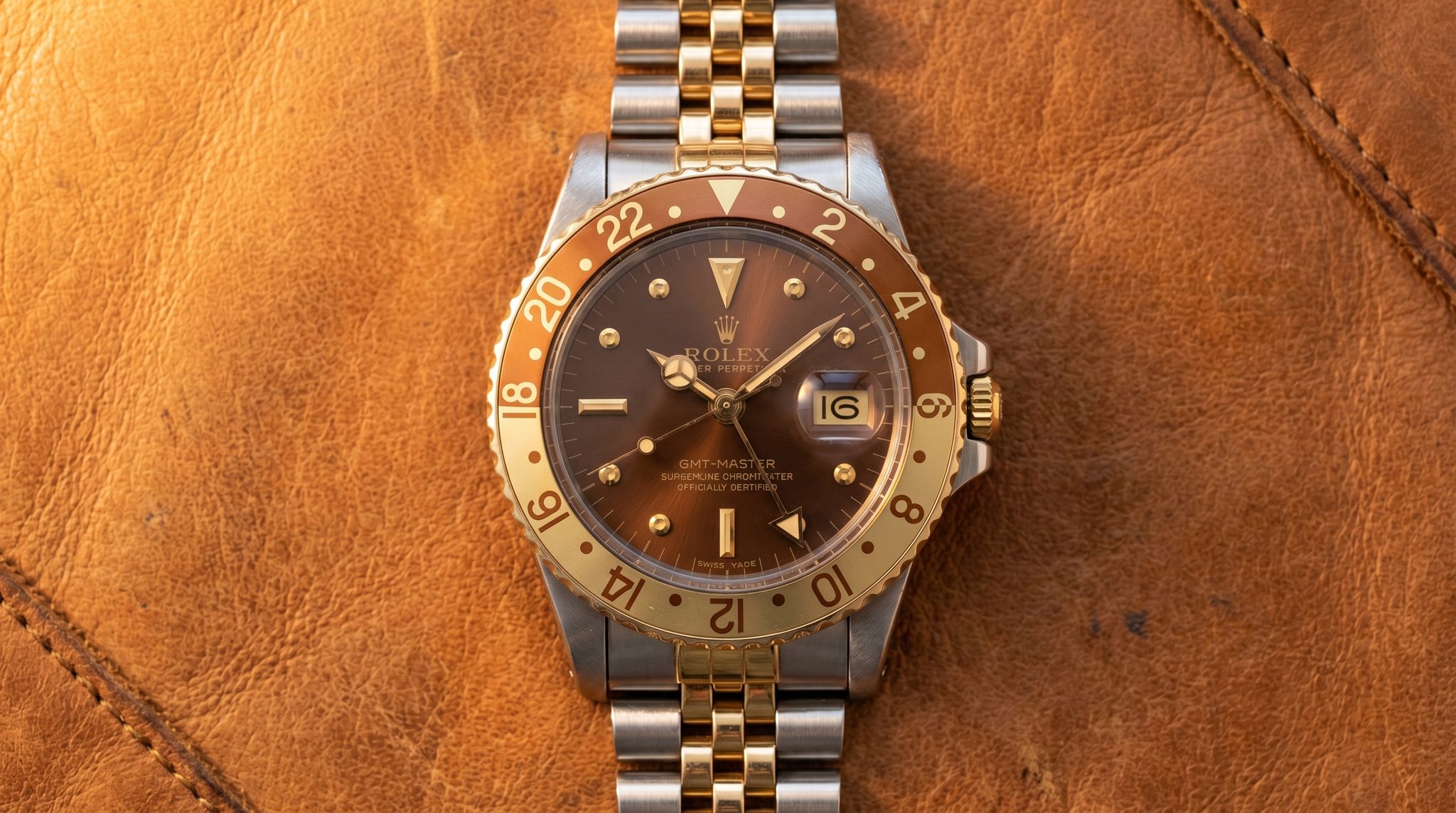
The Rolex 16753 is the two-tone GMT-Master that keeps the vintage acrylic-era look while bringing the line into the quickset, high-beat 3075 generation.
- Production
- c. 1980–1988
- Case
- Steel + 18k yellow gold
- Diameter
- 40 mm
- Bezel
- Bidirectional 24-hour
- Insert
- Aluminum (brown or black)
- Crystal
- Acrylic
- Water res.
- 100 m / 330 ft
- Dial
- Gloss (brown or black)
- Lume
- Tritium (T<25)
- Movement
- Cal. 3075
- Functions
- Date, GMT, hacking
- Bracelet
- Oyster or Jubilee
The Rolex GMT-Master 16753 was produced from about 1980 to 1988.
The Rolex 16753 is the moment the “Root Beer” GMT stopped being purely a vintage artifact and became a genuinely modern-to-use travel watch, without giving up the acrylic-crystal look that defines the earlier GMT-Master era. Every factory 16753 is built around Rolex’s caliber 3075, a 28,800 bph movement with hacking seconds and a quickset date, a practical leap over the earlier 1575-powered four-digit watches.
That split personality is the whole point of the Rolex GMT-Master 16753. Externally it stays faithful to the classic GMT-Master formula: a 40 mm Oyster case in steel and 18k yellow gold, an aluminum 24-hour insert, and the familiar two-time-zone logic of a linked GMT hand read against the rotating bezel (not the independently adjustable GMT hand of the later GMT-Master II). Internally it belongs to the five-digit “transitional” generation shared with the ref. 16750 and 16758, and it was sold with both Oyster and Jubilee bracelets.
Collectors tend to treat 16753 as one nickname, “Root Beer,” but the reference is better understood as a set of overlapping choices rather than a single fixed look: brown or black bezel inserts, brown or black glossy dials, and (most importantly) two different index architectures, the earlier conical “nipple” markers and later flat batons. Because many of these traits overlap in time and because inserts and dials can be swapped during service, the 16753 rewards careful, trait-by-trait evaluation more than any attempt to memorize a single linear sequence of “Mark” dials.
“Acrylic outside, 3075 inside: the two-tone GMT-Master that wears like the past and sets like the future.”
Rolex GMT-Master 16753 production years: c. 1980–1988
The 16753 sits in a narrow but influential pocket of GMT-Master history: the period when Rolex modernized the mechanics before it modernized the exterior. Its defining technical constant is caliber 3075, a 28,800 bph movement with hacking seconds and a quickset date, and the reason collectors call the reference “transitional” is plain even without a loupe. The case and crystal language stay in the acrylic era, while the user experience moves decisively toward the later five-digit watches.
That continuity on the outside is also why precise dating by a single feature is hard. The two-tone case and aluminum insert invite parts swapping, and the reference was offered with both black and brown insert colors as standard catalog variants during the same 1980s production span. Dial color also runs in parallel. Brown sunburst dials define the “Root Beer” identity, but black dials were produced alongside them.
The most visible internal evolution within the reference is not mechanical but architectural: the hour markers themselves. Earlier watches often use the faceted, conical gold “nipple” indices, while later production is more commonly seen with flat baton-style surrounds and larger luminous plots. Rolex did not publish a clean cutoff and surviving examples show overlap in the mid-1980s, so the honest conclusion is that 16753 production is best read as a set of concurrent options rather than a single marching sequence.
Seen as a whole, the 16753 shows how quickly the GMT-Master line changed in the 1980s. In the span of one short reference, Rolex combined the last acrylic-crystal travel watch format with the higher-beat, quickset convenience that owners now take for granted, then handed the line off to the sapphire-crystal ref. 16700 at the end of the decade.
- c. 1980/81AppearsTwo-tone 16753 case set
- c. early 1980sCal. 30753075 stamped on movement
- c. early – mid 1980sNipple dialsFaceted cone markers
- c. mid-1980sBaton dialsFlat plots with surrounds
- 1988Succeeded16700 has sapphire crystal
16753 against its neighbours
The 16753 makes the most sense when framed by the two references that bracket its era. The steel ref. 16750 shares its core mechanical generation, while the later steel ref. 16700 shows what Rolex changed next: the GMT-Master kept its linked GMT-hand architecture, but the exterior moved on from acrylic to sapphire.
16758 Sibling (full gold) c. 1980s | This reference 16753 Rolex · focal c. 1980–1988 | |||
|---|---|---|---|---|
| Production | c. 1979/80–1988 | c. 1980s | c. 1980–1988 | 1988–1999 |
| Case | Stainless steel | 18k yellow gold | Steel + 18k yellow gold | Stainless steel |
| Diameter | 40 mm | 40 mm | 40 mm | 40 mm |
| Crystal | Acrylic | Acrylic | Acrylic | Sapphire |
| Water res. | 100 m | 100 m | 100 m / 330 ft | 100 m |
| Bezel | Bidirectional 24-hour | Bidirectional 24-hour | Bidirectional 24-hour | Bidirectional 24-hour |
| Insert | Aluminum (Pepsi/black) | Aluminum | Aluminum (brown or black) | Aluminum |
| Dial | Matte → gloss | Gloss | Gloss (brown or black) | Gloss black |
| Lume | Tritium | Tritium | Tritium (T<25) | Tritium → Luminova |
| Movement | Cal. 3075 | Cal. 3075 | Cal. 3075 | Cal. 3175 |
| Functions | Date, GMT, hacking | Date, GMT, hacking | Date, GMT, hacking | Date, GMT |
| Bracelet | Oyster | Oyster | Oyster or Jubilee | Oyster or Jubilee |
Six dial generations across the run
The brown-and-gold 24-hour insert is the look most people mean by “Root Beer.” In hand, it reads less like a single color than a range of browns, from dark outer tones to warmer bronze, with gold-tone numerals that echo the yellow-gold crown and bezel ring. The brief does not document a start or end date for this insert within 16753 production, and period-correct examples overlap with black inserts across the reference’s life.
Because aluminum inserts are easy to swap, this is also one of the first places originality gets tricky. A correct, well-preserved brown insert that matches the watch’s overall age is valued, but it has to be judged alongside the dial and hands, not taken as proof of an “early” watch by itself.
What to check before buying a 16753
Buying a GMT-Master 16753 is less about finding a single correct “version” and more about confirming that the parts on one watch belong together. The reference’s most valuable traits, especially original dials and brown inserts, are also the easiest to disturb through decades of service, and the sources are explicit about how mixed, altered, and over-polished examples circulate.
The most important practical advantage of the 16753 is also the easiest to take for granted: all examples have the caliber 3075 with hacking seconds and a quickset date. That means a buyer can focus on originality and condition rather than chasing a movement sub-generation, but it also means the dials and bezels do most of the value-defining work.
A well-bought 16753 suits the owner who wants the warmer, two-tone side of the GMT-Master story, but still wants a watch that sets quickly and keeps time like a later five-digit Rolex. The reward is a travel watch that feels unmistakably acrylic-era on the wrist, yet avoids many of the everyday inconveniences of the earlier non-quickset GMT-Masters.
Rolex GMT-Master 16753 price and value
A Rolex GMT-Master 16753 sells for about $8,500 at the median, typically $7,000 to $10,000 across 76 comparable sales.
Rolex GMT-Master 16753 for sale
Indicative figures from recent dealer, auction, and Grey Market sales (updated this week). Every watch is verified before it sells here.
Each point is a recent dealer or auction sale, banded to an indicative figure. The range shown is not a valuation.
Adjacent in the GMT-Master family
Stories that discuss the 16753
Common questions about the 16753
The most defensible production window in the supplied sources is the early 1980s through 1988, with many sources citing 1981–1988. The exact start is not firmly documented, and some marketplace observations show watches described as 1979 or 1980, consistent with serial and sales-date overlap at the turn of the decade.
- Hodinkee Reference Points: Understanding the Rolex GMT-Masterhodinkee.com
- Fratello Watches: #TBT Rolex GMT Master 16753 Root Beerfratellowatches.com
- Bob's Watches: Rolex GMT-Master 16753 Review: The Iconic Root Beerbobswatches.com
Show 7 more
- Chrono24: Rolex 16753 price and listings overviewchrono24.com
- Precision Watches: Vintage Rolex GMT Master 16753 Root Beer 18k Yellow Gold & Steelprecisionwatches.com
- Analog:Shift: Rolex Ref. 16753 GMT Master (archived listing)analogshift.com
- Gray & Sons: The History and Evolution of the Rolex GMT-Mastergrayandsons.com
- Bob's Watches (video): Vintage Rolex GMT-Master 16753 “Root Beer”youtube.com
- The 1916 Company: Rolex GMT-Master 16753 Transitional Two Tone Classic (video/blog)the1916company.com
- Wind Vintage: Rolex GMT-Master Reference 16753 Unpolishedwindvintage.com