

Rolex GMT-Master 6542
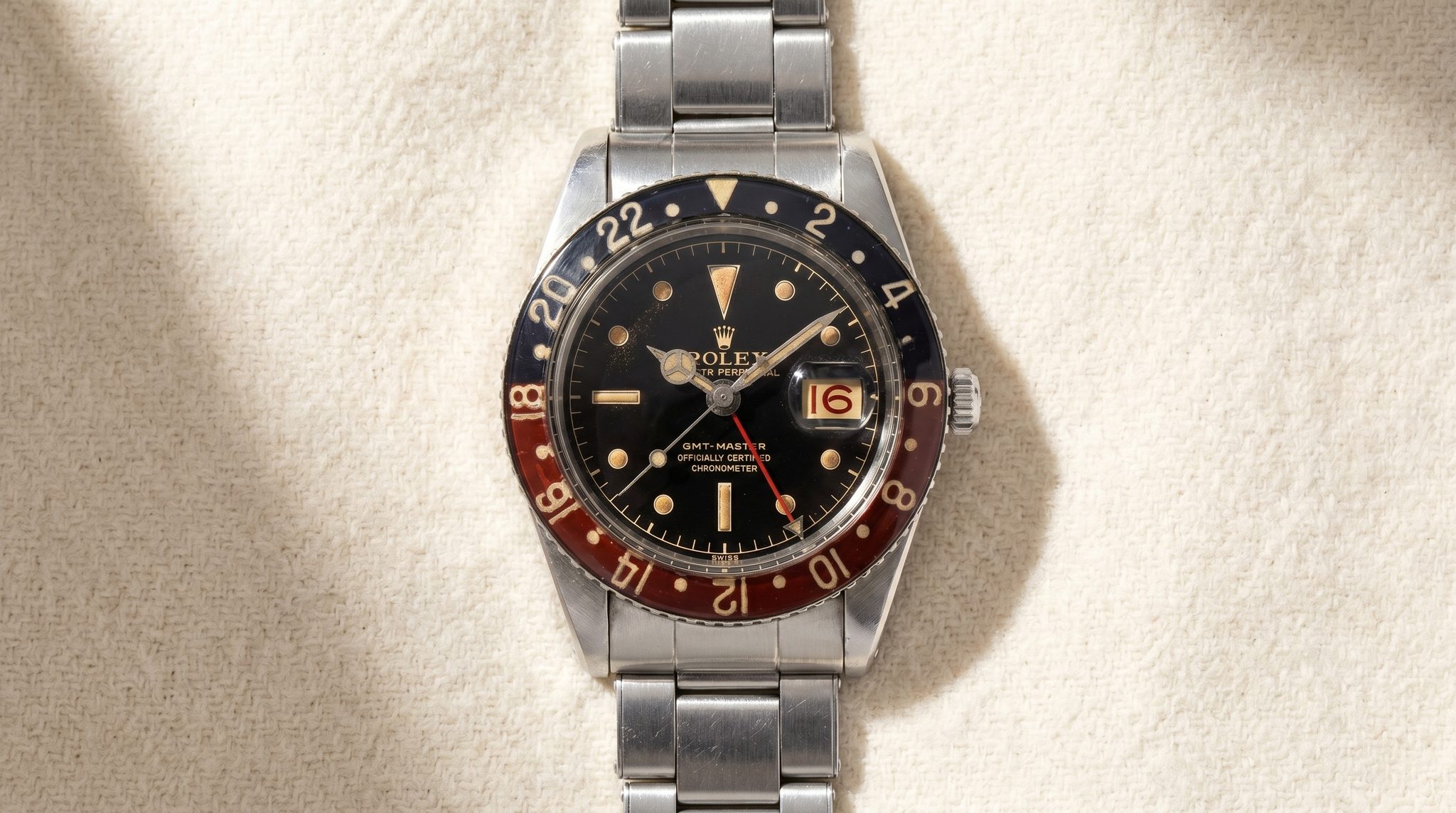
Rolex’s first GMT-Master is also its most fragile: the ref. 6542 launched the dual-time template, then spent its own short life shedding its radium Bakelite bezel for aluminum.
- Production
- c. 1954–1959
- Case
- Steel or 18k yellow gold
- Diameter
- 38 mm
- Thickness
- approx. 13 mm
- Lug to lug
- approx. 48 mm
- Bezel
- Bidirectional, 24-hour
- Insert
- Bakelite; alu from c. 1956
- Crystal
- Plexiglass, Cyclops
- Water
- 50 m
- Movement
- 1030-family GMT (1036 or 1065)
- Chronometer
- Yes (OCC)
- Lume
- Radium
The Rolex GMT-Master 6542 was produced from about 1954 to 1959.
The Rolex GMT-Master 6542 is the rare kind of first generation that is not only early, but also unrepeated. It introduced the GMT-Master format for Pan Am, then promptly forced Rolex to rethink its most visible component: the luminous Bakelite bezel insert, a radium-filled part so prone to cracking that aluminum inserts appear by about 1956.
That combination of invention and immediate revision is why the 6542 sits apart from every later GMT-Master. In the hand it feels like a mid-1950s sports Oyster that has been taught a new trick, a slim 38 mm case with no crown guards, a domed Plexiglass crystal with Cyclops over the date, and a rotating 24-hour bezel that lets the red 24-hour hand do its work. The bezel is the headline because it is also the liability. A true Bakelite insert has luminous numerals embedded under a glossy surface, and it is often the first thing a collector inspects under angled light for chips and hairline fractures.
Inside, the story is less dramatic but unusually nuanced for a Rolex reference. The movement is a GMT-adapted member of the 1030 family, variously described as cal. 1036 GMT or cal. 1065 depending on the literature, and built on the same 25-jewel architecture beating at 18,000 vph with about 38 hours of power reserve. It is also the earliest GMT-Master style of operation: the 12-hour and 24-hour hands are linked, and the rotating bezel is what turns “home time” into a second time zone.
Rolex replaced the 6542 in 1959 with the crown-guard GMT-Master ref. 1675, standardizing on aluminum inserts and a larger case. The 6542, by contrast, remains the GMT that still shows its prototype era in plain sight: a production span of roughly six years, and a signature bezel that many examples could not keep.
“The GMT-Master 6542 did not just introduce the red-blue bezel, it introduced a bezel material so fragile that many watches lost it during the reference’s own production run.”
Rolex GMT-Master 6542 production years: c. 1954–1959
The 6542 begins with a specific professional request. Pan Am wanted a watch that could keep “home” time visible while crews operated across time zones, and Rolex answered with a fourth hand that circles the dial once per day, read against a rotating 24-hour bezel. The resulting layout is the GMT-Master’s enduring grammar: set the main time, then rotate the bezel to translate the 24-hour hand into a second time zone.
Rolex’s first execution also carried an experimental material choice on the part that gets hit, scraped, and grabbed most often. Early inserts were made in Bakelite with luminous radium numerals, a striking look in daylight and a practical one at night, but Bakelite proved too fragile for the job. Revolution documents aluminum inserts appearing by about 1956, a move that solves cracking and radium concerns at once, but creates today’s central authenticity puzzle. Many steel 6542s have perfectly genuine Rolex lives yet wear later, non-luminous aluminum inserts because that is what service fitted when the original cracked.
By 1959 the GMT-Master had already been toughened up into the ref. 1675, with crown guards and aluminum inserts as the new baseline. The zoomed-out view is revealing. In roughly six years Rolex created the travel-watch template, learned which material decisions would not survive real use, and set the GMT-Master on the more standardized path it would follow for decades.
- c. 1954Introduced38 mm case, no guards
- 1955Name filed“GMT-Master” dial line
- c. 1956Insert shiftNon-luminous numerals
- c. 1958 – 1959Gold offered18k case, brown/black insert
- 1959SucceededCrown guards appear
6542 against its neighbours
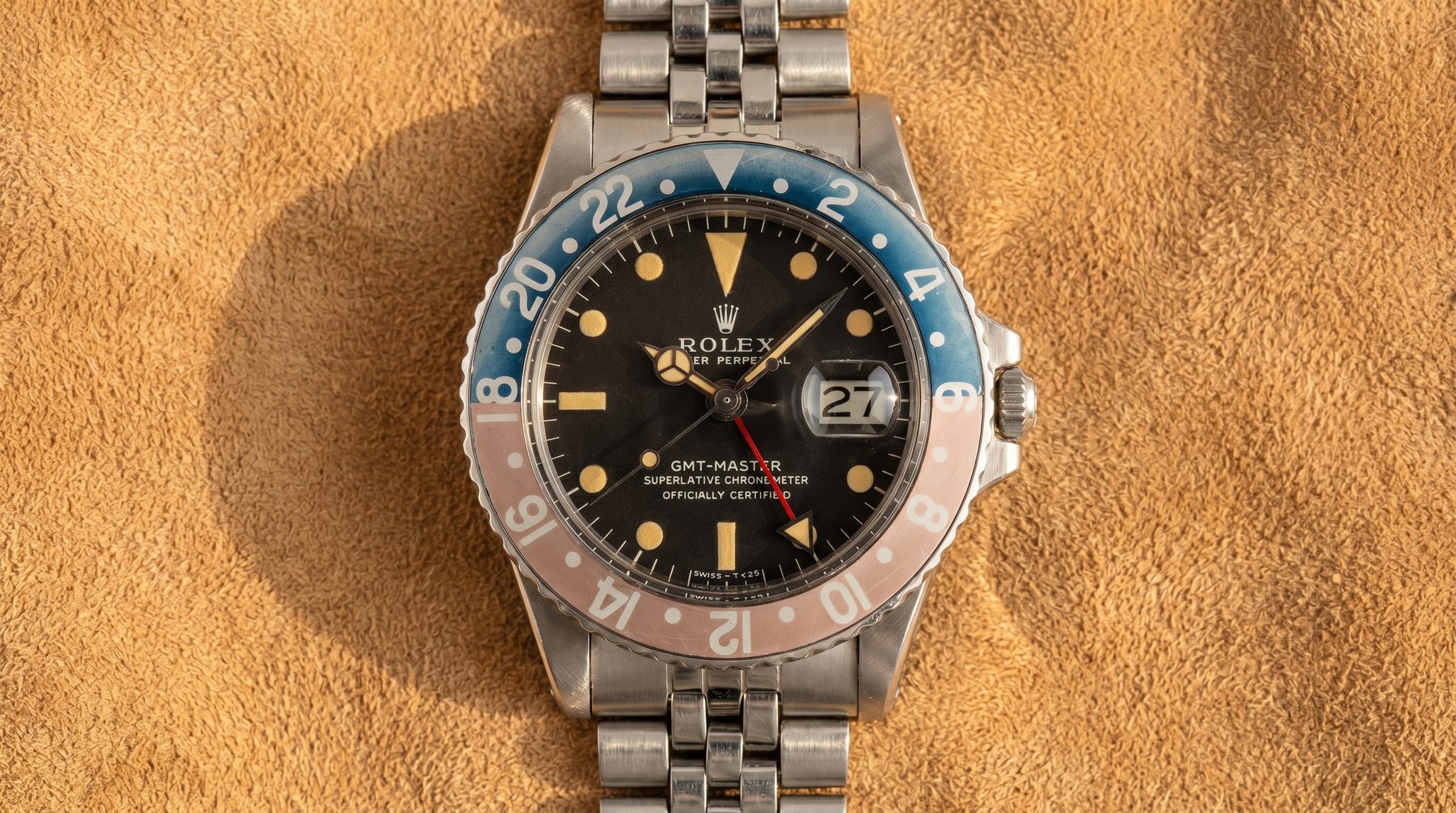
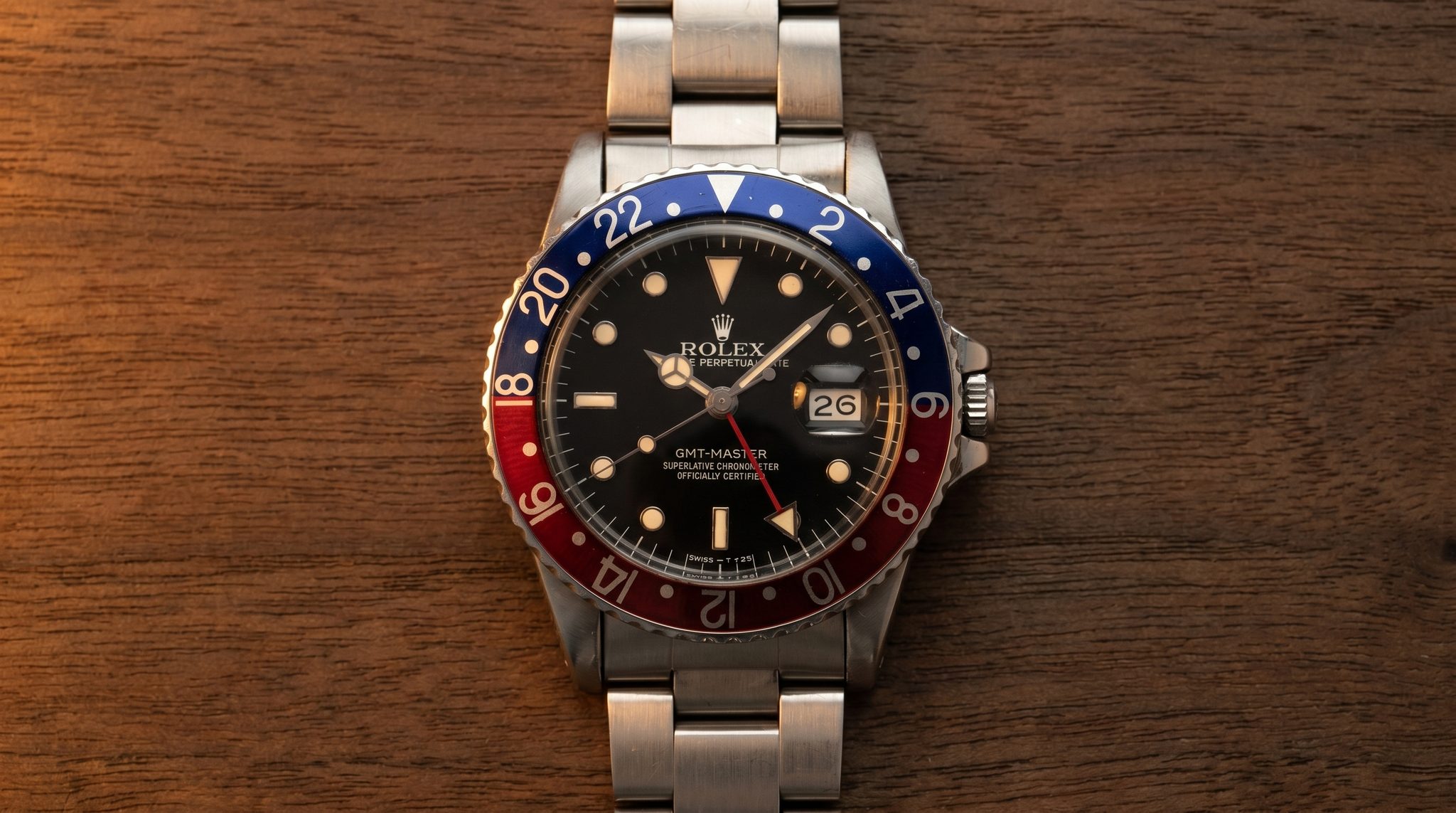
The 6542 is best understood at the two edges of its short life. The Turn-O-Graph ref. 6202 shows the rotating-bezel Oyster blueprint Rolex adapted into a pilot’s GMT, while the GMT-Master ref. 1675 shows the immediate hardening of the concept in 1959: a larger case with crown guards and an aluminum bezel insert as standard rather than an afterthought.
This reference 6542 Rolex · focal c. 1954–1959 | ||||
|---|---|---|---|---|
| Production | c. 1953–1954 | c. 1954–1959 | c. 1958–1959 | c. 1959–1980 |
| Case | Steel | Steel or 18k yellow gold | 18k yellow gold | Steel |
| Diameter | approx. 36 mm | 38 mm | 38 mm | 40 mm |
| Bezel | Bidirectional, timing | Bidirectional, 24-hour | Bidirectional, 24-hour | Bidirectional, 24-hour |
| Insert | – | Bakelite; alu from c. 1956 | Bakelite (brown/black) | Aluminium |
| Crystal | Acrylic | Plexiglass, Cyclops | Plexiglass, Cyclops | Acrylic |
| Water | – | 50 m | 50 m | 50 m / 165 ft |
| Movement | Cal. 620 | 1030-family GMT (1036 or 1065) | 1030-family GMT (1036 or 1065) | Cal. 1565 → 1575 |
| Chronometer | – | Yes (OCC) | Yes (OCC) | Chronometer text |
| Lume | Radium | Radium | Radium | Radium → tritium |
Nine dial generations across the run
The archetypal early GMT-Master 6542 is steel with a glossy black gilt dial and the red-blue Bakelite insert. On a strong example, the printing looks almost wet against the lacquer, and the gilt text catches light differently than later matte dials ever can. Many examples show a chapter-ring style minute track, which is a useful visual cue, but it does not define the bezel era by itself. The point of this configuration is the full early package: a no-crown-guard 38 mm case, a luminous Bakelite insert, and the original gilt-dial look that later GMTs quickly outgrew.
What to check before buying a 6542
A GMT-Master 6542 review is really a study in survivorship. The mechanics are early and straightforward, but the parts that define the reference are the ones most likely to have been replaced: the Bakelite insert that cracked, the glossy gilt dial that could be refinished, and small external components that often changed during decades of service.
The best examples feel “assembled by time, not assembled later”, a coherent set of mid-1950s surfaces where the bezel, dial, hands, and case wear all tell the same story. When that coherence breaks, values can break with it, sometimes dramatically.
Rolex GMT-Master 6542 price and value
A Rolex GMT-Master 6542 sells for about $31,750 at the median, typically $10,500 to $70,000 across 20 comparable sales.
Rolex GMT-Master 6542 for sale
Indicative figures from recent dealer, auction, and Grey Market sales (updated this week). Every watch is verified before it sells here.
Each point is a recent dealer or auction sale, banded to an indicative figure. The range shown is not a valuation.
Adjacent in the GMT-Master family
Common questions about the 6542
The GMT-Master 6542 is generally dated to about 1954–1959. Rolex has often cited 1955 in brand timelines, and the GMT-Master name was registered on 21 April 1955, which helps explain the overlap in dates. Yellow-gold 6542 variants are documented around 1958–1959, and individual watches can be sold or delivered slightly later than the end of production.
- ROLEX, STAINLESS STEEL DUAL TIME 'GMT MASTER', REF. 6542 (Christie’s Online)christies.com
- Rolex GMT-Master, A brief historyrevolutionwatch.com
- The Rolex GMT-Master: A Complete Collector's Guidesothebys.com
Show 7 more
- The first ever: Rolex GMT-Master (ref. 6542 from 1954)yourwatchhub.com
- Rolex 6542 GMT Master (in-depth review)le-monde-edmond.com
- Getting Baked: The Highly Collectible GMT Master 6542bobswatches.com
- The Rolex GMT-Master 6542 That Changed The Pilot's and...bobswatches.com
- Rolex GMT-Master Reference 6542 "Bakelite"windvintage.com
- 6542, GMT-Master, Steel (dealer example and notes)hairspring.com
- 1958 Rolex GMT-Master (Ref. 6542) Gilt "Chapter Ring" Dial (example)craftandtailored.com