

Rolex GMT-Master 16700
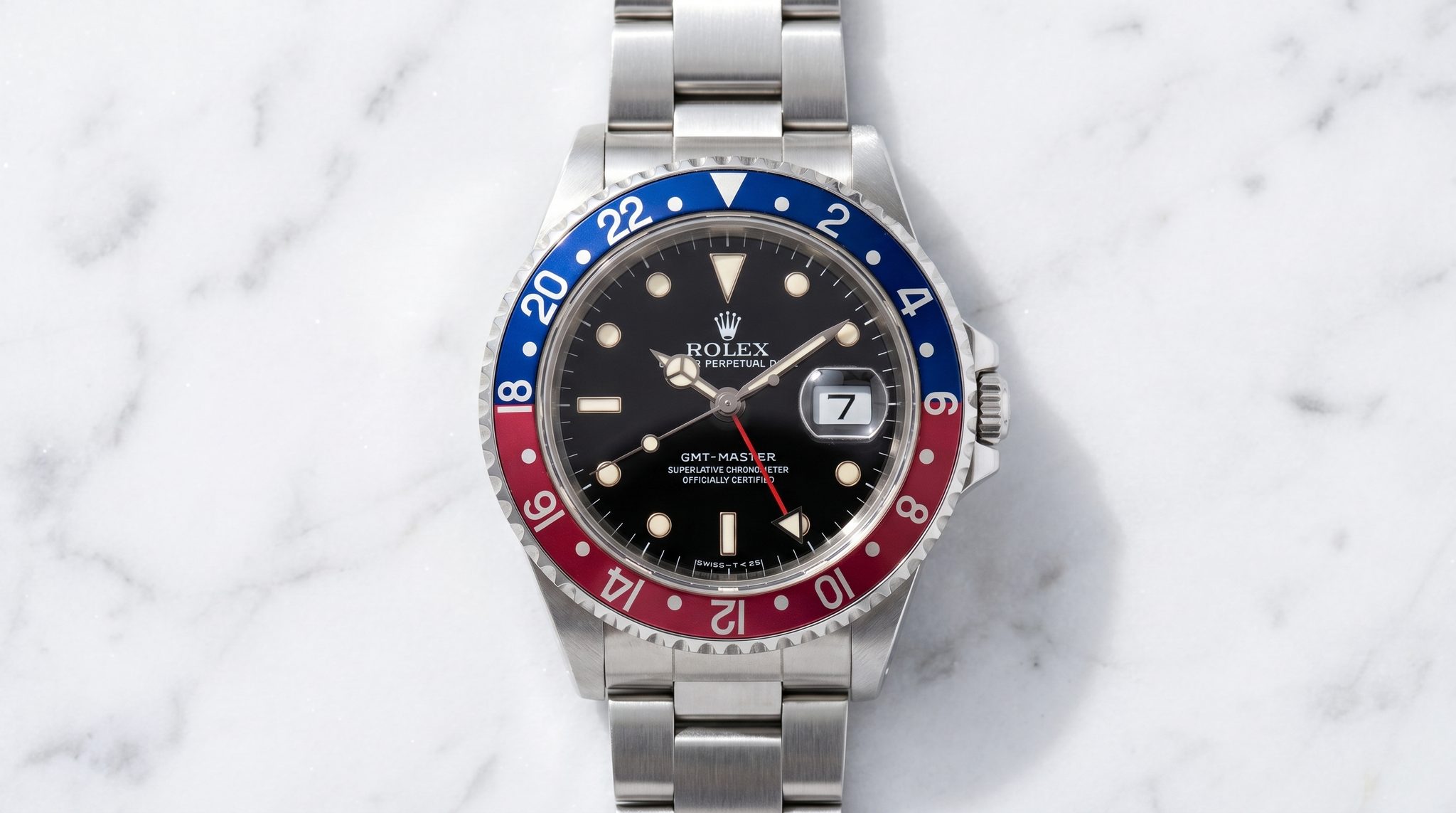
The Rolex GMT-Master 16700 is the final “classic” GMT-Master, pairing a sapphire-crystal 40 mm case with Rolex’s last fixed-GMT movement even as the GMT-Master II era was already underway.
- Production
- c. 1988–1999
- Case
- Stainless steel
- Diameter
- 40 mm
- Thickness
- c. 11.5–12.0 mm
- Lug width
- 20 mm
- Crystal
- Sapphire
- Water resist
- 100 m
- Bezel
- Bidirectional 24-hour
- Insert
- Aluminum: Pepsi/black
- Dial
- Black gloss, applied
- Lume
- Tritium → Luminova
- Movement
- Cal. 3175 (auto)
- Chronometer
- Yes (COSC)
The Rolex GMT-Master 16700 was produced from about 1988 to 1999.
The Rolex GMT-Master 16700 closed the book on the original GMT-Master idea at the exact moment Rolex was selling its next chapter. Introduced in 1988 and produced until about 1999, it looks and wears like a late five-digit sports Rolex, with a sapphire crystal, a 40 mm steel case, and 100 meters of water resistance, yet it keeps the classic GMT-Master operating logic: the 24-hour hand is geared to the main hour hand rather than independently adjustable.
That combination is the reference’s whole identity. The 16700 uses the caliber 3175, a movement made only for this model, with hacking seconds and a quickset date, but with the “fixed” GMT architecture that would not continue in later calibers. In Rolex’s catalog it lived alongside GMT-Master II models that offered an independently adjustable local-hour hand, including the 16760 at the 16700’s launch, which makes the 16700 an unusually clear snapshot of Rolex offering two different travel-watch philosophies at once.
The rest of the watch stays deliberately straightforward. The 16700 was made only in stainless steel and is described with a black glossy dial throughout production; variation is concentrated in a few visible, independently timed details, particularly the tritium-to-Luminova dial transition in the late 1990s and the choice of aluminum bezel insert, most often red-blue “Pepsi,” with a solid black insert also documented as an option.
“The GMT-Master 16700 is Rolex’s last classic, fixed-GMT travel watch, updated with a sapphire-crystal case for the 1990s.”
Rolex GMT-Master 16700 production years: c. 1988–1999
The 16700 arrives in 1988 as the direct successor to the GMT-Master 16750, and it does so with a very specific agenda: keep the traditional GMT-Master hand behavior while updating the watch to the contemporary Rolex sports-watch build. The result is a steel-only GMT-Master with a sapphire crystal and the caliber 3175, which adds hacking seconds and a quickset date while remaining Rolex’s last fixed-GMT movement.
Because Rolex offered GMT-Master II references alongside it, the 16700’s evolution is less about broad mechanical revisions and more about a late-1990s materials transition on the dial. Early and mid-production watches are defined by tritium dials marked “SWISS-T<25,” while late pieces adopt Luminova and drop the “T” designation, typically reading simply “SWISS.” Production ends around 1999, after which the steel travel-watch role in the range is generally treated as having been carried forward by the GMT-Master II line rather than by a new GMT-Master reference.
- 1988Introduced16700 between lugs at 12
- 1988Cal. 3175GMT hand not independently set
- 1988Sapphire eraFlat sapphire, no acrylic dome
- c. 1997 – 1998Lume change“SWISS” replaces “SWISS-T<25”
- 1999DiscontinuedLate examples, “SWISS” dial common
16700 against its neighbours
The GMT-Master 16700 makes the most sense when framed by the reference it replaced and the GMT-Master II models it overlapped. The 16750 shows what Rolex carried forward (the classic, coupled-hand GMT layout) and what it modernized (sapphire and the late five-digit feel), while the 16760 and 16710 explain why the 16700 exists at all: Rolex offered a simpler, fixed-GMT alternative beside the independently adjustable GMT-Master II.
This reference 16700 Rolex · focal c. 1988–1999 | ||||
|---|---|---|---|---|
| Production | c. 1979/80–1988 | c. 1983–1988 | c. 1988–1999 | c. 1989–2007 |
| Case | Steel / gold / two-tone | Stainless steel | Stainless steel | Stainless steel |
| Diameter | 40 mm | 40 mm | 40 mm | 40 mm |
| Crystal | Acrylic | Sapphire | Sapphire | Sapphire |
| Water resist | 100 m | 100 m | 100 m | 100 m |
| Movement | Cal. 3075 (auto) | Cal. 3085 (auto) | Cal. 3175 (auto) | Cal. 3185/3186 (auto) |
| Bezel | Bidirectional 24-hour | Bidirectional 24-hour | Bidirectional 24-hour | Bidirectional 24-hour |
| Insert | More options | Coke | Aluminum: Pepsi/black | Pepsi/Coke/black |
| Lume | Tritium | Tritium | Tritium → Luminova | Tritium → LumiNova |
| Dial | Matte or gloss | Gloss black | Black gloss, applied | Gloss black |
Six dial generations across the run
Most GMT-Master 16700s are defined by the tritium dial, the familiar glossy black layout with applied hour markers in white-gold surrounds and the “SWISS-T<25” signature at 6 o’clock. This is the look that dominates early and mid-1990s production, and it is the version most closely associated with the reference as a whole.
In collecting terms, the key is coherence: an untouched tritium dial with hands that have aged to the same tone reads as period-correct and is typically preferred over mixed luminous materials. Because tritium dials can show moisture damage or heavy degradation on glossy lacquer, condition often matters more than any subtle printing nuance.
What to check before buying a 16700
A GMT-Master 16700 can look straightforward, but the reference sits in an era when service replacement parts and cosmetic refinishing are common. Value and authenticity questions concentrate on whether the dial, hands, and bezel insert are appropriate to one another, and on whether the case still shows sharp, unrounded geometry rather than heavy polishing.
Rolex GMT-Master 16700 price and value
A Rolex GMT-Master 16700 sells for about $10,000 at the median, typically $8,800 to $11,500 across 280 comparable sales.
Rolex GMT-Master 16700 for sale
Indicative figures from recent dealer, auction, and Grey Market sales (updated this week). Every watch is verified before it sells here.
Each point is a recent dealer or auction sale, banded to an indicative figure. The range shown is not a valuation.
Adjacent in the GMT-Master family
Common questions about the 16700
The GMT-Master 16700 was produced from about 1988 to about 1999. Sources agree on those years, but the exact start and end months are not publicly documented.
- Sotheby’s: The Rolex GMT-Master: A Complete Collector's Guidesothebys.com
- HODINKEE Shop: 1991 Rolex GMT-Master Ref. 16700shop.hodinkee.com
- Langedyk Vintage Watches: Rolex GMT-Master 16700 vs GMT-Master II 16710langedykvintagewatches.com
Show 7 more
- Bob's Watches: Rolex GMT-Master Reference 16700 Ultimate Guidebobswatches.com
- Gray & Sons: 5 Things to Know About the GMT-Master 16700grayandsons.com
- Chrono24: Rolex Ref. 16700chrono24.com
- The 1916 Company (YouTube): Rolex GMT-Master 'Pepsi' 16700 Reviewyoutube.com
- Craft & Tailored: 1991 Rolex GMT-Master (Ref. 16700) 'Pepsi'craftandtailored.com
- 41Watch: History of the Rolex GMT-Master41watch.com
- GMT Master History: GMT-Master ref. 16700gmtmasterhistory.com