

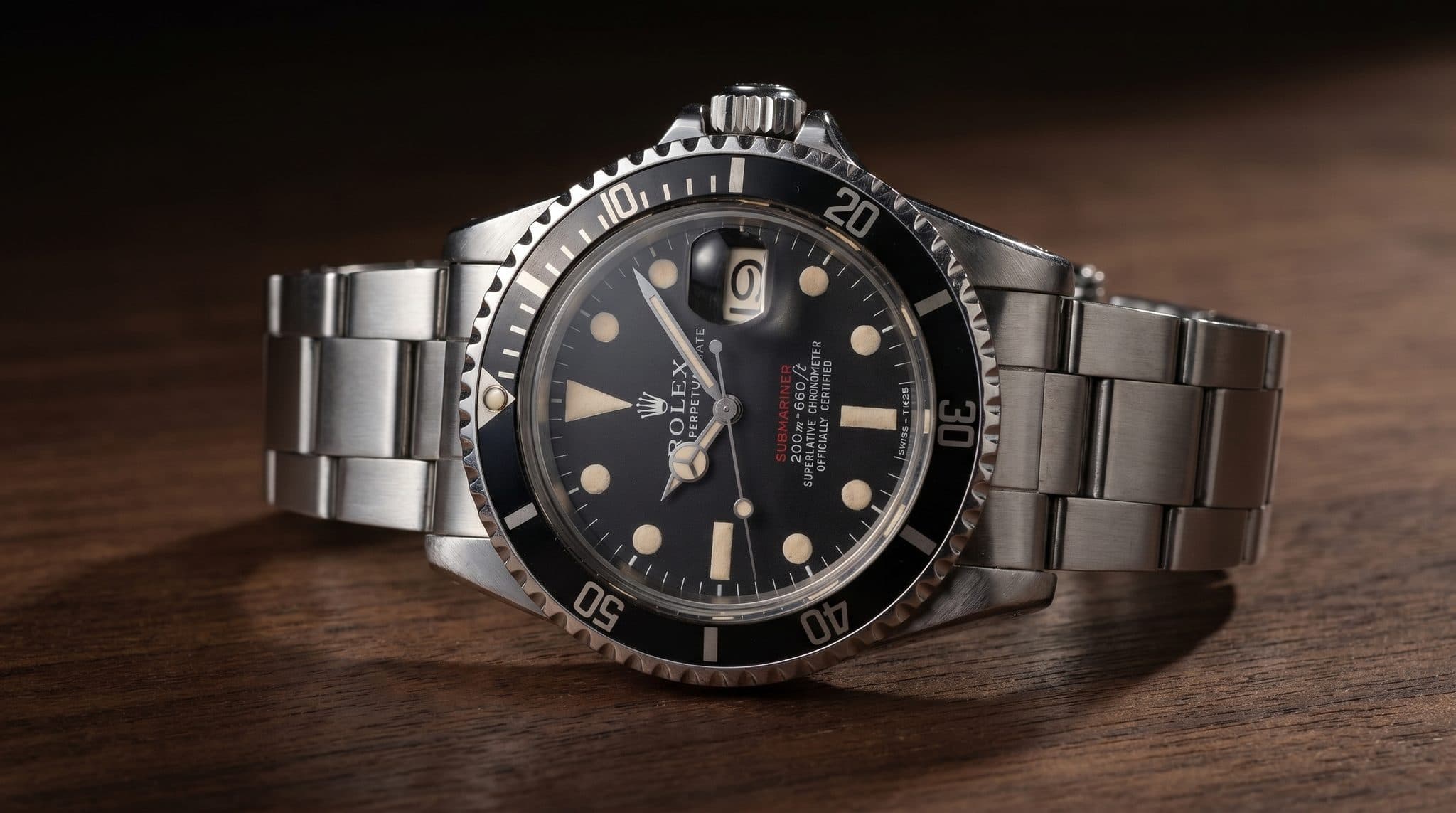
If you can read a Rolex dial, you can authenticate most Rolex watches.
Why the Dial Is the Authentication Anchor
For a Rolex, the dial is the highest-information surface on the watch. It encodes the production era through coronet shape, the depth-rating convention, lume formulation, font weight, indices construction, and printing technique. Every counterfeit attempts to replicate the dial. Almost all of them fail, because the era-specific tells are subtle and densely layered.
This visual guide is a reference of the most important era-by-era dial tells across major Rolex sport models. Use it alongside the serial number tutorial and our Rolex serial lookup when verifying a Rolex purchase, so you can check that the dial style fits the production year. For the broader authentication context, see the complete authentication guide. The dial is step five of our seven-step Rolex authenticity check.
The Coronet
The Rolex coronet — the five-pointed crown logo — has evolved subtly over decades. Counterfeiters routinely reproduce the wrong era's coronet on a watch claimed to be from a different era.
- 1950s–1960s coronet: Slimmer and slightly more elongated, with thinner orbs at the top of each point. The pad printing on dials of this era can show very fine ink edges under macro magnification.
- 1970s–1980s coronet: Slightly thicker, with rounder orbs. The proportions become more uniform across the five points.
- 1990s–2000s coronet: Approximately current proportions emerge, with sharp, defined points and consistent orb sizes. Applied (raised) coronets begin appearing on certain references.
- 2010s–present coronet: Highly consistent across all production. Modern manufacturing tolerances make the coronet itself less era-distinguishing — the era tells move to other dial elements.
A dial whose coronet does not match the production year claimed in the listing is, on its own, sufficient reason to halt a purchase pending further verification.
Depth Rating Convention (Sport Models)
On Submariner, Sea-Dweller, and similar dive watches, the depth rating printed on the dial is one of the most reliable era markers.
Submariner Depth Ratings
| Era | Rating | Format |
|---|---|---|
| 1953–1959 | 200/660 | "100m=330ft" or "200m=660ft" depending on early variant |
| 1959–1979 | 200m=660ft | Stable convention through this period |
| 1979–1989 | 660ft = 200m | Order reverses (feet first, then meters) |
| 1989–present | 1000ft = 300m | Increased depth rating with introduction of newer references |
A "200m=660ft" dial on a watch claimed to be from 1995 is almost certainly franken or counterfeit. Pay close attention to the order of the units (feet first vs. meters first) — this single-character distinction has caught countless misrepresented dials.
Lume Formulation
The luminous material on Rolex dials has changed three times in 70 years, and each transition leaves a permanent fingerprint on the dial's appearance over time.
Radium (Pre-1963)
Earliest Rolex sport watches used radium-based lume. Radium degrades over decades into a yellow-orange-brown patina, often with a slight halo effect on the dial around the lume plot. Radium is mildly radioactive and is no longer used; any Rolex from this era with bright modern-looking lume has had its lume replaced.
Tritium (1963–1998)
Tritium lume identifies as "T<25" or "T SWISS T" at the bottom of the dial below the 6 o'clock marker. Tritium ages to a creamy yellow-brown patina, often with a warm tropical tone on dials with significant sun exposure. Aging is internally consistent — the markers, hand inserts, and bezel pip should all show similar coloration if original.
Luminova (1998–2000)
A brief transition period using Luminova (no tritium signature on the dial). Dial markings during this transition show "SWISS" alone or "SWISS MADE" without the T markers.
Super-Luminova (2000–present)
Modern Rolex dials use Super-Luminova, which does not yellow significantly with age. Dials from this era retain bright white-green lume tones decades after production.
A watch claiming to be from 1972 should have tritium lume markers and "T<25" or "T SWISS T" at the dial bottom. A modern Super-Luminova lume on the same dial — bright, unyellowed, with no T markings — is a definitive franken or counterfeit signal.
Indices and Markers
Rolex indices construction has evolved from printed (early dials) to applied (raised metal markers). The transition years and applied-marker design vary by model.
- Gilt dials (1950s–1960s). Glossy black dial with gold printing achieved through a specific gilt-printing process. The gold elements appear to glow against the black surface. Reproductions of gilt dials are common, but the printing depth and three-dimensional quality of authentic gilt is difficult to replicate.
- Matte dials (late 1960s–early 1980s). Flat black dial with white painted text. Matte dials are typically less expensive than gilt examples but are highly desirable when in original condition with strong patina.
- Glossy dials with applied markers (1980s–present). The standard modern construction, with raised metal hour markers filled with luminous material.
Printing Sharpness and Font Weight
Authentic Rolex dial printing is uniformly sharp under macro magnification. Every letter has crisp edges, consistent stroke width, and precise spacing. Counterfeit dials almost always reveal themselves under 10x magnification:
- Slight font weight variation across letters
- Pixelated or jaggy letter edges (sign of digital printing)
- Inconsistent ink coverage within letters
- Spacing irregularities (kerning issues)
- Slightly different font for the depth rating vs. the model name
The fastest test: compare the submitted watch's dial photograph at maximum zoom against a high-resolution authenticated reference image of the same dial era. If anything looks slightly off, it almost certainly is.
Sub-Dial Configuration (Daytona)
For Rolex Daytona references, sub-dial layout is a critical era marker.
- Pre-1988 manual-wind Daytonas: Three sub-dials in distinctive layout, "Daytona" arc above the 6 o'clock sub-dial, no "Cosmograph" wording in some early variants.
- Zenith Daytona (1988–2000): Slightly redesigned sub-dial layout, "Daytona" wording above the 6 o'clock sub-dial, "Cosmograph" below 12.
- Modern in-house caliber 4130 Daytona (2000–2023): Updated sub-dial proportions, with the running seconds at 6 (rather than the small seconds positioning of earlier references).
The "Paul Newman" Daytona variants — among the most counterfeited watches in the world — have specific sub-dial design tells (block markers, art deco sub-dial registers, contrasting colors) that absolutely must match documented examples. A Paul Newman Daytona is too valuable to authenticate without specialist review.
Service Dials: The Hidden Franken Source
Rolex's service centers historically replaced dials during routine service, especially for watches showing radium or tritium degradation. These service dials are genuine Rolex parts but are not original to the watch they appear on. Indicators:
- Crisp, modern-looking lume on a watch from the 1970s or earlier
- Newer-style font on an early-era watch
- "T SWISS T" markings on a dial whose case dates to a non-tritium era
- Inconsistent lume color between dial markers and bezel pip or hands
Service dials are common, and many honestly-described vintage Rolexes have them. The price difference between an original-dial example and a service-dial example can exceed 50 percent for desirable vintage references, which makes correct identification central to fair pricing. This is the franken category covered in detail in our frankenwatch primer, and our vintage Rolex buying guide explains how original, service and refinished dials are priced.
Putting It Together
An authentic Rolex dial passes all of the following checks simultaneously:
- Coronet shape consistent with claimed era
- Depth rating format matches the production year
- Lume material correct for the era (radium, tritium, Luminova, or Super-Luminova)
- Indices construction (printed, gilt, applied) appropriate for the reference and year
- Printing uniformly sharp under macro magnification
- Lume color consistent across dial markers, hand inserts, and bezel pip
- Sub-dial configuration (where applicable) matches the reference
A watch that fails any one of these checks needs further investigation. A watch that fails two or more is almost certainly franken, service-dialed, or counterfeit.
For the related authentication topics, return to the authentication trust guide or read The Truth About Super Fakes for the latest counterfeit landscape.
Reference guides
Deep dives on the references discussed in this story:
- Rolex Submariner 5513 (1962–1989)
- Rolex Submariner 1680 (c. 1967–1979)
- Rolex Submariner 5512 (c. 1959–1978)
- Rolex GMT-Master 16750 (c. 1979/80–1988)
- Rolex Sea-Dweller 1665 (c. 1967–1983)
- Rolex Explorer II 1655 (1971–c. 1984/85)