

Rolex Cosmograph Daytona 6241
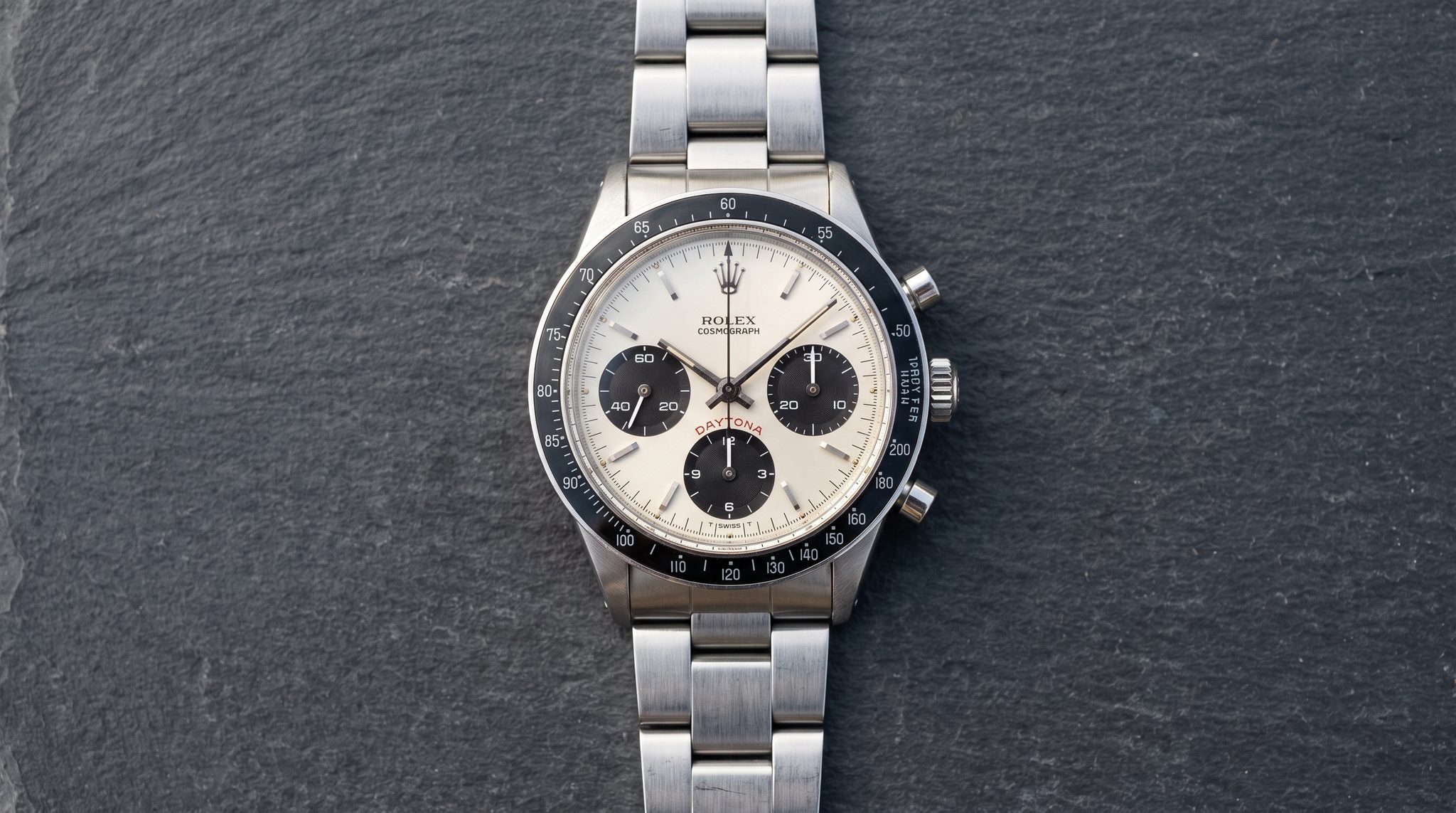
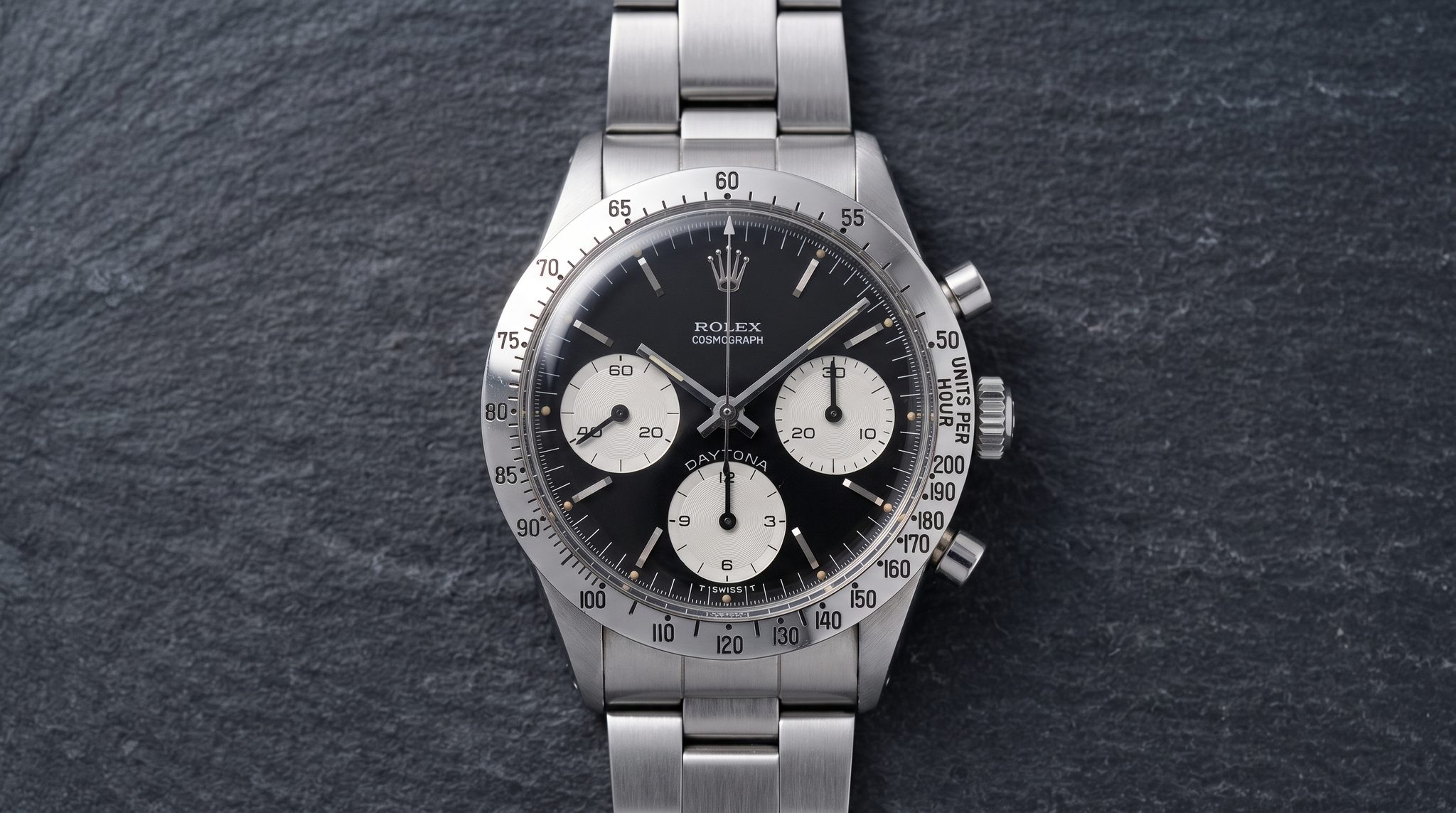
The Rolex Cosmograph Daytona 6241 is the short-run pump-pusher Daytona that turned a replaceable black acrylic tachymeter bezel into the reference’s defining evidence.
- Production
- c. 1966–1969
- Case
- Steel or yellow gold
- Diameter
- ~36.5–37.5 mm
- Lugs
- 19 mm
- Thickness
- 13.5 mm
- Bezel
- Black acrylic tachymeter
- Crystal
- Acrylic
- Pushers
- Pump (non screw-down)
- Movement
- Cal. 722 or 722-1
- Jewels
- 17
- Dial
- Standard or exotic
The Rolex Cosmograph Daytona 6241 is a reference where the bezel is not decoration but proof. Produced for only a narrow late‑1960s window, most often summarized as approximately 1966 to 1969, it is the pump‑pusher Daytona defined by a black acrylic tachymeter insert, the detail that separates it at a glance from the steel‑bezel ref. 6239.
That same insert is also the 6241’s fault line. Period examples are frequently scrutinized for originality because acrylic bezels are commonly replaced, refinished, or swapped, and because the value gap between a standard dial and an original “exotic” (Paul Newman) dial is enormous. In other words, the watch is simple to describe but hard to certify.
In period terms, the 6241 sits early in the manual‑wind Daytona lineage, bridging the first “Cosmograph Daytona” generation into the later black‑bezel tradition that would reappear on the screw‑pusher Oyster 6263. It keeps the same three‑register, column‑wheel Valjoux 72‑family chronograph architecture Rolex finished as calibres 722 and 722‑1, and it stays firmly in the non‑Oyster branch with pump pushers throughout its run.
“On a Daytona 6241, the black acrylic tachymeter bezel is the reference number you can see.”
6241 across c. 1966–1969
Public cataloguing places the 6241 squarely in the late 1960s, with Phillips repeatedly framing it as a reference launched in 1966 and produced only until 1969, while some catalogs widen the edges to 1965 at the start or to 1970 at the end. Rolex has not published a factory start or stop date in the material commonly cited alongside these watches, so the cleanest statement is the one auction houses repeat most often: approximately 1966 to 1969, with a small number of edge cases that stretch the bracket.
What is firm is the reference’s logic inside the Daytona family. After the 6239 established the external tachymeter bezel as a Daytona signature, the 6241 offered a different way to wear the same idea: a black acrylic tachymeter insert in place of the engraved metal ring. In parallel, the Oyster, screw‑pusher branch was developing in neighboring references, but the 6241 never crossed into that architecture, it remained pump‑pusher and non‑Oyster through its life.
Mechanically, the movement story is conservative, and that conservatism is part of the point. Surviving, catalogued examples show Rolex’s Valjoux 72‑family chronograph finished as calibre 722 or the later 722‑1, both described with 17 jewels in auction notes, and Phillips explicitly notes that the earlier 72B does not appear on this reference because it had already been discontinued when the 6241 was launched. Most of the variation that matters to collectors is therefore not a hidden technical leap but what is visible on the front: the bezel insert’s correctness, and, especially, whether the dial is a standard execution or the more elaborate “exotic” layout later nicknamed the Paul Newman.
Stepping back, the 6241 shows how quickly the Daytona was still being edited in real time. Within just a few years, Rolex tested how far the watch’s look could shift while keeping the same basic case and the same manual, column‑wheel chronograph architecture, and the result is a reference that modern buyers judge less by its name and more by whether its most valuable parts are convincingly, verifiably of the period.
- c. 1966IntroducedBlack acrylic tachy insert, pump pushers
- c. 1967722-1 appearsMovement signed 722-1 under caseback
- c. 1966 – 1969Exotic optionArt-deco numerals, square subdial marks
- c. 1969Production endsLate-1960s dated examples in catalogs
- c. 1970Edge examplesCatalogued as 1970 on some lots
6241 against its neighbours
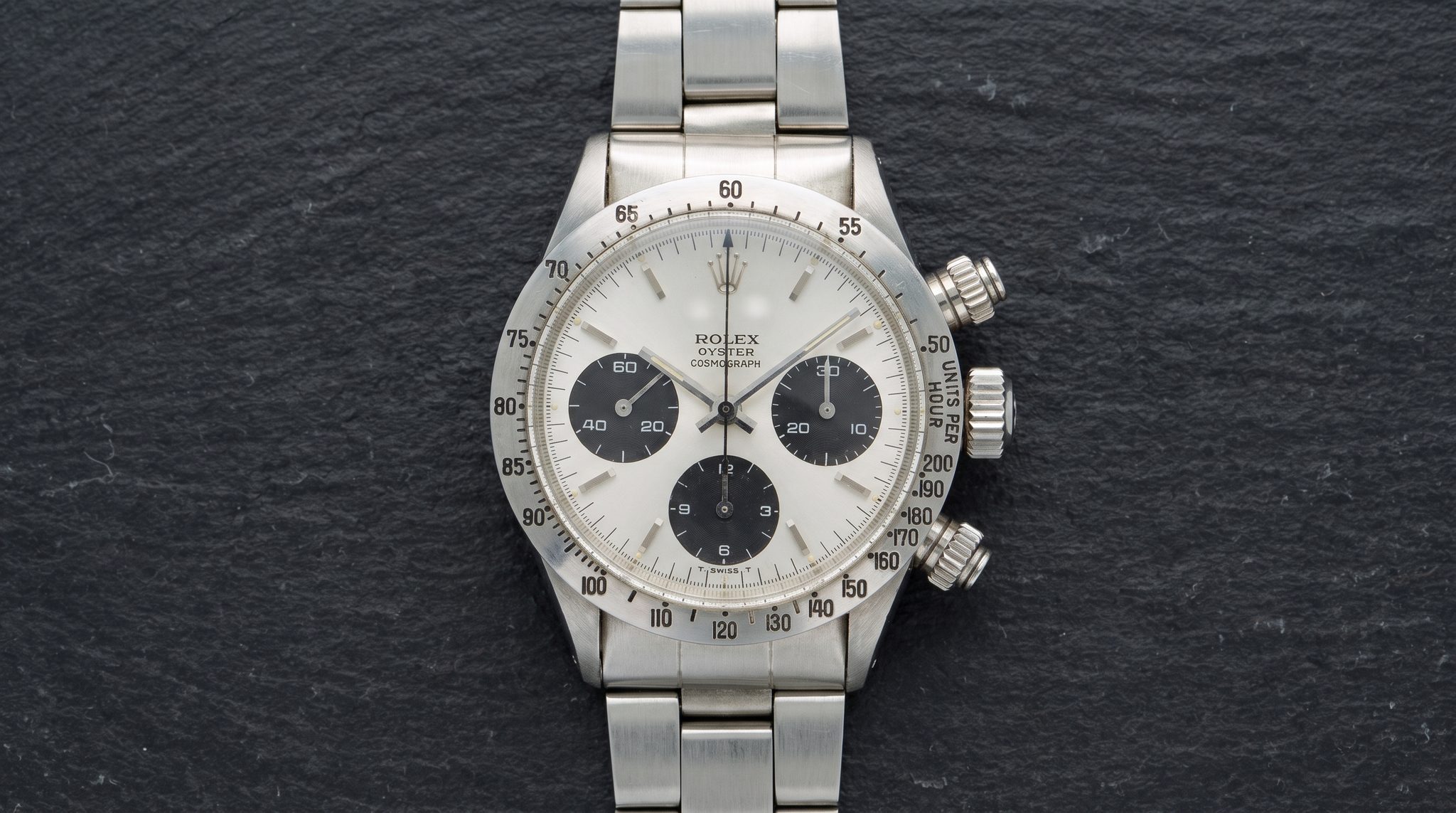
The 6241 makes sense when framed against the two Daytonas that define its boundaries: the steel‑bezel 6239 that it closely follows, and the later 6263 that revives the black‑bezel idea inside a screw‑pusher Oyster case. A third reference, 6240, runs alongside as the early Oyster, screw‑pusher counterpart, showing that the same black bezel could belong to two very different case philosophies.
6240 Contemporary sibling c. 1965–1969 | This reference 6241 Rolex · focal c. 1966–1969 | |||
|---|---|---|---|---|
| Production | c. 1963–1969 | c. 1965–1969 | c. 1966–1969 | 1971–c. 1987/88 |
| Case | Steel (also gold) | Stainless steel | Steel or yellow gold | Stainless steel / 14k / 18k |
| Diameter | ~36 mm | – | ~36.5–37.5 mm | 37 mm |
| Lugs | 19 mm | 19 mm | 19 mm | 19 mm |
| Bezel | Engraved tachymeter | Black acrylic | Black acrylic tachymeter | Black acrylic tachy |
| Crystal | – | – | Acrylic | Box acrylic |
| Pushers | Pump (non screw-down) | Screw-down (Oyster) | Pump (non screw-down) | Screw-down |
| Movement | Cal. 72B → 722 → 722-1 | Valjoux 72B / 722 / 722-1 | Cal. 722 or 722-1 | Cal. 727 (manual) |
| Dial | Standard or exotic | – | Standard or exotic | Standard or exotic |
Seven dial generations across the run
In its standard form, the 6241 reads like a straightforward early Daytona: baton hour markers, conventional sub-dial scales, and the familiar “Rolex Cosmograph” signature. Some examples add “Daytona” above the 6 o’clock register while others do not, a market-facing detail that collectors track but that does not define the reference itself. What always defines the watch is the black acrylic tachymeter bezel, the perimeter cue that confirms you are looking at 6241 rather than the steel-bezel 6239.
Because the standard dial does not carry the extreme premiums of the exotic layout, it is also where condition and correctness of the acrylic bezel insert can dominate the buying decision. Auction notes and dealer discussions repeatedly emphasize that inserts are frequently replaced or refinished, so a standard-dial 6241 can live or die on whether its most visible reference-defining part looks convincingly of the period.
What to check before buying a 6241
The 6241 is easy to mis-buy because its most valuable parts are also the most easily altered. Black acrylic bezel inserts are frequently replaced or refinished, and the exotic dial premium creates constant incentive for reprints, swaps, and assembled watches.
Pricing bands illustrate the stakes. Mid‑2020s market summaries place non‑exotic steel 6241s roughly around US$75,000–130,000, while steel exotic (Paul Newman) examples are broadly around US$250,000–450,000, with gold exotic pieces often grouped around US$400,000–800,000. These are wide ranges rather than guarantees, but they explain why buyers treat originality as a first-order concern.
The reference is also a reminder that “late 1960s” is not a single spec. A correct 6241 can be powered by calibre 722 or 722‑1, and the most credible year brackets are approximate, so the best purchases tend to be the ones whose visible reference-defining traits, movement, and documentation form a coherent late‑1960s whole rather than a watch that is merely plausible in isolation.
Owned well, the 6241 wears like a compact, purposeful chronograph, roughly 36.5–37.5 mm in diameter with 19 mm lugs, and it concentrates the early Daytona story into a single, stark silhouette: pump pushers, three registers, and a black tachymeter ring that has to be right for the rest of the watch to make sense.
Rolex Cosmograph Daytona 6241 for sale
Indicative market value from recent dealer, auction, and Grey Market sales: median ≈ $255,000, with a typical $245,000–$255,000 range across 6 comparable sales (updated this week).
Each point is a recent dealer or auction sale, banded to an indicative figure. The range shown is not a valuation.
Adjacent in the Cosmograph Daytona family
Common questions about the 6241
Most specialist auction catalogues place the Rolex Cosmograph Daytona 6241 at approximately 1966–1969. Some sources widen the edges to 1965 at the start, and at least one catalogued example is dated 1970, so exact cutoffs are not fully settled in publicly cited material.
- Phillips: Rolex The New York Watch Auction: NINE (ref. 6241 catalog note)phillips.com
- Phillips: Rolex The New York Watch Auction: XI (ref. 6241 catalog note)phillips.com
- Phillips: Rolex The New York Watch Auction: XI (ref. 6241 lot)phillips.com
Show 7 more
- Phillips: The Hong Kong Watch Auction: SIX (ref. 6241, cal. 722/722-1 note)phillips.com
- Phillips: START-STOP-RESET: 88 Epic Stainless Steel Chronographs (ref. 6241 dated example)phillips.com
- Hodinkee Shop: 1969 Rolex ‘Paul Newman’ Daytona Reference 6241 (dimensions, lug width, thickness)shop.hodinkee.com
- Cambiaste: Daytona ‘Paul Newman’ ref. 6241 (production estimates, configuration)cambiaste.com
- WatchClub: Rolex 6241 Cosmograph Daytona (722-1, pricing matrix examples)watchclub.com
- Perezcope: Frankenstein Paul Newman ‘Lemon’ and other examples (dial-swap risk)perezcope.com
- PDFCoffee: Rolex Daytona ALL Models Boek (reference overview)pdfcoffee.com