

Rolex Cosmograph Daytona 6238
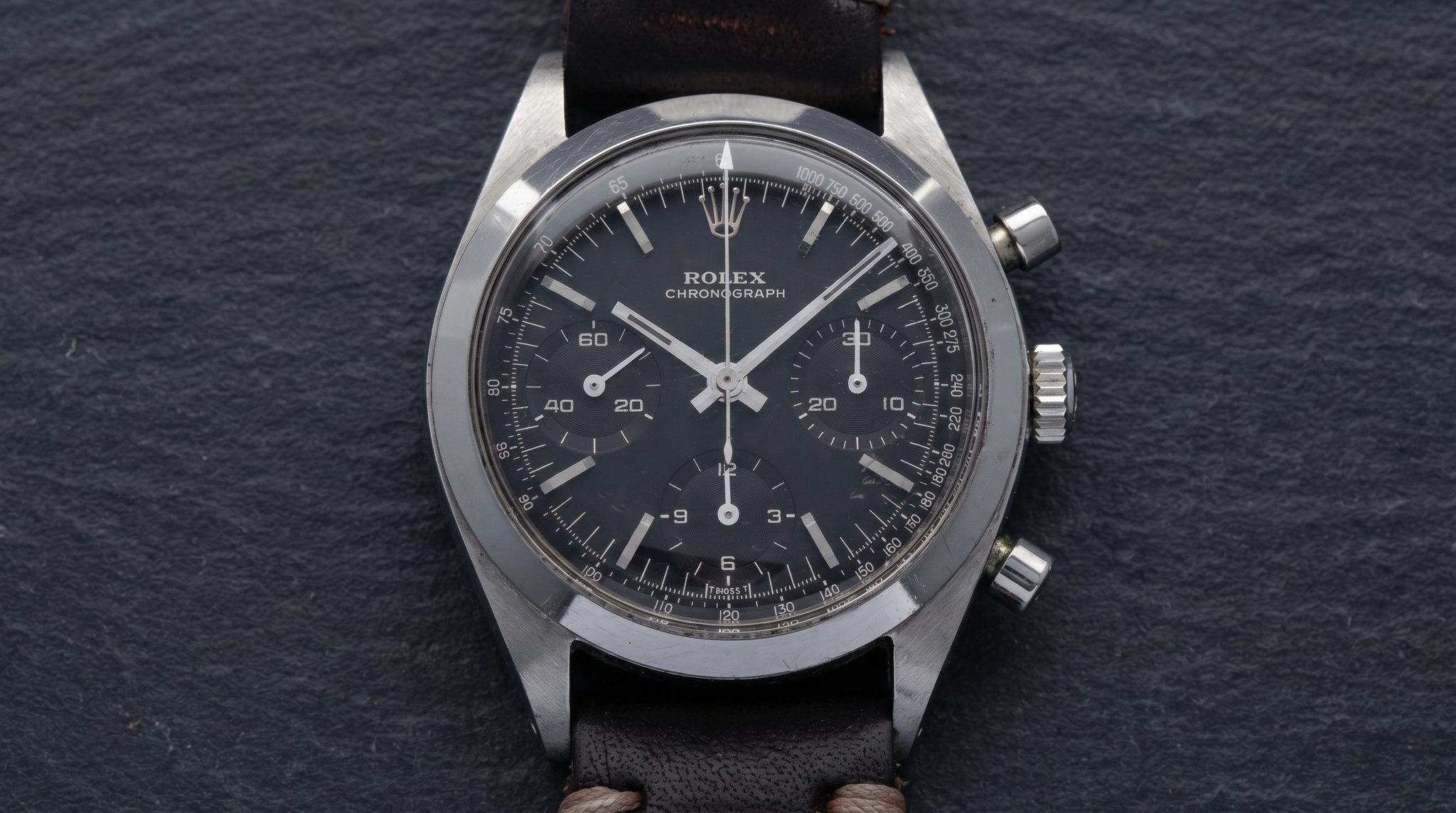
The Rolex Cosmograph Daytona 6238 is the last smooth-bezel Rolex chronograph whose collectibility is driven almost entirely by dial text, color, and finish.
- Production
- c. 1962–1968
- Case
- Steel, 14k, or 18k
- Diameter
- 36 mm
- Thickness
- 10 mm
- Lug width
- 19 mm
- Bezel
- Smooth, polished
- Dial
- Tachymeter on dial
- Pushers
- Pump pushers
- Movement
- Cal. 72B → 722
A Rolex 6238 can look like two different watches depending on what is written on its dial. The earliest examples still speak in the language of the ref. 6234, with “ROLEX / OYSTER CHRONOGRAPH” under the coronet and “ANTI-MAGNETIC” above 6 o’clock, often paired with distinctive dagger hands. By late 1963, the same reference is more restrained and more modern, often reduced to “ROLEX” and a single “Chronograph” line, with baton hands and a clean, monochrome face.
That swing in tone is why the Rolex Cosmograph Daytona 6238, often called the “Pre-Daytona,” is collected more like a study in dial execution than a study in case evolution. Across its broadly cited production window of circa 1962 to 1967 or 1968, the architecture stays consistent: a 36 mm Oyster chronograph case with pump pushers, a smooth polished bezel, and the tachymeter scale printed on the dial rather than engraved on the bezel. The fascination, and the price dispersion, comes from the way Rolex experimented with text, typography, color, and surface finish right up to the handoff to the bezel-tachymeter ref. 6239.
It is also a reminder that “Daytona” was not inevitable. The 6238 carries neither “Cosmograph” nor “Daytona” on the dial, and it has no “Paul Newman” exotic-dial counterpart documented for the reference. What it offers instead is an unusually legible map of Rolex’s mid-1960s chronograph thinking, visible one printed word and one dial surface at a time.
“On the ref. 6238, the case stays steady while the dial does the talking, from “Oyster Chronograph” and “Anti-Magnetic” to a pared-back “Rolex / Chronograph” face.”
6238 across c. 1962–1968
The story of the 6238 is unusually readable because Rolex left the case nearly alone and did its experimenting where the wearer looks most: the dial. Early examples are explicitly transitional, borrowing the ref. 6234’s vocabulary with “OYSTER CHRONOGRAPH” and the emphatic “ANTI-MAGNETIC” line, and they are often paired with dagger-style hands that make the watch feel more like a 1950s chronograph than a racing watch.
After that opening, the documentation turns less tidy. A two-tone dial series is described in collector studies as a bridge toward the coming Daytona look, with a recognizable typography cue in the Rolex signature and a tachymeter track set further from the sub-registers, closer to the dial edge. The sources do not pin this series to exact start and stop years, and the absence of a factory “mark” system means the boundary is defined by surviving watches rather than a Rolex bulletin.
By late 1963 the reference settles into the monochrome “ROLEX / Chronograph” family that most people picture when they hear “Pre-Daytona.” Even here, the dial remains the moving target: silver is common, a darker grey is documented as rarer, and black dials appear within this late production without a firmly dated introduction. Black then splits into overlapping traits that do not behave like a clean sequence, since finish (matte versus glossy, including galvanic gloss examples) and printing color (silver or white graphics versus gilt writing) can combine in multiple correct ways.
The zoomed-out lesson is that the 6238 was not a single fixed design waiting to be named. It was a stable platform that Rolex kept re-writing in real time, right up to the moment the next reference, 6239, moved the tachymeter off the dial and onto the bezel and made the Daytona identity easier to recognize at a glance.
- 1962Reference appearsTachymeter printed on dial
- c. 1962Transitional dialANTI-MAGNETIC above 6 o’clock
- c. 1960sTwo-tone seriesGraceful “R”, track nearer edge
- c. 1963Monochrome eraNo “Oyster”, no “Anti-Magnetic”
- c. 1960sBlack-dial axisMatte or glossy, silver or gilt print
- c. 1960sMovement updateMovement engraving under the bridge
- c. 1967 – 1968Production ends6239 has tachymeter bezel
6238 against its neighbours
Ref. 6238 sits between two clearer identities: the ref. 6234 that still reads like an earlier Oyster chronograph, and the ref. 6239 that relocates the tachymeter to the bezel and becomes the first Daytona-line Cosmograph. Comparing the three makes the 6238’s real theme obvious: its case formula is consistent, but its dial language is in motion.
This reference 6238 Rolex · focal c. 1962–1968 | ||||
|---|---|---|---|---|
| Production | early 1950s–early 1960s | c. 1962–1968 | 1963–1969 | c. 1966–1969 |
| Diameter | 36 mm | 36 mm | ~36 mm | – |
| Bezel | Smooth (no scale) | Smooth, polished | Tachymeter bezel | Black acrylic bezel |
| Dial | Tachy + telemeter scales | Tachymeter on dial | Standard or exotic | – |
| Pushers | Pump pushers | Pump pushers | Pump (non screw-down) | Pump pushers |
| Movement | Valjoux 72 family | Cal. 72B → 722 | Cal. 72B, later 722/722-1 | 722 / 722-1 family |
| Case | Steel and gold | Steel, 14k, or 18k | Stainless steel | Stainless steel |
Nine dial generations across the run
This earliest, explicitly transitional 6238 dial is the one that still sounds like the preceding ref. 6234. Under the crown it reads “ROLEX / OYSTER CHRONOGRAPH,” and above the 6 o’clock sub-dial it adds “ANTI-MAGNETIC,” a line that disappears on later 6238s. In hand, the appeal is as much typographic as technical: the extra text fills the dial and makes the watch feel busier and more mid-century.
Collectors often associate this era with dagger-style hands and older-style applied markers. The tachymeter printing is not a reliable shortcut here, because documented examples appear with or without a tachymeter scale. That single fact is important when judging originality, since a missing tachymeter on an early dial can be correct rather than a sign of later alteration.
What to check before buying a 6238
Buying a Rolex Cosmograph Daytona 6238 is less about chasing a single “best” configuration and more about being precise about what, exactly, is being sold. The reference’s case architecture is consistent, so the market’s big premiums concentrate where replacements and refinishing are easiest to hide: the dial surface, the printing, and the correctness of rare dial types.
The largest trap is lazy labeling. “Black dial” is not a single thing on a 6238. Sources separate matte black from galvanic gloss black as different finish families, and they also describe printing-color variation (silver or white graphics versus gilt writing) that can overlap either finish. Multiscale and medical-style dials add another layer of risk, since unusual scale work is where fantasy dials tend to appear.
The other recurring fork in value is case metal. Steel is the baseline and most common, while 14k and 18k gold are markedly rarer and trade in different territory, especially when paired with rare dials. For gold, correct hallmarks and coherent caseback and between-lug markings matter as much as dial originality.
In practice, the 6238 rewards the kind of ownership that is visual and patient. It wears small at 36 mm and sits relatively flat, and the smooth bezel keeps it quieter than later Daytonas. For many collectors that restraint is the point: the watch only reveals itself when the dial is right, and when it is right, it feels like a chronograph that was refined by typography rather than redesigned by hardware.
Rolex Cosmograph Daytona 6238 for sale
Indicative market value from recent dealer, auction, and Grey Market sales: median ≈ $33,500, with a typical $21,000–$50,000 range across 11 comparable sales (updated this week).
Each point is a recent dealer or auction sale, banded to an indicative figure. The range shown is not a valuation.
Adjacent in the Cosmograph Daytona family
Common questions about the 6238
The Rolex Cosmograph Daytona 6238 is most safely dated to circa 1962–1968. Many auction houses and specialist references also summarize it as 1962–1967, with 1968 often reflecting late deliveries or assembly cutoffs rather than a sharply documented factory end date.
- 1968 Rolex ‘Pre-Daytona’ Chronograph Reference 6238 (example specs)shop.hodinkee.com
- Rolex 6238 ‘Pre-Daytona’ Chronograph Review (dial eras, late-1963 shift)watchprosite.com
- Rolex Pre-Daytona 6238 Dial Variations Studywatchprosite.com
Show 7 more
- Rolex 6238 Pre-Daytona In-Depth Review (early dials, movement notes)le-monde-edmond.com
- The History of the Rolex Cosmograph, Part I: The Pump Pushers (context, transitional observations)watchprozine.com
- Rolex Ref. 6238 (collector overview, dial notes)corradomattarelli.com
- Rolex 6238: The Pre-Daytona That Inspired The Myth (dial-series framing)italianwatchspotter.com
- Rolex The Geneva Watch Auction: X (auction record context for ref. 6238)phillips.com
- Rolex The Geneva Watch Auction: NINE (ref. 6238 catalogue context)phillips.com
- Rolex ‘Pre-Daytona’ Chronograph (6238) (matte vs galvanic black market commentary)watchworkspdx.com