

Rolex Cosmograph Daytona 6239
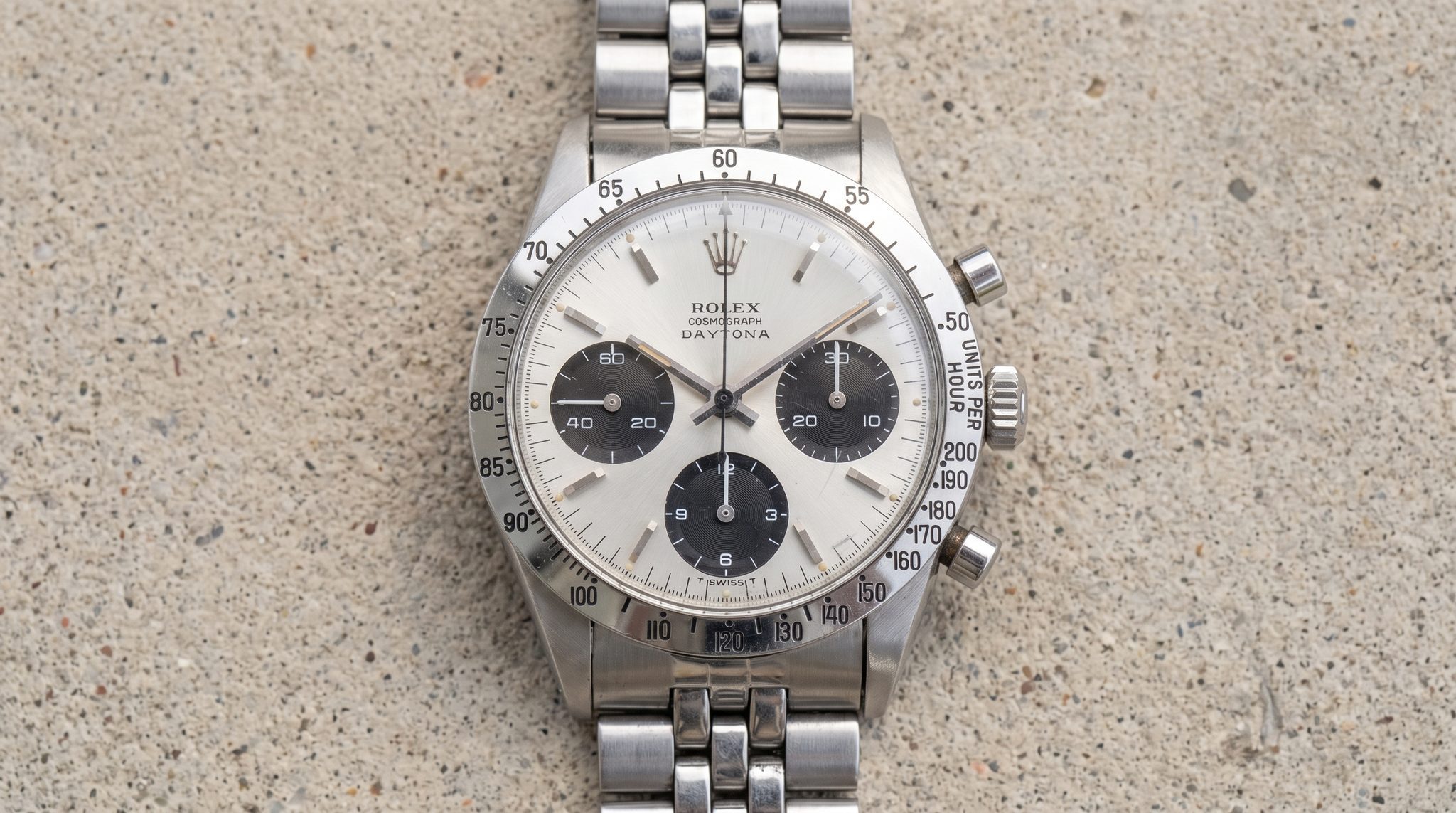
The reference 6239 is the first Daytona, a pump‑pusher Cosmograph whose identity lives in dial-print variations and an engraved metal tachymeter bezel that appears as early “300” and later “200” scales (with overlap).
- Production
- c. 1963–1969
- Case
- Steel (also gold)
- Diameter
- ~36 mm
- Lug width
- 19 mm
- Thickness
- ~13–14 mm
- Bezel
- Engraved tachymeter
- Pushers
- Pump (non screw-down)
- Movement
- Cal. 72B → 722 → 722-1
- Jewels
- 17
- Dial
- Standard or exotic
- Chronograph
- 3-register, manual
The reference 6239 is the Daytona before the Daytona was a fixed idea: Rolex launched its first Cosmograph Daytona in 1963, then spent the rest of the decade testing what the name, the dial, and even the bezel should look like. The signature detail is concrete and easy to spot in the hand, not a slogan: the tachymeter scale is engraved on the metal bezel, and early examples show “300” units per hour before a “200” scale appears soon after, with both scales known to overlap rather than forming a clean cutover.
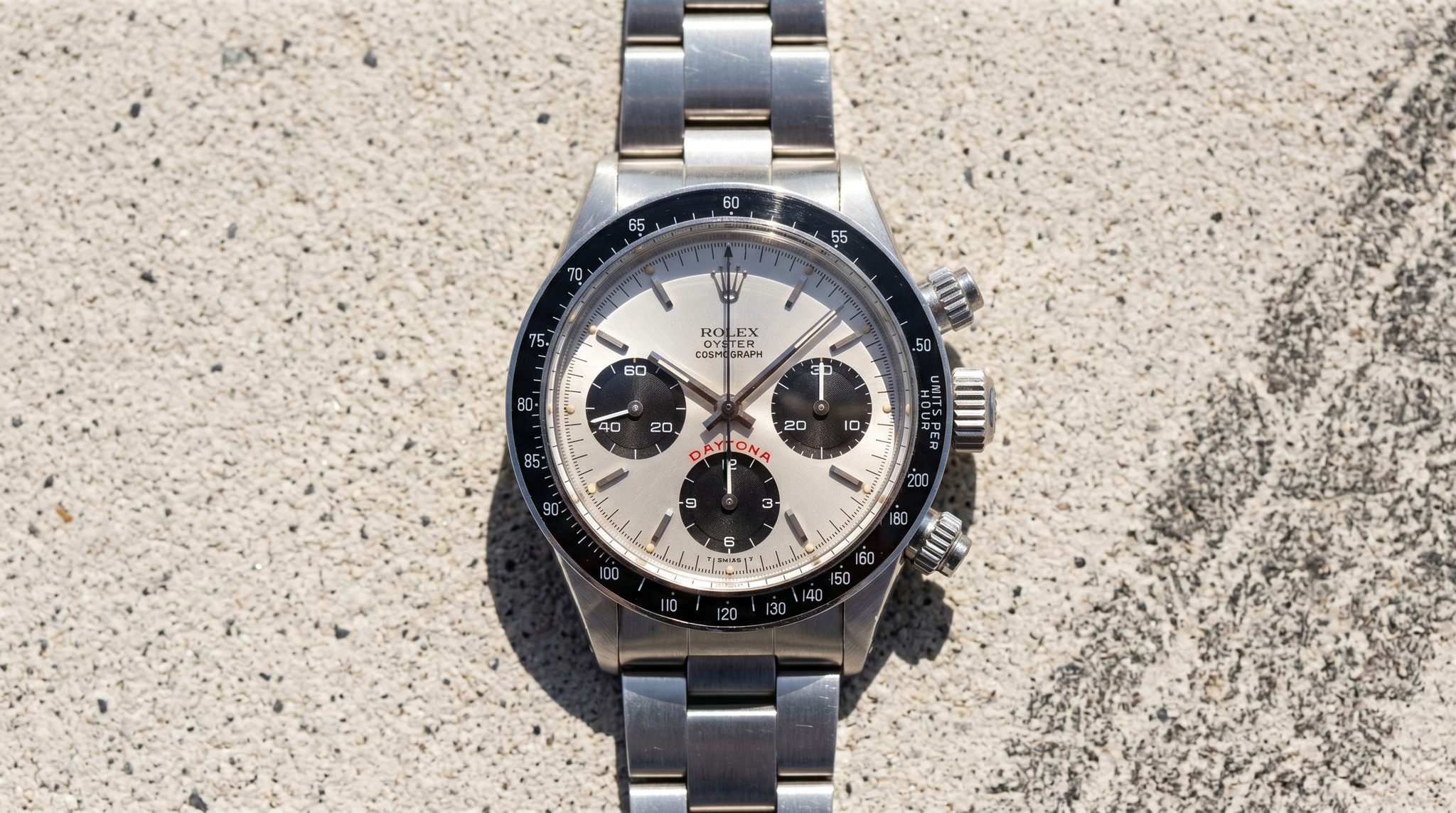
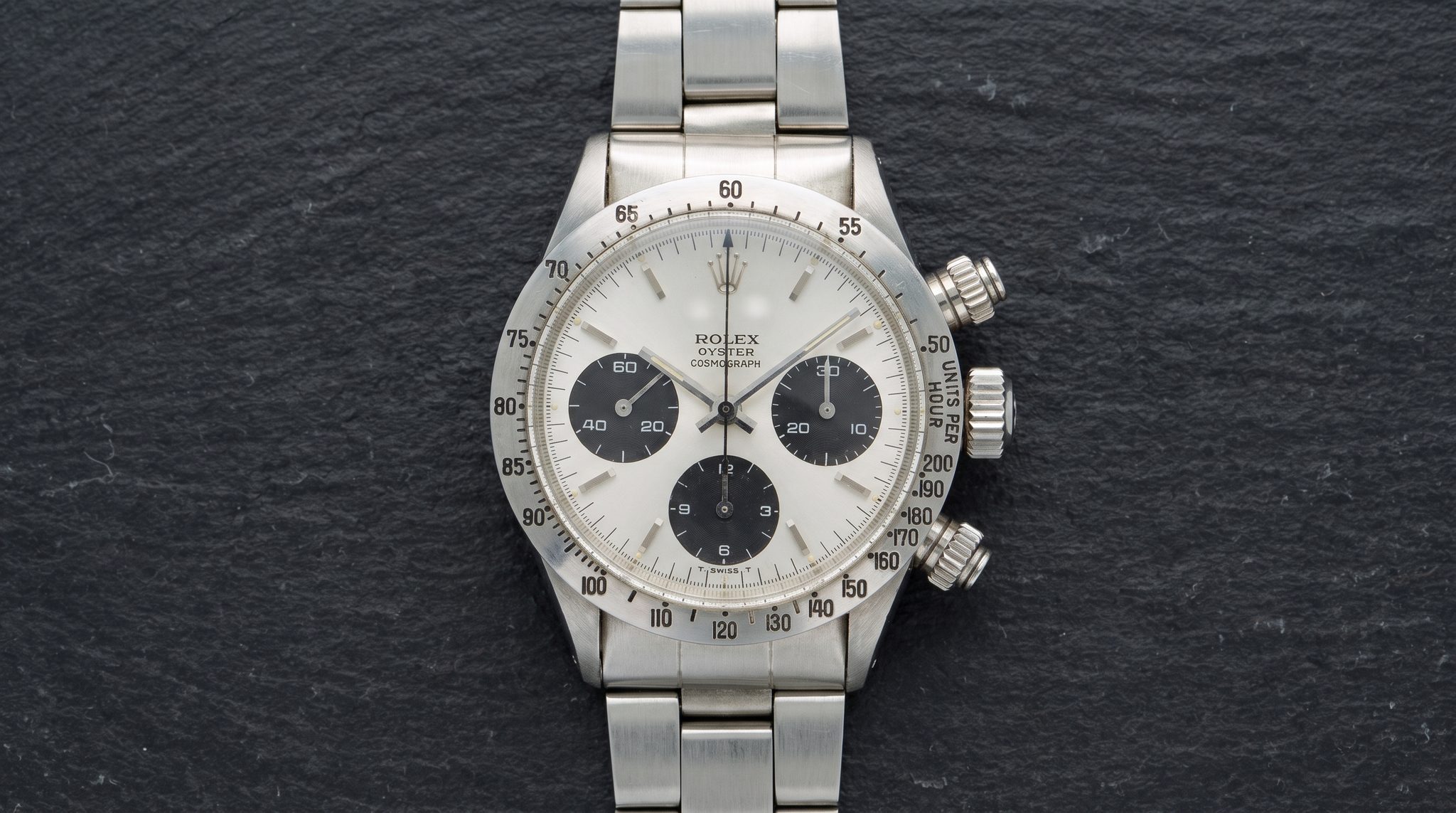
That visual stability in the case and bezel is exactly why collectors read the 6239 through its printing. Within the broadly accepted c. 1963–1969 production span, the same pump‑pusher chronograph can show very early “double SWISS” dials without any Daytona text, transitional underline dials, later dials that move “Daytona” to different locations and sizes, and the factory “exotic” option that later gained the Paul Newman nickname. In other words, a Rolex 6239 is often dated and judged one independent trait at a time, because Rolex itself did not treat the dial as a single, locked specification during this reference’s short life.
“A single case and bezel concept, then a decade of dial experiments: the first Daytona is easiest to understand by what Rolex printed, not what it built.”
6239 across c. 1963–1969
The 6239 enters the record in 1963 as the first Cosmograph Daytona, and its most enduring idea is also its most literal one: the tachymeter leaves the dial and moves onto an engraved metal bezel. Even that “fixed” feature shows Rolex still feeling its way, with very early bezels engraved to 300 units per hour and later examples more commonly showing 200, a change described as happening quickly but not cleanly enough to create a simple before-and-after dating rule.
Mechanically, the watch stays in the Valjoux 72 family throughout, with specialist accounts placing a roughly c. 1963–1965 72B phase, c. 1965–1967 Cal. 722, and a late Cal. 722‑1 in the last years. These are internal evolutions rather than external redesigns, so the front of the watch remains the better historical record: early “Cosmograph” dials without Daytona branding, transitional underline and “SWISS” signature details, and then the many ways Rolex experimented with where “Daytona” should appear once the motorsport association took hold.
The exotic dial option, introduced around the middle of the decade, underlines what makes the 6239 unusual in the Daytona line. Rolex did not create a separate reference for the exotic configuration, and it did not leave a public schedule for when each printing detail changed. The result is a first-generation Daytona that looks stable in case and function, yet reads like a living draft in typography, minute tracks, and signatures. It is one of the clearest examples of a Rolex sports watch whose history is written in ink, not architecture.
- 1963IntroducedPump pushers, engraved bezel
- c. 1963Bezel scalesTachymeter reads 300 or 200
- c. 1965Cal. 722Internal: Cal. 722
- c. 1965Exotic optionSquare-ended sub-dial markers
- c. 1967Cal. 722-1Internal: Cal. 722-1
- c. 1969DiscontinuedLater 4-digit refs follow
6239 against its neighbours
The 6239 makes the most sense when framed by the references directly around it: the more restrained 6238 that precedes the Daytona name, the near-twin 6241 that swaps the engraved metal bezel for a black acrylic insert, and the later 6262 that keeps the metal bezel and pump pushers but steps into the next movement era.
This reference 6239 Rolex · focal c. 1963–1969 | ||||
|---|---|---|---|---|
| Production | c. 1962–1968 | c. 1963–1969 | c. 1966–1969 | c. 1970–1971 |
| Case | Steel & gold | Steel (also gold) | Steel & gold | Steel |
| Diameter | 36 mm | ~36 mm | – | – |
| Lug width | 19 mm | 19 mm | – | – |
| Thickness | 10 mm | ~13–14 mm | – | – |
| Bezel | Smoother / less tachy | Engraved tachymeter | Black acrylic insert | Engraved tachymeter |
| Pushers | Pump | Pump (non screw-down) | Pump | Pump |
| Movement | Valjoux 72-family | Cal. 72B → 722 → 722-1 | Valjoux 72-family | Cal. 727 |
| Jewels | 17 | 17 | – | – |
| Dial | Pre-Daytona styling | Standard or exotic | Standard or exotic | Standard or exotic |
| Chronograph | 3-register, manual | 3-register, manual | 3-register, manual | 3-register, manual |
Six dial generations across the run
This is the 6239 at its most historically revealing: a dial that still looks like it is catching up to a new bezel. The defining tell is that the watch shows no “Daytona” text, and instead carries two separate “SWISS” signatures at 6 o’clock, one printed at the outer edge and another printed further in so it remains visible once the broader tachymeter bezel covers the perimeter. In hand it reads like a production correction that Rolex chose to print, not hide.
“Double Swiss” is best treated as its own dial-generation clue, separate from later underline dials or any “Daytona” placement. The brief association is with the earliest 1963 examples, but Rolex did not publish a cutoff, so surviving watches are the practical evidence for how short the run was.
What to check before buying a 6239
Buying a 6239 is less about hunting one “correct” configuration than about confirming that its individual, visible choices belong together. The reference’s case and bezel concept is consistent, but the dial is not. That is exactly why the biggest value swings follow the dial, particularly the factory exotic option, and why originality is the first question rather than a finishing detail.
The second trap is vocabulary. “Paul Newman” is not a Rolex model name, and it is often applied loosely in listings to any 6239. In practice, the premium is for the exotic dial construction itself, and auction and dealer writing repeatedly separates original exotic dials from later service or refinished examples.
Living with a Cosmograph Daytona 6239 is living with a compact, mid‑century chronograph that wears small by modern standards at about 36 mm, yet feels purposeful because the bezel does the talking: the tachymeter is on the metal ring, not printed on the dial. For many owners, that combination is the point. The watch has the familiar Daytona layout, but it still shows Rolex making up its mind in real time, one printing line at a time.
Rolex Cosmograph Daytona 6239 for sale
Indicative market value from recent dealer, auction, and Grey Market sales: median ≈ $68,000, with a typical $45,000–$164,000 range across 40 comparable sales (updated this week).
Each point is a recent dealer or auction sale, banded to an indicative figure. The range shown is not a valuation.
Adjacent in the Cosmograph Daytona family
Common questions about the 6239
Most specialist sources place Rolex Cosmograph Daytona 6239 production from 1963 to around 1969, often written as c. 1963–1969. One commercial source compresses the end date to 1967, but the broader specialist consensus clusters around 1969 as the approximate end.
- 1968 Rolex 'Paul Newman' Daytona Reference 6239hodinkee.com
- 1966 Rolex Cosmograph 'Big' Daytona Ref. 6239hodinkee.com
- Reference Guidevintagedaytona.com
Show 7 more
- Review of Rolex Daytona 6239 Paul Newman41watch.com
- The complete history of the Rolex Daytona41watch.com
- Rolex Daytona 6239: The Chronograph That Changed...tropicalwatch.com
- The Rolex Cosmograph Daytona (1963 birth)rolexpassionreport.com
- Rolex Daytona 6239 "Paul Newman" Ultimate Buying Guidebobswatches.com
- A COMPREHENSIVE GUIDE TO THE ROLEX PAUL NEWMAN DIALSwatchfid.com
- Rolex Daytona History: The Complete Cosmograph Storythewatchology.com