

Rolex Cosmograph Daytona 6234
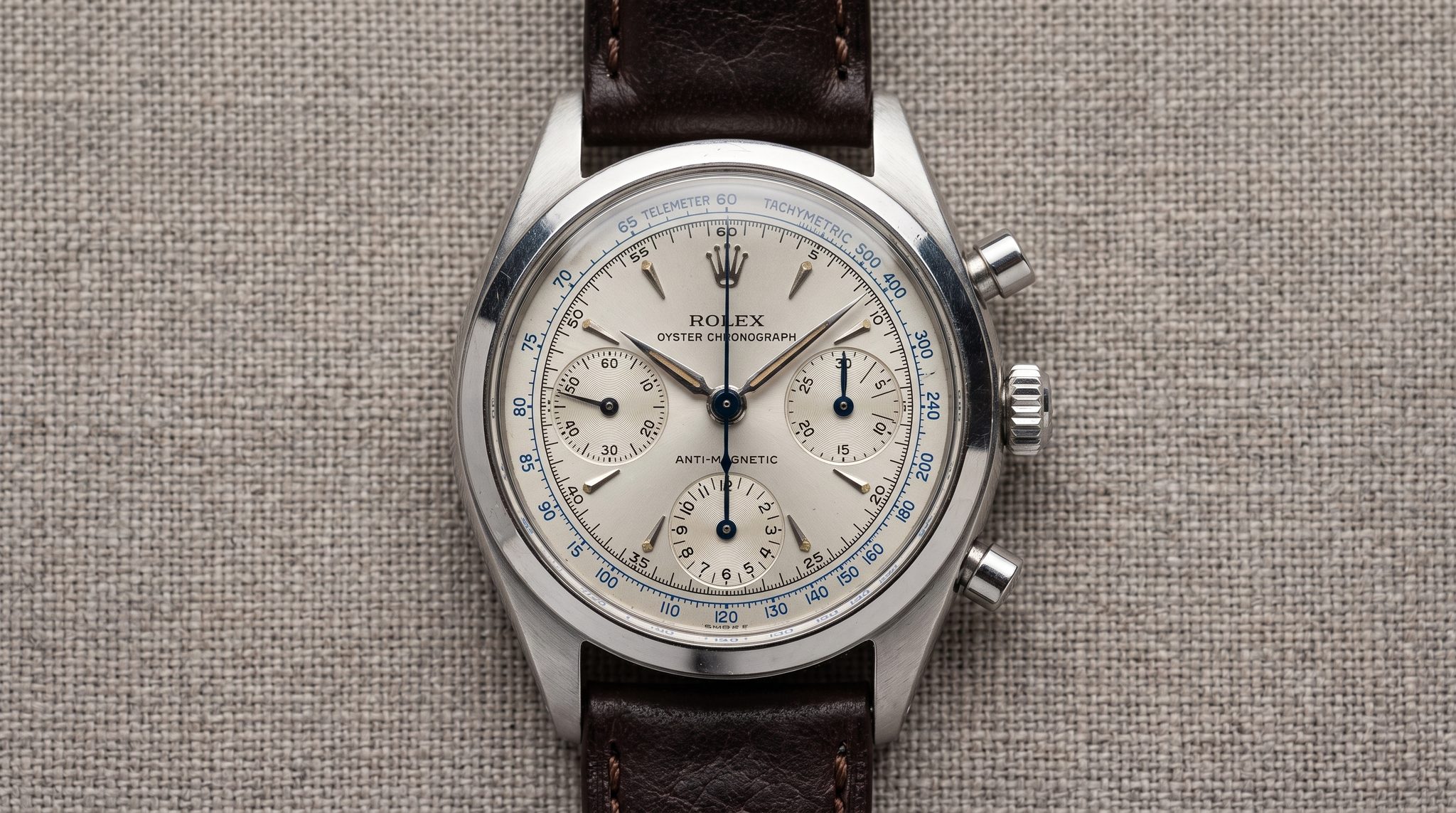
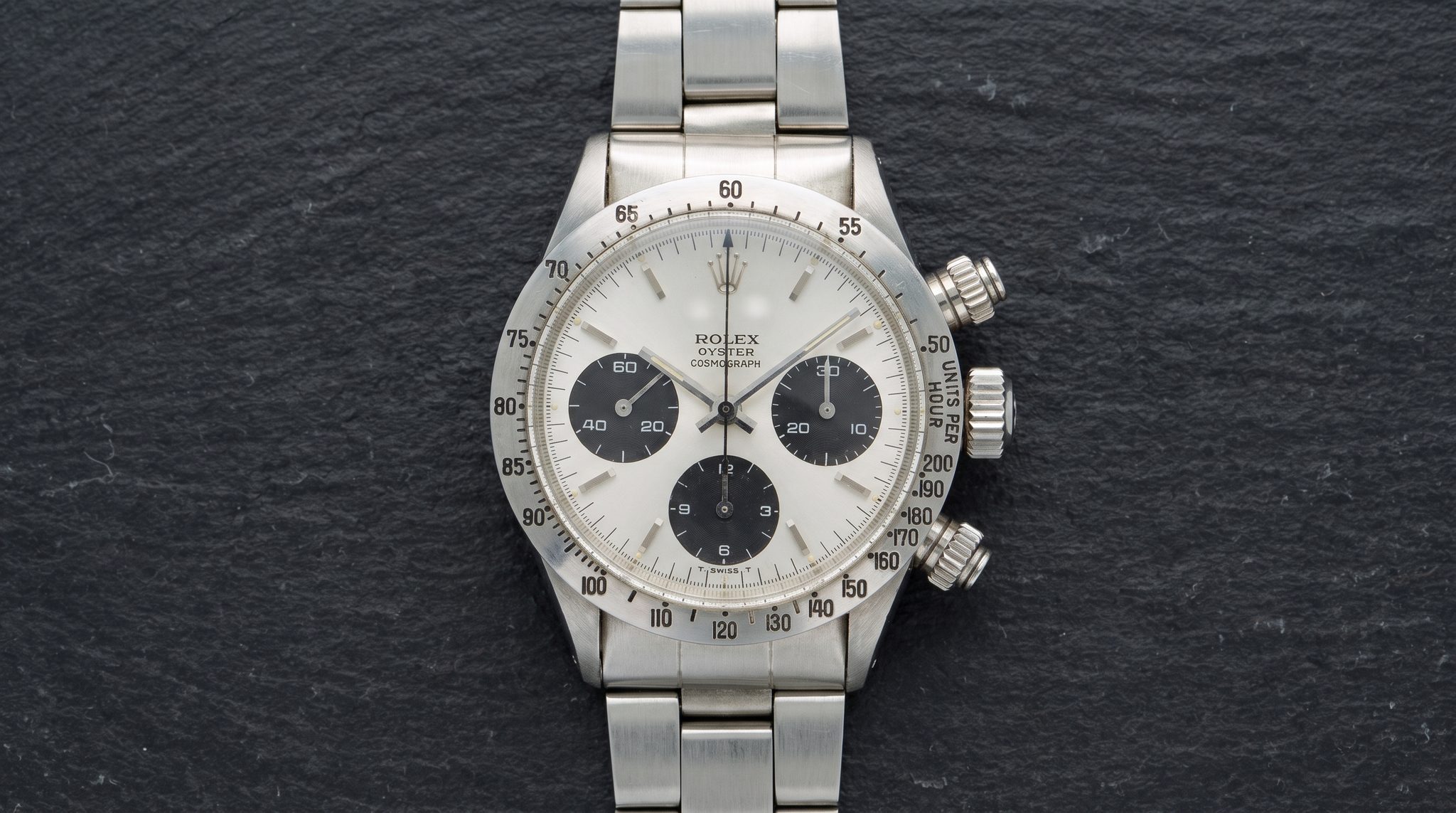
The Rolex 6234 is the pre-Daytona chronograph that proves the “Daytona look” was not inevitable, a 36 mm Oyster whose dial carried the speed and distance scales before Rolex moved that information to the bezel.
- Production
- c. 1955–1961
- Case
- Oyster, steel or gold
- Diameter
- 36 mm
- Bezel
- Smooth (no scale)
- Dial
- Tachy + telemeter scales
- Movement
- Valjoux 72 family (manual)
- Chronograph
- Column-wheel, 3-register
- Jewels
- 17
- Pushers
- Pump pushers
- Lume
- Radium era
The Rolex 6234 is the pre-Daytona chronograph that makes the later Daytona feel like a decision, not a destiny. Its most repeatable tell is simple and visual: the bezel is smooth, while the tachymeter and telemeter scales live on the dial itself, printed as two fine rings that turn the face into an instrument panel.
That layout, paired with a 36 mm Oyster case and a manual, Valjoux 72-family column-wheel chronograph movement, places the 6234 squarely in the experimental years when Rolex was still feeling out what a sports chronograph should look like. Produced roughly from 1955 to 1961 (and catalogued in period materials through 1963), it sits after the earlier ref. 6034 and before the ref. 6238, the last major stop before the Daytona-named era begins with the 6239.
Collectors care about the 6234 because it is both more restrained and more varied than the Daytonas that followed. The reference is anchored by a consistent architecture, three-register chronograph, smooth bezel, and dual dial scales, yet it appears with meaningful, independent options: steel or very scarce gold cases, silver or black dials in different finishes, different scale color executions, and differing sub-dial proportions. Instead of a neat mark-by-mark taxonomy, the 6234 rewards the ability to read one feature at a time, and to accept that Rolex was comfortable letting several dial solutions coexist.
“A smooth bezel and dial-printed tachymeter and telemeter tracks make the Rolex 6234 the point where Rolex tried several answers to the sports-chronograph problem before the Daytona fixed the formula.”
6234 across c. 1955–1961
Rolex launched the 6234 in the mid-1950s as an Oyster-cased chronograph that still looked like a precision tool rather than a branded sports statement. The core idea is consistent across the reference: a three-register dial with running seconds at 9 o’clock, a 30-minute counter at 3, and a 12-hour counter at 6, driven by a manual-wind Valjoux 72-family column-wheel movement that auction and dealer documentation variously identifies as cal. 72, 72A, or 72B (all cited in 17-jewel form). The exact reason the caliber designation appears differently in published descriptions is not documented.
What makes the 6234 historically legible is where it puts information. Instead of the later Daytona habit of relocating speed timing to a tachymeter bezel, the 6234 keeps a smooth bezel and prints both tachymeter and telemeter scales on the dial. In hand, that choice changes the whole reading experience. Your eye meets two hairline rings at the periphery, and the watch feels like it is asking to be used, even when it is dressed up in polished steel or yellow gold.
Within that stable architecture, Rolex allowed real diversity. Scale executions appear in single-color and multi-color combinations, including well-documented late-1950s examples with a blue telemeter track paired with a darker tachymeter scale. Sub-dial proportions vary as well, with both smaller-register layouts and a larger-register style that appears prominently on late-1950s watches. These are not cleanly sequential changes with published factory cutoffs; scholarship describes them as overlapping solutions rather than a strict evolution.
The handoff to the next reference clarifies the direction Rolex would take. The ref. 6238 is generally described as the immediate successor and is known for dropping the telemeter scale, simplifying the dial toward the look that would be codified soon after in the Daytona-era 6239.
Seen as a whole, the 6234 compresses a surprisingly wide range of dial decisions into a short production life. That is why it can feel more revealing than some later, more famous Daytonas: it shows Rolex trying possibilities in public, before the brand settled on one layout that the market would eventually treat as inevitable.
- c. 1955IntroducedSmooth bezel, dual dial scales
- c. 1959Dial varietyBlue telemeter, black tachy
- c. 1961Production endsStill dual dial scales
- 1961Successor eraTelemeter generally deleted
6234 against its neighbours
The 6234 is best understood by what comes immediately on either side of it. The ref. 6238 carries the pre-Daytona idea forward but simplifies the dial by generally removing the telemeter, while the ref. 6239 introduces the Daytona identity and shifts the tachymeter off the dial and onto the bezel, turning the same basic chronograph into a more clearly branded sports tool.
This reference 6234 Rolex · focal c. 1955–1961 | |||
|---|---|---|---|
| Production | c. 1955–1961 | c. 1962–1968 | 1963–1969 |
| Diameter | 36 mm | 36 mm | ~36 mm |
| Bezel | Smooth (no scale) | Smooth, polished | Tachymeter bezel |
| Dial | Tachy + telemeter scales | Generally no telemeter | Daytona-era layout |
| Movement | Valjoux 72 family (manual) | Valjoux 72 family | Valjoux 72 / cal. 722 |
| Pushers | Pump pushers | Pump pushers | Pump (non screw-down) |
Six dial generations across the run
Most ref. 6234s present the reference’s defining face: tachymeter and telemeter scales printed directly on the dial, often accompanied by the “Anti-Magnetic” signature. Visually, it reads as two concentric measuring rings around a three-register chronograph, with applied dagger markers and small luminous plots that commonly age into warm yellows. Because the scholarship does not provide firm, watch-wide cutoffs for the many small printing and color differences, the safest way to evaluate a candidate is by overall period coherence: the crispness and spacing of the scale printing, the harmony of the aged lume across plots and hands, and whether the dial surface looks like an original, un-reworked finish rather than a modern repaint.
What to check before buying a 6234
Buying a Rolex 6234 is less about chasing a single correct dial “mark” and more about resisting false certainty. The reference is documented with overlapping dial executions and export-market quirks, so the safest purchases are the ones that tell one coherent story across independent features: the dial’s printing quality and surface, the case metal and hallmarks, the movement family and its markings, and the presence or absence of US-market signals like miles scales and “ROW.”
The biggest practical risk is the dial, because the 6234’s value swings dramatically with originality and with rare configurations. A standard multi-scale dial can be expensive in honest condition, while a documented outlier like the no-scale Stern black dial can land in an entirely different price universe. That spread creates the incentive for restoration and creative assembly.
A good 6234 is also a lesson in case geometry. Over-polishing can erase the character of a 36 mm Oyster case, and it is difficult to unsee once noticed. The most satisfying examples are often the ones that look quietly used rather than cosmetically perfected.
Living with a 6234 is living with a chronograph from a moment when Rolex had not yet decided what a Daytona should be. The reward is not just owning an early Rolex chronograph, it is wearing a design that still shows its questions, especially when the dial’s fine scale rings and aging luminous plots catch the light.
Rolex Cosmograph Daytona 6234 for sale
Indicative market value from recent dealer, auction, and Grey Market sales: median ≈ $24,500, with a typical $20,250–$29,000 range across 10 comparable sales (updated this week).
Each point is a recent dealer or auction sale, banded to an indicative figure. The range shown is not a valuation.
Adjacent in the Cosmograph Daytona family
Common questions about the 6234
Rolex ref. 6234 was produced roughly from 1955 to 1961. It is also documented as being listed in Rolex catalogues through 1963, which is why exact year cutoffs are usually treated as approximate rather than absolute.
- Phillips Geneva: Rolex Decade One (2015–2025) lot with rare 6234 dial details (Stern markings, no-scale black dial)phillips.com
- Phillips: production estimate and configuration notes for gold 6234 (steel vs gold rarity, miles telemeter, ROW)phillips.com
- Christie’s lot description for Rolex ref. 6234 (dial text observations, US-market bracelet note, tropical-style aging description)christies.com
Show 7 more
- Hodinkee: Found, a tropical Rolex Oyster Chronograph ref. 6234 (collector context and lineage framing)hodinkee.com
- Rolex Passion Market: ref. 6234 overview emphasizing dial-printed tachymeter vs later bezel layoutsrolexpassionmarket.com
- Collector Square: Rolex pre-Daytona ref. 6234 reference page (production window and core description)collectorsquare.com
- The Watch Boutique: Family Tree, Rolex Pre-Daytona (lineage context 6234 to 6238 to Daytona era)thewatchboutique.com
- Bob’s Watches: Vintage of the Week, Rolex Chronograph 6234 (overview and positioning as pre-Daytona)bobswatches.com
- Hairspring: 6234 Pre-Daytona Anti-Magnetic Chronograph (collector-oriented overview and configuration notes)hairspring.com
- Wikipedia: Rolex Cosmograph Daytona (model-line framing and later Daytona identity)wikipedia.org