

Rolex Cosmograph Daytona 6262
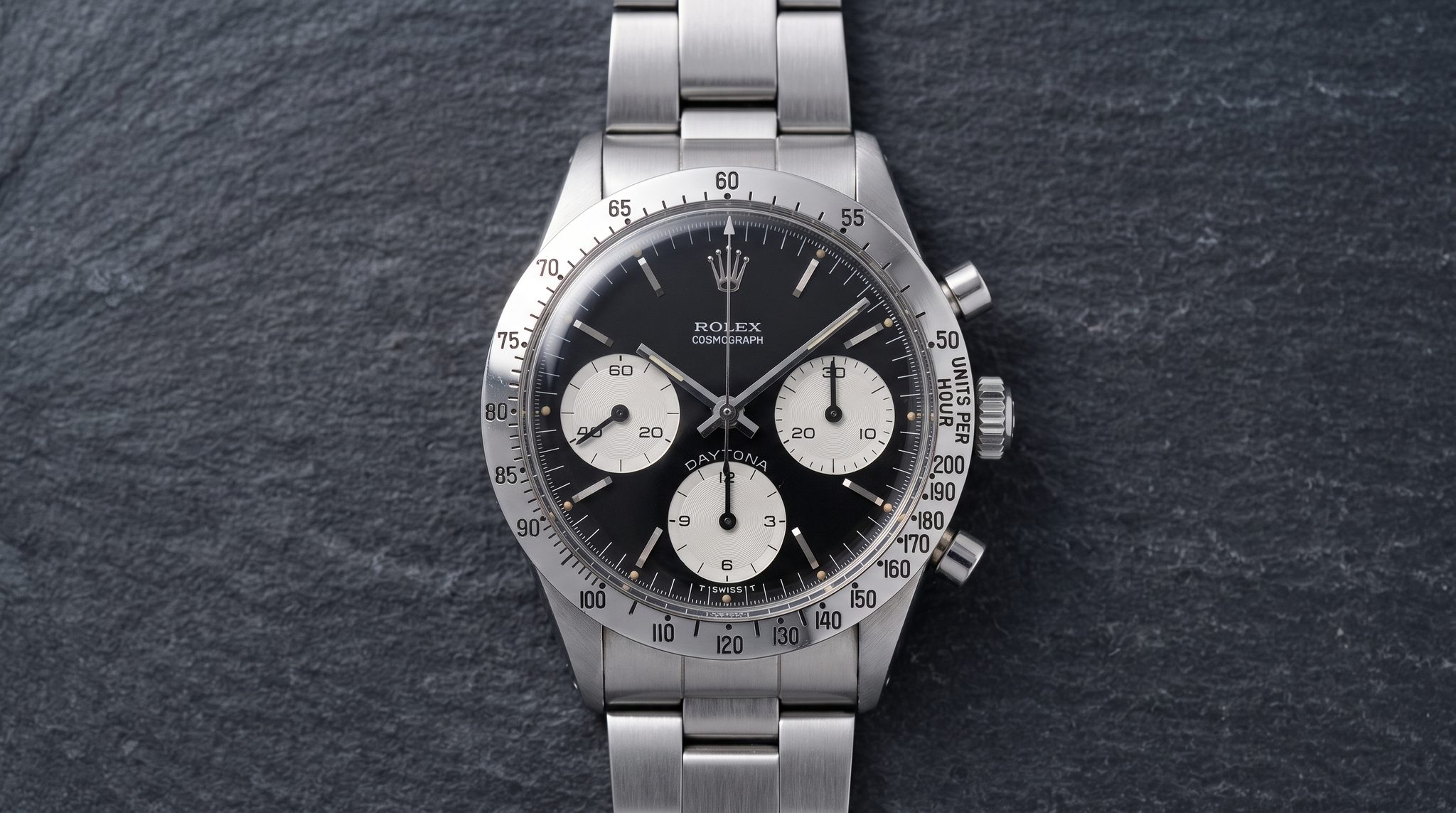
Rolex Cosmograph Daytona ref. 6262 is the short-run pump‑pusher Daytona that introduced caliber 727 behind the familiar steel tachymeter bezel.
- Production
- c. 1970–1971
- Case
- Steel or yellow gold
- Diameter
- 37 mm
- Lug-lug
- 43.4 mm
- Thickness
- 13.6 mm
- Bezel
- Metal tachy (to 200)
- Crystal
- Acrylic
- Pushers
- Pump (non screw-down)
- Movement
- Cal. 727 (manual)
- Jewels
- 17
- Dial
- Standard or exotic
- Lug width
- 18.5 mm
Ref. 6262 is the Daytona that hides its biggest change where only a watchmaker sees it: a pump‑pusher, steel‑bezel Cosmograph that looks like the preceding 6239, but runs on Rolex’s higher‑beat caliber 727. That single decision, to fit the Valjoux‑based 727 (commonly described at 21,600 vph) into the last generation of non‑screw‑down “Cosmograph” cases, is why the Rolex Cosmograph Daytona 6262 is treated as the hinge between the early, lower‑beat pump‑pusher era and the long Oyster‑pusher era that followed.
Its production span is narrow and, importantly, not documented by Rolex with a clean cutoff. Many summaries call it a one‑year reference centered on 1970, while other specialist guides place it from late 1969 into 1971, with dated examples appearing on either side of that boundary. In practice the watch is defined less by a precise start date than by a fixed external formula, a 37 mm case with pump pushers and an all‑metal tachymeter bezel graduated to 200 units per hour, plus an internal upgrade that aligns it mechanically with later manual‑wind Daytonas.
Because the hardware is so consistent across the reference, collectors tend to judge a 6262 from the dial outward. The reference is documented with standard dials and with exotic “Paul Newman” dials, and specialist literature further distinguishes a small set of standout executions, including the matte black “Blue Daytona” treatment and extremely rare gold examples. In a market where the highest premiums concentrate in the dial, ref. 6262 rewards the buyer who can read printing, textures, and sub‑dial details as carefully as they read the reference number inside the caseback.
“A pump‑pusher, steel‑bezel Daytona on caliber 727, built briefly at the turn of 1970, and collected almost entirely by what is printed on its dial.”
6262 across c. 1970–1971
Ref. 6262 arrives at a moment when Rolex’s Daytona line was changing from the inside out. Externally it stays in the pump‑pusher “Cosmograph” world that ref. 6239 had defined, with a compact 37 mm case, an acrylic crystal, and a fixed metal tachymeter bezel whose scale runs up to 200 units per hour. The documented break is mechanical: the 6262 carries caliber 727, a Valjoux‑based manual chronograph described by specialist sources as higher beat than the earlier 722‑series movements, and commonly specified at 21,600 vph rather than 18,000.
The reason Rolex drew that new movement into a case that still used non screw‑down pushers is not documented, but the effect is clear in the lineage. Ref. 6262 and its acrylic‑bezel sibling 6264 sit as the last pump‑pusher Daytonas, while the early 1970s shift to screw‑down pushers defines the next long phase of the manual‑wind era (refs. 6263 and 6265). With such a short production window, there is no long sequence of dated micro-edits inside the reference; instead, the evidence that survives on the wrist is the dial. Standard and exotic “Paul Newman” architectures are both documented on the 6262, and within those families the details that matter to collectors are visual and tactile: the contrast of a silver sunburst surface against black registers, the distinctive geometry of exotic minute tracks and sub‑dial markers, or the unusual “Blue Daytona” execution described in specialist literature.
One zoomed‑out truth emerges when these pieces are placed side by side: the Daytona that later became a model of continuity was still being assembled in real time around 1970, with Rolex keeping the same silhouette while quietly standardizing the movement that would power the line for years.
- c. 1969/70Reference appearsPump pushers, metal tachy bezel
- c. 1969 – 1971Cal. 727 eraMovement marked “727”
- c. 1969 – 1971Steel vs goldCase metal and matching bezel
- c. 1969 – 1971Dial choiceExotic track and sub‑dial markers
- c. 1971Oyster era risesScrew‑down pushers on later refs
- c. 1971 – 1972Pump pushers endLater line is screw‑down only
6262 against its neighbours
Ref. 6262 makes the most sense when it is framed by the watch it replaced and the two directions Rolex pursued immediately after. The 6239 shows the same pump‑pusher, steel‑bezel idea on earlier 72x-series movements, while the 6264 mirrors the 6262’s caliber 727 but swaps the metal bezel for a black acrylic one. Ref. 6265 represents the later answer to the same brief, keeping a metal tachymeter bezel but moving the line into the screw‑down‑pusher Oyster era.
6264 Closest sibling c. 1969–1972 | This reference 6262 Rolex · focal c. 1970–1971 | |||
|---|---|---|---|---|
| Production | c. 1963–1969 | c. 1969–1972 | c. 1970–1971 | c. 1971–1987/88 |
| Case | Steel (also gold) | Steel or gold | Steel or yellow gold | Steel or yellow gold |
| Diameter | ~36 mm | – | 37 mm | ~37–37.5 mm |
| Bezel | Metal tachymeter | Black acrylic tachy | Metal tachy (to 200) | Metal tachymeter |
| Crystal | – | – | Acrylic | Acrylic |
| Pushers | Pump (non screw-down) | Pump (non screw-down) | Pump (non screw-down) | Screw-down (Oyster) |
| Movement | Cal. 72/722/722-1 | Cal. 727 (manual) | Cal. 727 (manual) | Cal. 727 (manual) |
| Dial | Standard or exotic | Standard or exotic | Standard or exotic | – |
Five dial generations across the run
This is the 6262 in its most straightforward expression: a standard, non‑exotic Cosmograph dial with a silver sunburst surface and black sub‑dials. In hand, the sunburst finish reads as a changing sheen rather than a flat color, and the watch’s personality comes from the contrast between the bright main dial and the three dark registers. Specialist dealer literature distinguishes this execution by its more subdued “DAYTONA” print, described as grey or black rather than the red typically associated with exotic dials in the same reference. The important separation is architectural: the layout is the conventional Daytona dial, not the “Paul Newman” exotic configuration.
What to check before buying a 6262
Buying a Rolex 6262 is less about hunting for hidden technical permutations than about proving that the visible parts have not been rewritten. The reference is mechanically consistent in period descriptions, with pump pushers, a metal tachymeter bezel, and caliber 727, so the purchase risk concentrates where the value concentrates: the dial.
Exotic “Paul Newman” dials are heavily faked and refinished, and even within genuine exotic dials, named sub-variants such as the “Musketeer” are defined by subtle sub‑dial textures that cannot be checked from a single photo. For standard dials, the danger is different but equally real, service-era replacements and cosmetic restoration that erase the finishes that make a silver sunburst dial look alive or a matte black dial look correctly flat.
The best ownership experience tends to come from coherence rather than perfection: a watch whose dial printing, hands, and luminous material age together, whose pushers and bezel match the reference, and whose caliber 727 is present and correct. In that form, the 6262 wears like an early Daytona should, compact at 37 mm and straightforward in use, while still carrying the movement upgrade that defines its place at the turn of 1970.
Rolex Cosmograph Daytona 6262 for sale
Indicative market value from recent dealer, auction, and Grey Market sales: median ≈ $62,000, with a typical $45,000–$86,000 range across 14 comparable sales (updated this week).
Each point is a recent dealer or auction sale, banded to an indicative figure. The range shown is not a valuation.
Adjacent in the Cosmograph Daytona family
Common questions about the 6262
Rolex did not publish a definitive cutoff for ref. 6262, and specialist sources disagree on the exact span. Many summaries place it as a roughly one‑year reference centered on 1970, while other guides and dated examples support a broader window from late 1969 into 1971. A careful shorthand is c. 1969–1971.
- Phillips: The 2021 New York Watch Auction (Rolex ref. 6262, cal. 727, 17 jewels)phillips.com
- Phillips: The Geneva Watch Auction XX (notes on 6262/6264 as last pump-pusher references)phillips.com
- Hodinkee Shop: 1970 Rolex Daytona Ref. 6262 (catalog successor framing, short production)shop.hodinkee.com
Show 7 more
- VintageDaytona Reference Guide (6262 production estimates, cal. 727 beat rate)vintagedaytona.com
- DaytonaInfo Models table (6262 as transitional, commonly cited as 1970)daytonainfo.watch
- Bob’s Watches: Vintage of the Week, Rolex Daytona ref. 6262 (production estimates, overview)bobswatches.com
- Raymond Lee Jewelers: Rolex 6262 review (cal. 727 beat rate, pump-pusher phaseout context)raymondleejewelers.net
- Wind Vintage: What Is a Rolex “Blue” Daytona? (6262 variant enumeration, light-blue DAYTONA)windvintage.com
- Gray & Sons listing (measured case dimensions for a 6262 example)grayandsons.com
- Christie’s lot note (introduced 1969/70, produced for around a year)christies.com