

Rolex Cosmograph Daytona 6240
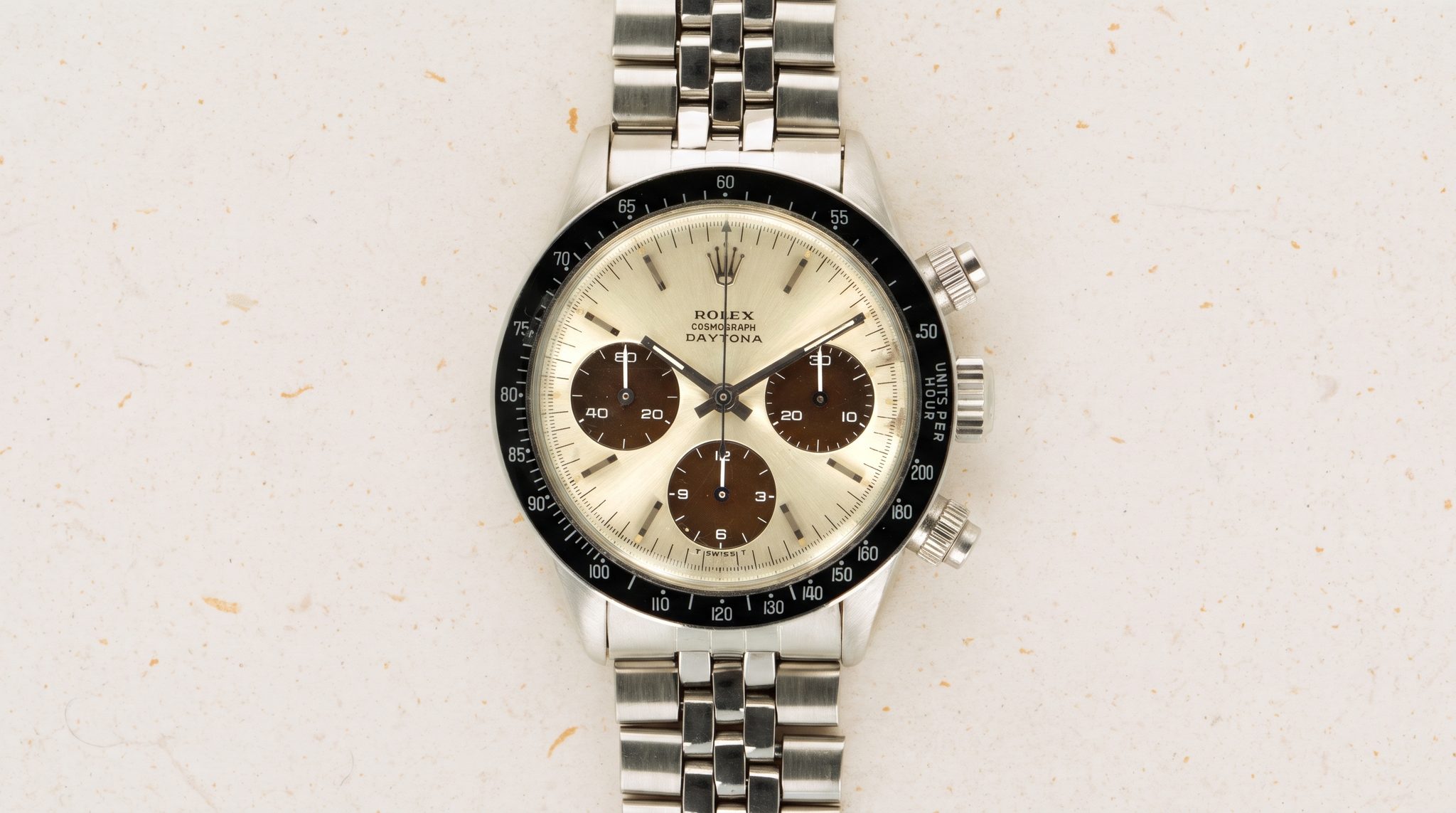
The Rolex Cosmograph Daytona 6240 is the short-run experiment that turned the Daytona into an Oyster chronograph, introducing screw-down pushers and the black acrylic tachymeter bezel that defined what came next.
- Production
- c. 1965–1969
- Case
- Stainless steel
- Diameter
- ~37 mm
- Lug width
- 20 mm
- Bezel
- Black acrylic tachy
- Crystal
- Acrylic
- Pushers
- Screw-down (Oyster)
- Movement
- 72B → 722 → 722-1
- Power
- ~48h
- Frequency
- 18,000 vph
- Dial
- Standard or exotic
- Scale
- Bezel tachymeter (200)
The Rolex Cosmograph Daytona 6240 was produced from about 1965 to 1969.
The Rolex Cosmograph Daytona 6240 is the Daytona caught in the act of becoming waterproof: a short, circa 1965–1969 experiment whose defining move was to replace pump pushers with screw-down pushers while keeping the familiar hand-wound, Valjoux 72-based architecture. The detail collectors repeat is simple and physical. The reference pairs those first screw-down chronograph pushers with a black acrylic tachymeter insert calibrated to 200 units per hour, a combination that immediately separates it from the metal-bezel, pump-pusher 6239 it ran alongside.
That mix of continuity and disruption is the point of the 6240. Mechanically it stays within the same movement family as the earliest Daytonas, progressing through 72B, then 722, then 722-1 across its short life. Visually and functionally, it is where Rolex tests what an “Oyster” chronograph should look like and how it should be sealed. Some early watches even appear with non-Oyster dials borrowed from ref. 6239, including the small “floating” Daytona signature better known from the pump-pusher era. Later examples introduce dials that actually print “Oyster” into the Rolex Cosmograph signature, making the idea explicit.
Because Rolex never published month-by-month production documentation for this reference, most fine dating rests on the way independent traits overlap. Pusher style changes on its own schedule, dial text evolves on another, and movement designations shift again, with the transitions reconstructed from surviving examples and serial ranges rather than from an archival bulletin. That is why the 6240 has become a collector’s reference point: it is a four-year run where tiny typographic choices and small pieces of hardware carry more historical weight than they would in a decades-long model.
It also explains why the same reference can feel like two watches. At one extreme is an early 6240 with ribbed “Millerighe” screw-down pushers and a non-Oyster dial, essentially a 6239 face fitted to a new, sealed case. At the other is a later 6240 with the “ROLEX OYSTER COSMOGRAPH” signature that reads like a direct prologue to the long-running screw-down 6263 and 6265 generation. Between them sit the rare “Solo” dials that omit both “Daytona” and “Oyster,” and the exceptionally scarce Paul Newman (exotic) dials that specialist research places in a very tight window around 1967. For anyone looking for a Cosmograph Daytona 6240 review that explains why the reference matters, that tension is the story: the 6240 is not the first Daytona, it is the first one trying to be an Oyster tool watch.
“Ref. 6240 is the Daytona in transition: the first screw-down-pusher case, and a dial story that shows Rolex working out what “Oyster Cosmograph” would mean.”
Rolex Cosmograph Daytona 6240 production years: c. 1965–1969
The 6240’s short life is best understood as Rolex testing a sealed chronograph in real time. Around 1965 the reference appears as a steel Cosmograph Daytona that looks familiar at a glance, three registers, acrylic crystal, tachymeter on the bezel, but feels different when you handle it. The chronograph pushers no longer sit as simple pump tubes. They screw down, like the crown, turning the case into the first Daytona designed around the Oyster idea.
Early examples underline how transitional the project was. Christie’s and Phillips document watches with non-Oyster dials, including small “floating Daytona” dials associated with ref. 6239, fitted into the new screw-down case. The reason Rolex did this is not documented in factory material, but auction scholarship consistently reads it as pragmatic reuse of existing dial stock while the new configuration was being introduced.
Hardware evolves quickly. The earliest screw-down pushers are the ribbed “Millerighe” type, with fine vertical grooves that catch the light around the pusher cap. A specialist guide places these in an early serial band and notes that from roughly mid-1966 the pushers shift to a smooth cylindrical form. This change is independent of dial text, which is why a correct 6240 can pair early or later pushers with different dial layouts.
Meanwhile the movements progress within the same Valjoux 72-based family. Millenary documents 72B confined to 1965, then 722 through most of the run, followed by 722-1 in the last circa two years. These are refinements rather than reinventions, improvements in balance, shock protection, and regulation rather than a new complication or display.
The dial story is where the reference’s identity is most debated and most collectible. Hodinkee notes that many mid-serial examples are best known for omitting both “Oyster” and “Daytona,” the so-called “Solo” look, with T SWISS T at 6. Later, examples appear with “ROLEX OYSTER COSMOGRAPH” on the top line, aligning the wording with the screw-down hardware. Sigma-signed dials have been observed on some 6240s, but they sit in a less accepted category, largely because sigma is associated with the early 1970s while 6240 production is generally placed in the 1965–1969 band.
One zoomed-out truth emerges from all of this: the Daytona that now reads as a fixed template was still being assembled as a concept in the mid-1960s. The 6240 captures that moment, when the same reference can carry leftover pump-pusher-era dial language, prototype-like pushers, and a late-run Oyster signature, all while staying within a four-year arc that ends as the 6263 and 6265 generation takes over.
- c. 1965Reference beginsScrew-down pushers, acrylic bezel
- 196572B period72B/72B-style markings
- c. 1966Pusher changeRibbed vs smooth pusher caps
- c. 1967Exotic windowExotic dial graphics
- c. 1968 – 1969722-1 late722-1 signed movement
- c. 1969Reference endsLater serial-era examples
6240 against its neighbours
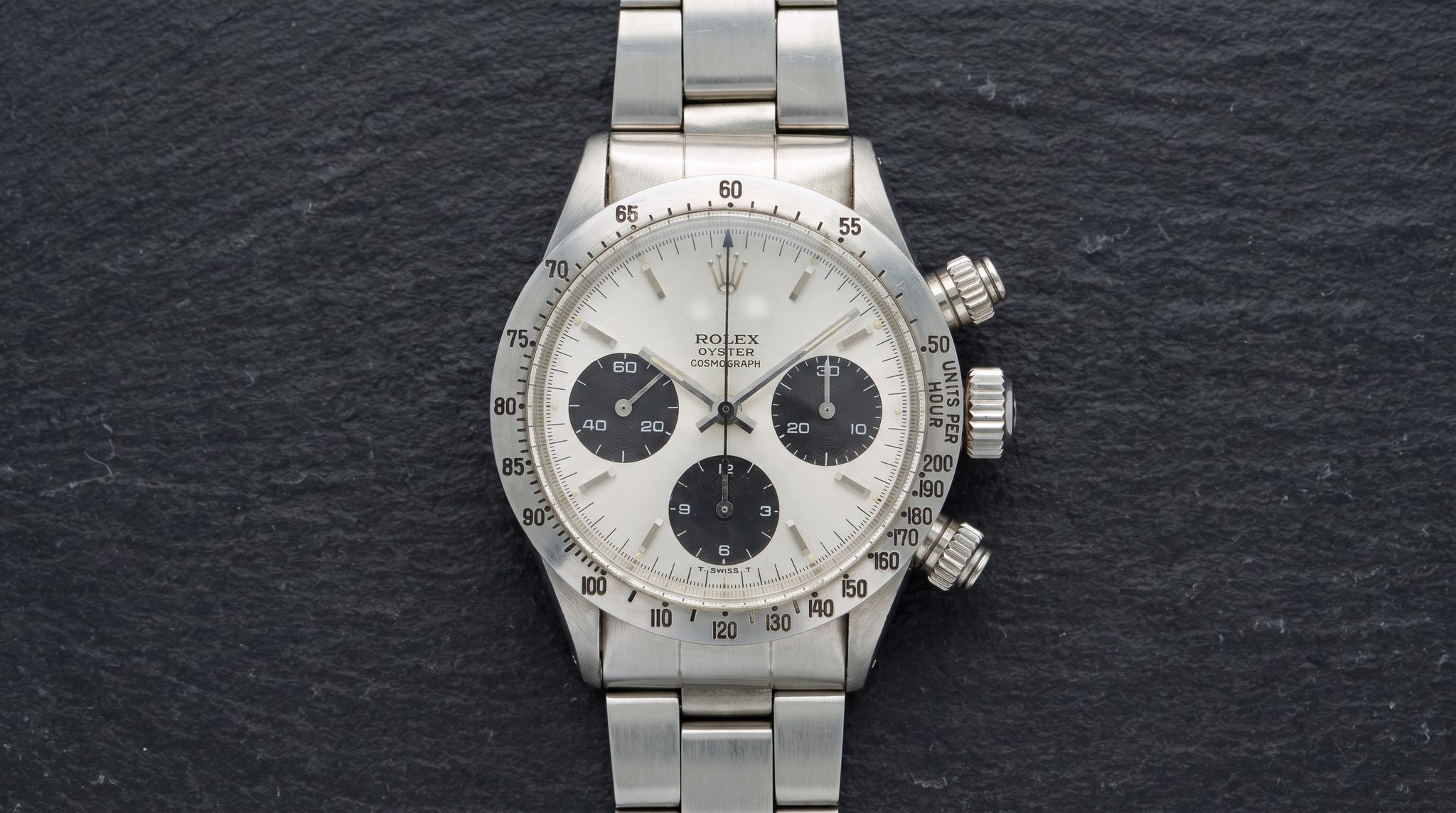
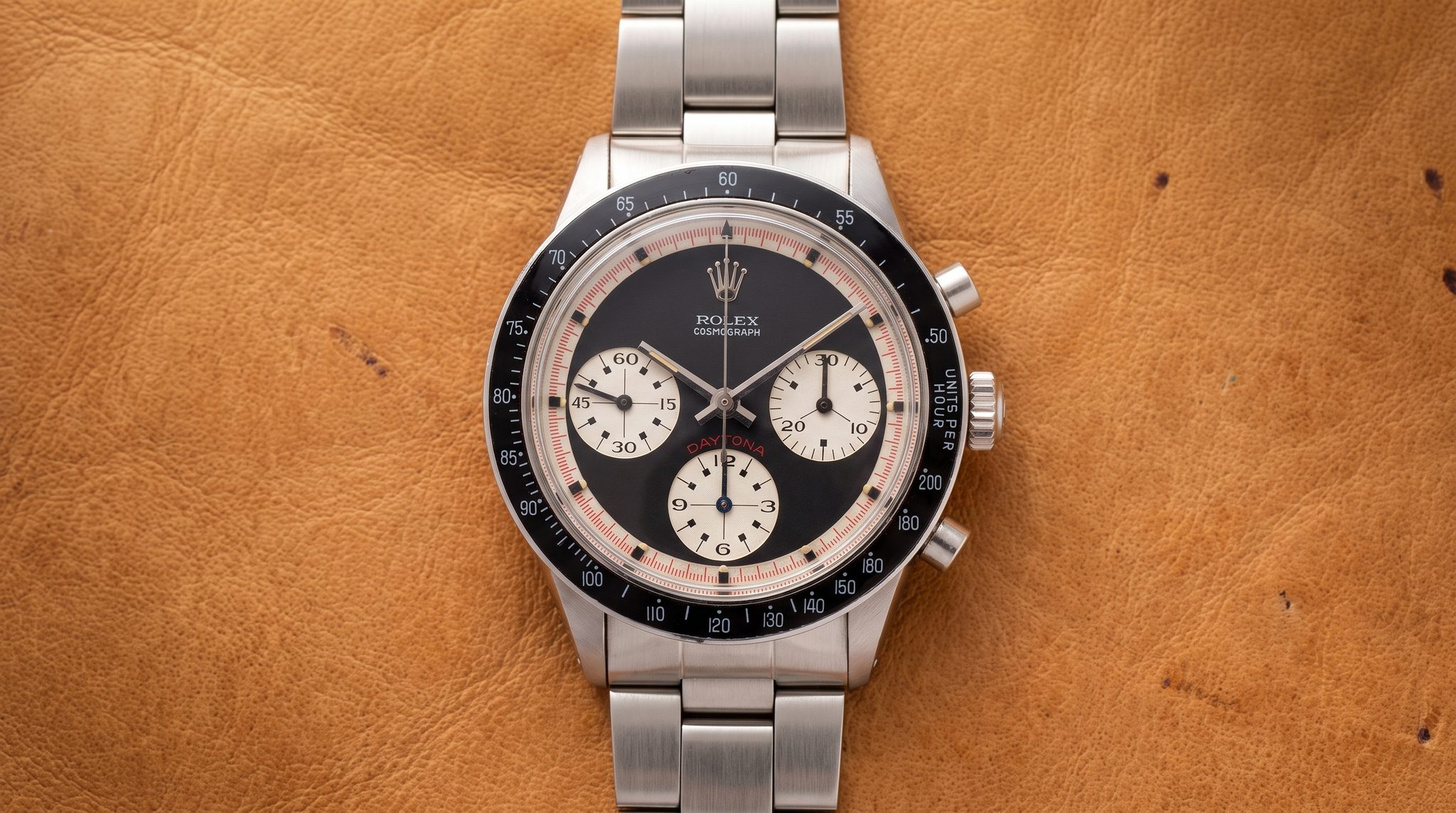
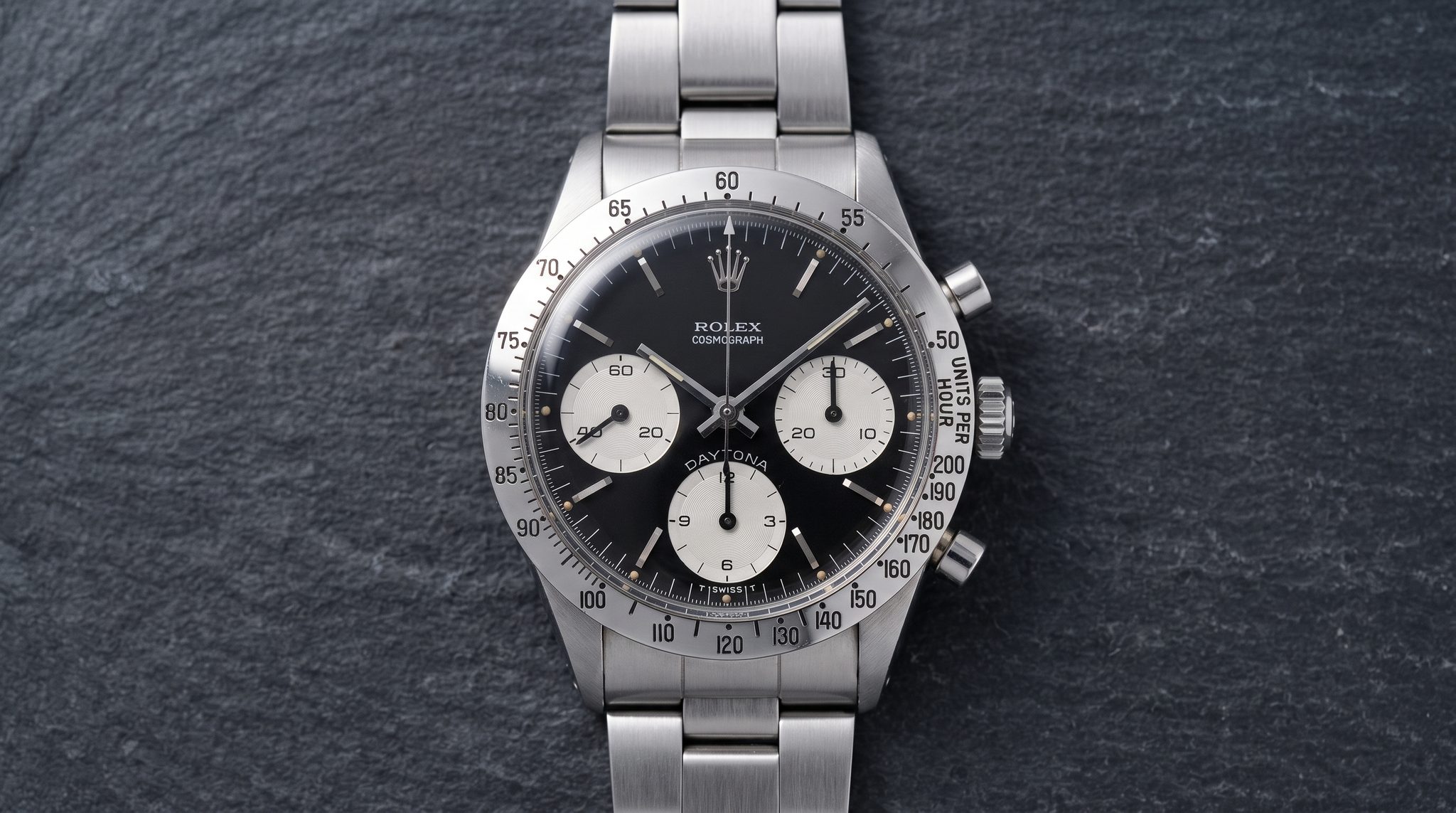
Ref. 6240 only makes sense when it is framed by the two watches it overlaps and the one it foreshadows. Ref. 6239 shows the original pump-pusher, metal-bezel Daytona that 6240 did not replace so much as challenge. Ref. 6241 is the near-twin in look, the same black acrylic bezel idea but kept on pump pushers. Ref. 6263 is the long-form answer to the 6240 experiment, carrying the screw-down, black-bezel formula forward for years rather than seasons.
This reference 6240 Rolex · focal c. 1965–1969 | ||||
|---|---|---|---|---|
| Production | c. 1963–1969 | c. 1965–1969 | c. 1966–1969 | 1971–c. 1987/88 |
| Case | Steel (also gold) | Stainless steel | Steel or yellow gold | Stainless steel / 14k / 18k |
| Diameter | ~36 mm | ~37 mm | ~36.5–37.5 mm | 37 mm |
| Bezel | Engraved tachymeter | Black acrylic tachy | Black acrylic tachymeter | Black acrylic tachy |
| Crystal | Acrylic | Acrylic | Acrylic | Box acrylic |
| Pushers | Pump (non screw-down) | Screw-down (Oyster) | Pump (non screw-down) | Screw-down |
| Movement | Cal. 72B → 722 → 722-1 | 72B → 722 → 722-1 | Cal. 722 or 722-1 | Cal. 727 (manual) |
| Dial | Standard or exotic | Standard or exotic | Standard or exotic | Standard or exotic |
Eight dial generations across the run
The earliest 6240s are defined as much by their hardware as by their dial. The screw-down pusher caps show fine vertical grooves, the “Millerighe” texture, making them look like miniature crown knurling. A specialist guide places these first-generation pushers in an early serial band and treats them as a first-batch trait, before Rolex moves to a simpler smooth cap. Because pushers can be replaced in service, the key is the feel and look: crisp, evenly spaced ribs rather than a smooth cylinder.
What to check before buying a 6240
Buying a Rolex 6240 is less about finding a clean example than finding a coherent one, because so many valuable components can be swapped: pushers, bezel insert, and dials all trade independently of the case. The reference’s short c. 1965–1969 run means even small mismatches can move a watch from convincing to compromised. The safest purchases are those whose dial generation, pusher type, and movement designation make sense together for the mid-to-late 1960s, and whose most fragile parts, especially the acrylic bezel, have not been replaced.
Living with a correct 6240 is the pleasure of a purposeful 1960s chronograph that still wears compact at around 37 mm, yet feels unusually engineered for its era because every control screws down. It is the Daytona that rewards looking closely, not because it hides secrets, but because it documents Rolex’s own learning curve in steel, acrylic, and ink.
Rolex Cosmograph Daytona 6240 price and value
A Rolex Cosmograph Daytona 6240 sells for about $85,000 at the median, typically $80,000 to $375,000 across 6 comparable sales.
Rolex Cosmograph Daytona 6240 for sale
Indicative figures from recent dealer, auction, and Grey Market sales (updated this week). Every watch is verified before it sells here.
Each point is a recent dealer or auction sale, banded to an indicative figure. The range shown is not a valuation.
Adjacent in the Cosmograph Daytona family
Common questions about the 6240
The Rolex Cosmograph Daytona 6240 was produced from about 1965 to 1969. Rolex did not publish a formal start and end date for the reference, so finer cutoffs are reconstructed from serial ranges and surviving examples.
- Phillips: A Round-Up of 14 Manual-Wind Rolex Daytonasphillips.com
- Christie’s lot essay: Rolex Cosmograph ref. 6240 “floating small daytona”, circa 1966christies.com
- Hodinkee: Reference Points, Understanding the Rolex (Non-Paul Newman) Daytonahodinkee.com
Show 7 more
- Monochrome: The History of the Rolex Daytonamonochrome-watches.com
- Rolexopedia: Reference 6240rolexopedia.net
- 41Watch: The complete history of the Rolex Daytona41watch.com
- Millenary Watches: Rolex Daytona Movement overview (72B, 722, 722-1 for 6240)millenarywatches.com
- WatchProSite: The History of the Rolex Cosmograph part II, screw down pusherswatchprosite.com
- Wind Vintage: Collector’s Guide to the Seven Different Paul Newman Daytona Referenceswindvintage.com
- timeXchange: Rolex Daytona Prototype “small Daytona” ref. 6240timexchange.com