

Rolex Cosmograph Daytona 6265
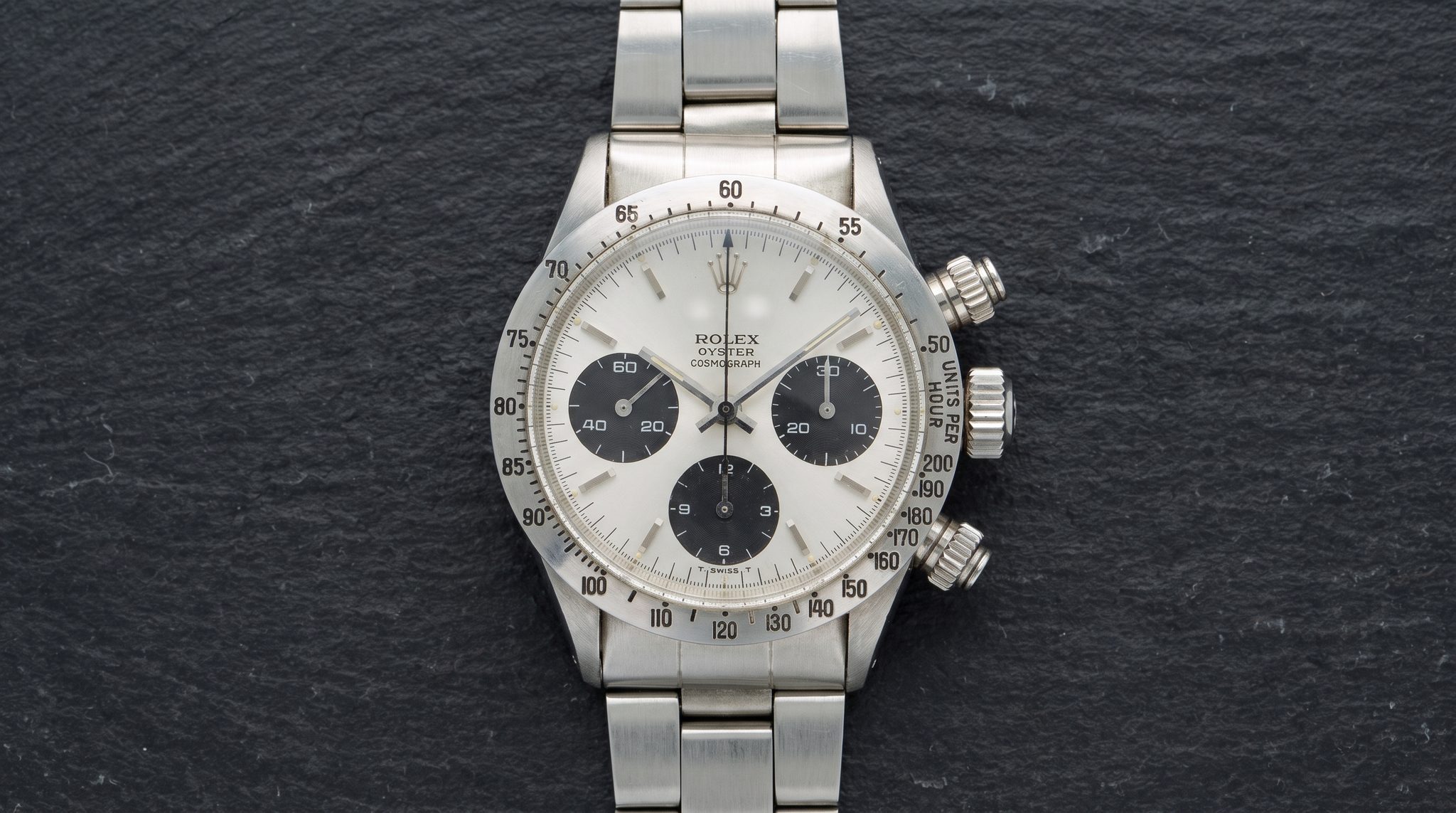
The Rolex 6265 is the long-running manual-wind Oyster Daytona whose mechanics stay constant while dial text, sigma marks, bracelets, and service-era replacements do most of the visible evolving.
- Production
- c. 1971–1987/88
- Case
- Steel or yellow gold
- Diameter
- ~37–37.5 mm
- Lug width
- 19 mm
- Bezel
- Engraved metal tachy
- Crystal
- Acrylic
- Pushers
- Screw-down (Oyster)
- Water resist
- c. 100 m (nominal)
- Movement
- Rolex Cal. 727
- Power res
- ~45–48h
- Chronometer
- Typically gold only
- Lume
- Tritium (T SWISS T)
The Rolex 6265 is the manual-wind Daytona that stayed mechanically fixed long enough for its dials to become the story. The proof is inside the case: throughout its widely cited c. 1971–1987/88 run, the reference is consistently described with the same Rolex caliber 727, a Valjoux 72-based column-wheel chronograph upgraded to 21,600 vph, while the watch in hand changes its “voice” through ROC text, red Daytona signatures, Big Red prints, sigma marks, and later service-era replacements.
What makes the Cosmograph Daytona 6265 easy to recognize is also what makes it easy to misunderstand. It is an Oyster Daytona, with a screw-down crown and screw-down pushers, and it is defined against its closest sibling by its bezel: the 6265 wears an engraved metal tachymeter bezel, where the otherwise near-identical 6263 carries a black acrylic insert. That stable case-and-movement identity is why collectors focus so intensely on the parts Rolex did swap over time, especially the dial printing at 6 o’clock and the small codes flanking “T SWISS T.”
Because Rolex did not publish a fully granular by-year archive for vintage references, the 6265’s production years and dial cutoffs are best treated as approximations rather than hard borders. In practice, the reference rewards a more observational approach: identify the watch first by its fixed architecture, then date it by the independent cues that survive on the surface, from the presence or absence of “Daytona,” to the size and placement of that red line, to whether the dial quietly announces sigma construction.
“A constant-caliber, screw-down Oyster Daytona where the dial details do the dating, and the wrong replacement parts can rewrite the watch.”
6265 across c. 1971–1987/88
Reference 6265 appears in the early 1970s as the screw-down “Oyster” continuation of the manual-wind Cosmograph line, a functional step away from pump-pusher predecessors such as 6262 and 6264. The defining hardware is straightforward to see: the pushers thread down like small caps, the crown is screw-down, and the crystal remains acrylic, while the tachymeter is engraved into a solid metal bezel rather than carried on a black acrylic insert as on the sister reference 6263.
Once that architecture is set, the timeline becomes less about mechanical change and more about what Rolex chose to print on the dial, and what later servicing might have replaced. Early examples can appear without the “Daytona” signature at all, using the “Rolex Oyster Cosmograph” layout often shortened to ROC. In parallel, the most collectible early detour is the Oyster Paul Newman, an exotic dial style defined by its stepped minute track, contrasting sub-registers, and distinctive numerals. Across the Oyster Paul Newman family, production is generally confined to the first several years and ends around 1974–1975.
From the mid-1970s onward, many 6265s are encountered with the larger red “DAYTONA” print associated with “Big Red” dials, and later still, collectors encounter “Floating Big Red” prints where the red word sits noticeably higher above the 6 o’clock register. The reasons for these printing shifts are not documented in the public record, but their visual effect is clear: the same watch can read quiet, clinical, or emphatic depending purely on typography.
One detail that cuts across those layouts is the sigma signature at 6 o’clock. Dials marked σ T SWISS T σ are understood to signal gold dial elements and tend to cluster in the early part of the reference’s life, with multiple sources placing their phase-out toward the end of the 1970s. Bracelet supply also moves with the era: steel examples are commonly seen on folded-link Oyster bracelets early (notably ref. 7835), with a transition to solid-link bracelets (such as 78350) around 1977.
Stepping back, the 6265’s appeal is the way a single, stable manual chronograph platform can be read like a historical record. The cal. 727, metal bezel, and screw-down Oyster case anchor the reference, while the fragile, replaceable surfaces of a working chronograph, dial, hands, pushers, bezel, bracelet, and even luminous material, are where time and service leave their signatures.
- c. 1971IntroducedScrew-down pushers, ref. 6265 back
- c. 1974 – 1975Newman fadesExotic dial with Art Deco subdials
- c. 1976Big Red eraOversized red DAYTONA above 6
- c. 1977Bracelet update7835 folded vs 78350 solid
- c. 1970sSigma wanesσ T SWISS T σ at 6
- c. 1987 – 1988DiscontinuedLast-series dials, late serials
6265 against its neighbours
The 6265 makes the most sense when framed by the two watches it is constantly confused with: the 6263, which shares the same screw-down Oyster formula but swaps the bezel to black acrylic, and the pump-pusher 6262, which previews the steel-bezel look without the full Oyster pusher configuration. The automatic 16520 generation then marks the clean break, replacing acrylic and manual winding with a modern architecture.
This reference 6265 Rolex · focal c. 1971–1987/88 | |||
|---|---|---|---|
| Production | 1970s–1980s | c. 1971–1987/88 | 1988–2000 |
| Diameter | 37 mm | ~37–37.5 mm | 40 mm |
| Bezel | Black acrylic insert | Engraved metal tachy | Fixed steel tachymeter |
| Crystal | Acrylic | Acrylic | Sapphire |
| Pushers | Screw-down (Oyster) | Screw-down (Oyster) | – |
| Movement | Rolex Cal. 727 | Rolex Cal. 727 | Automatic (Zenith-based) |
| Chronometer | – | Typically gold only | COSC |
| Lume | Tritium | Tritium (T SWISS T) | – |
Seven dial generations across the run
On a 6265, the Paul Newman dial is the easiest to spot from across a room because it refuses to look like a standard Daytona dial at all. The minute track is stepped, the sub-registers are in contrasting colors, and the numerals inside them have an Art Deco character that makes the watch feel more like graphic design than instrument.
Oyster Paul Newman dials across the 6263 and 6265 family are generally confined to the early screw-down years, with most published guides placing the phase-out around 1974–1975. On 6265 specifically, they are repeatedly described as rare and concentrated in early steel production. The practical takeaway is simple: if the watch has screw-down pushers and a metal bezel, an exotic dial is not just a style choice, it is an early-era configuration that deserves extra scrutiny for originality.
What to check before buying a 6265
A Cosmograph Daytona 6265 is bought on details that can be swapped, not on the reference number alone. Dials, hands, pushers, bezels, crowns, and bracelets are all serviceable parts, and the market prices originality aggressively, especially when the dial is the value driver.
The safest inspections are the simplest: confirm the reference-level identity first (screw-down pushers, metal tachymeter bezel, correct caseback stamping), then treat every visible component as something that can be period-correct, period-incorrect, or later service. When claims escalate from “Big Red” to “Paul Newman” or “special order,” the burden shifts to physical tells and credible documentation.
Living with a 6265 is living with a compact vintage chronograph that wears smaller than modern Daytona generations. At roughly 37–37.5 mm with 19 mm lugs and an acrylic crystal, it remains a watch sized for daily use, but it is one whose value is preserved by restraint: careful servicing, minimal polishing, and a preference for honest aging over cosmetic “improvement.”
Rolex Cosmograph Daytona 6265 for sale
Indicative market value from recent dealer, auction, and Grey Market sales: median ≈ $72,000, with a typical $54,000–$85,000 range across 58 comparable sales (updated this week).
Each point is a recent dealer or auction sale, banded to an indicative figure. The range shown is not a valuation.
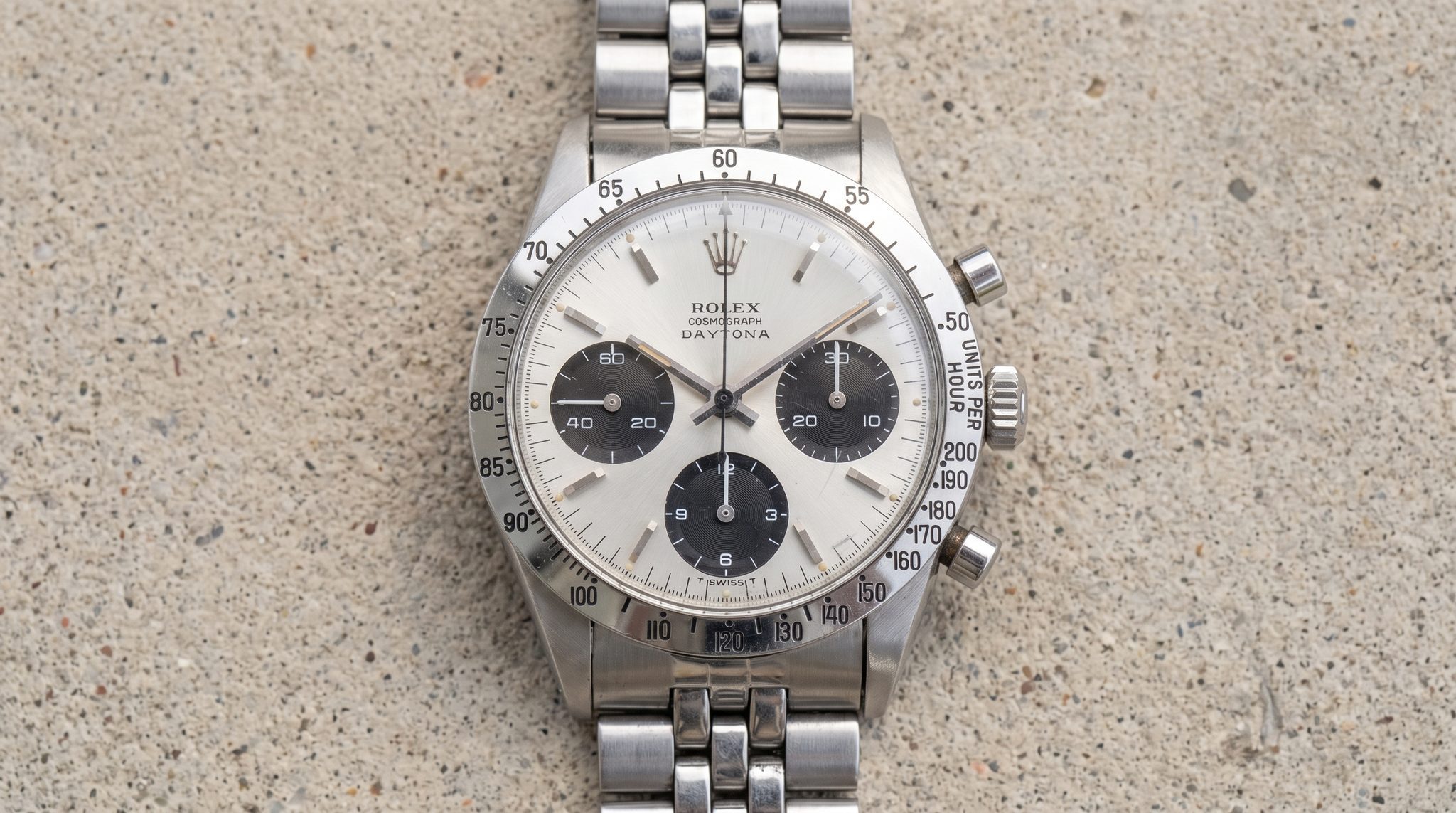
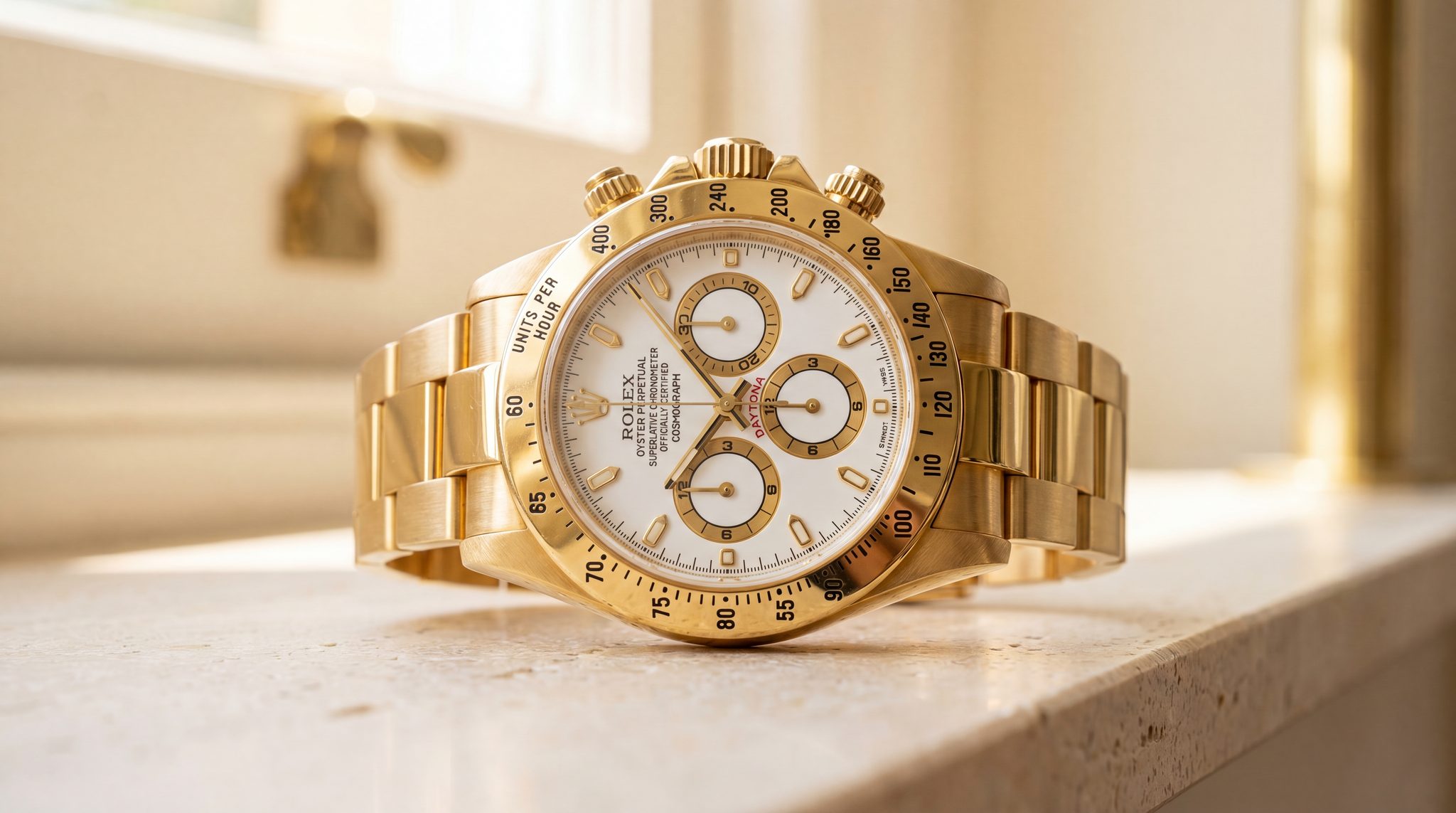
Adjacent in the Cosmograph Daytona family
Common questions about the 6265
Most specialist and dealer-oriented sources place Rolex Cosmograph Daytona 6265 production at approximately 1971 to 1987 or 1988, with some noting that remaining inventory shipped into early 1989. Rolex did not publish a fully granular by-year archive for the reference, so these are best treated as approximate ranges rather than hard cutoffs.
- In-Depth: Collecting The Rolex Daytona Oyster Paul Newmanhodinkee.com
- Technical review of Rolex Daytona 6265 Big Red41watch.com
- Rolex 6265-001: Daytona 6265 Stainless Steel / Silver / Big Redwatchbase.com
Show 7 more
- The Daytona 6263 / 6265 Era: Manual-Wind Rolexwristbuzz.com
- Rolex Daytona 6265 Review: Hands-On, Specs & Valuewatchguys.com
- Vintage Gold Rolex Cosmograph Daytona 6265bobswatches.com
- 7 Shots at the Rare Gold Daytona 6265bobswatches.com
- The Sigma Dial Reference 6265 Rolex Daytonabobswatches.com
- Technical Analysis of the 6263/6265 Dials with Small Daytona Writingandreapiccinini.com
- The complete history of the Rolex Daytona41watch.com