

Patek Philippe Perpetual Calendar 2499
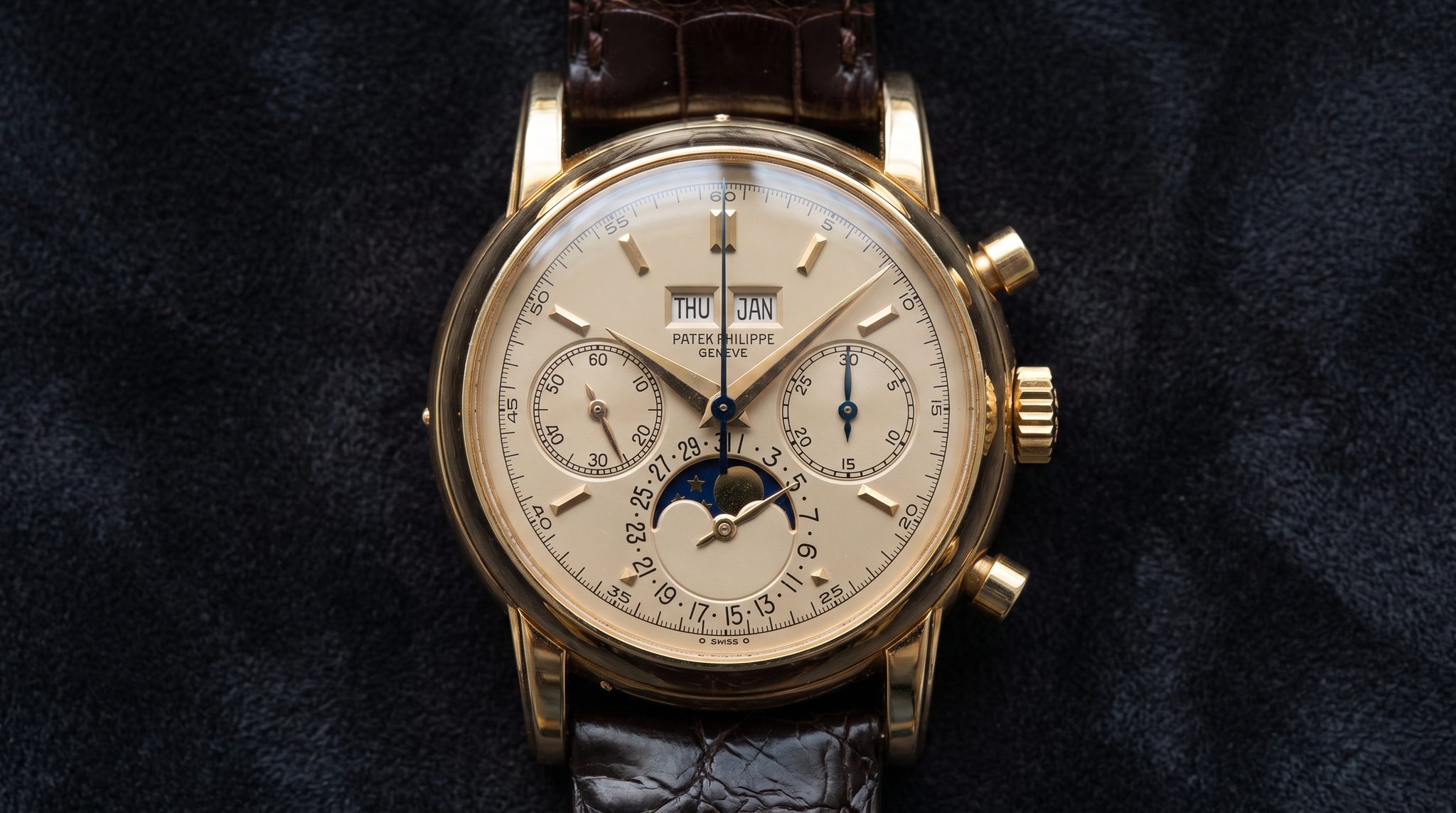
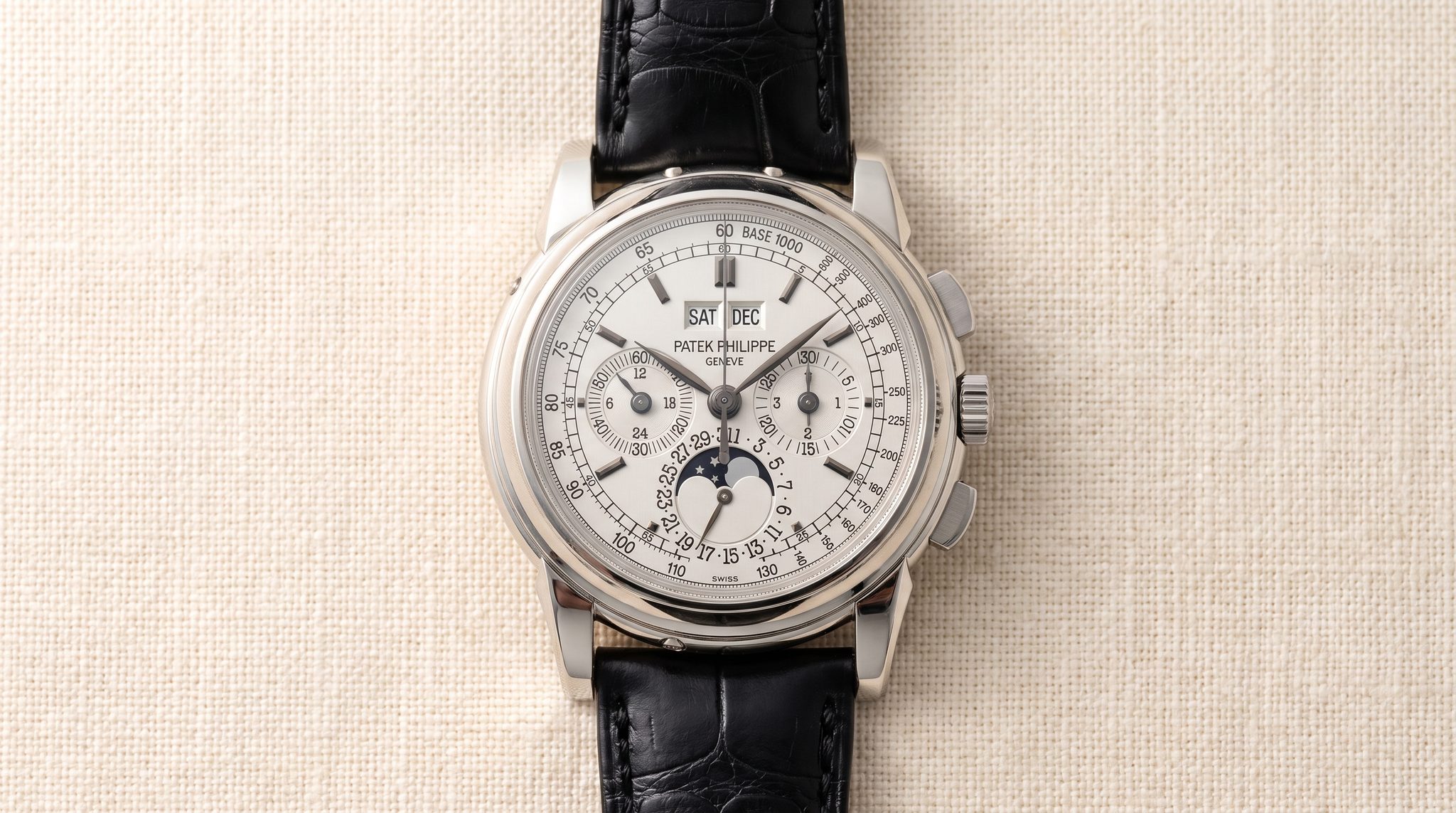
The Patek Philippe 2499 is the perpetual calendar chronograph that stayed in the catalog for roughly 35 years yet never settled into a single “correct” look, a reference whose identity is built from overlapping case and dial eras rather than one fixed specification.
- Production
- 1951–c. 1985/86
- Case
- 18k gold; rare Pt
- Diameter
- ~36–37.7 mm
- Crystal
- Acrylic → sapphire
- Pushers
- Square → round
- Dial
- Tachy → seconds track
- Movement
- Cal. 13''' / 13-130 Q
- Winding
- Manual
- Jewels
- 23
- Complications
- QP + chronograph
- Moonphase
- Yes
- Chronograph
- Column-wheel
The Patek Philippe 2499 is the rare kind of “standard” that never became standardized: across roughly 34 to 35 years it kept the same Valjoux-based, hand-wound perpetual calendar chronograph movement, yet its outward identity is a mosaic of overlapping case makers, pusher shapes, dial scales, and dial-making techniques. The headline number that makes collectors sit up is the oft-cited total of about 349 examples for the entire run, a scale so small that every visible detail becomes consequential.
Introduced in 1951 as the successor to reference 1518, the 2499 carried forward the same basic architecture, a column-wheel chronograph base finished by Patek Philippe and adapted into caliber 13''' / 13-130 Q with a perpetual calendar and moon-phase. Its dial is dense but legible in the way only mid-century Patek seems to manage: day and month in twin apertures at 12, a moon-phase at 6 framed by a pointer date, and the chronograph’s two registers balanced at 3 and 9.
What makes the 2499 a distinct collecting universe is that its key traits do not move in lockstep. Square pushers belong to first-series watches, but the tachymeter scale survives into the second series after pushers go round. Arabic numerals dominate early production, yet baton markers appear alongside them during the second series before becoming baton-only from the third series onward. Even the way the dial itself was made changes on a different schedule: engraved, hard-enamel dials are associated with earlier production, while printed dials become common from the 1970s onward. The result is a reference that teaches the eye: not to memorize one “correct” 2499, but to read each component as its own clue.
The end of the story is as softly edged as the beginning. Auction catalogues often anchor production at 1951–1985, while editorial histories sometimes extend it to around 1986, aligning the switchover to the 3970. That hazy finish is fitting. By the time Patek introduced the smaller 36 mm reference 3970 in 1986 with a Lemania-based caliber 27-70 Q, the 2499 had already shown what the lineage could be: a grand complication worn daily, executed in so few pieces that evolution was visible not as a clean redesign, but as a slow layering of choices.
“The 2499 is not one watch but a small population of watches: the same movement and complications, then four series of case and dial choices that overlap in time and make every detail matter.”
2499 across 1951–c. 1985/86
Reference 2499 begins in 1951 as Patek Philippe’s second-generation perpetual calendar chronograph wristwatch, replacing the pioneering 1518 while keeping the same essential engine, a Valjoux-derived, column-wheel chronograph movement finished by Patek and adapted into the perpetual calendar configuration known as 13''' / 13-130 Q. The reason collectors can meaningfully divide the 2499 into “series” is not a movement evolution, at least not one documented in the public auction literature, but a sequence of visible exterior decisions: case makers, pusher shapes, dial scales, and later, crystal type.
The earliest watches, the first series, are easiest to spot because of their square chronograph pushers and their period tachymeter scale, a perimeter that makes the dial feel busier and more overtly chronograph-forward. Some early cases were made by Vichet and are documented as slightly smaller, around 36 to 36.5 mm, with a flatter back and sharply downturned, claw-shaped lugs; later cases are often attributed to Wenger and settle into the better-known 37.5 mm profile with a bombé caseback. The record explains what changed, but not always why Patek used multiple case makers within the same reference.
The second series shows how the 2499’s traits can move independently. Pushers turn round, but the tachymeter remains, so a round-pusher 2499 can still look unmistakably 1950s. Hour markers also stop being a single answer: Arabic numerals and baton markers both exist during this period, and the change from Arabic to baton is not pinned to a single year in the published sources.
Around the start of the third series, the dial perimeter simplifies: the tachymeter disappears and an outer seconds track takes its place. At the same time, baton markers become the rule rather than one option. Then, later still, the dial’s manufacturing method begins to change on its own schedule. Sources describe early dials as engraved and hard-enamel, with scales cut into the metal and filled, while from the 1970s onward printed dials become common. It is one of the clearest examples of the 2499’s character: the watch did not “become” a new reference when techniques changed, it simply accumulated another datable layer.
The fourth series, often called 2499/100, brings the 2499 closest to the modern era, chiefly through sapphire crystal and, in many catalogued examples, a glazed display back, while keeping the same fundamental dial layout and complication set. One zoomed-out way to see the reference is this: over a mid-century lifespan that lasted into the 1980s, Patek kept the hardest part constant, the movement and the complication stack, and allowed almost everything a wearer touches or sees to evolve in small, overlapping steps. That is why the 2499 reads less like a single model and more like a long, careful conversation between a workshop, its suppliers, and an unusually demanding clientele.
By 1985, or around 1986 depending on how one defines the final catalog presence, the 2499 gives way to the reference 3970. The successor is smaller at about 36 mm and switches to a Lemania-based caliber 27-70 Q, a clear mechanical line in the sand after decades of Valjoux-derived continuity.
- 1951IntroducedDay/month windows at 12
- c. 1951 – 1960First seriesRectangular chrono pushers
- c. 1955 – 1964Second seriesRound pushers with tachy
- c. 1960 – 1978Third seriesClean perimeter seconds track
- c. 1970sDial makingScales printed, not engraved
- c. 1978 – 1985Fourth seriesSapphire crystal (2499/100)
- c. 1985/86Discontinued2499 exits catalog
2499 against its neighbours
The 2499 sits between two watches that clarify its appeal. The 1518 is the pioneering template, smaller and earlier, while the 3970 is the streamlined successor that shifts both case size and movement architecture. Put beside them, the 2499 reads as the long mid-century bridge: larger on the wrist than the 1518, mechanically continuous with it, and only finally displaced when Patek adopted a Lemania-based chronograph calibre for the modern era.
This reference 2499 Patek Philippe · focal 1951–c. 1985/86 | 5020 Later lineage cousin later 1990s | |||
|---|---|---|---|---|
| Production | c. 1941–c. 1954 | 1951–c. 1985/86 | 1986–2004 | later 1990s |
| Case | 18k gold; rare steel | 18k gold; rare Pt | 18k gold or Pt | – |
| Diameter | ~35 mm | ~36–37.7 mm | 36 mm | – |
| Crystal | – | Acrylic → sapphire | Sapphire | – |
| Movement | Valjoux-based Cal. 13 | Cal. 13''' / 13-130 Q | Cal. 27-70 Q | – |
| Winding | Manual | Manual | Manual | – |
| Jewels | 23 | 23 | – | – |
| Complications | QP + chronograph | QP + chronograph | QP + chronograph | QP + chronograph |
What to check before buying a 2499
Buying a Patek Philippe 2499 is less about finding “the” specification than about making sure the specification in front of you makes sense. The reference’s defining traits overlap, so it is possible for an example to look plausible at first glance yet be wrong in the details, especially when a service dial has erased an earlier tachymeter layout or swapped period typography for later printing.
The market has made its priorities unusually clear. A service dial can cost more than half the value of an otherwise comparable watch, crisp and unpolished lug geometry can add a documented 20 to 50 percent premium, and full documentation including an archive extract can add another 15 to 30 percent. In other words, the things that are easiest to lose over decades of ownership, the original dial, the sharp case, the papers, are the things buyers now pay to keep.
Living with a 2499 is living with a grand complication that was sized to be worn. Most examples are catalogued around 37.5 mm, meaning it wears more modern than its era suggests, while the earliest Vichet cases sit closer to 36 to 36.5 mm and feel more purely 1950s. Either way, the attraction is the same: a watch made in tiny numbers, with a format Patek refined slowly enough that time left visible seams, seams that an attentive owner can still learn to read.
Patek Philippe Perpetual Calendar 2499 for sale
Auctions on Grey Market run on seven-day cycles, every watch verified before it sells. Browse what's live now, or consign your 2499.
Adjacent in the Perpetual Calendar family
Common questions about the 2499
Reference 2499 is documented as introduced in 1951. Its end is usually cited as 1985 in auction catalogues, while some editorial histories extend its catalog presence to around 1986, aligning the transition to ref. 3970. A precise final cut-off within 1985–1986 is not consistently published.
- Phillips | Patek Philippe ref. 2499, The Geneva Watch Auction: FIVE (lot essay)phillips.com
- Sotheby’s | Patek Philippe ref. 2499 first series with Vichet case, made in 1951 (catalogue entry)sothebys.com
- Phillips | Patek Philippe, Winning Icons: Legendary Watches of the 20th Century (ref. 2499 context)phillips.com
Show 7 more
- Hodinkee | History of the Patek Philippe 3970 (2499 predecessor and timeline context)hodinkee.com
- Borro | The Patek Philippe Reference 2499: master guide (series overview and lineage)borro.com
- Hautetime | Patek Philippe Perpetual Calendar Chronograph ref. 2499 overviewhautetime.com
- Collectors Square | Patek Philippe ref. 2499 listing (movement and configuration description)collectorsquare.com
- SJX Watches | Geneva Auctions Fall 2024 (2499 pricing commentary examples)watchesbysjx.com
- Forbes | Auction: A Very Special Patek Philippe 2499 Tops $3.5 Million (high-end result context)forbes.com
- Italian Watch Spotter | Patek Philippe ref. 2499 guide (engraved vs printed dial discussion)italianwatchspotter.com