

Patek Philippe Perpetual Calendar 3970
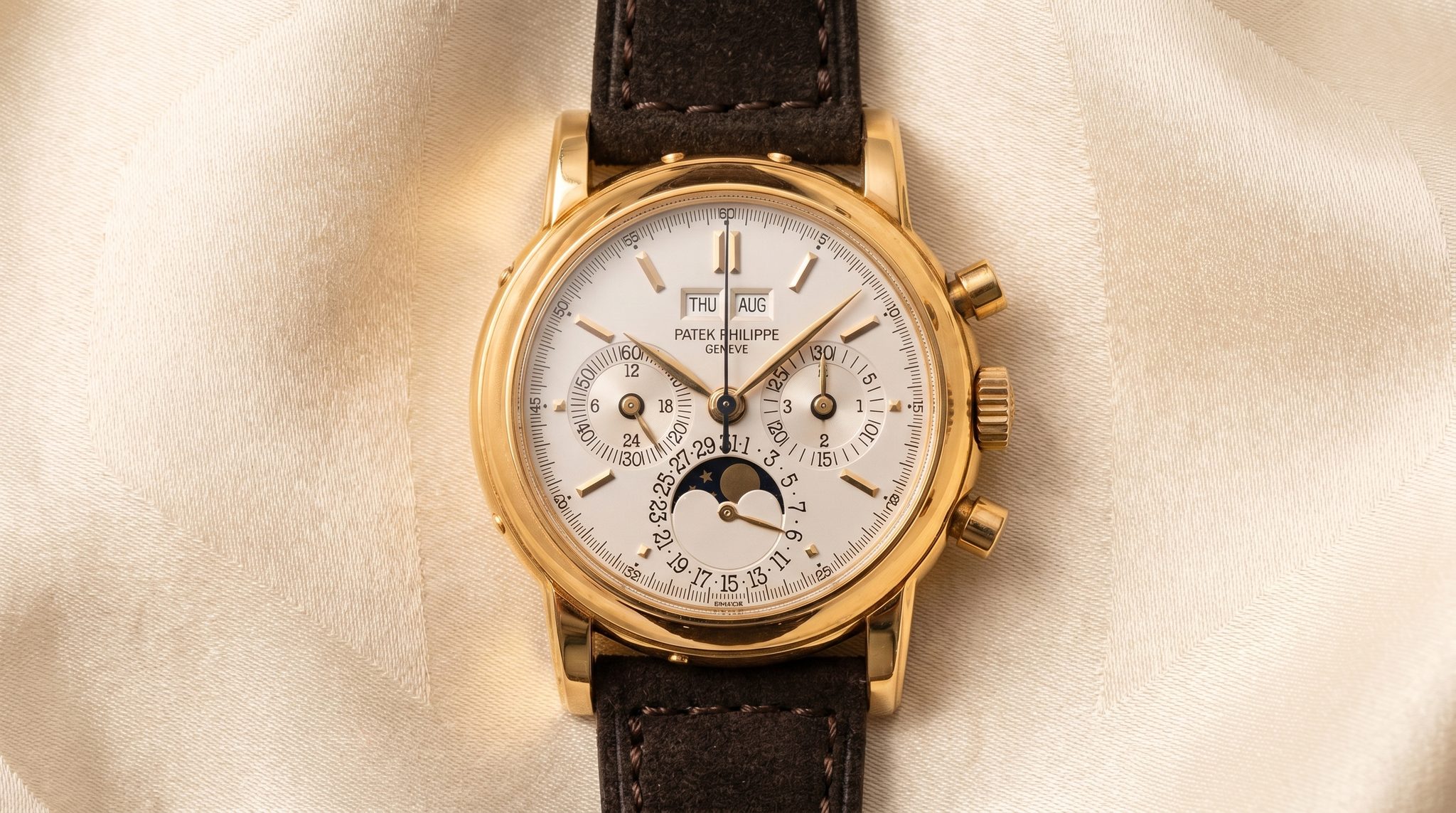
The ref. 3970 is Patek Philippe’s long-running reset of the perpetual calendar chronograph, a 36 mm, Lemania-based classic defined by a handful of early caseback and dial-furniture tells that collectors can still read at a glance.
- Production
- 1986–2004
- Case
- 18k gold or platinum
- Diameter
- 36 mm
- Crystal
- Sapphire
- Back
- Solid, sapphire, or both
- Water res.
- 2.5 ATM
- Bezel
- Smooth
- Movement
- Cal. CH 27-70 Q
- Winding
- Manual
- Power res.
- 60h
- Complications
- QP + chronograph
The ref. 3970 is the Patek perpetual calendar chronograph that stopped trying to be rare and started trying to be repeatable, and it did it by running for 18 years while barely changing its face. The easiest proof is physical: the earliest examples are defined by caseback policy as much as by design, with a tiny first run of about 100 pieces in yellow gold, and the series that follows is identified by the unusual “double-back” delivery of a solid back fitted to the watch and an extra sapphire back supplied loose.
Introduced in 1986 to replace the ref. 2499 at the end of the Valjoux era, the 3970 anchored the line around a new movement, Patek Philippe’s CH 27-70 Q, a deeply reworked Lemania 2310-based, column-wheel, lateral-clutch chronograph paired with a perpetual calendar. It also modernized the information shown on the dial for this lineage, adding a leap-year indication and a 24-hour display that earlier perpetual calendar chronographs in the family did not have. The result is a watch that reads like an old Patek from across a room, but dates like a modern reference once you know where to look: the caseback arrangement, the hand shape, the marker geometry, and (late in the run) small delivery cues such as the deployant clasp.
Collectors care about the Patek Philippe 3970 for a specific reason that survives fashion cycles. It is the bridge between two worlds, the last generation before the line grew to 40 mm with the ref. 5970, and the first perpetual calendar chronograph from Patek to leave Valjoux behind for a Lemania-based architecture that would define the next decades of the complication.
“A 36 mm perpetual calendar chronograph that ran for 18 years, and still lets you date it by what is on the back and what your eye catches first on the dial.”
3970 across 1986–2004
Ref. 3970 begins in 1986 as the direct replacement for the ref. 2499, closing one chapter of Patek perpetual calendar chronographs and opening another with the CH 27-70 Q. The shift is mechanical as much as historical: where the 1518 and 2499 family is tied to Valjoux ébauches, the 3970 is built around a Lemania 2310-based, manually wound, column-wheel chronograph that Patek modified and finished to Geneva Seal standards.
The reference’s early collecting vocabulary is shaped less by radical redesign than by packaging and small, datable details. The first series is remembered for its scarcity and its constraint: approximately 100 pieces, only in yellow gold, and defined by a solid-back configuration. Soon after, the watch enters the period most people picture when they hear “early 3970,” the era of feuille (leaf) hands and stick markers, but now with the distinctive double-back delivery that gives you two personalities in one watch: a closed back for a pure dress profile, and a sapphire back that reveals the movement.
Around 1989/1990 the visual language becomes more contemporary. The leaf hands give way to baton hands, and the hour markers sharpen into pointed batons, changes that are independent of the caseback approach, which remains the double-back format. In the mid-1990s, the fourth series begins not because the watch suddenly looks different from the front, but because case and movement serials jump into a new range and delivery shifts toward a deployant clasp. It is an unusual kind of evolution: a reference that stays stable enough to feel timeless, yet changes just enough that careful eyes can still place an example within Patek’s late twentieth-century timeline.
Viewed at arm’s length, the 3970 can look like a single, continuous idea from 1986 to 2004. Up close, it is more like a controlled experiment in how little Patek needed to change to move from the end of the handmade-vintage era into a modern production rhythm, without abandoning the proportions that made the complication wearable in the first place.
- 1986Introduced36 mm case, CH 27-70 Q
- c. 1986 – 1988First seriesSolid caseback only
- c. late 1980s – 1991Second seriesExtra sapphire back supplied
- c. 1989/1990 – 1995Third seriesNo leaf hands; sharper batons
- c. 1994/1995 – 2004Fourth seriesLooks like 3rd; later range
- 2004Discontinued40 mm successor launched
3970 against its neighbours
Ref. 3970 sits between two direct bookends in Patek’s perpetual calendar chronograph lineage, the ref. 2499 that preceded it and the ref. 5970 that followed it. Adding the ref. 3940 as a contemporary sibling clarifies what the 3970 uniquely is: not simply a perpetual calendar of the era, but the manual-wind chronograph version, built around the Lemania-based CH 27-70 Q family that carried the line forward.
This reference 3970 Patek Philippe · focal 1986–2004 | ||||
|---|---|---|---|---|
| Production | 1951–c. 1985/86 | 1985–2007 | 1986–2004 | 2004–2010 |
| Diameter | ~37.5 mm | 36 mm | 36 mm | 40 mm |
| Case | 18k gold, rare Pt | 18k gold or platinum | 18k gold or platinum | 18k gold or platinum |
| Movement | Valjoux-based | Cal. 240 Q | Cal. CH 27-70 Q | Cal. CH 27-70 Q |
| Winding | Manual | Automatic | Manual | Manual |
| Complications | QP + chronograph | Perpetual calendar | QP + chronograph | QP + chronograph |
Seven dial generations across the run
The first-series 3970 is the reference at its most constrained, and that constraint is exactly what makes it legible. Production is estimated at about 100 pieces and it is documented as yellow-gold only, but the trait that matters most in the hand is the caseback policy: these watches are defined by a solid-back configuration without the later extra sapphire back supplied as part of the set. On the dial side, the early aesthetic is often summarized as feuille (leaf) hour and minute hands paired with straightforward baton markers, a combination that reads softer and more traditional than later 3970s.
This is also the era when the 3970’s design shows its intent to look classical rather than busy. The day and month windows sit neatly at 12, the moon phase is nested inside the date register at 6, and the subdials carry the 24-hour and leap-year information that distinguishes the 3970 generation within Patek’s perpetual calendar chronograph family. The result is a watch that feels close in spirit to what it replaced, even though the movement inside marks a significant shift.
What to check before buying a 3970
Buying a Patek Philippe 3970 is less about hunting a single “right” configuration than about confirming that independent traits agree with each other. The reference spans multiple collector series, and the market pays meaningful premiums for early attributes like leaf hands and for scarce metals and special dials, so swapped parts and incorrect dials are the central risk.
Condition matters unusually much because the watch’s appeal is tied to crisp case geometry and to the correctness of small visual details. Add the mechanical reality that a perpetual calendar chronograph is complex, and a casual purchase can become expensive if the movement needs significant work or if service history introduced incorrect components.
The practical attraction of the 3970 is that it still wears like a dress watch despite being a flagship complication: a 36 mm case, a manual-wind movement with a documented 60-hour power reserve, and enough variation across the years to let collectors choose between closed-back discretion and display-back enjoyment. The best 3970s feel assembled by time rather than assembled later, with a series-correct front and a caseback set that matches the era.
Patek Philippe Perpetual Calendar 3970 for sale
Auctions on Grey Market run on seven-day cycles, every watch verified before it sells. Browse what's live now, or consign your 3970.
Adjacent in the Perpetual Calendar family
Common questions about the 3970
Patek Philippe produced the ref. 3970 from 1986 to 2004.
- A Collector's Guide to the Patek Philippe Perpetual Calendar Chronograph Ref. 3970phillips.com
- Why You Should Care About The Patek Philippe Reference 3970hodinkee.com
- The History of the Patek Philippe Perpetual Calendar Chronographmonochrome-watches.com
Show 7 more
- A collector's guide: The Patek Philippe 3970acollectedman.com
- Patek Philippe Perpetual Calendar Chronograph 3970Echrono24.com
- Grail Worthy: The Patek Philippe Perpetual Calendar Chronograph Reference 3970analogshift.com
- The Entire History of Patek Philippe's Perpetual Calendarsrevolutionwatch.com
- Patek Philippe Perpetual Chronograph 3970 Watchesessential-watches.com
- Hands-On With The Rare Patek Philippe 3970 Second Serieswatchesbysjx.com
- Patek Philippe Reference 3970EPwindvintage.com