

Patek Philippe Perpetual Calendar 5020
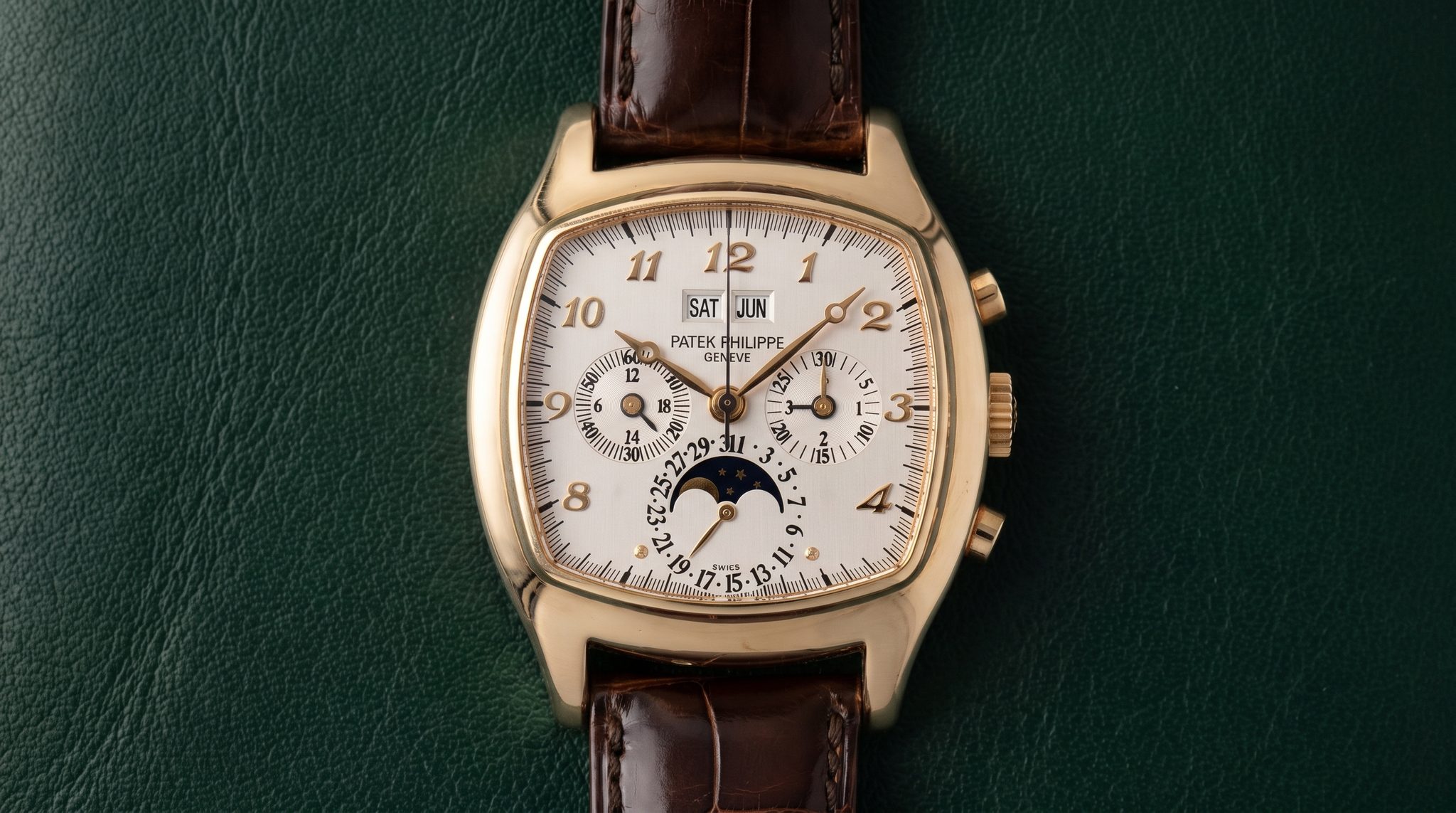
Patek Philippe’s Perpetual Calendar 5020 turned the standard Lemania chronograph into an eight-year shaped-case experiment.
- Production
- c. 1994/95–2002
- Case
- Gold or platinum
- Size
- ≈37 × 45 mm
- Shape
- Cushion, TV screen
- Case maker
- Atelier Réunis
- Caseback
- Solid or exhibition
- Movement
- Cal. CH 27-70 Q
- Winding
- Manual
- Jewels
- 24
- Complications
- QP + chronograph
- Metals
- J, R, G, P
The Patek Philippe Perpetual Calendar 5020 was produced from about 1994 to 2002.
The Patek Philippe Perpetual Calendar 5020 is the rare case in which Patek Philippe’s established complication became more radical without becoming mechanically different. Its cushion-shaped, TV-screen case measured about 37 by 45 mm, yet the watch carried the same Lemania-based Cal. CH 27-70 Q architecture as the round Ref. 3970. That contrast is the reason collectors care: the 5020 is not a new movement generation or a direct replacement, but an unusually brief alternative form for one of Patek’s central perpetual calendar chronographs. Standard production lasted only about eight years, from approximately 1994/95 to 2002, and specialist estimates place total output around 200 to 250 examples, although Patek Philippe never published a definitive production ledger.
The case was made for Patek Philippe by Atelier Réunis and appeared in yellow, pink, and white gold, as well as platinum. Its proportions are neither conventionally round nor conventionally rectangular. Seen on the wrist, the broad horizontal body and long overall length make the calendar and chronograph dial feel compressed into a television frame, while the manual-winding movement preserves the classical mechanical identity beneath it. The result is a reference whose singularity is visible before its movement is even examined.
The distinction between the 5020 and the mainline family is important. Ref. 3970 remained the round, continuing production reference and ran until 2004; Ref. 5970 then succeeded it in 2004. The 5020 occupied the interval as a parallel case version, sharing the complications and movement rather than replacing the 3970. Its platinum executions add a second layer of rarity, including silver dials with Breguet numerals and black dials with diamond markers, while unusual archive-documented combinations must be judged individually. A later movement in an earlier case can reflect special assembly or service history, not a separate standard movement generation. The 5020 is therefore best understood as a short-lived act of case design applied to a mature mechanical formula, and as a watch whose originality is inseparable from the configuration that left the factory.
“The 5020 changed the silhouette, not the formula, and made that familiar formula scarce enough to become a deep cut.”
Patek Philippe Perpetual Calendar 5020 production years: c. 1994/95–2002
The 5020’s chronology is less a sequence of movement generations than a record of a case experiment. Patek Philippe retained Cal. CH 27-70 Q, the manually wound Lemania-based architecture shared with Ref. 3970, because the reference’s purpose was to offer the same perpetual calendar chronograph in a different body. That is why the movement does not provide the dating ladder found in some other vintage references. On the watch, the broad cushion outline and long 45 mm axis are the first evidence of the 5020’s identity, while the movement confirms its place beside the 3970 rather than after it.
The metal range developed across the same approximate production span. Yellow, pink, and white gold formed the regular precious-metal field, with platinum examples occupying the rarest end of the reference. Platinum adds a separate dial story rather than a new case generation. A silver surface with Breguet numerals reads conventionally elegant against the unconventional case; a black dial with diamond markers makes the same geometry feel more severe. The documented public counts for these executions are tiny, but they describe known examples rather than a factory census, so they establish rarity without proving an absolute total.
One documented outlier clarifies why the 5020 must be assessed as a physical object, not by reference number alone. Christie’s describes a 5020J-016 with a case dating from 1994 and a movement dated 2010. The reason for that later assembly is not documented in the available record, but it should not be mistaken for evidence that regular production continued after 2002. The watch’s parts can tell a more complicated story than the reference’s official production window.
In roughly eight years, Patek Philippe produced a watch that looked like a new design language while leaving the underlying chronograph formula intact. The 5020’s rarity is therefore not simply the result of a short run. It comes from the collision of a mature movement, an unfamiliar case, and configurations that were never made in numbers large enough to become ordinary.
- c. 1994/95Introduced37 × 45 mm TV-screen profile
- c. 1994/95Movement carriedManual winding, 24 jewels
- 1994 – 2002Metal rangeJ, R, G, and P case marks
- c. 1994 – 2002Platinum dialsSilver Breguet or black diamond dial
- 2001Special assemblyEarlier case, later movement
- 2002DiscontinuedNo regular production beyond 2002
- 2004Line advancesSuccessor is round, not cushion
5020 against its neighbours
These three references frame the 5020 by separating its mechanical continuity from its unusual case role. Ref. 3970 is the round contemporary predecessor in the main line, Ref. 5970 is the later round successor, and Ref. 5021 is the closest shaped-case sibling, distinguished primarily by gem-setting.
This reference 5020 Patek Philippe · focal c. 1994/95–2002 | |||
|---|---|---|---|
| Production | 1986–2004 | c. 1994/95–2002 | 2004–2010 |
| Case | Round, gold or platinum | Gold or platinum | Round, gold or platinum |
| Size | 36 mm | ≈37 × 45 mm | 40 mm |
| Movement | Cal. CH 27-70 Q | Cal. CH 27-70 Q | Cal. CH 27-70 Q |
| Winding | Manual | Manual | Manual |
| Complications | QP + chronograph | QP + chronograph | QP + chronograph |
Seven case and dial variants across the run
The yellow-gold 5020J is the most straightforward expression of the design: the warm case makes the TV-screen outline feel less severe, while the compact dial still has to accommodate the perpetual calendar and chronograph displays. It is a standard metal execution, not a separate movement generation. Its identity rests on the sharpness of the cushion geometry and the originality of the dial, hands, and caseback.
What to check before buying a 5020
Buying a Perpetual Calendar 5020 means buying configuration before buying rarity. The reference is short-lived, but its value is especially sensitive to whether the case, dial, movement, and bracelet or buckle correspond to the factory record. The unusual silhouette also makes polishing unusually consequential: softened edges can erase the very geometry that distinguishes the watch from a round 3970.
The safest approach is to treat every exceptional claim as something to prove. A platinum case, an unusual dial, a factory bracelet, or a later movement may all be legitimate, but each needs documentation and physical inspection. The final question is not simply whether the watch is a 5020. It is whether this particular 5020 still represents the configuration that made the reference singular.
Patek Philippe Perpetual Calendar 5020 price and value
Patek Philippe Perpetual Calendar 5020 for sale
Auctions on Grey Market run on seven-day cycles, every watch verified before it sells. Browse what's live now, or consign your 5020.
Grey Market runs watch auctions for vintage and neo-vintage pieces, every lot reviewed before it lists and verified before the seller is paid, and the Watch Exchange, where ID-verified collectors buy and sell at a fixed price. Selling one? See the ways to sell a Patek Philippe, or check what it’s worth. For more vintage Patek Philippe, see the Patek Philippe reference guide.
Adjacent in the Perpetual Calendar family
Common questions about the 5020
Standard production ran for approximately eight years, from about 1994/95 to 2002. The launch is variously described as 1994 or 1994/95, while serious sources converge on 2002 as the end of regular production.
- Patek Philippe's TV-Shaped Ref. 5020 Is A Genuine '90s Deep-Cutphillips.com
- Patek Philippe The New York Watch Auction: SIXphillips.com
- Patek Philippe The Geneva Watch Auction: XIIIphillips.com
Show 7 more
- Ref. 5020J-016, Circa 2018christies.com
- The History of the Patek Philippe Perpetual Calendar Chronographmonochrome-watches.com
- Patek Philippe Chronographs and the Lemania 2310 Calibreforbes.com
- Inside the Movement: Nouvelle Lémaniacollectability.com
- Patek Philippe Ref. 5020P Chronograph with Perpetual Calendarantiquorum.swiss
- Patek Philippe Perpetual Calendar Chronograph Ref. 5020 & 5021watchprosite.com
- Patek Philippe Perpetual Calendar Chronograph Ref. 5020 and 5021watchprosite.com