

Patek Philippe Perpetual Calendar 3940
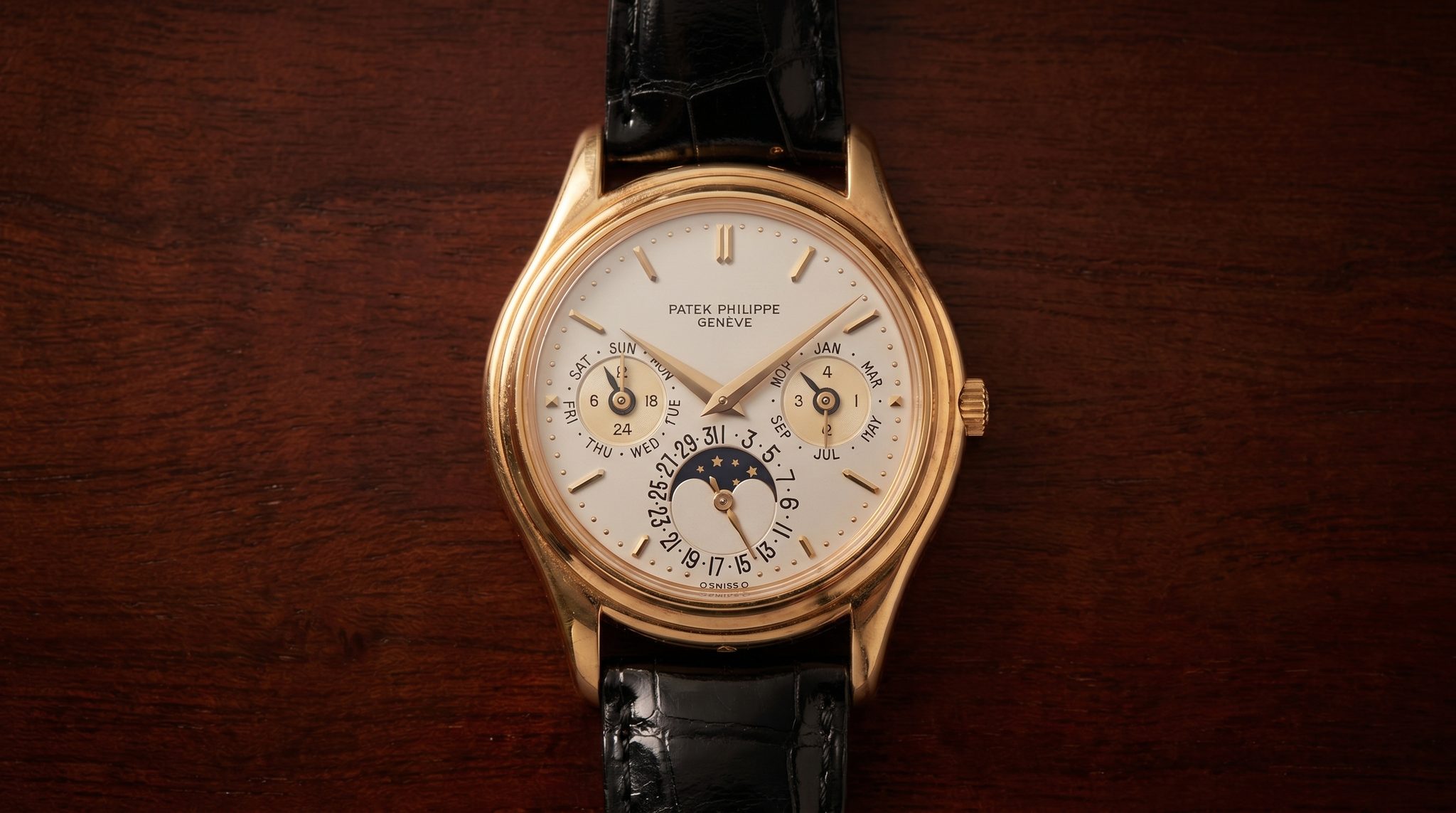
The Patek Philippe Perpetual Calendar 3940 is the modern template for a thin, automatic perpetual calendar, a watch whose collector story is written in tiny, datable dial and caseback tells rather than big-spec reinventions.
- Production
- 1985–2007
- Case
- 18k gold, Pt950
- Diameter
- 36 mm
- Thickness
- 8.5 mm
- Movement
- Cal. 240Q
- Winding
- Automatic micro-rotor
- Power
- ~48h
- Display
- 3-register QP
- Crystal
- Sapphire
- Back
- Solid or sapphire
- Lume
- None (typical)
The Patek Philippe 3940 is the rare perpetual calendar that became a standard, not by growing larger or louder, but by being so thin and so resolved that later Patek perpetuals kept copying its logic. In a case about 36 mm wide and roughly 8.5 mm thick, it manages a full perpetual calendar with moon-phase and day-night, driven by the micro-rotor caliber 240Q that is itself only about 2.53 mm tall.
Its significance is not a single headline change across the run, but the opposite: the reference stayed in production from 1985 to 2007 while Patek quietly revised the details that collectors now use as a dating key. The earliest dials carry an accented “Genève,” flat sub-dials, and a solid back; soon after, the accent disappears, sub-dials become bevelled, sigma marks migrate relative to the minute track, and exhibition backs appear, yet none of those changes perfectly line up with case metal or with each other. That independence is the 3940’s defining collector lesson: it is a “modern classic” that still has an archaeological layer-by-layer history.
Introduced as part of Patek’s mechanical statement in the quartz era, the 3940 also marked a display pivot. It brought in the three-register perpetual calendar layout that later continued in the reference 5140, replacing the earlier aperture-style approach seen in references such as the 3448 and 3450. In period it read as contemporary to the 3970, its perpetual calendar chronograph sister launched in 1986, but the 3940’s enduring identity is calmer: a compact dress watch whose complexity is primarily revealed when you start to look closely.
“The 3940 is the perpetual calendar that barely needed redesigning, so its history is told in accents, sub-dial edges, sigma placement, and what you see when you turn it over.”
3940 across 1985–2007
The 3940 arrived in 1985 as an automatic perpetual calendar built around Patek’s micro-rotor caliber 240, here in perpetual form as the 240Q. The technical point was thinness with autonomy: the 240Q’s micro-rotor and ultra-slim build (about 2.53 mm for the movement) helped keep the entire watch at roughly 8.5 mm, while still driving a full calendar display: day at 9 o’clock with a 24-hour day-night indicator, month at 3 with leap-year, and date and moon-phase at 6.
The early watches, commonly grouped as first series (approximately 1985 to 1987/88), are where the 3940’s collector identity begins. On the dial, “Patek Philippe Genève” is printed smaller and retains the grave accent in “Genève,” and the sub-dials read as flat, like the calendar registers are printed on the same plane as the rest of the dial. Many early pieces are associated with solid backs rather than sapphire, which suits the period idea of a grand complication worn as a closed, private object.
The second series (approximately 1988 to 1989/90) is the first reminder that the 3940 changed in discrete, separable moves. The accent in “Genève” disappears and the signature grows slightly, but the most visible shift is in the sub-dials: they become bevelled, creating a crisp edge and a stronger sense of depth at 3 and 9. In the same general era, display backs appear as an option. The reason Patek chose that moment to introduce an exhibition back is not documented, but the effect is obvious: the 3940’s selling point is no longer only thinness and correctness, it is also the chance to see the micro-rotor architecture and finishing.
The third series (approximately 1989/90 to 1995/96) keeps the bevelled registers and the non-accented signature, but introduces a dial detail that is easy to spot once you know where to look. The “σ SWISS σ” signature shifts so it falls in line with the minute track rather than sitting outside it. That single change is a practical collector tool because bevelled sub-dials alone cannot separate a second-series watch from a third-series one.
From approximately 1995/96 until the end of production around 2007, the fourth series refines rather than reinvents. Sources agree on the broad series window and on the continuing absence of the accented “Genève,” while micro-details such as sigma usage in the later period are debated and do not present as a single, clean cutover. Casebacks also become more standardized in practice, with sapphire display backs common on non-platinum examples.
Taken as a whole, the 3940’s long run is a lesson in how a “template” is built. It is tempting to treat it as one fixed object, but surviving watches show Patek iterating in real time: typography, sub-dial construction, and even what the owner is invited to see on the back evolve on partly independent schedules. That is why the best 3940s feel cohesive, and why mismatched dials, discs, and backs stand out so sharply once the reference’s grammar is understood.
- 1985Introduced36 mm, 3-register QP
- 1985 – c. 1987/88Series IAccent over “è”
- c. 1988Series IIStepped sub-dials
- c. 1988Display backExhibition back present
- c. 1989/90Series IIIσ marks on track line
- c. 1995/96Series IVLater print proportions
- 2007Discontinued5140-era handover
3940 against its neighbours
The 3940 makes the most sense when framed by what came immediately before and what followed after. The ref. 3448 represents Patek’s earlier automatic perpetual calendar language with aperture displays, while the ref. 5140 carries the 3940’s three-register logic forward in a slightly larger, more contemporary case. For a same-era check on intent, the ref. 3970 shows how Patek expressed the same post-quartz-crisis confidence when a chronograph was added to the perpetual calendar.
3448 Predecessor c. 1962–1981 | This reference 3940 Patek Philippe · focal 1985–2007 | 5140 Successor 2006–2017 | ||
|---|---|---|---|---|
| Production | c. 1962–1981 | 1985–2007 | 1986–2004 | 2006–2017 |
| Diameter | 37.5 mm | 36 mm | 36 mm | 37–37.2 mm |
| Thickness | – | 8.5 mm | – | – |
| Movement | Cal. 27-460 Q | Cal. 240Q | CH 27-70 Q | Cal. 240 Q |
| Winding | Automatic | Automatic micro-rotor | Manual | Automatic micro-rotor |
| Display | Apertures + date hand | 3-register QP | QP chronograph | 3-register QP |
| Back | – | Solid or sapphire | Solid, sapphire, or both | – |
| Case | 18k gold (mostly) | 18k gold, Pt950 | 18k gold, platinum | 18k gold, platinum |
Seven series, dials, and configurations across the run
First-series dials are the quickest way to see the 3940 as a product of the mid-1980s rather than the 1990s. The “Patek Philippe Genève” signature is printed in a smaller hand and includes the grave accent in “Genève,” a tiny mark that becomes an outsized dating clue because it disappears later. The calendar registers also look flatter, with less of a cut edge to the sub-dials. On many examples the overall effect is more planar and restrained, as if the dial were typeset rather than engineered.
Within the first series, dial finish matters. Period accounts describe an opaline silver dial as typical and a rarer doré, gold-toned dial as a notable outlier. Because later service dials exist, a first-series watch that no longer has its accented signature or that presents a later print style should be evaluated as a changed example rather than a simple “early” watch.
What to check before buying a 3940
Buying a Patek Philippe 3940 is less about finding the “right year” than finding a watch whose parts tell the same story. Because dial series, case metal, and caseback type overlap rather than marching together, the main risk is a watch that looks plausible at a glance but combines elements from different periods due to service replacement or later swapping.
The second risk is condition that undermines the very appeal of the reference. The 3940’s case is thin and elegant, and heavy polishing quickly softens the lug definition and hallmarks that help confirm originality. The third risk is functional: the calendar must advance cleanly and correctly, and amateur adjustment or deferred service can be expensive on a perpetual.
At its best, living with a 3940 is precisely the point of the reference. It wears smaller than its complication level suggests, remains slim on the wrist at roughly 8.5 mm, and makes its complexity legible without turning the dial into a poster. Many were delivered on strap with a matching Patek buckle or deployant, and later examples often came with multiple casebacks. The ownership experience is closer to a refined daily dress watch than a fragile safe-queen, provided the configuration is coherent and the watch has been responsibly serviced.
Patek Philippe Perpetual Calendar 3940 for sale
Auctions on Grey Market run on seven-day cycles, every watch verified before it sells. Browse what's live now, or consign your 3940.
Common questions about the 3940
The Patek Philippe 3940 was introduced in 1985 and remained in production until around 2007. Some listings cite 2006 as an end date, but the best-supported span in specialist writing is 1985–2007.
- A collector's guide: The Patek Philippe 3940acollectedman.com
- PATEK PHILIPPE PERPETUAL CALENDAR REF. 3940collectability.com
- In Depth: Patek Philippe References 3940 and 3970analogshift.com
Show 7 more
- Reference Talk: 3940 Patek Philippe Perpetual Calendarwatchbrotherslondon.com
- Second Series 3940J Patek Philippe Perpetual Calendarhairspring.com
- Patek Philippe Perpetual Calendar 3940 Watchesessential-watches.com
- Patek Philippe 3940G Perpetual Calendarbazamu.com
- Patek Philippe Perpetual Calendar 3940: Deep Diveyoutube.com
- Patek Philippe 3940 - Perpetual Calendar watcheschrono24.com
- First Series Beyer 3940J Patek Philippe Perpetual Calendarhairspring.com