

Patek Philippe Perpetual Calendar 1518
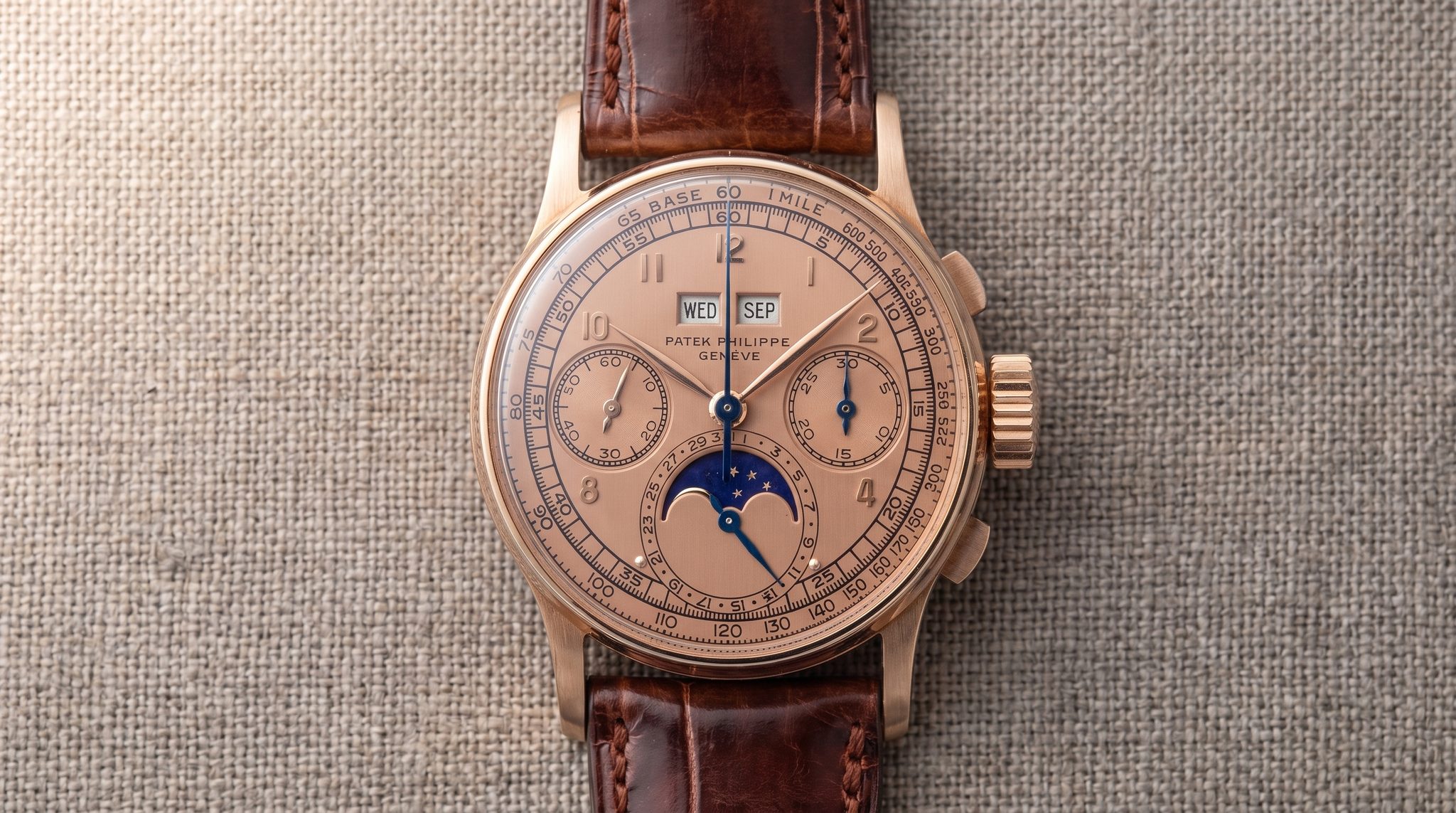
The Patek Philippe Perpetual Calendar 1518 is the first serially produced perpetual calendar chronograph wristwatch, made in about 281 pieces, and its scarcity is read in metals, dials, and paper trail as much as in the complication itself.
- Production
- 1941–c. 1954
- Case
- 18k gold; rare steel
- Diameter
- ~35–36 mm
- Thickness
- ~14 mm
- Lug to lug
- 42.5 mm
- Winding
- Manual
- Movement
- Cal. 13'''130 Q
- Jewels
- 23
- Calendar
- Perpetual
- Chronograph
- Column-wheel
- Dial
- Day/month windows
The Patek Philippe Perpetual Calendar 1518 is the watch that made the perpetual calendar chronograph a production reality, and it did it in numbers small enough to turn every surviving example into its own documented case study: about 281 pieces are credited to the entire run from 1941 to around 1954. That combination of “first in series” status and tightly bounded output is why ref. 1518 is less a single configuration than a reference you learn by reading its axes of rarity, case metal, dial execution, and the paper trail that ties a specific watch to its original state.
At a glance, the 1518 established a layout that still reads as the grammar of the complication. Day and month sit in twin apertures beneath 12 o’clock, a central hand points to the date, and the moon phase is framed within the 6 o’clock calendar register. The chronograph is a bi-compax arrangement, with a 30-minute counter at 3 and running seconds at 9. Under that dial, Patek Philippe used a manual-wind chronograph caliber designated 13'''130 Q, built from a Valjoux 13-ligne ébauche that was heavily reworked and finished, and paired with a perpetual calendar mechanism under the dial that specialist literature attributes to Victorin Piguet. Auction catalogues and editorial technical descriptions consistently note 23 jewels, Geneva stripes, a swan-neck micrometer regulator, a Breguet overcoil balance spring, and the presence of the Geneva Seal.
The reference’s short life also explains its place in the catalogue. There is no serially produced Patek predecessor that combined chronograph and perpetual calendar in a wristwatch; 1518 begins that line. It was followed by ref. 2499 as the direct successor, with overlap beginning in 1950, and together those two references are treated in modern scholarship as the defining early chapter of Patek Philippe’s perpetual calendar chronograph lineage.
“Ref. 1518 is the first serial perpetual calendar chronograph, and with about 281 made, its rarity is read through case metal, dial execution, and documentation.”
1518 across 1941–c. 1954
Ref. 1518 appears in 1941 as a new kind of production watch for Patek Philippe, not a one-off commission but a serial reference combining a column-wheel chronograph with a full perpetual calendar and moon phase. Its movement is designated 13'''130 Q, based on a Valjoux 13-ligne chronograph ébauche that Patek reworked and finished, with the perpetual calendar mechanism under the dial attributed in specialist literature to Victorin Piguet. The technical language that follows the 1518 through auction catalogues is concrete rather than romantic: 23 jewels, Geneva stripes on the bridges, a swan-neck micrometer regulator, and a Breguet overcoil, with the Geneva Seal noted as the finishing attestation.
Within the production span, the most widely repeated dates are straightforward, 1941 to 1954, but the last year is also the point where certainty stops. The year itself is consistently cited, while the exact cutoff within 1954 is not publicly documented. That partial clarity matters because ref. 2499, the direct successor, is documented as being introduced in 1950, so the story is not a clean handoff but an overlap, two references sharing the same complication family at once.
The collectible texture of the 1518 is less about a long chain of factory “marks” than about a few big, independent axes that play out within a small population. Most watches were cased in yellow gold, a much smaller group in pink gold, and the steel examples sit in a different category entirely. Some scholarship repeats a count of four publicly known steel 1518s, while other specialist writing frames the total as a wider single-digit range. This uncertainty is part of what makes documentation central to the reference.
Late in the reference’s modern afterlife, record-setting public sales sharpened the same point. A steel 1518 sold at Phillips in 2016 for CHF 11,020,000, and a pink-on-pink example sold at Sotheby’s New York in December 2021 for US$9.6 million. The numbers are memorable, but they are consequences, not the premise. Ref. 1518 is an origin point in serial production, and its limited output ensures that configuration, metal, and provenance do not decorate the story, they are the story.
- 1941IntroducedDay/month windows at 12, bi-compax chrono
- 1942Series shiftEnameled indexes; applied “12”
- 19502499 overlaps1518 and 2499 both seen after 1950
- 1954Run endsExact cutoff within 1954 not public
- 2016Steel recordPhillips Geneva result for steel example
- 2021Pink-on-pink resultSotheby’s New York December sale
- 2025Steel estimatePhillips estimate for steel example
1518 against its neighbours
Ref. 1518 is easiest to understand by triangulating it against the watches immediately around it in Patek Philippe’s catalogue: the sister perpetual calendar without chronograph (ref. 1526) launched in the same era, and the direct successor within the same complication family (ref. 2499), introduced in 1950 and overlapping the end of 1518 production.
1526 Parallel sibling 1941–c. 1952 | This reference 1518 Patek Philippe · focal 1941–c. 1954 | |
|---|---|---|
| Production | 1941–c. 1952 | 1941–c. 1954 |
| Case | 18k gold (mostly) | 18k gold; rare steel |
| Diameter | – | ~35–36 mm |
| Thickness | – | ~14 mm |
| Winding | Manual | Manual |
| Movement | – | Cal. 13'''130 Q |
| Chronograph | No | Column-wheel |
| Calendar | Perpetual | Perpetual |
| Dial | No chrono registers | Day/month windows |
| Crystal | – | – |
Six case and dial variants across the run
Yellow gold is the reference’s baseline because it is simply how most ref. 1518s were made. Across the roughly 281 examples attributed to the full production, auction and editorial writing consistently describes the majority as yellow gold, with the familiar 1518 architecture unchanged: day and month in twin windows beneath 12 o’clock, the pointer date sweeping the dial, and the moon phase tucked into the 6 o’clock calendar register.
What changes within yellow-gold production is not a new reference identity but the watch’s execution, especially the way the hour markers are realized. Antiquorum describes multiple “series” for 1518 that are defined by index style, from applied gold Arabic numerals, to enameled indexes with an applied “12” introduced at the Basel Fair in 1942, through later applied index patterns. In practice, the easiest way to read those descriptions on a watch is to start at 12 o’clock. On an enameled-index dial, the hour track looks drawn rather than built, with the applied “12” sitting proud above a flatter, painted field.
Because these series labels are scholarship tools rather than factory marks, the most reliable identification practice is to treat them as visual categories and then confirm the details against documentation and known examples from major auction archives.
What to check before buying a 1518
Buying a ref. 1518 is less about finding a correct spec sheet and more about proving a specific watch’s identity, because the reference’s value is concentrated in independent traits that can be separated by later service work. Case metal can be confirmed, but it does not determine dial color. Dial color can be extraordinary, but only if the dial itself is original and period-correct. Even apparently small dial inscriptions, like “FAB. SUISSE,” can move a watch into a rarity tier that demands documentation rather than assumption.
The risks follow from that structure. Service dials, restored printing, replaced hands, and refinished cases can all make a watch visually tidy while erasing the very evidence that makes an 1518 legible to scholarship. Auction houses repeatedly stress dial originality, correct typography, and case condition, with crisp hallmarks and intact geometry standing in for a watch’s untouched history.
The practical consequence is simple: an archive extract and high-quality, comparable photography are not optional at this level. They are the tools that allow the 1518’s small-production story, about 281 pieces across all metals, to be read correctly.
When everything does line up, the ownership experience is the opposite of modern fragility. At roughly 35–36 mm and about 14 mm thick, the watch wears like a compact mid-century chronograph that happens to carry a full perpetual calendar, and its appeal is that the information is dense but arranged with a calm, legible logic. This is the rare grand complication that still behaves like a wristwatch first, provided it is approached with the same seriousness its documentation requires.
Patek Philippe Perpetual Calendar 1518 for sale
Auctions on Grey Market run on seven-day cycles, every watch verified before it sells. Browse what's live now, or consign your 1518.
Adjacent in the Perpetual Calendar family
Common questions about the 1518
Most specialist auction and editorial sources place Patek Philippe ref. 1518 production from 1941 to 1954, with the exact cutoff within 1954 not publicly documented.
- Collecting Patek Philippe’s Perpetual Calendar Chronographsothebys.com
- Phillips in Depth: The Stainless-Steel Patek Philippe Perpetual Calendar Chronograph Ref. 1518phillips.com
- Hodinkee: In-Depth, The Patek Philippe 1518 In Steelhodinkee.com
Show 7 more
- Monochrome: History of the Patek Philippe Perpetual Calendar Chronograph (1518 to modern)monochrome-watches.com
- Christie’s lot: Signed Patek Philippe, ref. 1518 (Mustad “Empire” case example)christies.com
- Christie’s lot: Ref. 1518J manufactured in 1943christies.com
- Antiquorum catalogue: Patek Philippe ref. 1518 lot details and series descriptioncatalog.antiquorum.swiss
- Italian Watch Spotter: Patek Philippe Ref. 1518 complete guideitalianwatchspotter.com
- Phillips Geneva Watch Auction: Ref. 1518 catalogue entryphillips.com
- Robert Maron: Patek Philippe 1518 first series listing (dimensions)robertmaron.com