

Patek Philippe Perpetual Calendar 3448
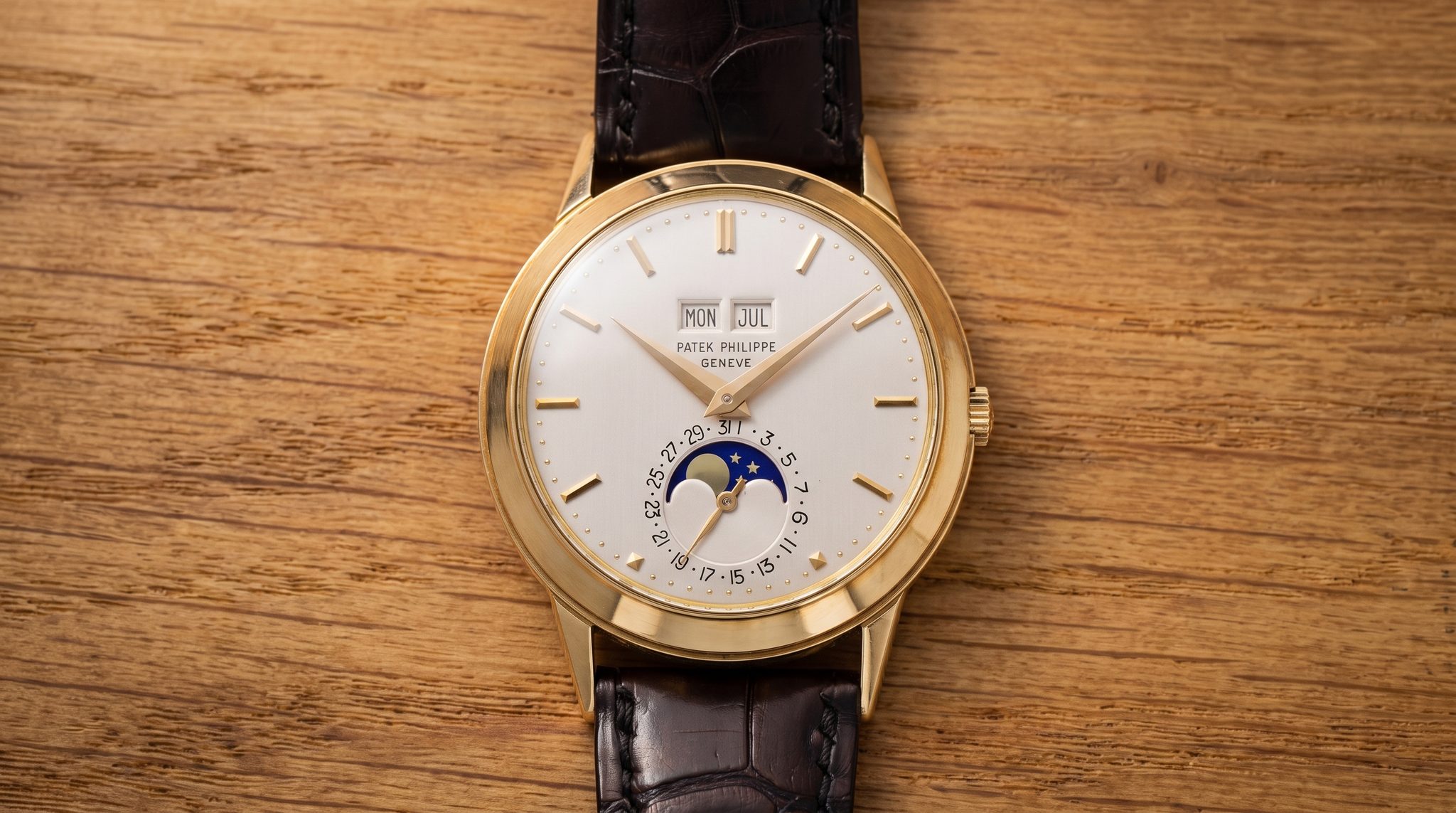
Reference 3448 is the watch that turned the perpetual calendar from an artisanal, manual-wind specialty into a repeatable automatic series, with only about 586 made over roughly two decades.
- Production
- 1962–c. 1981
- Case
- 18k gold; rare Pt
- Diameter
- ~37 mm
- Back
- Snap-on
- Movement
- Cal. 27-460 Q
- Winding
- Automatic
- Power res.
- 38h
- Frequency
- 19,800 vph
- Jewels
- 37
- Seal
- Geneva Seal
- Calendar
- Perpetual + moonphase
- Leap year
- No (standard)
The Patek Philippe Perpetual Calendar 3448 was produced from 1962 to about 1981.
- Production years
- 1962–c. 1981
- Replaced
- 2497
- Replaced by
- 3450
- Movement
- Cal. 27-460 Q
Reference 3448 is the perpetual calendar that stopped being precious and started being practical, even if Patek Philippe still built it in tiny numbers. Phillips estimates only about 586 examples in total, yet for roughly sixteen years it stood alone as the only self-winding perpetual calendar wristwatch on the market. That combination, genuine series production paired with scarcity, is why the 3448 sits at the hinge of the complicated wristwatch’s modern story.
The move that made it possible was mechanical rather than stylistic. The 3448 is powered by Patek Philippe’s caliber 27-460 Q, an automatic movement created by taking the celebrated 27-460 (a three-hand self-winding base used in watches like the ref. 2526) and fitting Patek’s patented perpetual calendar mechanism under the dial. In hand, that architecture explains both the watch’s calm, almost spare display and its historical importance: the calendar is doing the hard work invisibly, while the dial stays legible with day and month in twin windows at 12, and the date arranged around the moonphase at 6.
Collectors often call the 3448 “Padellone” for its broad, flat presence on the wrist. Sources converge on a diameter around 37 mm (European Watch Company measures 37.2 mm on one example), which helps explain why the reference reads more contemporary than most early-1960s dress watches. Thickness is less consistently published; a reputable dealer documents 11.5 mm on one watch, and absent a factory drawing in the public record it is safest to treat the reference as roughly 11 mm rather than chase a single definitive number.
What makes the 3448 unusually satisfying to study is that its evolution is visible, but not in a single neat package. Over its long run, Patek altered the dial manufacturing and layout in ways that can be dated one feature at a time. Christie’s and Phillips describe four main dial series, defined by minute track execution and the size of the date ring. Early dials use engraved and enamel-filled minute divisions that catch light with a crisp, slightly relief-like edge. Later dials shift to printed graphics and, eventually, a larger date ring that pushes the numerals outward for legibility. These changes track practical realities of production, although the precise reasons for each cutoff are not documented beyond the general shift toward less labor-intensive dial work.
Then, near the end, the reference briefly becomes a laboratory. A handful of late watches are documented with experimental leap-year indications on the dial, including the white-gold “Red Dot” transitional pieces recorded by Christie’s, a preview of the ref. 3450 that replaced the 3448 around 1981 with a standardized leap-year display and the upgraded caliber 27-460 QB. In other words, the 3448 is both the first modern automatic perpetual calendar series and the place where Patek worked out what that modern series would become.
“The 3448 is the rare watch that made the perpetual calendar an automatic series, then spent twenty years quietly refining its face until the 3450’s leap-year display was ready.”
Patek Philippe Perpetual Calendar 3448 production years: 1962–c. 1981
The 3448’s story starts with a technical decision: Patek took its high-grade automatic 27-460 and turned it into a perpetual calendar by adding a patented mechanism beneath the dial. That allowed the brand to offer a self-winding perpetual calendar as a regular model beginning in 1962, and it also explains why the reference’s most visible evolution happens on the dial rather than in the basic architecture.
Christie’s and Phillips describe four main dial series, and the key is to treat them as manufacturing choices you can actually see. The earliest dials (c. 1962–1965) have engraved minute divisions filled with enamel, so the track looks crisp and slightly raised, with a small, compact date ring around the moonphase. Around the mid-1960s, the minute track becomes beady, a ring of tiny dots that reads softer and more decorative at the edge. Then, around the early 1970s, the date ring grows: the numerals become larger and sit farther outward, a legibility tweak that is obvious the moment the watch is next to an earlier small-ring example.
The late-1970s dials move further toward printing. Baton minute divisions return, but now as printed marks rather than enamel-filled engraving, and late dials are often encountered with sigma signatures indicating gold dial furniture. Exactly when these late features become common is not a clean single year, and documented watches show overlap, which is why serious cataloguing separates minute track style, printing method, and date-ring size rather than forcing them into a single rigid cutoff.
At the very end of the run, the 3448 becomes a bridge to its successor. Standard production 3448s do not display leap year, but Christie’s documents white-gold transitional watches with a leap-year mechanism and distinctive dial markings, and other specialist coverage records additional experimental configurations, including pieces that drop the moonphase. The zoomed-out lesson is that the watch now treated as the archetypal “Padellone” was not frozen in 1962. It was a long-running platform that Patek kept adjusting in small, legible steps until the leap-year display was ready to be standardized as the ref. 3450.
- 1962IntroducedDay/month windows at 12
- c. 1965Dial shiftPerlé dot minute track
- c. 1971Date ringBigger numerals at 6
- c. 1978Printing eraBaton track, printed not enamel
- c. 1981TransitionalLeap-year marking within date ring
- c. 1981SucceededLeap-year aperture on 3450
3448 against its neighbours
The 3448 makes the most sense when framed against what came immediately before and after it: manual-wind perpetual calendars that established the complication in wristwatch form, and the ref. 3450 that kept the same basic platform but finally put the leap-year cycle onto the dial.
2497 Manual predecessor 1950s | This reference 3448 Patek Philippe · focal 1962–c. 1981 | 3450 Successor Introduced 1981 | ||
|---|---|---|---|---|
| Production | 1950s | 1962–c. 1981 | Introduced 1981 | 1985–2007 |
| Case | Gold | 18k gold; rare Pt | Gold | Gold or platinum |
| Diameter | – | ~37 mm | ~37 mm | 36 mm |
| Movement | – | Cal. 27-460 Q | Cal. 27-460 QB | Cal. 240Q |
| Winding | Manual | Automatic | Automatic | Automatic |
| Calendar | Perpetual | Perpetual + moonphase | Perpetual + moonphase | Perpetual |
| Leap year | No display | No (standard) | Yes | No display |
Five dial generations across the run
The earliest 3448 dials are defined by their minute track more than their typography. The baton minute divisions are engraved and then enamel-filled, so the marks look crisp and slightly dimensional, catching light differently than later flat printing. These dials pair that track with the small date ring around the moonphase, giving the 6 o’clock register a tighter, more compact look that many collectors associate with the reference’s earliest years.
What to check before buying a 3448
Buying a Patek Philippe 3448 is less about hunting one perfect year and more about insisting that each visible feature makes sense on its own timeline. The reference ran long enough, and changed just often enough, that incorrect or service-replaced dials can look plausible until minute-track style, printing method, and date-ring size are checked separately. The financial incentive to misrepresent rare transitional leap-year pieces makes documentation essential when a watch is described as experimental.
Patek Philippe Perpetual Calendar 3448 price and value
Patek Philippe Perpetual Calendar 3448 for sale
Auctions on Grey Market run on seven-day cycles, every watch verified before it sells. Browse what's live now, or consign your 3448.
Grey Market runs watch auctions for vintage and neo-vintage pieces, every lot reviewed before it lists and verified before the seller is paid, and the Watch Exchange, where ID-verified collectors buy and sell at a fixed price. Selling one? See the ways to sell a Patek Philippe, or check what it’s worth. For more vintage Patek Philippe, see the Patek Philippe reference guide.
Adjacent in the Perpetual Calendar family
Common questions about the 3448
Reference 3448 was introduced in 1962 and was produced into the early 1980s. The best-supported end point is around 1981, although some sources describe the run as 1962–1982, and exact last-assembly or delivery dates are not systematically published.
- Patek Philippe's Perpetual Calendar Ref. 3448 Was the First of Its Kindphillips.com
- In-Depth: The Curious Case Of The Patek Philippe Reference 3448 "Senza Luna"hodinkee.com
- REF. 3448, MOVEMENT NO. 1'119'045, CASE NO. 318'496, MANUFACTURED IN 1966christies.com
Show 7 more
- ref. 3448, manufactured in 1974christies.com
- Patek Philippe The Geneva Watch Auction: XX (catalog entry)phillips.com
- Patek Philippe The Watch Auction: One (catalog entry)phillips.com
- PATEK PHILIPPE, REF. 3448G, “RED DOT” (Christie’s lot page)christies.com
- The Extraordinary Patek Philippe Perpetual Calendar Reference 3448 in Platinumphillips.com
- Patek Philippe 3448 Perpetual Calendar "Disco Volante" (dealer listing with measurements)europeanwatch.com
- SIGNED PATEK PHILIPPE, GENÈVE, REF. 3448, MOVEMENT NO. 1'119'580, CASE NO. 332'620, MANUFACTURED IN 1981christies.com