

Rolex Sea-Dweller 1665
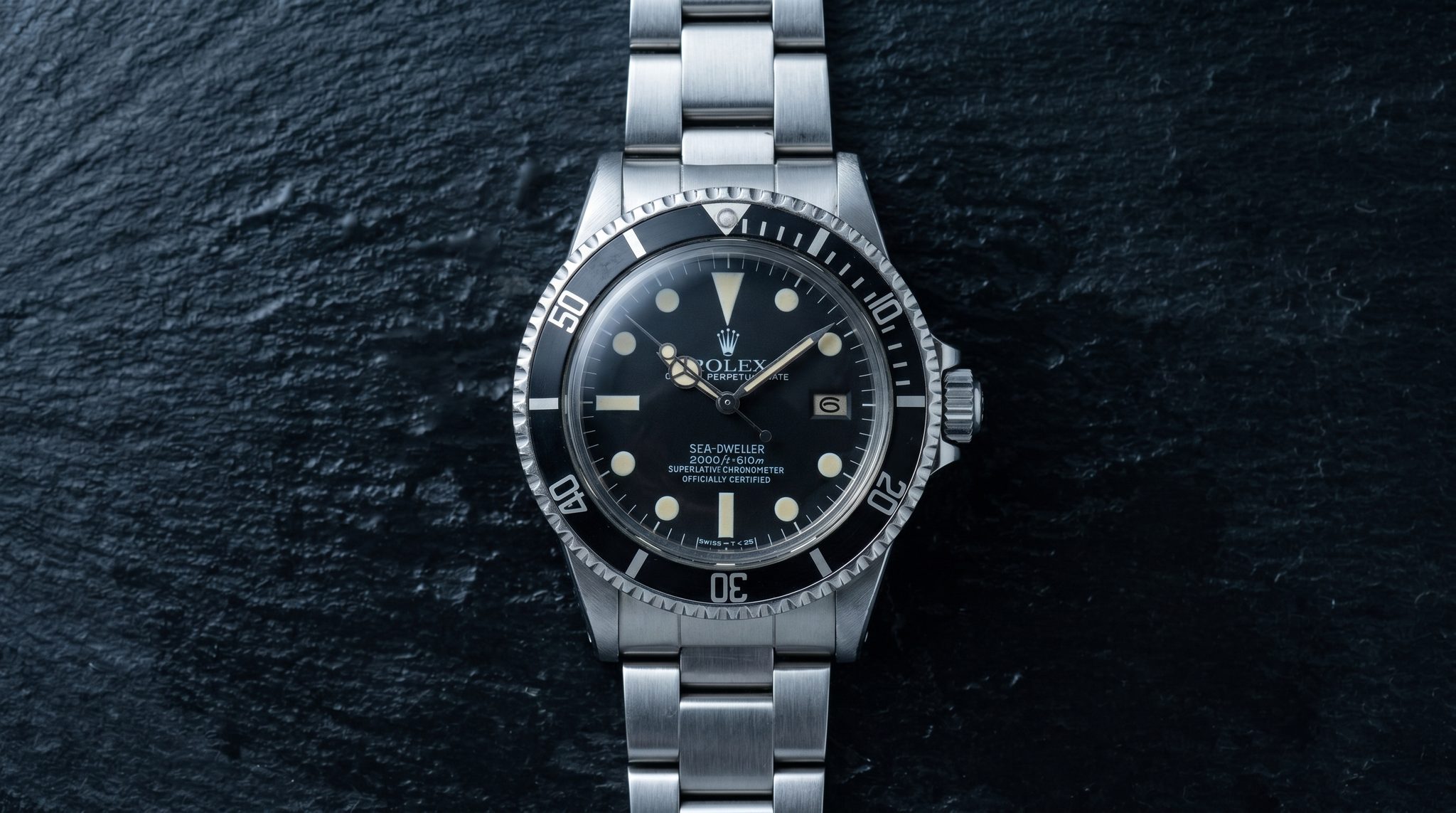
The Rolex Sea-Dweller 1665 is the first serial-production Sea-Dweller, a watch whose identity was defined less by mechanical reinvention than by a slow, datable rewrite of dial text and caseback engraving.
- Production
- c. 1967–1983
- Case
- Steel, 40mm
- Bezel
- Aluminum, bidir, 60-min
- Crystal
- Domed acrylic
- Water res.
- 610m / 2,000ft
- Valve
- Helium escape valve
- Crown
- Triplock, screw-down
- Movement
- Cal. 1575
- Chronometer
- Yes
- Dial
- Matte, tritium
- Date
- No quickset
The Rolex Sea-Dweller 1665 was produced from about 1967 to 1983.
- Production years
- c. 1967–1983
- Replaced by
- 16660
- Movement
- Cal. 1575
The Sea-Dweller 1665 is Rolex’s first serial-production Sea-Dweller, and its history is written in words. One reference spans two named eras that collectors treat almost like different watches: the Double Red dial with the red “SEA-DWELLER” and “SUBMARINER 2000” lines, and the later Great White dial that drops “Submariner” entirely and turns the text white.
That continuity is the point. Across its late-1960s to early-1980s life (commonly summarized as c. 1967–1983), Rolex kept the same basic formula: a 40 mm steel Oyster case with a helium escape valve, a deep 610 m / 2,000 ft rating, and a high domed acrylic crystal that rises noticeably above the bezel. What visibly changes is the language on the dial and the engraving on the caseback, and those changes overlap rather than snapping to a single, official cutoff. The result is a reference that rewards careful looking: dial layout, depth-rating order, and caseback wording can each date a watch, while later service parts can create historically inconsistent combinations.
Inside, the Sea-Dweller 1665 uses the Rolex 15xx-family date movement generally identified as Caliber 1575 (often discussed in collector writing alongside the closely related 1570 architecture). It is chronometer-certified, runs at 19,800 bph, and uses a non-quickset date, a period-correct inconvenience that also helps place the watch before the quickset era introduced with its successor.
“Rolex did not reinvent the Sea-Dweller 1665 with a new metal or a new movement generation. It reinvented it with dial text and caseback engraving.”
Rolex Sea-Dweller 1665 production years: c. 1967–1983
The story of the Sea-Dweller 1665 begins with Rolex taking a Submariner-sized professional case and pushing it into saturation-diving territory. The defining hardware is already present at the start: a helium escape valve in the left case flank, a 610 m / 2,000 ft depth rating, and a domed acrylic crystal that gives the watch a noticeably taller profile than contemporaneous Submariners, even with the same nominal 40 mm diameter.
What shifts over time is how Rolex describes the watch to the wearer. Early commercial examples are closely associated with casebacks carrying “PATENT PENDING,” a wording that later disappears; sources do not document a single cutoff year or the specific reason the wording changes. Through roughly 1967–1977, the reference is most recognized in Double Red form, with two red lines reading “SEA-DWELLER” and “SUBMARINER 2000,” and a broader family of dial marks that differ in fonts, coronet shapes, and the ordering of the depth rating (meters-first versus feet-first), often with overlap rather than a clean handoff.
Around 1977, the watch’s most legible identity change arrives: the Great White dial replaces the red text with all-white printing and removes “Submariner” from the dial wording, leaving Sea-Dweller to stand on its own. Great White production runs roughly to around 1983, still with matte tritium dials and the same basic movement family, while the successor ref. 16660 is introduced by 1978 and overlaps the late 1665 period.
Late in the run, the cumulative effect is striking: the reference stays anchored to one case metal and one movement family, yet it becomes easy to date and authenticate by reading it. Small typographic decisions, a line of caseback text, or the alignment of two words can carry as much historical weight as a mechanical upgrade, which is why originality and period-correct combinations matter so much for the 1665.
- c. 1967Public debut610m rating, HEV case
- c. 1967 – 1968Patent Pending“PATENT PENDING” on caseback
- 1967 – 1977Double Red eraTwo red dial lines
- c. 1977Great WhiteWhite text, no “Submariner”
- c. 1978 – 197916660 introducedSapphire crystal, 1,220m
- c. 1983DiscontinuedLast acrylic Sea-Dweller
1665 against its neighbours
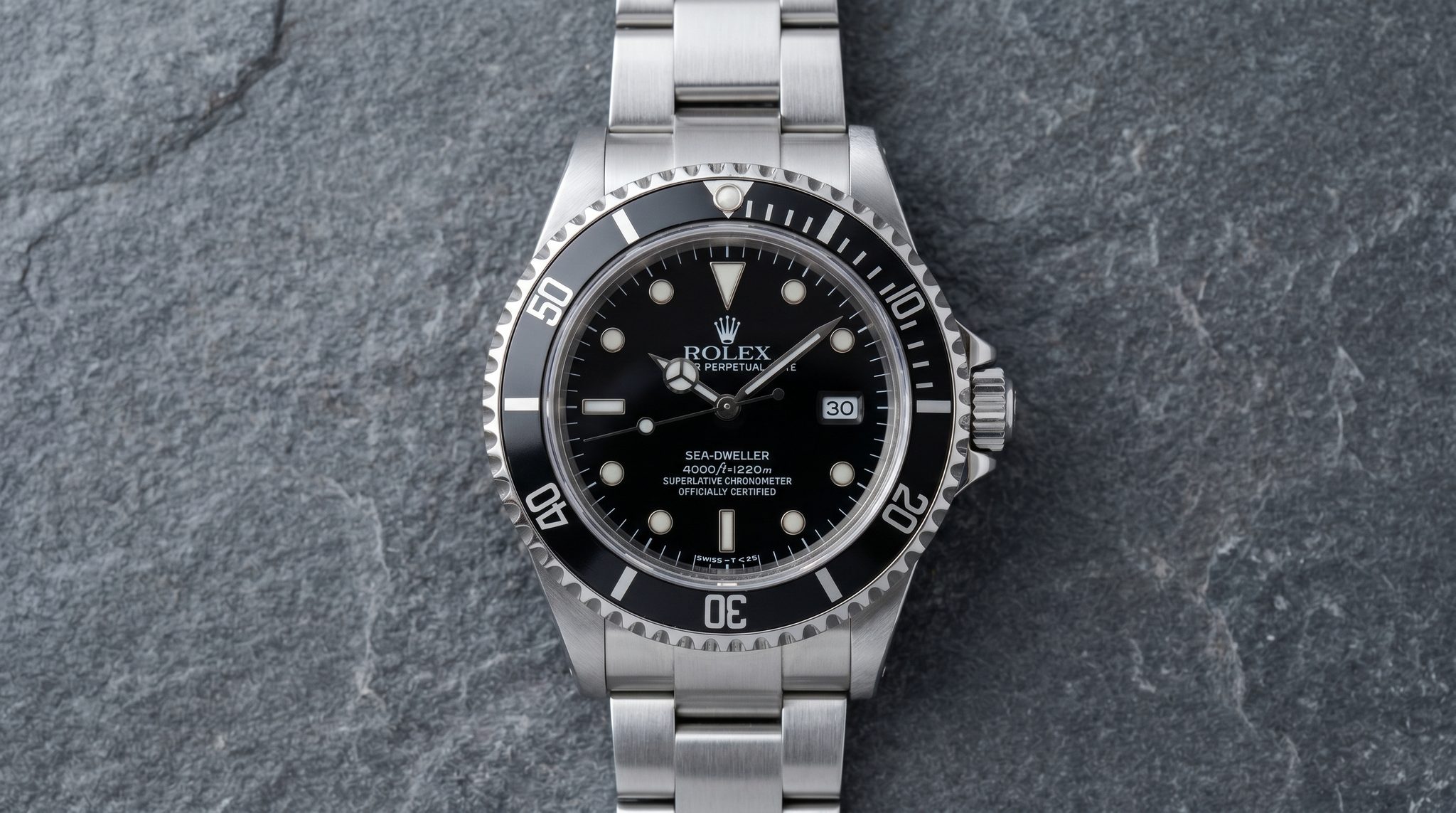
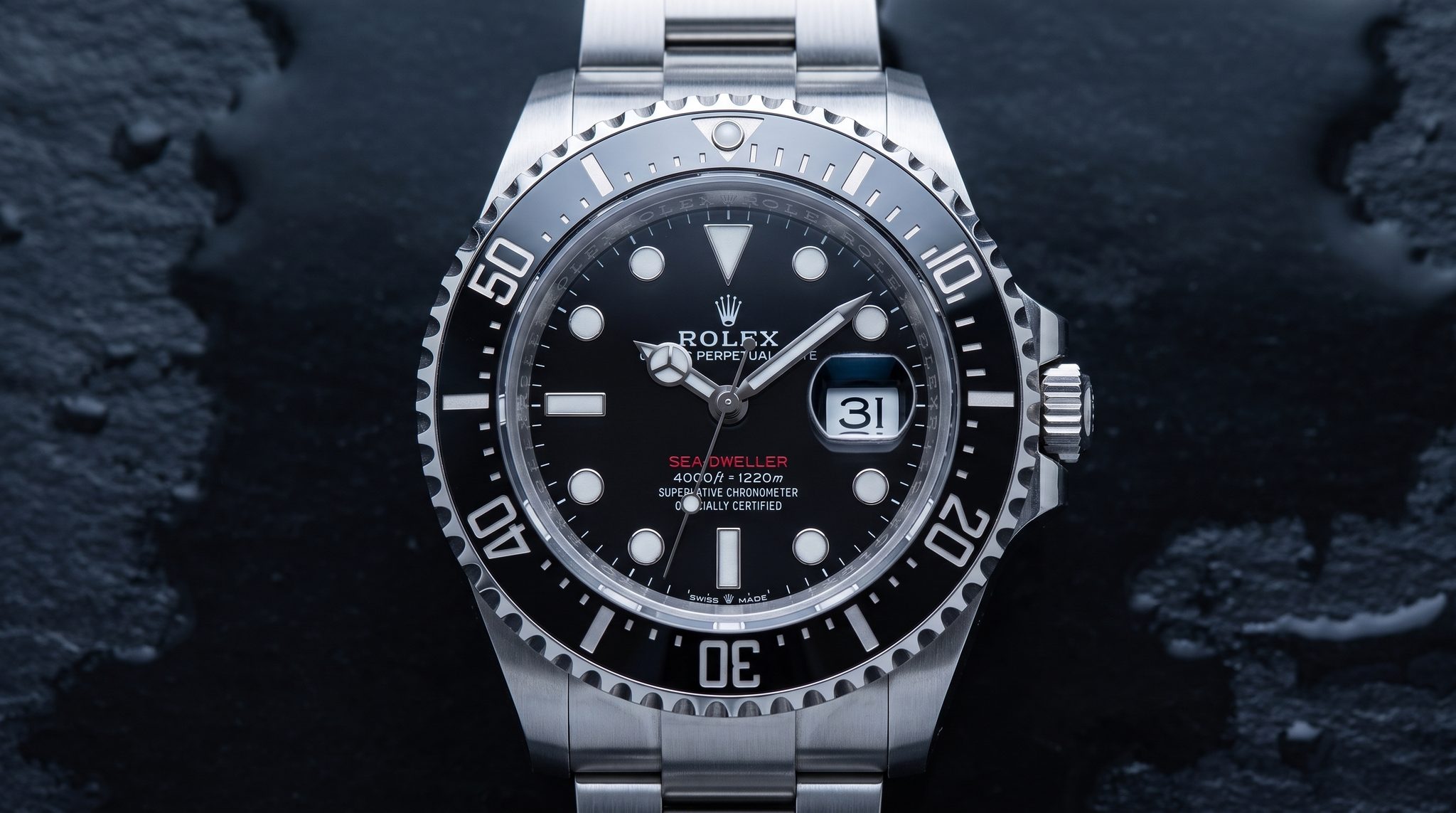
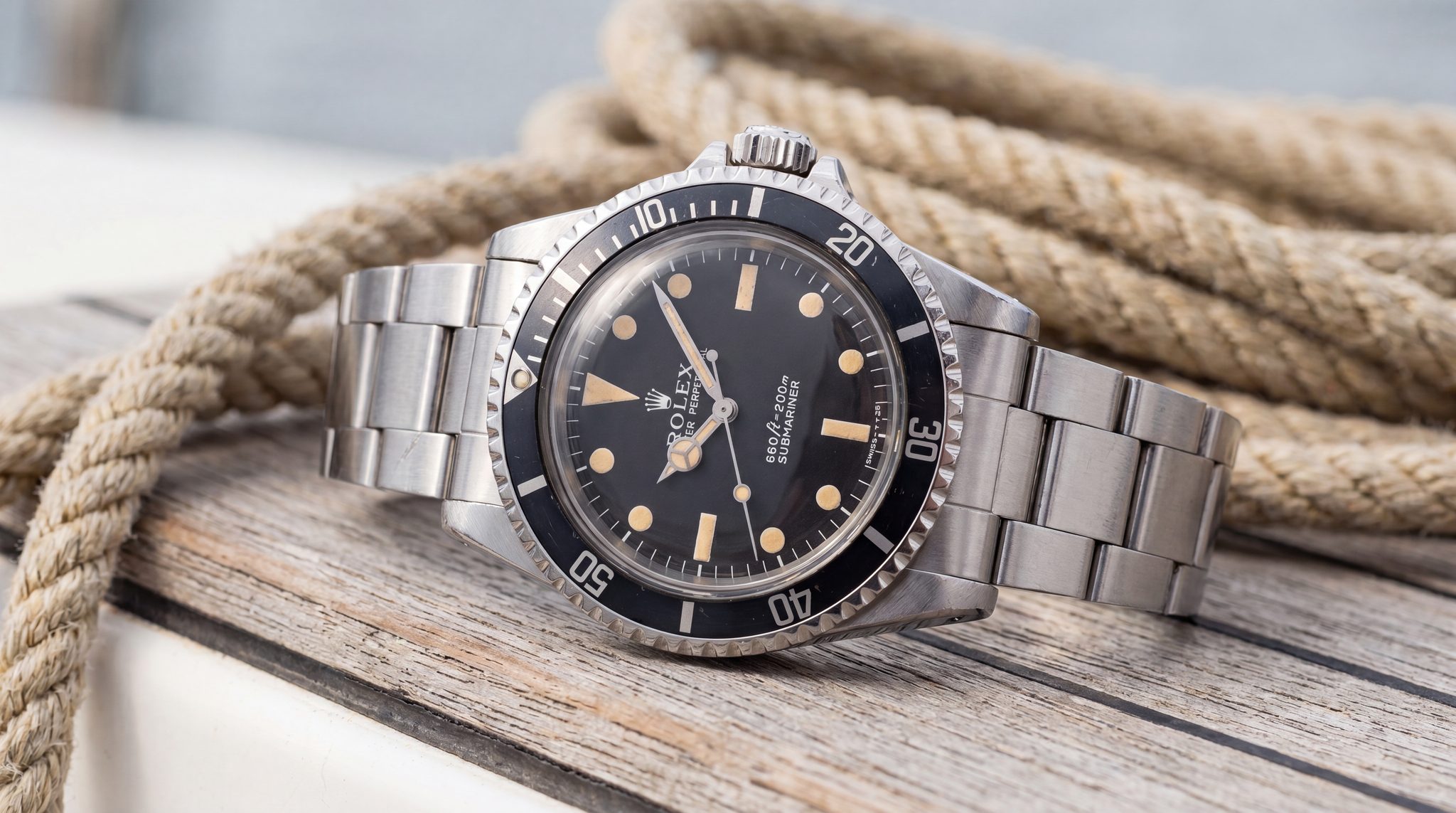
The Sea-Dweller 1665 is easiest to place by bracketing it between the contemporary Submariner Date 1680, which shares the era’s acrylic-and-15xx feel but not the helium valve or 610 m build, and the Sea-Dweller 16660, which modernizes the line with sapphire and quickset date while overlapping the late 1665 years.
This reference 1665 Rolex · focal c. 1967–1983 | ||||
|---|---|---|---|---|
| Production | c. late 1960s–1979 | c. 1967–1983 | c. 1978–1989 | 2014–2017 |
| Case | Steel, 40mm | Steel, 40mm | Steel, 40mm | Stainless steel |
| Crystal | Acrylic | Domed acrylic | Sapphire | Sapphire, no Cyclops |
| Water res. | 200m / 660ft | 610m / 2,000ft | 1,220m / 4,000ft | 1,220 m / 4,000 ft |
| Movement | Cal. 1575 | Cal. 1575 | Cal. 3035 | Cal. 3135 |
| Date | No quickset | No quickset | Quickset | No Cyclops |
| Chronometer | Dial-marked SCOC | Yes | Yes (COSC) | Yes (COSC) |
| Valve | No | Helium escape valve | Helium escape valve | Yes (HEV) |
Seven dial generations across the run
A small set of COMEX-related pre-series pieces sits in the orbit of the 1665 story rather than cleanly inside it. The defining look is a single red “SEA-DWELLER” line without the later “Submariner 2000” wording, and sources note that some very early examples lack a helium escape valve while others use experimental solutions. Because these watches were effectively test pieces, the usual “Mark” taxonomy does not apply, and individual caseback engravings and specifications vary from watch to watch.
What to check before buying a 1665
Buying a Sea-Dweller 1665 is largely an exercise in reading and matching: the biggest price steps come from dial era and dial mark, and many watches have lived through decades of Rolex service where dials and hands could be replaced. A Double Red case carrying a later Great White service dial is a known outcome of service history, and it changes both historical character and value.
Because high premiums concentrate around early traits such as “PATENT PENDING” casebacks, COMEX signing, and rare Great White executions like the Rail Dial, the incentive to mix parts is real. The most convincing 1665s are the ones whose independent details agree with each other: dial text, depth-rating layout, luminous-era markings, and caseback engraving all pointing to the same slice of the reference’s long run.
In day-to-day ownership, the reference is unusually consistent for a watch with so many collectible sub-types. Every 1665 shares the same basic wearing experience: a 40 mm steel professional diver that sits taller than a Submariner because of its domed acrylic crystal and deep-rated case, with the practical quirks of a non-quickset date. That mix of single-spec purpose and evolving language is why the watch can feel both straightforward on the wrist and endlessly specific on the desk.
Rolex Sea-Dweller 1665 price and value
A Rolex Sea-Dweller 1665 sells for about $22,500 at the median, typically $16,500 to $33,500 across 120 comparable sales.
Rolex Sea-Dweller 1665 for sale
Indicative figures from recent dealer, auction, and Grey Market sales (updated this week). Every watch is verified before it sells here.
Each point is a recent dealer or auction sale, banded to an indicative figure. The range shown is not a valuation.
Adjacent in the Sea-Dweller family
Stories that discuss the 1665
Common questions about the 1665
The commonly cited range for the Sea-Dweller 1665 is approximately 1967–1983, reconstructed from serials and period documentation rather than a single official Rolex cutoff. Within that span, the Double Red era is generally placed at 1967–1977 and the Great White era at roughly 1977–1983.
- Vintage of the Week: Sea Dweller Reference 1665 - Bob's Watchesbobswatches.com
- The Rolex Sea-Dweller 1665 (Great White)fratellowatches.com
- History Of The Rolex Sea-Dwellerrevolutionwatch.com
Show 7 more
- Technical and historical review of the Rolex Sea-Dweller 166541watch.com
- Rolex 1665: The Rail Dialwatchprosite.com
- Mark 4 1665 Rolex 'Double Red' Sea-Dwellerhairspring.com
- Vintage Rolex Sea-Dweller Reference 1665 (YouTube)youtube.com
- Rolex Sea-Dweller Ref. 1665 'Great White' (listing context)oliverandclarke.com
- Vintage Rolex Sea-Dweller ref 1665 Ultimate Guideswisswatchexpo.com
- Vintage Rolex Sea-Dweller Reference 1665 "Great White" (TimeRediscovered)timerediscovered.com